

Bell-curve-meme Memes

Posts tagged with Bell-curve-meme
Is Regex Hard

Is Regex Hard
Oh, the beautiful duality of regex! You've got 14% of developers on each end saying "regex is hard" while some absolute maniac in the middle is literally CRYING and screaming "NOOOO IT'S SO SIMPLE UR DUMB" with an IQ score that's apparently off the charts. The irony? That middle person has clearly spent so much time with regex that they've transcended into a different plane of existence where (?<=\w)\b(?=\w) makes perfect sense. Meanwhile, the rest of us mortals are just trying to validate an email address without accidentally summoning Cthulhu. Classic bell curve meme energy - the people who know just enough think it's impossible, the people who know way too much think it's trivial, and both are technically right depending on whether you're matching a phone number or parsing HTML (don't parse HTML with regex, you'll open a portal to the void).

Advanced Debugging

Advanced Debugging
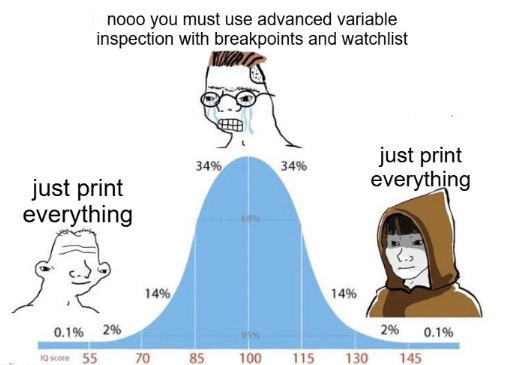
Oh, the AUDACITY of suggesting we use proper debugging tools! Listen, we didn't spend years learning to code just to actually *use* the IDE's built-in features like some kind of responsible professional. The bell curve doesn't lie, honey – the true geniuses are out here spamming console.log() and print() statements like it's 1999, living their best chaotic lives. Meanwhile, the "intellectuals" in the middle are having a full meltdown trying to set up breakpoints and configure watchlists like they're diffusing a bomb. Both ends of the spectrum have figured out the ultimate truth: why spend 5 minutes learning the debugger when you can spend 5 hours adding print statements everywhere? It's called *efficiency*, sweaty.

I Fixed The Meme

I Fixed The Meme
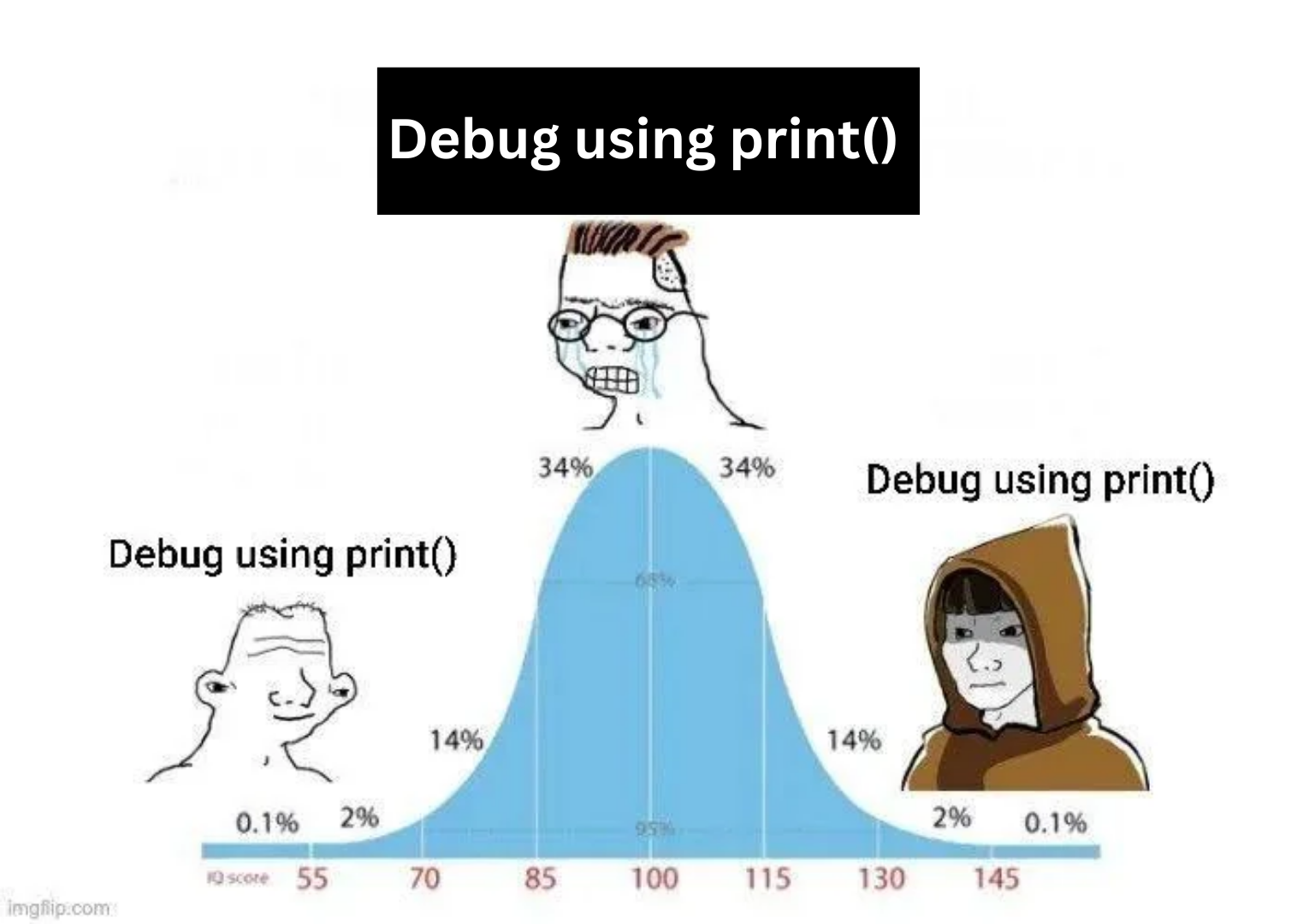
Someone took the classic bell curve meme format and applied it to debugging methodology, and honestly? They're not wrong. The distribution shows that whether you're a complete beginner frantically spamming print statements everywhere, an average developer who's "too sophisticated" for that (but secretly still does it), or a senior engineer who's transcended all pretense and gone full circle back to print debugging—you're all doing the same thing. The middle 68% are probably using debuggers, breakpoints, and other "proper" tools while judging everyone else, but the truth is that a well-placed print("got here") has solved more bugs than any IDE debugger ever will. The extremes understand what the middle refuses to admit: sometimes the fastest way to find a bug is to just print the damn variable.

You Can Pry Pattern Matching From My Cold Dead Hands

You Can Pry Pattern Matching From My Cold Dead Hands
When someone suggests that programming language choice doesn't matter because "architecture and business" are what really count, they're technically correct but also completely missing the point. Sure, your microservices architecture matters. Sure, meeting business requirements is crucial. But tell that to the developer who just discovered pattern matching and now sees nested if-else statements as a personal attack. The bell curve meme captures this perfectly: the beginners obsess over languages because they don't know better yet. The "enlightened" midwits preach language-agnostic wisdom while secretly still writing Java. And the actual experts? They've tasted the forbidden fruit of modern language features and would rather quit than go back to languages that make them write boilerplate like it's 1999. Pattern matching, exhaustive type checking, algebraic data types—once you've had them, you realize some languages really are just objectively better for your sanity. Architecture matters, sure. But so does not wanting to throw your keyboard through a window every day.

Is Leap Year

Is Leap Year
Year 2000 leap year logic is the ultimate litmus test for whether someone actually understands the rules or just memorized "divisible by 4." The century rule (divisible by 100 = not a leap year, UNLESS divisible by 400 = actually a leap year) catches everyone off guard. So 2000 gets people arguing in three camps: the "divisible by 4, obviously yes" crowd, the "wait it's a century year so no" smartypants, and the rare enlightened souls who remember the 400-year exception. The bell curve nails it. Low IQ: simple rule, correct answer. Mid IQ: overthinks it with the century exception, gets it wrong. High IQ: knows the full ruleset, correct answer. It's like watching people debug datetime libraries in real-time.

It's All There In The Specs, Bro

It's All There In The Specs, Bro
So you're telling me that accessing an array with a negative index in JavaScript not only works but actually adds a property to the array? And then when you check the array, it shows you this cursed -1: 4 sitting there like it belongs? The bell curve perfectly captures the JavaScript experience: beginners think it's ridiculous (correct), experts also think it's ridiculous (also correct), but the middle crowd has Stockholm syndrome and will defend it with their lives. "It makes sense bro, everything in JS is an object!" Yeah, and that's exactly the problem. JavaScript treats arrays like objects because they are objects, so test[-1] = 4 is just adding a property named "-1" to your array object. It's technically in the spec, which somehow makes it worse.

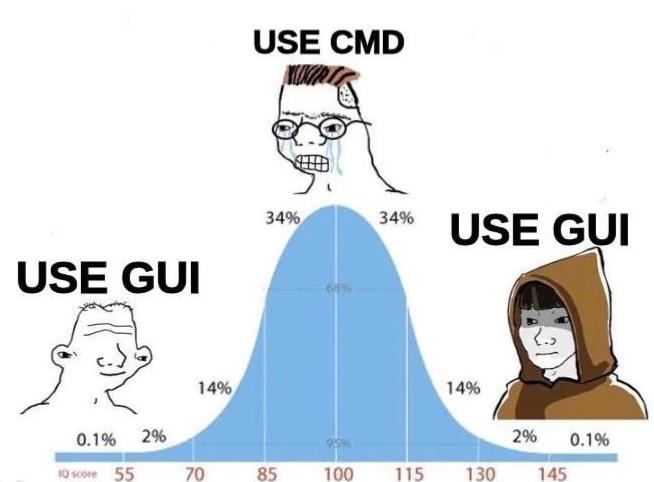
Graphical User Interface Vs Command Line Interface

Graphical User Interface Vs Command Line Interface
The classic bell curve meme strikes again, and this time it's coming for your terminal preferences. The smoothbrains on the left just want their pretty buttons and drag-and-drop simplicity. The galaxy-brain elitists on the right have transcended to GUI enlightenment after years of carpal tunnel from typing commands. But the sweaty try-hards in the middle? They're convinced that memorizing 47 flags for a single git command makes them superior beings. Here's the truth nobody wants to admit: both extremes are right. GUIs are genuinely better for visual tasks and discovery, while CLIs are unmatched for automation and speed once you know what you're doing. The real big-brain move is knowing when to use which tool instead of being a zealot about either. But let's be honest—that guy in the middle spent 3 hours writing a bash script to save 5 minutes of clicking, and he'll do it again tomorrow.