I Get This All The Time...

I Get This All The Time...
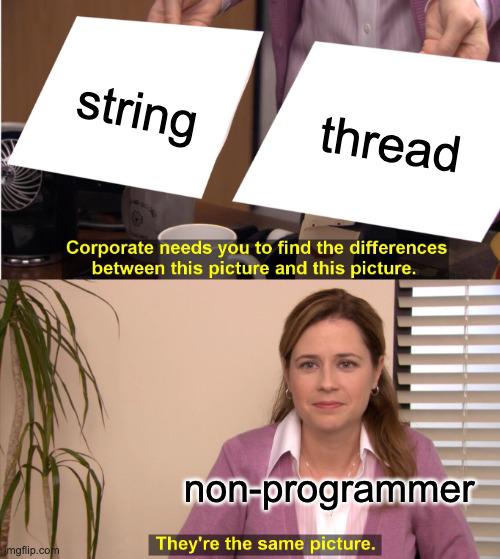
The eternal struggle of being a machine learning engineer at a party. Someone asks what you do, you say "I work with models," and suddenly they're picturing you hanging out with Instagram influencers while you're actually debugging why your neural network thinks every image is a cat. The glamorous life of tuning hyperparameters and staring at loss curves doesn't quite translate to cocktail conversation. Try explaining that your "models" are mathematical representations with input layers, hidden layers, and activation functions. Watch their eyes glaze over faster than a poorly optimized gradient descent. Pro tip: Just let them believe you're doing something cool. It's easier than explaining backpropagation for the hundredth time.

And Here We Are Today!

And Here We Are Today!
They promised us automation would eliminate all manual labor. Instead, we're out here duct-taping circuit boards to sticks because the legacy system from 2003 needs to interface with the new IoT sensor array and nobody budgeted for proper mounting hardware. The future is now, and it's held together with electrical tape and prayers. Turns out "technologically advanced" just means we have more sophisticated ways to MacGyver solutions when the budget gets slashed and the deadline stays the same. At least the stick is biodegradable, so we're technically green tech now.

Docker Docker

Docker Docker
Your CPU is basically that strict parent interrogating Docker about its absolutely OBSCENE resource consumption. "Docker, Docker" gets a sweet "Yes papa" response. But then things take a dark turn when papa CPU asks about eating RAM, and Docker straight-up denies it like a toddler with chocolate smeared all over their face. Same with telling lies. But the MOMENT papa CPU says "Open your mouth!" we see the truth: com.docker.hyperkit casually munching on 9.06 GB of memory like it's a light snack. Busted! Nothing says "lightweight containerization" quite like your Docker daemon treating your RAM like an all-you-can-eat buffet while swearing it's on a diet.

Me In 2050

Me In 2050
The year is 2050. Tech companies have finally achieved their ultimate dream: forcing everyone to authenticate through their cloud services for literally everything. Want to access your own files on your own machine? Sorry buddy, Microsoft/Google/Apple needs to verify your identity first. The UN peacekeepers are here to "help" you migrate to the cloud, but you're having none of it. You've barricaded yourself in your home office, clutching your local user account like it's the last bastion of digital freedom. They can pry your offline credentials from your cold, dead hands. Future historians will call this the Great Local Account Resistance of 2050. Your grandchildren will ask "What was a local user account, grandpa?" and you'll shed a single tear while explaining the ancient times when you could actually own your own computer without needing internet permission to use it.

Hypothetically, If You Were Pivoting To Adult Games, What Would You Name Your Studio? I'm Leaning Toward One-Handed Games 😆

Hypothetically, If You Were Pivoting To Adult Games, What Would You Name Your Studio? I'm Leaning Toward One-Handed Games 😆
So you innocently browse Patreon's top-funded games section out of pure curiosity about indie game development trends, and suddenly you're hit with the realization that adult games are absolutely dominating the funding charts. That sophisticated cat in a business suit reading the newspaper? That's you, calmly processing this market research while thinking "maybe my indie studio pivot should be more... strategic." The "One-Handed Games" studio name is chef's kiss level wordplay—because obviously you'd need one hand free for... holding your coffee while playtesting. Right? The adult game industry on Patreon is genuinely massive, with some projects pulling in $50k+ monthly. Turns out horny gamers have better monetization than most SaaS startups. Who needs venture capital when you've got visual novel enthusiasts with credit cards? The sophisticated cat format captures that exact moment when your brain goes from "I'm just researching game dev" to "wait, these numbers are insane" to "I should learn Ren'Py" in about 3.5 seconds.

Microsoft Is The Best

Microsoft Is The Best
Someone asked Bing if floating point numbers can be irrational, and Bing confidently responded with a giant "Yes" followed by an explanation that would make any computer science professor weep into their keyboard. Spoiler alert: floating point numbers are always rational by definition—they're literally fractions with finite binary representations. Irrational numbers like π or √2 can't be perfectly represented in floating point, which is why we get approximations. But Bing? Nah, Bing said "trust me bro" and cited Stack Exchange like that makes it gospel. The best part? It sourced Stack Exchange with a "+1" as if upvotes equal mathematical correctness. Peak search engine energy right here. Google might be turning into an ad-infested nightmare, but at least it hasn't started inventing new branches of mathematics... yet.

I Love It

I Love It
Windows will happily install software from the Reagan administration without batting an eye, maintaining backward compatibility like it's a sacred duty. Meanwhile, Linux is out here with that smug "already installed" energy because half your system came pre-packaged from 1999. The duality of operating systems: one hoards legacy support like a digital museum, the other ships with everything including the kitchen sink. Both approaches are equally chaotic in their own special way, and somehow we've all just accepted this as normal.

Just Made My First Pull Request To Main

Just Made My First Pull Request To Main
Someone just pushed +30,107 additions and -3,016 deletions directly to main. That's not a pull request, that's a war crime. The panicked scribbling to hide the evidence says it all—they know exactly what they've done. For context: a typical feature PR might be like +50/-20 lines. This person just rewrote the entire codebase, probably replaced the framework, migrated databases, and added a blockchain integration nobody asked for. The four green squares suggest this passed CI somehow, which means the tests are either non-existent or lying. Senior devs are already drafting the postmortem while the intern frantically Googles "how to undo git push force."

I'm Going To Fail That Class

I'm Going To Fail That Class
When your software architecture professor asks about your design patterns and you realize your entire codebase is held together by duct tape, prayer, and a single try-catch block that catches Exception. Sure, you've got architecture—disaster architecture. The kind where every component is tightly coupled, your database talks directly to your UI, and your "separation of concerns" is just different folders with the same spaghetti code. But hey, at least you're self-aware about the impending doom, which is more than most CS students can say when they're confidently explaining their monolithic mess as "microservices-ready."

Not Knowing To Code

Not Knowing To Code
Plot twist: they're both the same person at different stages of their career. AI Engineers out here getting six-figure salaries by writing prompts and calling APIs while traditional devs are grinding through LeetCode mediums at 2 AM. The real kicker? Both groups are equally terrified when asked to implement a linked list from scratch. The modern tech industry has basically decided that knowing how to sweet-talk GPT-4 into generating React components is just as valuable as actually understanding what useState does under the hood. And honestly? They might not be wrong. Why spend years mastering algorithms when you can just ask ChatGPT and hope it doesn't hallucinate a sorting function that only works on Tuesdays?

Straight To Prod

Straight To Prod
You know that split second between hovering over "Commit and Push" and actually clicking it? That's when your entire life flashes before your eyes. Did you test it? Nope. Did you write tests? Absolutely not. Did you even read what you changed? Who has time for that? But here you are, about to yeet your code directly into production because you're 90% sure it works and honestly, that's better odds than most things in life. The "Commit and Push" button is basically the programming equivalent of "do you feel lucky, punk?" and the answer is always a confident "probably?" The sweaty guy on the phone perfectly captures that moment when you realize your push is going straight to main branch and there's no staging environment to catch your mistakes. Time to grip those armrests and hope your regex didn't just delete the entire user database.

Evolution Of The Trash Icon

Evolution Of The Trash Icon
The recycle bin icon started as actual trash, then slowly evolved into something recognizable. But somewhere around 2000, Microsoft decided Internet Explorer deserved its own dedicated spot in the metaphor. Fast forward to 2025-2026, and we're predicting Microsoft Teams and whatever rainbow monstrosity they're cooking up next will become the new universal symbols for "things you want to delete." The trajectory is clear: Microsoft products aren't just software anymore—they're waste management infrastructure. Give it a few more years and the entire taskbar will just be one giant trash can with different flavors of regret.