You Never Know If You're Gonna Need One Some Day

You Never Know If You're Gonna Need One Some Day
That drawer in your office that's basically a graveyard for every AUK cable variant ever manufactured. Sure, you haven't used DisplayPort to Mini-DVI in six years, but the moment you throw it out, someone's gonna walk in with a 2009 MacBook and an urgent presentation. So you keep them all. Every. Single. One. The USB-A to USB-B, the VGA that weighs more than your laptop, that mysterious proprietary connector from a printer that died in 2014. Your coworkers mock you until they need to connect something obscure, then suddenly you're the hero. Cable hoarding isn't a problem, it's disaster preparedness.

Would You?

Would You?
Oh honey, the AUDACITY of these anti-piracy ads thinking they can guilt-trip developers! "You wouldn't download a car" energy but for RAM? PLEASE. Every developer with 47 Chrome tabs open, Docker containers eating memory like it's an all-you-can-eat buffet, and their IDE running in the background would absolutely, positively, WITHOUT HESITATION download more RAM if they could. We're out here closing tabs like we're playing memory management Tetris just to compile our code. If there was a sketchy website called downloadmoreram.com that actually worked? The internet would BREAK from traffic. Nice try, capitalism, but you clearly don't understand the sheer desperation of a developer watching their system monitor hit 99% RAM usage. 🫠

Old Stuff Disguised As New

Old Stuff Disguised As New
The tech industry's favorite party trick: repackaging the same old complexity with a fresh coat of "modern" paint. Your shiny new API client comes wrapped in buzzwords and promises, but crack it open and surprise—it's still got the same bloated UI, authentication nightmares, paywalls, and enough cloud dependencies to make your infrastructure cry. It's like receiving a Trojan horse but instead of soldiers, it's filled with vendor lock-in and subscription fees. The devs are thrilled to present this "revolutionary" solution, completely oblivious to the fact that they're just wheeling in legacy problems with extra steps. Nothing says "innovation" quite like mandatory OAuth flows and a dashboard that requires three different logins to access basic metrics.

The AAA Industry Seems Broken Beyond Repair

The AAA Industry Seems Broken Beyond Repair
Triple-A game studios have perfected the art of failing upward. Ship a buggy mess? Fired. Ship something merely forgettable? Also fired. But somehow deliver a record-breaking bestseller that prints money? Believe it or not, straight to the unemployment line. The logic here is absolutely bulletproof: why keep the talented devs who just made you billions when you could pocket that money and hire cheaper replacements for the next inevitable disaster? It's like deleting your production database after a successful deployment because "we don't need it anymore." Welcome to modern game dev, where success is punished harder than failure because shareholders need their quarterly sacrifice. The beatings will continue until morale improves—oh wait, we laid off morale last quarter.

Technically, I'M A Millionaire Too... Thanks To My Credit Card Limit..

Technically, I'M A Millionaire Too... Thanks To My Credit Card Limit..
That feeling when you see "1.1TB Storage" and your brain immediately goes "wow, that's a lot!" until you realize it's 1TB OneDrive (cloud storage you don't own) + 128GB SSD (actual storage you can use). It's like saying you're a millionaire because you have access to a million dollars... that belongs to someone else and you're just renting. Marketing departments have mastered the art of creative math. Sure, technically you have "access" to 1.1TB, just like technically you could spend your entire credit limit. But try downloading your entire Steam library on that 128GB and see how far you get before reality hits harder than a null pointer exception. Also, 32GB RAM on a laptop with an Intel 4-Core and only 128GB SSD? That's like putting a racing engine in a car with bicycle tires. Someone in product management had... interesting priorities.

Getting Rejected

Getting Rejected
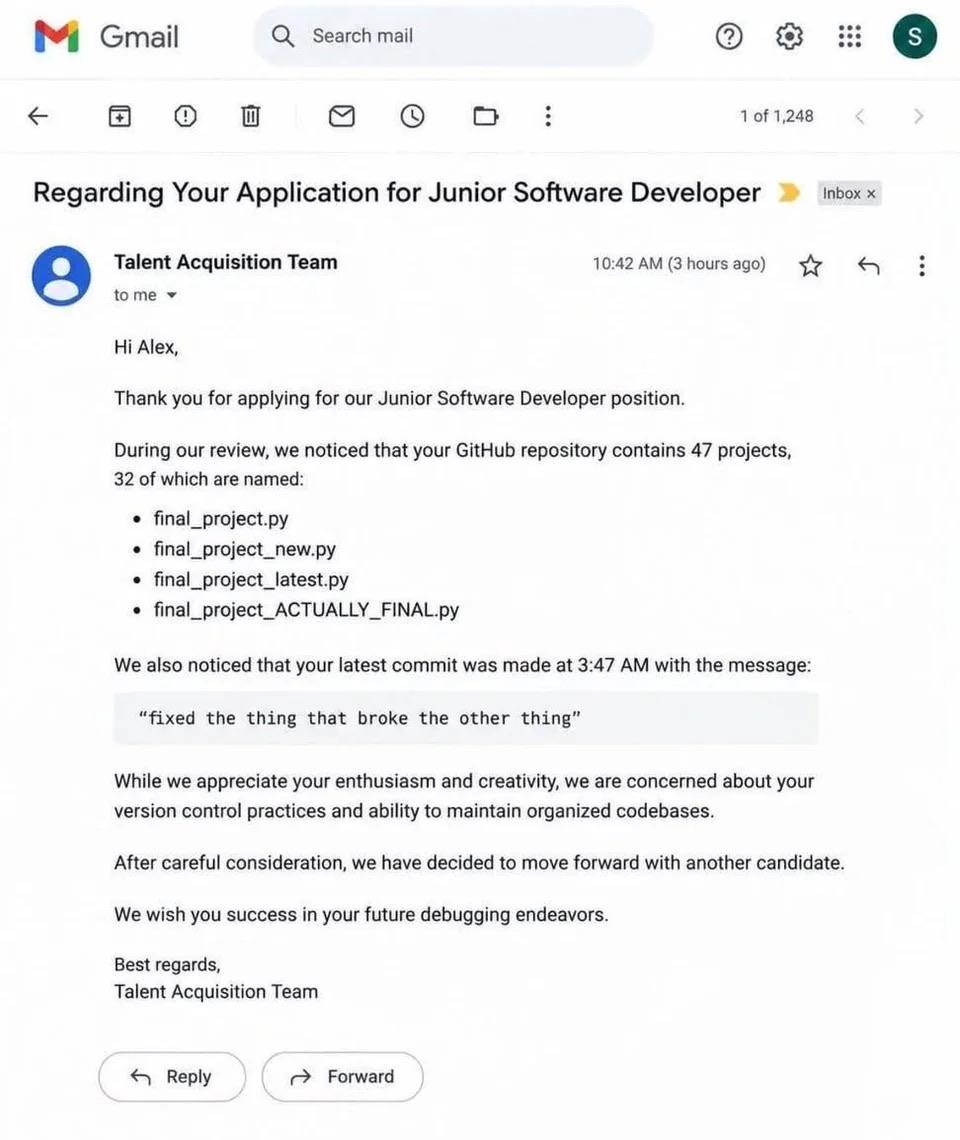
Regular people get to enjoy the simple life: send CV, get rejected, cry into pillow. But software engineers? We're out here running an entire obstacle course just to reach the same disappointing conclusion. Send CV, survive HR's keyword scanner, convince actual developers you're not a fraud, endure the technical interview where they ask you to invert a binary tree while standing on one leg, and THEN get rejected. It's like paying for the deluxe rejection package when the basic one would've hurt just fine. The tech hiring process has more stages than a SpaceX rocket launch, except instead of reaching orbit, you just crash back to Earth with a "we've decided to move forward with other candidates" email. At least regular people save time on their journey to disappointment.

Multi Million Dollar Idea

Multi Million Dollar Idea
Someone took the classic programmer aesthetic—ruled notebook paper with that little cartoon mascot we all doodled during boring meetings—and slapped it on a Nike. The sole reads "Notepad++" which is either genius branding or a cry for help from someone who's been editing config files for 72 hours straight. The swoosh now doubles as syntax highlighting. The frog looks like he's seen some things, probably legacy code. Would unironically wear these to standup meetings just to assert dominance over the VS Code users. Fun fact: Notepad++ has been around since 2003 and is still faster to open than most modern IDEs are to load their splash screens. These shoes would probably boot faster than IntelliJ too.

Modern API Tools

Modern API Tools
You just wanted a simple way to test your REST endpoints, but somehow ended up with a 500MB Electron app that requires OAuth2, stores everything in their proprietary cloud, and needs you to create an account just to send a GET request. The Trojan Horse analogy hits different when you realize modern API clients come bundled with more bloat than Windows Vista. Meanwhile, the defenders of the castle are absolutely stoked to let in this massive wooden horse filled with unnecessary features, forced authentication flows, and subscription models for what should be a simple HTTP client. Sometimes you just miss the days when curl was enough, but hey, at least the UI is pretty, right?

All These People Talking About Curved Monitors, If You Look Closely My Screen Is Curved Too!!

All These People Talking About Curved Monitors, If You Look Closely My Screen Is Curved Too!!
When your CRT monitor from 2003 is technically curved, but not in the flex-worthy way everyone's posting about on Reddit. Yeah buddy, that's not the immersive gaming experience they're talking about – that's just the natural bulge of cathode ray tube technology. While everyone's dropping $800 on their sleek ultrawide curved displays, you're out here representing the OG curve that came standard with a 60Hz refresh rate and enough electromagnetic radiation to warm your coffee. The best part? That thing probably weighs more than a small car and takes up half your desk, but hey, at least you can say you've been on the curved monitor trend since before it was cool. Sometimes the budget doesn't match the ambition, and that's okay – we've all been there with our hand-me-down hardware.

Senior Dev Said The Code Needs To Be Future Proof

Senior Dev Said The Code Needs To Be Future Proof
Oh sure, let me just hardcode EVERY SINGLE YEAR until the heat death of the universe because that's definitely what "future proof" means! Nothing screams sustainable architecture like a 2000-line switch statement checking if it's 2020, 2021, 2022... The comment "add more years before 2028 release" is the cherry on top of this disaster sundae. Imagine being the poor soul who has to maintain this abomination in 2027, frantically adding year 2028 before the whole system implodes. Fun fact: leap year logic is literally just divisible by 4 (except centuries unless divisible by 400), but why use a simple algorithm when you can create a monument to technical debt instead? This is what happens when someone takes "explicit is better than implicit" a bit TOO literally.

Time To Shine

Time To Shine
You know that developer who's been quietly sitting in the corner for months, suddenly feeling a surge of primal power coursing through their veins? That's what happens when the non-technical founder—who's been making all the "visionary" decisions—finally discovers Claude can write code. Suddenly, that senior dev who's been warning about technical debt and asking for proper architecture reviews? Yeah, they're about to get replaced by an AI that hallucinates APIs and confidently suggests storing passwords in localStorage. The developer's existential crisis just got weaponized by someone who thinks HTML is a programming language. Plot twist: Give it two weeks before the founder comes crawling back when Claude generates a beautiful React component that somehow breaks production, deletes the database, and orders 47 pizzas to the office. But until then, enjoy watching them explain to investors how they "optimized their tech team."

Sure Thing Boss

Sure Thing Boss
When your manager tells you to "just patch it in production" and you know damn well this is going to be a structural disaster. The image shows people casually dining on a deck while workers are literally holding up the foundation beneath them with what appears to be emergency construction work. That's basically every "quick fix" in production—everything looks fine from the user's perspective (people eating peacefully), but behind the scenes, devs are frantically propping up the entire system with duct tape and prayers. The "should be quick!" part is chef's kiss. Because nothing says "quick" like potentially bringing down the entire platform while users are actively on it. But sure, let's skip staging, ignore the CI/CD pipeline, and YOLO this hotfix straight to prod. What could possibly go wrong?