


Air Gapped Secrets Management

Air Gapped Secrets Management
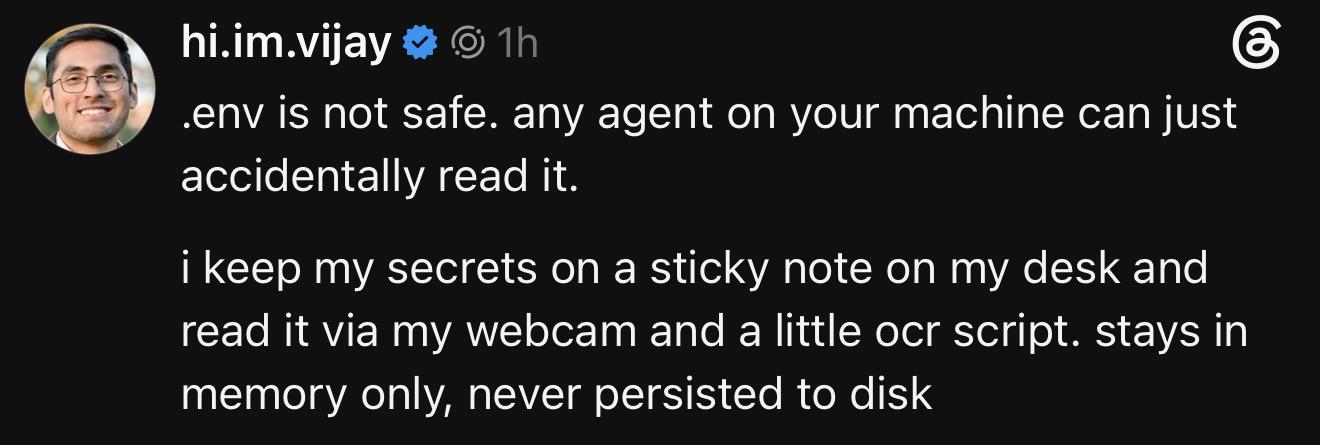
Someone just solved the entire secrets management industry with a sticky note, a webcam, and OCR. While everyone's busy setting up HashiCorp Vault clusters and AWS Secrets Manager with rotation policies, this genius is literally reading passwords off their desk through a camera feed and keeping them in RAM only. Zero persistence, maximum jank. The "air gap" here is the physical space between the sticky note and the computer. Technically more secure than committing your .env to GitHub, which is the bar we're working with these days. The OCR script probably fails half the time because of handwriting recognition, but hey, that's just built-in rate limiting. Fun fact: This is unironically more secure than what half of production environments are running. At least there's no plaintext in the git history.

It's More Common Than You'd Think

It's More Common Than You'd Think
The three-headed dragon of modern development: one head thinks it's a purist warrior monk, another believes it's evolved beyond mortal IDEs, and the third... well, the third is just vibing with its tongue out while playing ping-pong with ChatGPT. Writing code by hand? Respectable but slow. Using CLI tools and agentic coding? Efficient and intimidating. But let's be real—most of us are that derpy third dragon, frantically copying AI-generated code snippets, pasting them into our IDE, watching them fail, then copy-pasting the error message back to the LLM like we're playing the world's most expensive game of telephone. The best part? All three dragons think they're superior to the others, but they're all just trying to ship code before the sprint ends. At least the third one is honest about it.

Aww Shit Here We Go Again

Aww Shit Here We Go Again
Every senior dev knows that sinking feeling when the intern proudly announces they've built "the future of AI" as their PoC. You already know what's coming: a bloated enterprise solution that could've been replaced by a simple Python script using OpenAI's API and maybe some basic prompt engineering. Twenty lines. That's it. But now you're stuck in meetings explaining why we don't need a microservices architecture for what's essentially a glorified API wrapper. The intern's already scheduled a demo with stakeholders. Management thinks they've discovered the next Zuckerberg. You're just standing there with your coffee, dead inside, knowing you'll be the one maintaining this monstrosity when the intern leaves in three months. The cigarette really sells the existential dread of having to pretend this is innovative while mentally refactoring the entire thing in your head.

Following Bukkake Coding

Following Bukkake Coding
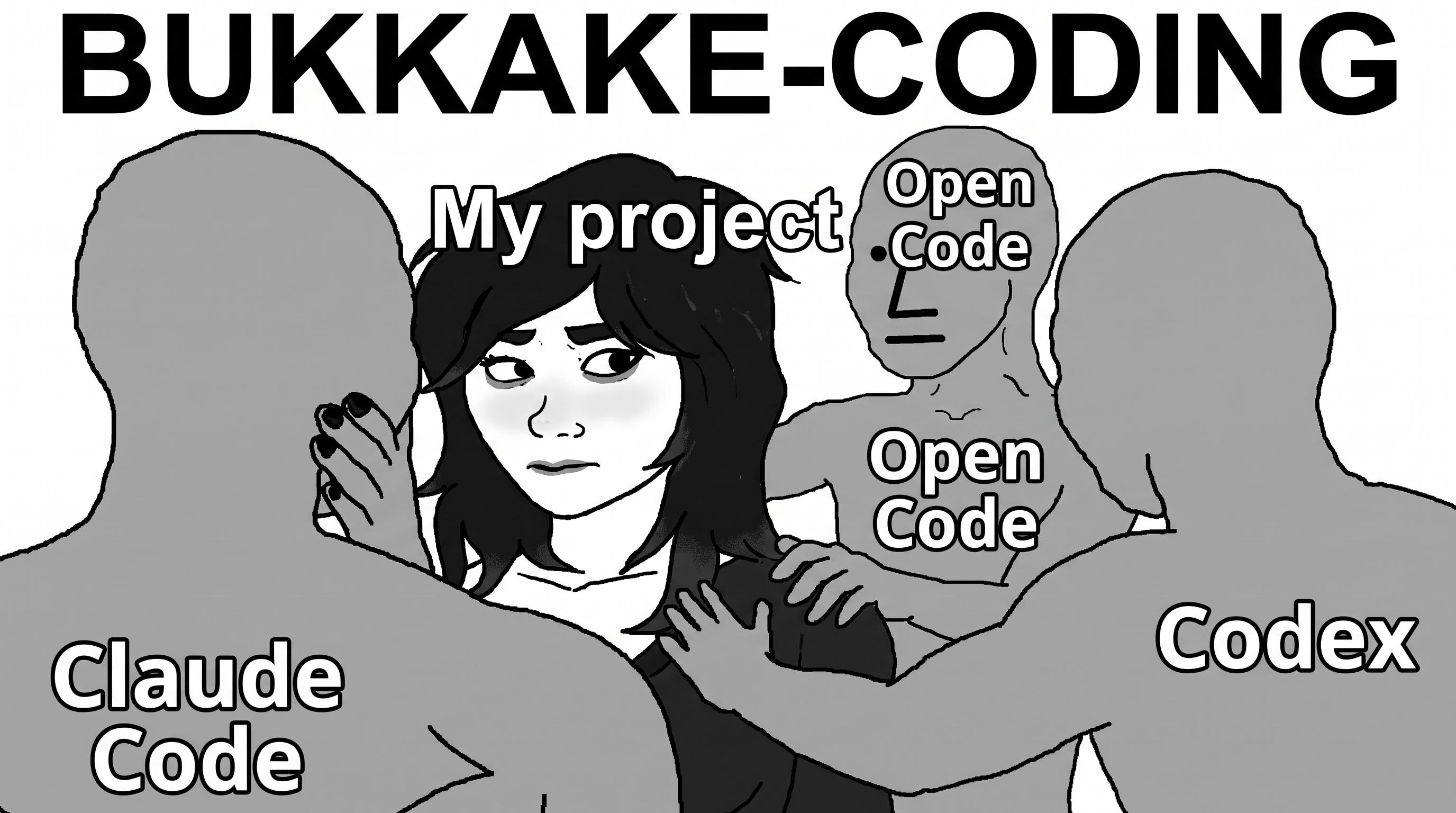
Your personal project getting absolutely swarmed by every AI coding assistant and open-source library known to humanity. Claude Code whispering sweet nothings in one ear, OpenAI's Codex breathing down your neck, and random GitHub repos you cloned at 2 AM all fighting for dominance in your codebase. The project just sits there, overwhelmed and confused, wondering how it went from a simple "Hello World" to being surrounded by more dependencies than a JavaScript node_modules folder. Bukkake-coding: when you let every tool, framework, and AI assistant have their way with your code until you can't tell what you wrote anymore versus what the machines generated. At least your commit history will be... interesting.

Effective Feature

Effective Feature
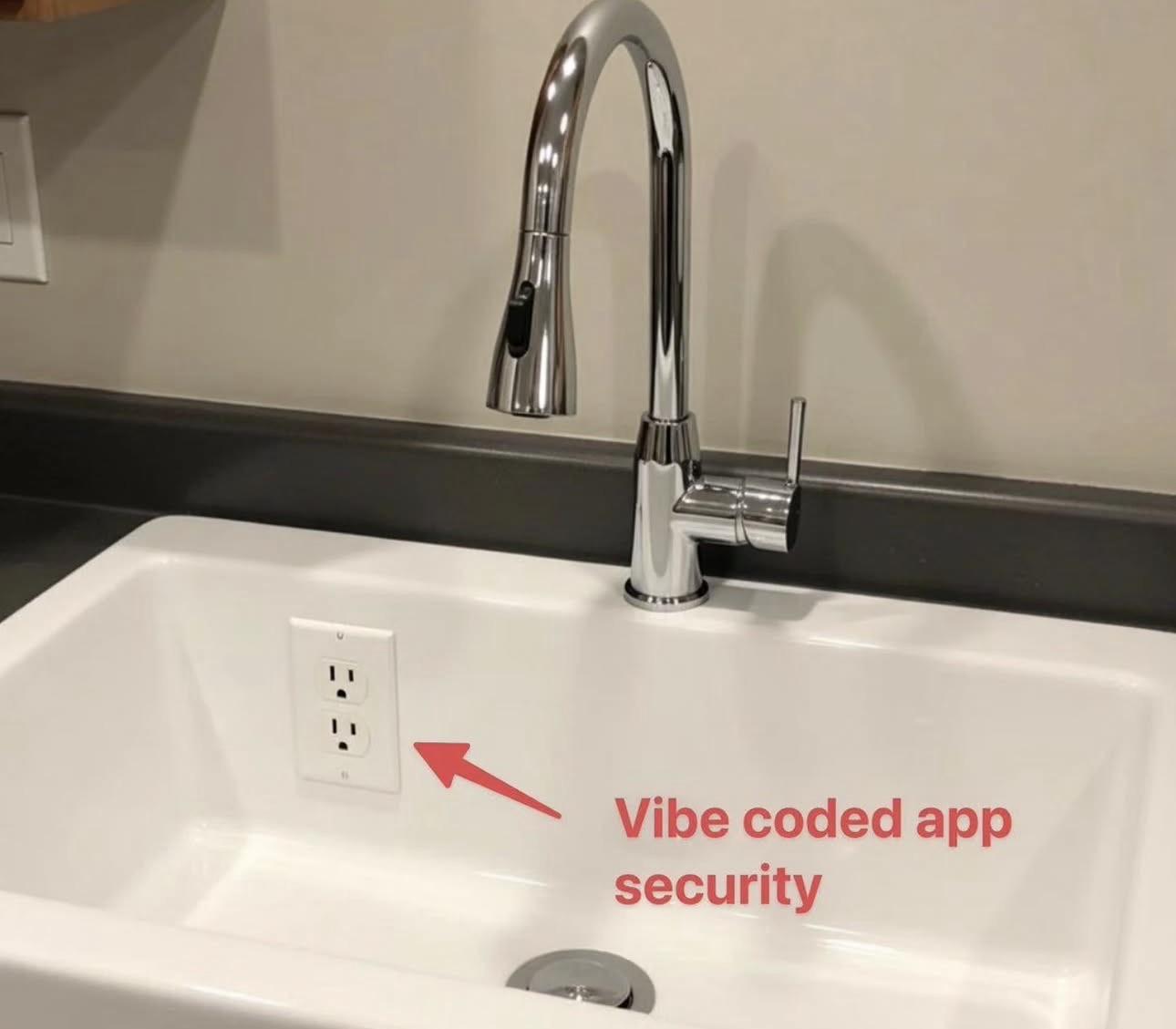
When your app security is so robust that it's literally just an electrical outlet positioned perfectly above a sink full of water. Nothing says "user authentication" quite like the threat of electrocution. Forget OAuth, JWT tokens, or encryption—just let physics handle your access control. The ultimate air-gapped security solution: one wrong move and your attacker becomes a crispy critter. Sure, it violates every building code known to humanity, but hey, zero reported breaches so far. Sometimes the best firewall is a literal wall... with 120 volts running through it.

It Works On My Machine

It Works On My Machine
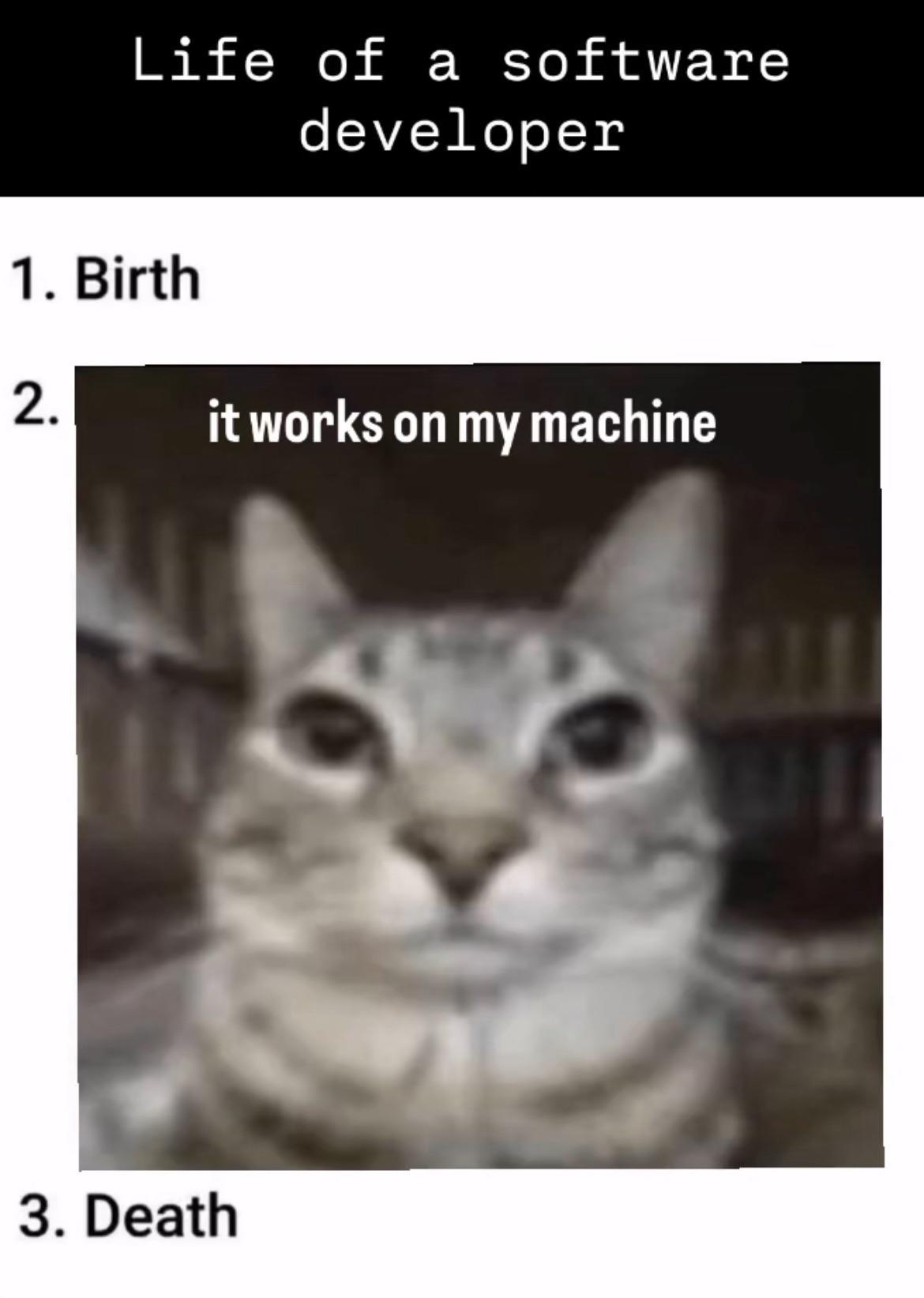
The three stages of a developer's life cycle, beautifully summarized: Birth, uttering those four cursed words that haunt every code review and production incident, then Death. Because once you say "it works on my machine" with that smug confidence, you've basically signed your own death warrant. QA will find the bug. Production will crash. Your coworker's environment will spontaneously combust. And you'll spend the next 6 hours discovering you hardcoded localhost or forgot to commit your .env file. The real tragedy? Those words feel so RIGHT when you say them. Your code IS working. On YOUR machine. Which is the only machine that matters, right? Right...?

Who Needs Loops Anyway

Who Needs Loops Anyway
Someone just discovered copy-paste and decided it was a perfectly valid alternative to loops. They hardcoded every single move in their tic-tac-toe game with nested if-statements, creating a beautiful monument to code repetition. When questioned about the absurd nesting depth, they hit us with the "replay feature" excuse—because apparently adding one more layer of if-statements is easier than learning what a while loop is. This is what happens when you skip the fundamentals and go straight to building projects. DRY principle? Never heard of her.

Bose QuietComfort Ultra Bluetooth Headphones, Wireless Headphones with Spatial Audio, Over Ear Noise Cancelling with Mic, Up to 24 Hours of Playtime, White Smoke

Bose QuietComfort Ultra Bluetooth Headphones, Wireless Headphones with Spatial Audio, Over Ear Noise Cancelling with Mic, Up to 24 Hours of Playtime, White Smoke
SPATIAL AUDIO HEADPHONES: Bose QuietComfort Ultra Headphones with spatial audio give you an immersive experience that makes music feel more real; CustomTune technology offers personalized sound, shap…

Life Lately

Life Lately
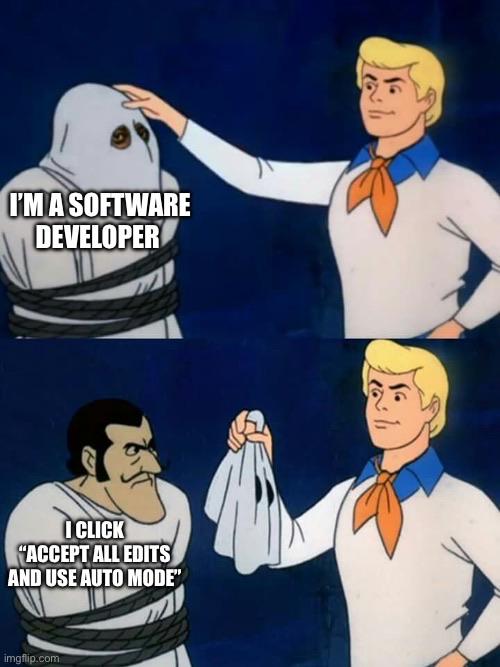
The duality of developer existence in one devastating image. You start the day as this majestic creature who builds software from scratch, architecting elegant solutions and writing beautiful code. Then someone unmasks you and BOOM—turns out you're just frantically clicking "Accept All Edits" on whatever ChatGPT/Copilot/Claude suggests and praying to the tech gods that it compiles. The transformation from "I write code" to "I supervise robots writing code" happened so fast we didn't even notice we became glorified code reviewers for AI. The ascot stays on though, because we still need SOME dignity while our robot overlords do the actual typing.

Gen AI Creating Code

Gen AI Creating Code
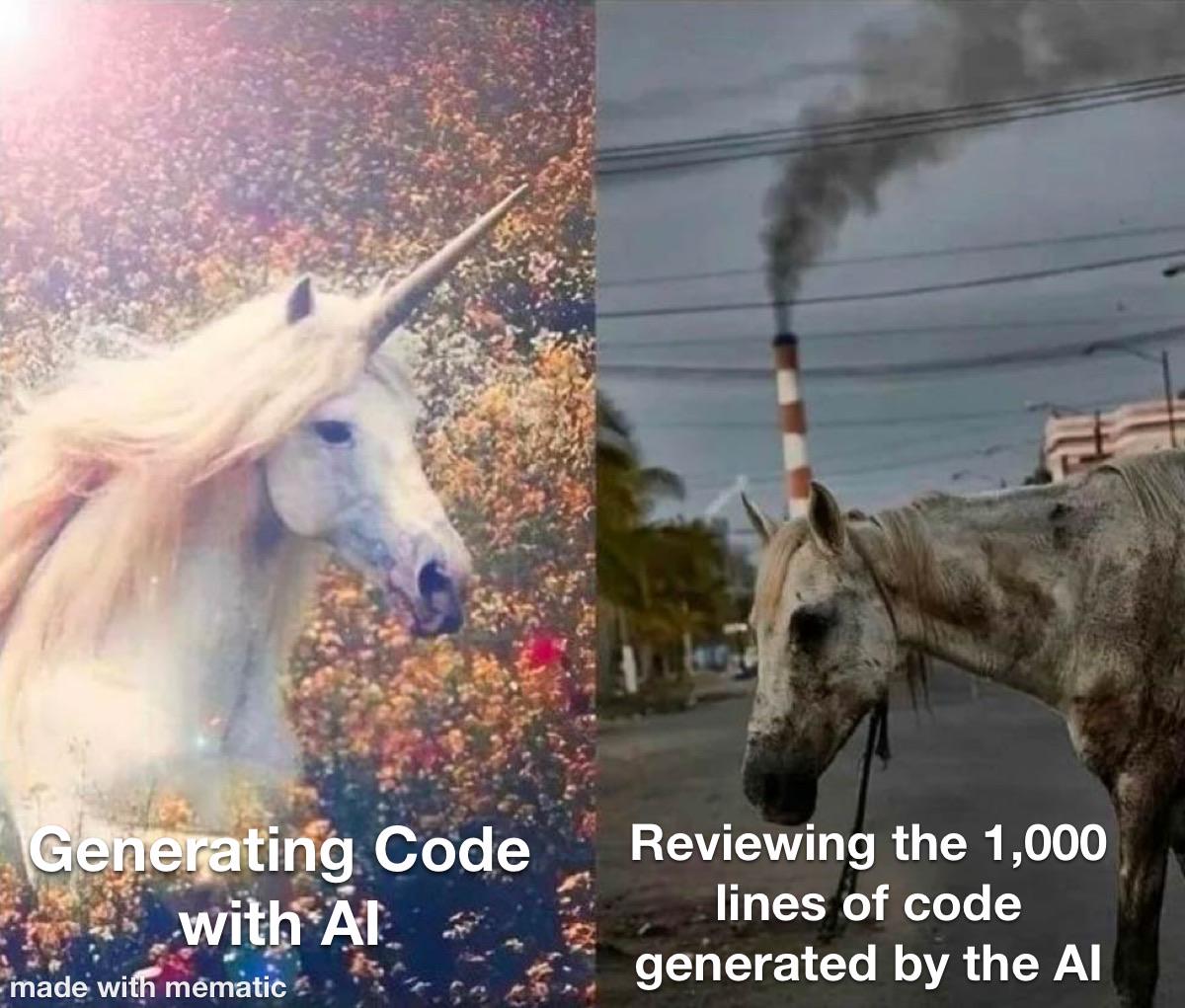
Left side: watching the AI spit out code at lightning speed with all the confidence of a majestic unicorn prancing through sparkles. Right side: you, dead inside, trudging through the industrial wasteland of hallucinated functions, deprecated libraries, and logic that somehow works but also doesn't. Sure, the AI gave you 1,000 lines in 10 seconds, but now you're spending 3 hours debugging why it imported a package that doesn't exist and created a recursive function that would make Fibonacci weep. The unicorn-to-donkey pipeline is real, folks.

Java Classes On A Single Line

Java Classes On A Single Line
Java developers just got handed their holy grail: a 49-inch ultrawide monitor. Why the celebration? Because fitting a single Java class declaration on one line is basically impossible on a normal screen. Between the verbose access modifiers, the abstract factory bean singleton pattern wrapper, the implements clause listing 17 interfaces, and the extends clause reaching back to AbstractBaseEntityManagerFactoryBean, you need a monitor wider than a highway billboard just to see where your class name ends and the opening brace begins. The guy's excitement is totally justified—he can finally read public class MyClass extends SomeReallyLongClassName implements Interface1, Interface2, Interface3 without horizontal scrolling. Living the dream, one ridiculously long line at a time.

Both Work Though

Both Work Though
Imagine thinking you're some kind of coding aristocrat because you let an AI agent write your code while the rest of us peasants are over here manually typing like it's the Stone Age. The superiority complex is REAL. Meanwhile, both groups are shipping features and getting paid the same, but one side gets to feel fancy about it while sipping their oat milk latte as the AI does the heavy lifting. Plot twist: the "primitive" coders probably understand what their code actually does. But sure, go ahead and judge from your ivory tower of automation, Your Majesty.

One Wrong Description

One Wrong Description
Sony executives standing in their fancy office watching the PlayStation homebrew scene absolutely thrive because someone on their legal team wrote one slightly inaccurate technical description in a DMCA takedown. The irony here is delicious - these multi-billion dollar corporations with armies of lawyers somehow manage to shoot themselves in the foot by getting technical details wrong, which then becomes the very loophole that jailbreakers exploit. It's like watching someone lock their front door but leave the keys in the lock. The whole "watching from a distance" vibe really captures that helpless corporate rage when your own incompetence becomes exhibit A in why you can't stop the hackers.