


Grh Proved Through The Last One

Grh Proved Through The Last One
You know your proof is solid when the program exits cleanly. Forget mathematical rigor—if it returns 0, it's basically a theorem at that point. Proof by induction? Cute. Proof by contradiction? Respectable. But proof by "left as an exercise to the reader"? That's the academic equivalent of "works on my machine." The real galaxy brain move is proving correctness by exit code 0. No compiler warnings, no segfaults, just pure success. QED stands for "Quit, Everything's Done."

Thank You Nvidia

Thank You Nvidia
Your SSD is out here living its best life, strutting confidently down the red carpet while Nvidia's driver is lurking behind like an overly attached stalker. Nvidia drivers are notorious for being absolute storage hogs, consuming gigabytes upon gigabytes of disk space with their bloated installations, shader caches, and enough telemetry data to make the NSA jealous. Meanwhile, your poor SSD is just trying to maintain its composure while watching its free space evaporate faster than a developer's motivation on a Friday afternoon. The best part? You can't even uninstall the old drivers cleanly without using DDU because Nvidia loves leaving remnants everywhere like digital breadcrumbs.

Job Market Right Now

Job Market Right Now
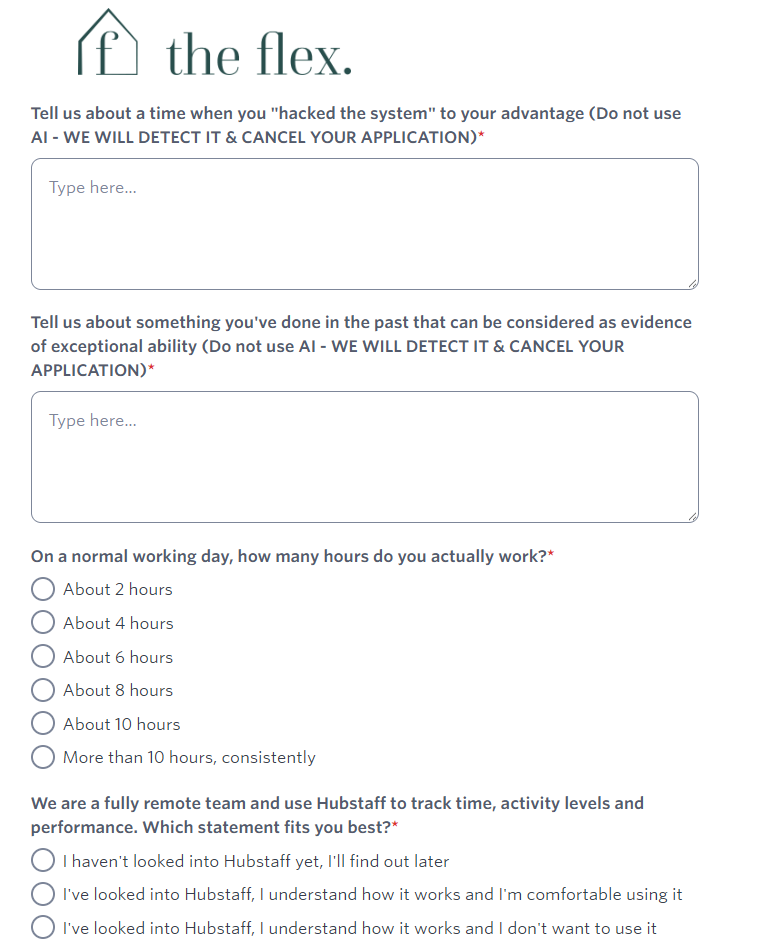
So you're telling me I need to write an essay about "hacking the system" without using AI, prove I have "exceptional ability" (also without AI), disclose my exact productivity metrics, AND let you spy on me with Hubstaff? For an entry-level position that pays $45k? The job market has officially lost its mind. Companies are out here acting like they're recruiting for the Avengers when they're really just hiring someone to update their React components. The paranoia about AI-generated applications has reached fever pitch, and now we've got employers threatening to cancel your application like it's a Netflix subscription. And that Hubstaff question? Chef's kiss. "Tell us you're okay with invasive surveillance without telling us you're okay with invasive surveillance." Nothing says "we trust our employees" like time-tracking software that monitors your activity levels. Can't wait to explain why my mouse wasn't moving during those 15 minutes I spent actually thinking about the architecture.

It's Always 1 St Jan

It's Always 1 St Jan
Steam's age verification gate is the digital equivalent of a bouncer who's given up on life. You could be 87 years old trying to check out a mature game, and Steam will still be like "yeah, I'm gonna need to see some ID... again... for the 500th time this month." The real kicker? Everyone just defaults to January 1st because who actually remembers their real birthday when you're just trying to see if that indie horror game is worth $3.99? At this point, half the internet is apparently born on New Year's Day. Steam's database probably thinks there's a global birthday epidemic every January 1st spanning from 1920 to 2005. It's like those cookie consent popups - legally required, universally ignored, and absolutely nobody believes it's doing what it's supposed to do. But hey, compliance is compliance, right?

Riemann Hypothesis Solved

Riemann Hypothesis Solved
When you realize that implementing matrix multiplication is somehow more intimidating than solving one of the seven Millennium Prize Problems worth a million dollars. Sure, the Riemann Hypothesis has stumped mathematicians since 1859, but have you tried to remember if it's row-times-column or column-times-row without Googling it? The Riemann zeta function looks all mystical and profound with its infinity symbol, but matrix multiplication? That's the real final boss. You need to track indices, remember dimensions, avoid off-by-one errors, and somehow not transpose everything by accident. Plus, there's always that one edge case with non-square matrices that'll haunt your unit tests. Fun fact: The Riemann Hypothesis is actually about the distribution of prime numbers and has implications for cryptography. Meanwhile, your matrix multiplication bug is about why your neural network thinks every image is a hot dog.

IT Support, 2026: Have You Tried Turning It Off?

IT Support, 2026: Have You Tried Turning It Off?
The timeless wisdom of IT support distilled into its purest form. Doesn't matter if we're in 2026, 2046, or the heat death of the universe—the first troubleshooting step will always be "turn it off and on again." It's funny because it works like 80% of the time. Memory leaks? Reboot. Weird network issue? Reboot. Existential crisis about your code? Reboot your brain with coffee and try again. The joke here is that despite all our technological advances, AI taking over the world, and quantum computers becoming mainstream, IT support in 2026 will still be asking the same question they asked in 1996. Some things never change, and honestly? They shouldn't.

NordVPN

NordVPN
Encrypt your traffic on public Wi-Fi, stream from anywhere, and cover up to ten devices with one plan. 30-day money-back guarantee.

All Other Formats Are Inferior

All Other Formats Are Inferior
When someone claims they prefer "superior text storage" over JSON and YAML, only to reveal they mean plain .txt files. The absolute audacity. The sheer confidence. The complete lack of structure, validation, or any semblance of data organization. JSON devs are out here parsing nested objects. YAML enthusiasts are managing their Kubernetes configs with elegant indentation. Meanwhile, this legend is storing everything in a text file like it's 1985 and regex is the only parser they'll ever need. No schemas, no types, just vibes and string manipulation. Honestly? Respect the commitment to chaos. Why worry about data integrity when you can just grep your way through life?

Another CVE

Another CVE
Bash just casually dropping a privilege escalation vulnerability where literally changing PS1 to "#" gives you root. You know, PS1, the thing people customize in their .bashrc to make their terminal look pretty with colors and emojis. The severity? CRITICAL . The CVSS score? A perfect 13 (on a scale of 10, apparently). Affected versions? All of them . Because why patch things incrementally when you can just be vulnerable since the dawn of time? The security researcher really said "let me publish this in 2026" and then traveled back in time to warn us. Either that or Bash vulnerabilities are so inevitable we're just scheduling them in advance now. At this rate, we'll have CVEs for vulnerabilities that won't be discovered until the heat death of the universe.

Devs At The Beginning Vs The End

Devs At The Beginning Vs The End
Start of project: Clean robes, organized tech stack, confident smile. You've got your JavaScript, CSS, HTML5, and a single require() statement. Everything makes sense. The architecture is beautiful. You're a wizard. End of project: Covered in technical debt like you fought a paper shredder and lost. NaN everywhere. Undefined lurking in every corner. Switch statements you don't remember writing. null checking that somehow became your entire personality. And that one "util" file that's now 3000 lines of existential dread. The transformation from "I'll use best practices" to "why is this variable called 'aaaa' and why does the entire app break when I rename it" happens faster than you think.

State Of Market 2026

State Of Market 2026
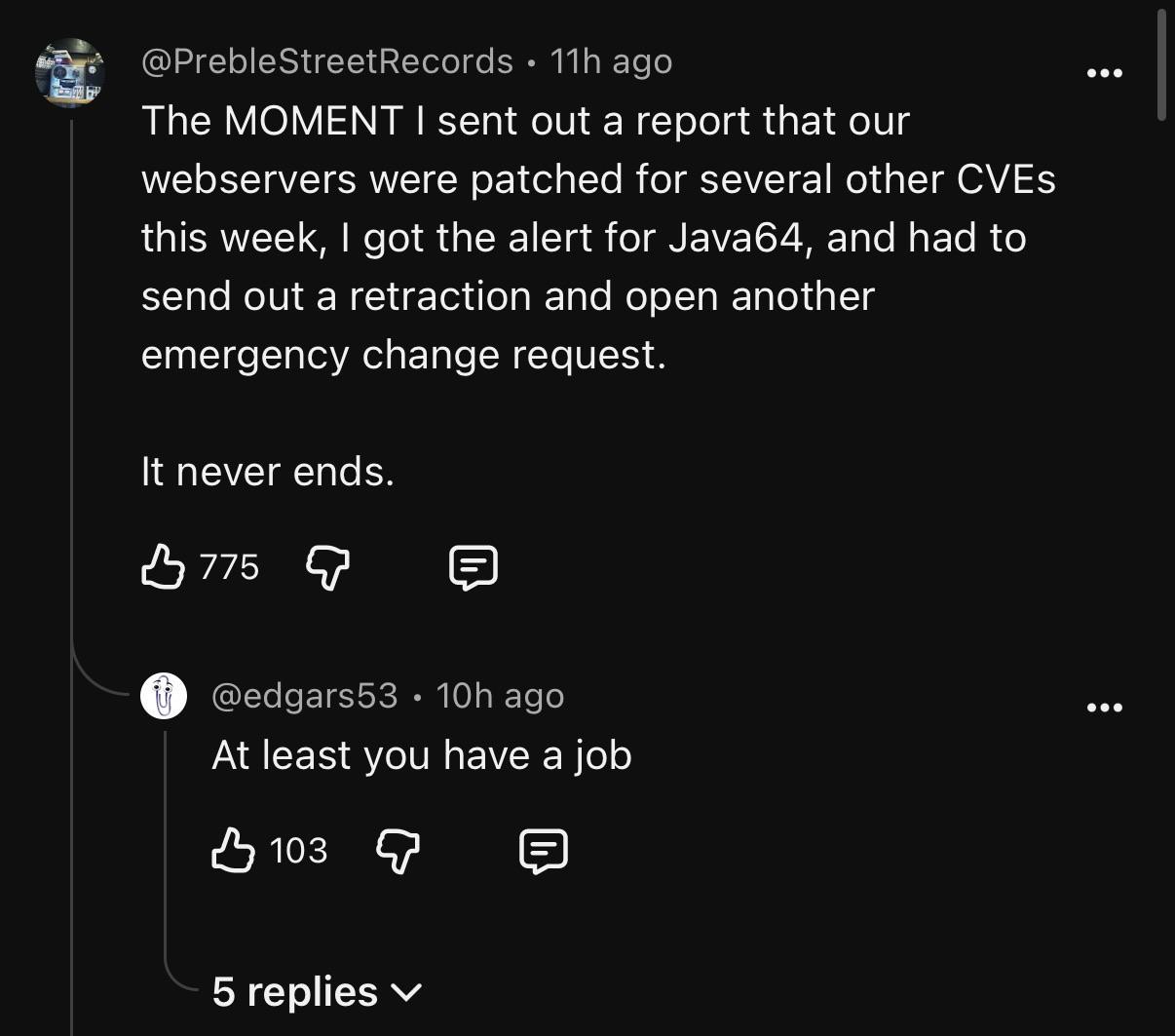
Sent out a report celebrating that webservers got patched for multiple CVEs. Immediately got alerted that Java64 is vulnerable. Had to send a retraction and open another emergency change request. The eternal cycle of security patching, where victory laps are measured in minutes before the next vulnerability drops. The reply "At least you have a job" is the perfect dark humor response—because job security in IT is literally just an endless stream of emergencies keeping you employed. It never ends indeed.

Complexity With Superior Formats

Complexity With Superior Formats
YAML and JSON are both data serialization formats, but YAML fans love to act like they're the enlightened ones because of the "human-readable" whitespace-based syntax. Meanwhile, JSON is sitting there with its brackets and quotes, getting the job done without any drama. The strikethrough shows the real hierarchy here: YAML thinks it's too good to acknowledge JSON, but secretly both formats are just looking down at... well, YAML itself. It's the classic "we're not so different, you and I" moment, except YAML refuses to admit it needs those same curly braces when things get nested. The irony? Both formats parse to the same data structures anyway. Also, fun fact: YAML is technically a superset of JSON, which makes this superiority complex even more delicious.

Comments In Json

Comments In Json
JSON doesn't support comments. Never has, never will. Douglas Crockford decided comments were unnecessary because he saw people putting parsing directives in them, so he just... removed the feature entirely. Now we're all stuck using "_comment": "this is a workaround" like savages or switching to JSON5/JSONC like we're asking permission to use basic functionality that literally every other config format has had since 1970. The genie's reaction is perfect. You want WHAT? Comments? In MY data interchange format? That's somehow more forbidden than necromancy. At least you can hack together bringing back the dead with some creative coding. But comments in JSON? Absolutely haram. There are 4 rules now.