Windows defender Memes

Posts tagged with Windows defender
When I Couldn't Enter No One Could

When I Couldn't Enter No One Could
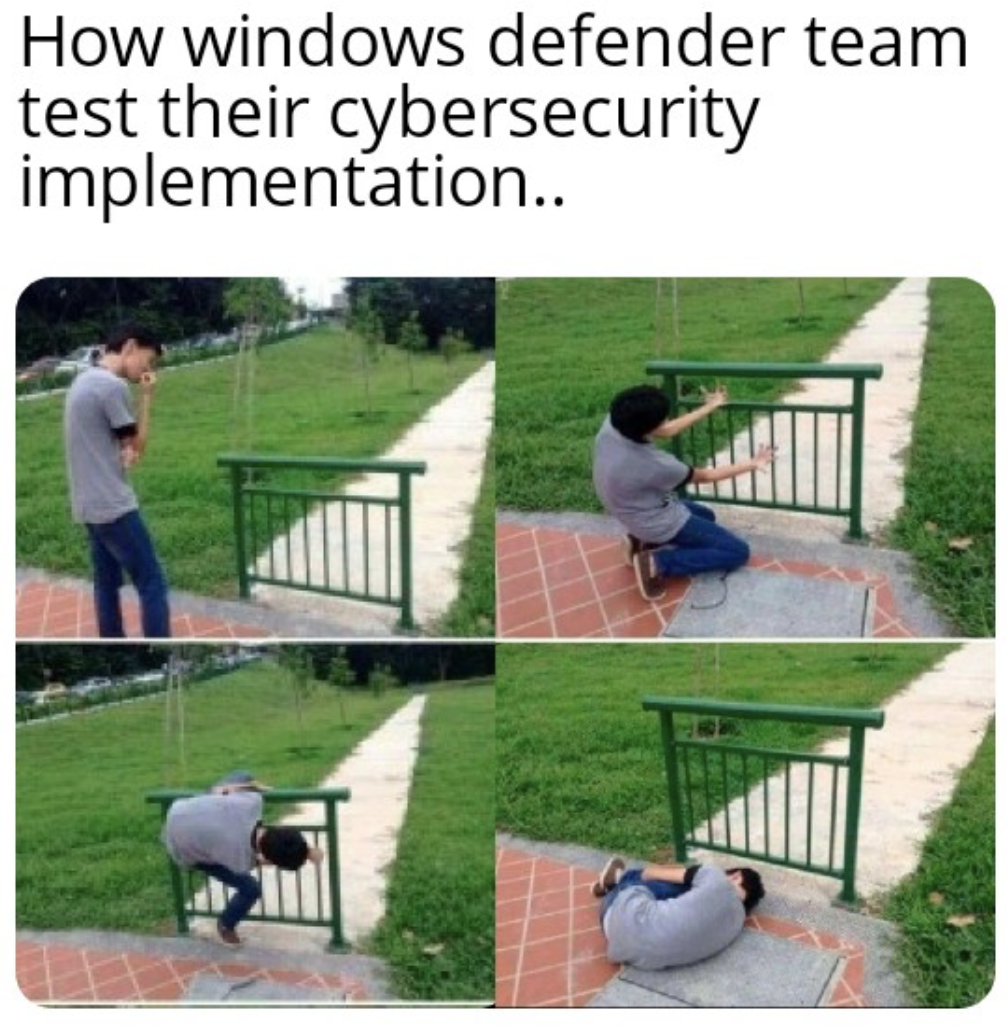
Windows Defender's approach to security: if I can't get through this gate, then it's definitely secure. The guy literally tests the gate by trying to climb over it himself, fails spectacularly, and concludes "yep, impenetrable." That's basically how Microsoft implements security—by accidentally locking out everyone, including legitimate users. It's not a vulnerability if nobody can access the system, right? The cybersecurity equivalent of burning down your house to prevent burglaries. 10/10 penetration testing methodology.

That And The Antimalware Service Executable

That And The Antimalware Service Executable
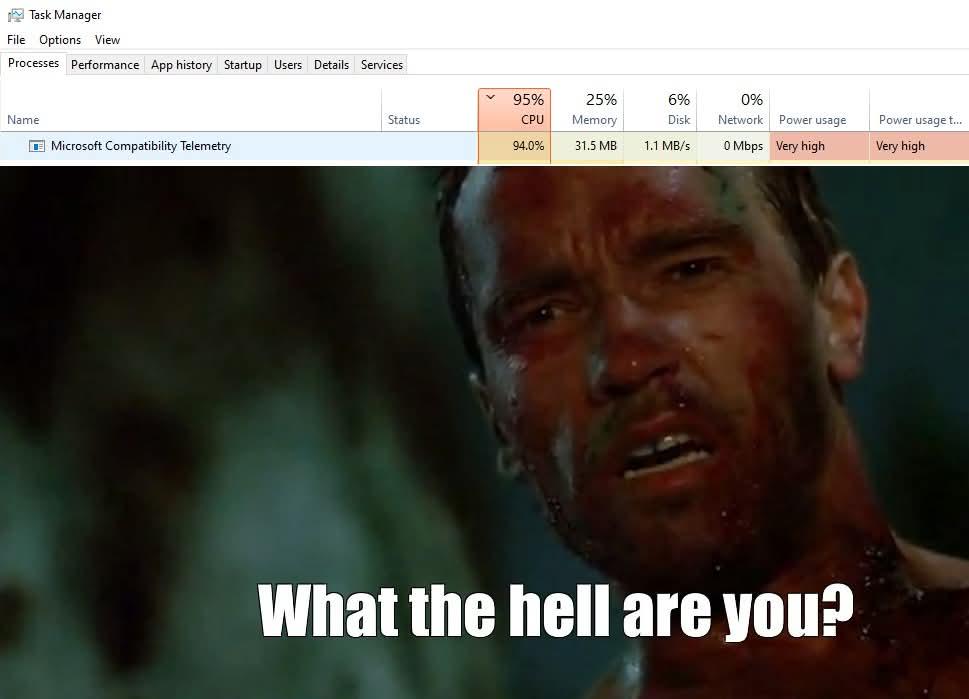
You open Task Manager because your PC is running slower than a Python script parsing JSON with regex, and there it is: "Microsoft Compatibility Telemetry" casually consuming 95% of your CPU like it's mining Bitcoin for Bill Gates. Meanwhile, you're just trying to compile your code without your laptop turning into a space heater. Microsoft Compatibility Telemetry is basically Windows spying on your system to "improve user experience" (translation: sending data back to Microsoft HQ). Combined with the Antimalware Service Executable—which somehow uses more resources than the actual malware it's supposed to catch—you've got a recipe for rage-quitting your entire development session. Nothing says "productivity" quite like your OS fighting you for CPU cycles while you're just trying to run Docker containers and VS Code simultaneously.

Programming On Windows Be Like

Programming On Windows Be Like
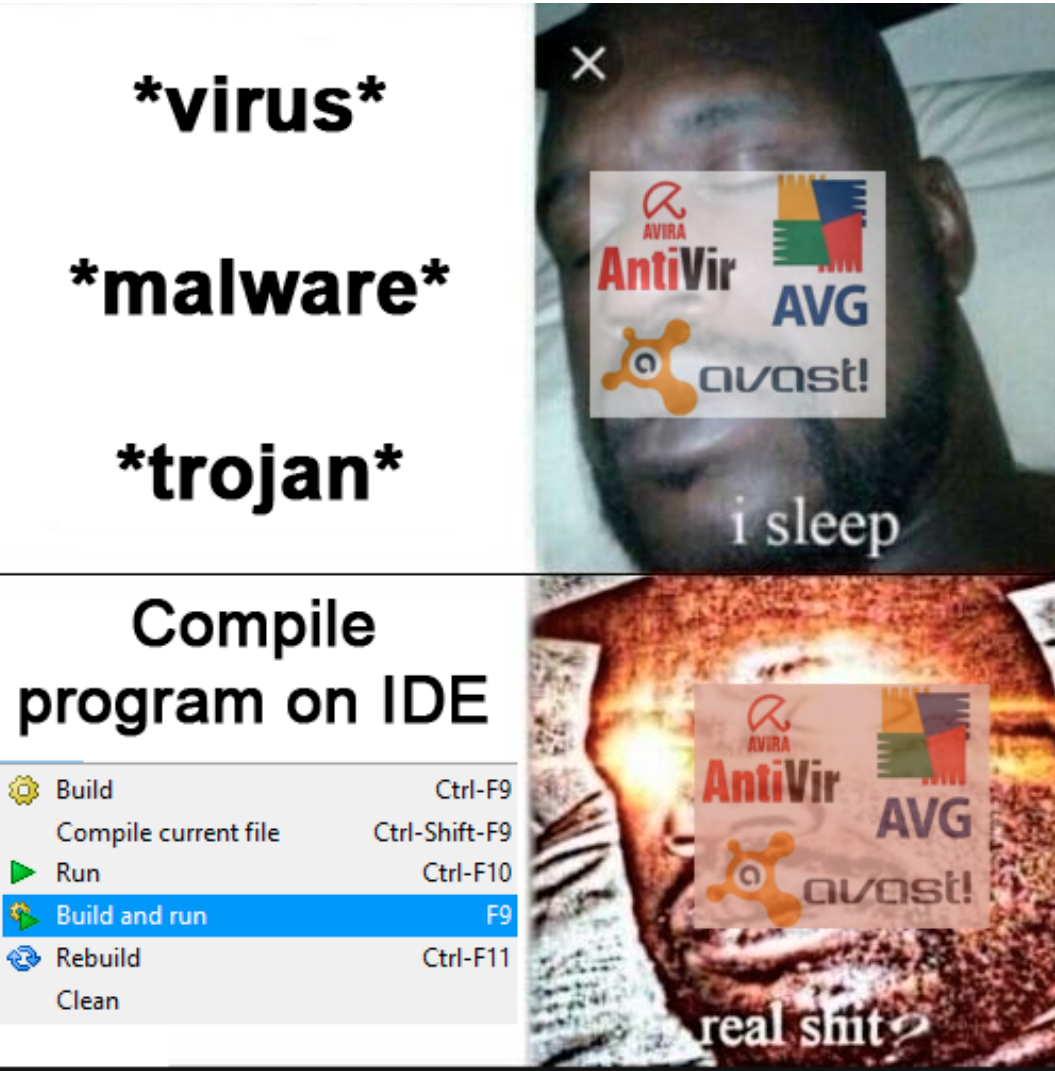
Antivirus software on Windows has exactly one mode: paranoid delusion. Your code sits there doing absolutely nothing? Antivirus sleeps. The moment you hit F9 to compile, suddenly your IDE becomes a threat to national security and every antivirus known to mankind collectively loses its mind. Apparently compiling your "Hello World" program triggers the same alarm bells as launching a cyber attack. Avira, AVG, and Avast form an unholy trinity of false positives, treating your freshly compiled executable like it's ransomware written by a nation-state actor. Meanwhile, actual malware probably just walks right through because it doesn't have the audacity to be compiled on the same machine. The solution? Add your entire development folder to the exclusion list and pray your machine doesn't actually get infected while your antivirus is busy ignoring it. Welcome to Windows development, where your own computer doesn't trust you.

Microsoft Protecting Me From Itself

Microsoft Protecting Me From Itself
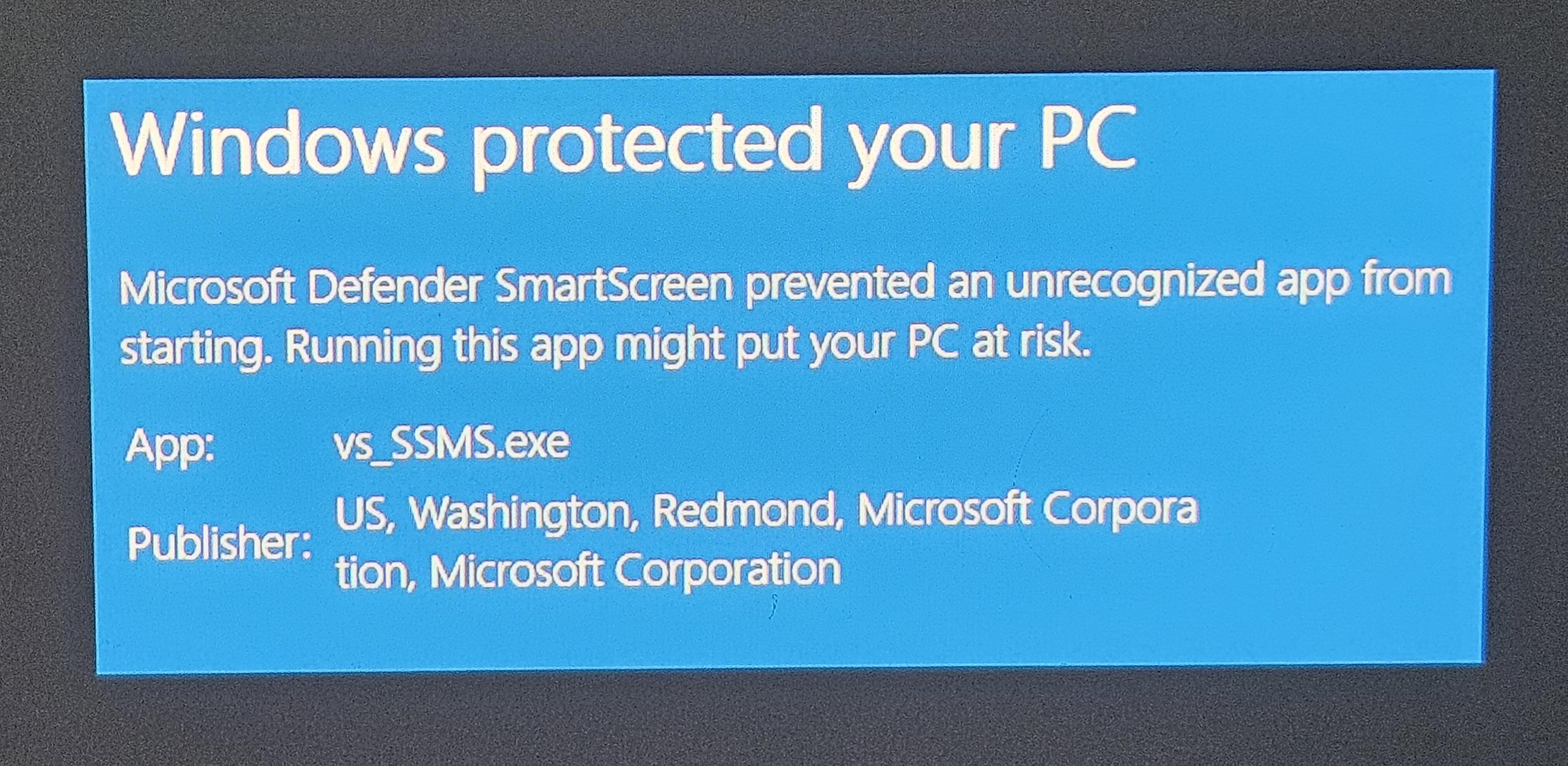
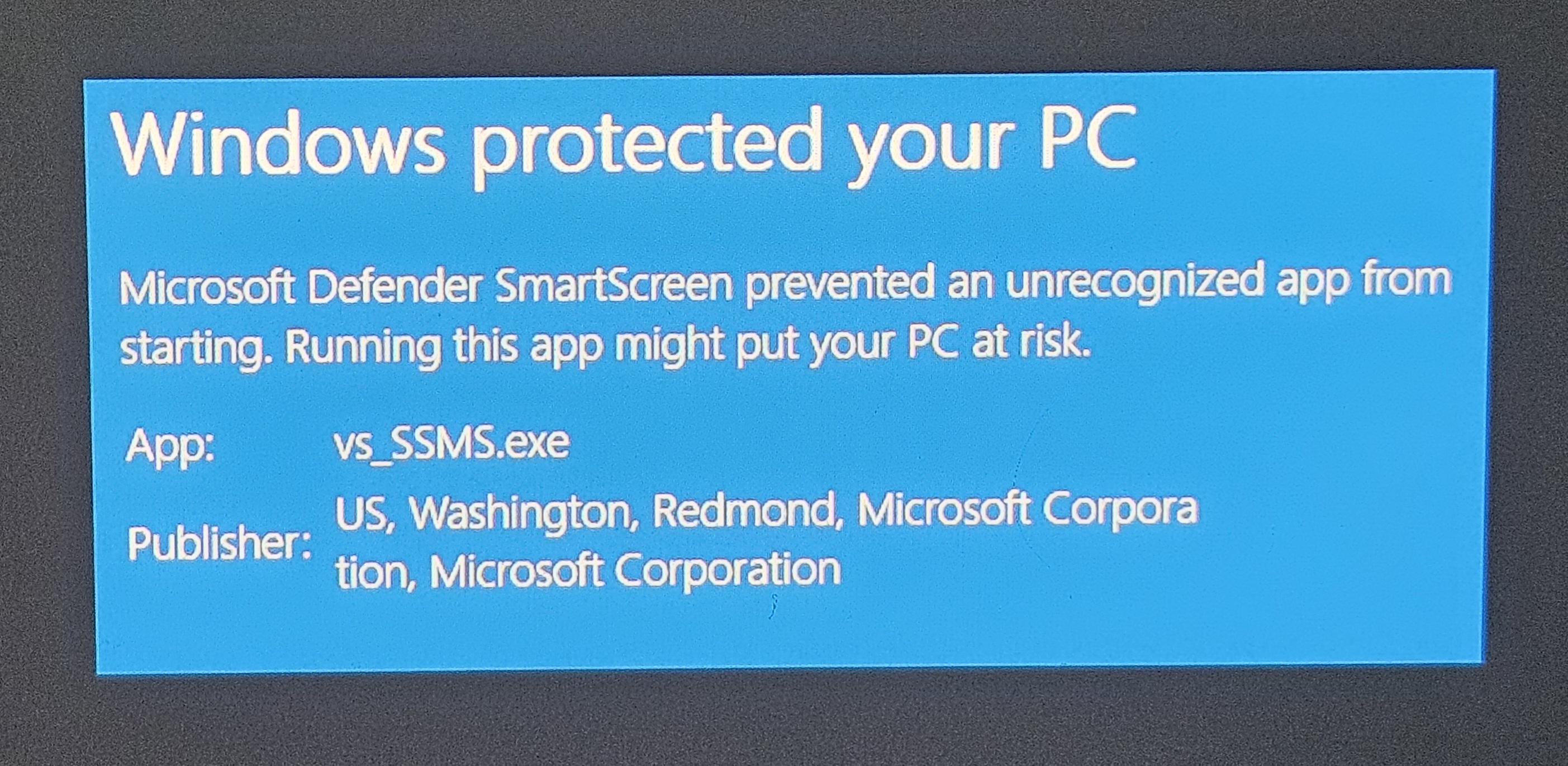
When Windows Defender SmartScreen blocks a Microsoft executable signed by Microsoft Corporation from Redmond, Washington... you know the irony has reached critical mass. It's like your immune system attacking your own cells—except instead of an autoimmune disorder, it's just Microsoft's quality assurance doing its thing. The "vs_SSMS.exe" (Visual Studio SQL Server Management Studio installer) getting flagged as "unrecognized" by Microsoft's own security software is the kind of self-own that makes you question everything. Like, did the Defender team and the SSMS team ever talk to each other? Did they at least exchange Slack messages? Fun fact: SmartScreen uses reputation-based detection, so even legitimate Microsoft apps can get blocked if they're too new or haven't been downloaded enough times. So basically, Microsoft is saying "we don't trust our own software until enough people have been brave enough to run it first." That's one way to do beta testing.

Microsoft Protecting Me From Itself

Microsoft Protecting Me From Itself
Nothing says "enterprise-grade security" quite like Windows Defender blocking a Microsoft executable signed by Microsoft Corporation from Redmond, Washington. You know, just your typical Tuesday where the left hand doesn't trust the right hand, even though they're both attached to the same billion-dollar corporation. The irony is chef's kiss level here. Microsoft Defender SmartScreen is literally telling you that Microsoft's own software might be dangerous. It's like your immune system attacking itself—which, come to think of it, is basically what autoimmune disease is. Turns out Microsoft has autoimmune disease. The best part? This probably happens because their internal signing processes are so convoluted that even their own security software can't keep up. Or maybe SmartScreen is just being honest for once about the quality of Microsoft software. Either way, someone in Redmond is having a bad day.

Another Windows Zeroday, The Repo Text Is Hilarious

Another Windows Zeroday, The Repo Text Is Hilarious
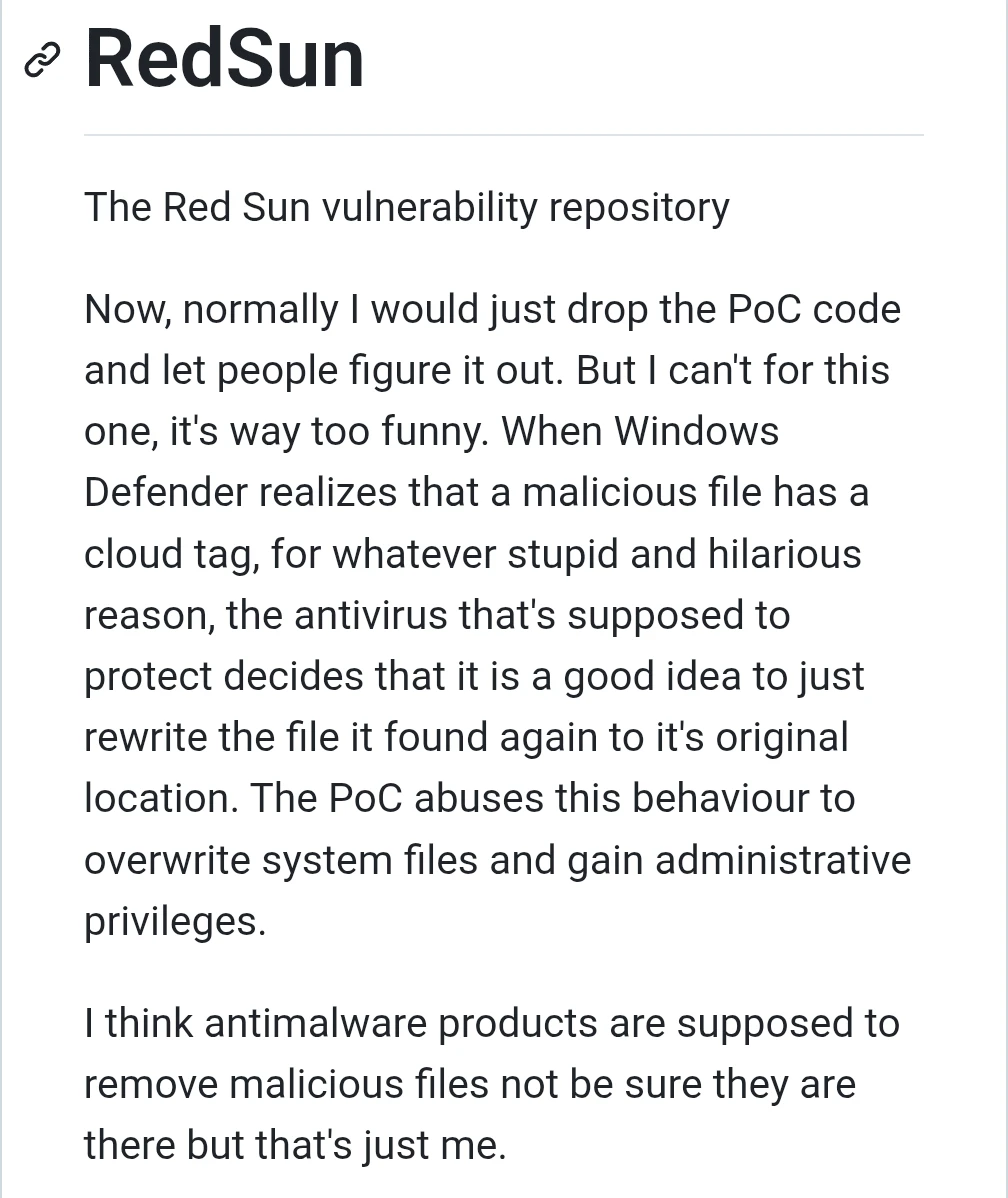
So Windows Defender found a malicious file with a "cloud tag" and thought, "You know what? Let me just restore this bad boy to its original location." Because nothing says security like putting the threat back where you found it. The exploit author couldn't even keep a straight face while writing the PoC—when your antivirus actively helps malware overwrite system files and gain admin privileges, you've transcended from bug to comedy gold. The sarcastic kicker at the end is *chef's kiss*: "I think antimalware products are supposed to remove malicious files not be sure they are there but that's just me." Yeah, just a minor detail in antivirus software design. It's like hiring a bouncer who not only lets the troublemakers in but also gives them the VIP pass and keys to the safe. Microsoft's security team must be having a great day reading this one. Another Tuesday, another zero-day that makes you question if Windows Defender is secretly working for the other side.

Prebuilt Users Can Relate To This

Prebuilt Users Can Relate To This
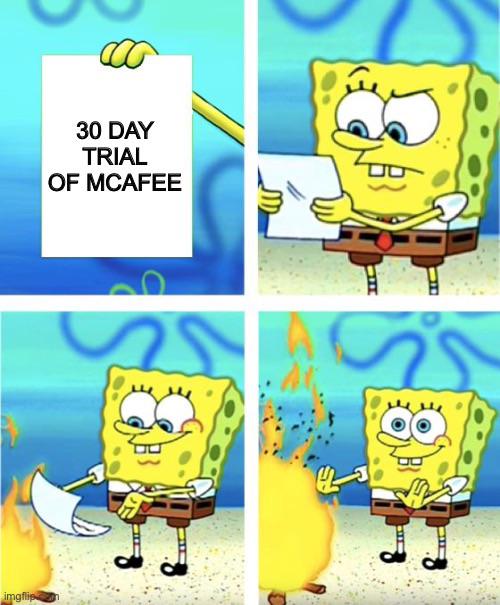
When you download a prebuilt PC with McAfee bloatware pre-installed and discover it comes with a "generous" 30-day trial. SpongeBob's progression from cautiously reading the fine print to full-blown panic mode captures the exact moment you realize this thing is about to nag you every 12 seconds once the trial expires. McAfee has become legendary for being that one piece of software that's harder to uninstall than it is to accidentally install three different toolbars in 2010. It clings to your system like a barnacle, spawning processes faster than you can kill them in Task Manager. The real kicker? Most security researchers agree you probably don't even need it since Windows Defender exists. But hey, at least it keeps your CPU warm during winter by running constant background scans of files you haven't touched since 2015.

NordVPN

NordVPN
Encrypt your traffic on public Wi-Fi, stream from anywhere, and cover up to ten devices with one plan. 30-day money-back guarantee.

The Only Virus I Ever Had Was The One I Paid For

The Only Virus I Ever Had Was The One I Paid For
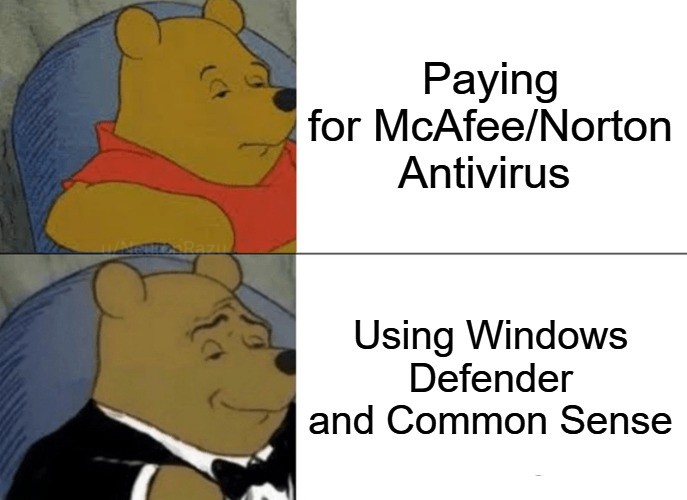
Ah yes, the classic tech industry scam: convincing people that their computer needs a $99/year bodyguard when Windows Defender has been sitting there like a perfectly capable bouncer since 2009. McAfee and Norton are basically the digital equivalent of those mall kiosk guys trying to sell you overpriced phone cases—except they slow down your entire system while doing it. The real kicker? These "antivirus" programs hog more resources than actual malware, spam you with notifications, and are harder to uninstall than a Stage 5 Clinger. Meanwhile, Windows Defender quietly does its job without turning your PC into a slideshow. Common sense is still the best antivirus though: don't click on "FREE_IPHONE_WINNER.exe" and you're already ahead of 90% of users.

My Computer Has Trust Issues

My Computer Has Trust Issues
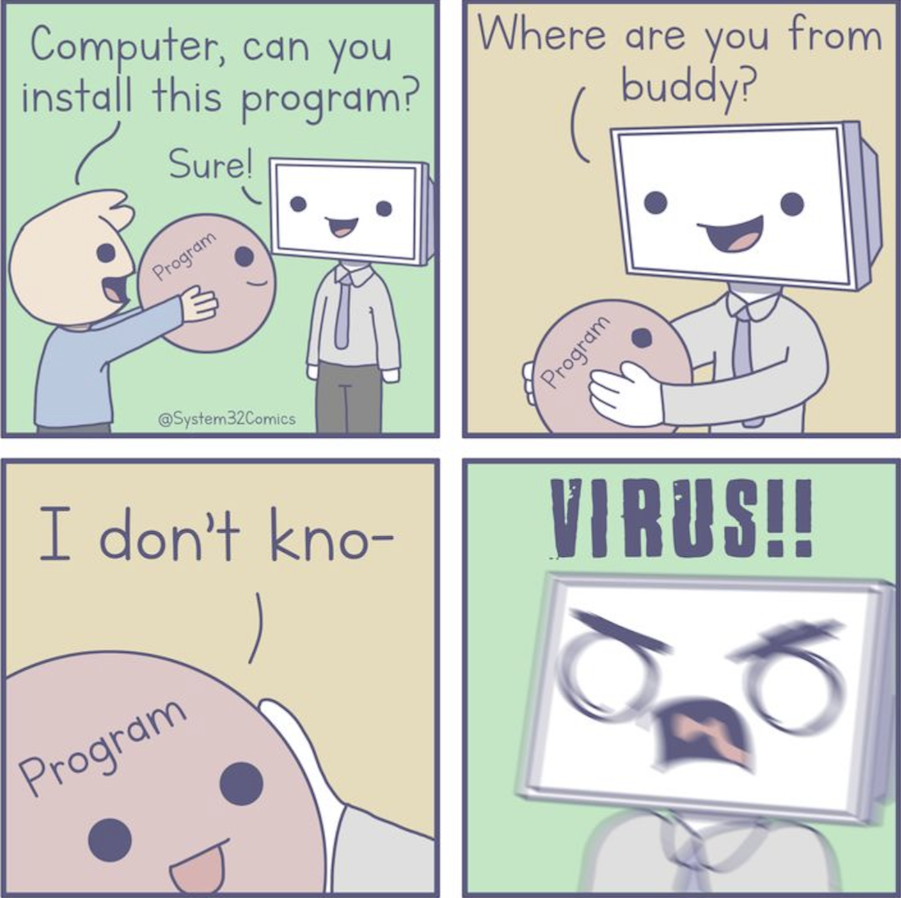
Your computer treats every program like it's a suspicious stranger in a dark alley, even the ones you literally just downloaded yourself. You ask it nicely to install something, it cheerfully agrees, then immediately goes full paranoid detective mode: "Where are you from? What's your publisher? Show me your digital signature!" And when the program can't produce a notarized letter from Bill Gates himself, your computer loses its mind and screams VIRUS at the top of its digital lungs. The best part? Half the time it's flagging your own code that you compiled five minutes ago. Like dude, I literally made this. That's me. You're calling me a virus. Thanks for the vote of confidence, Windows Defender.

Stop. Wrestling. Control. From Me.

Stop. Wrestling. Control. From Me.
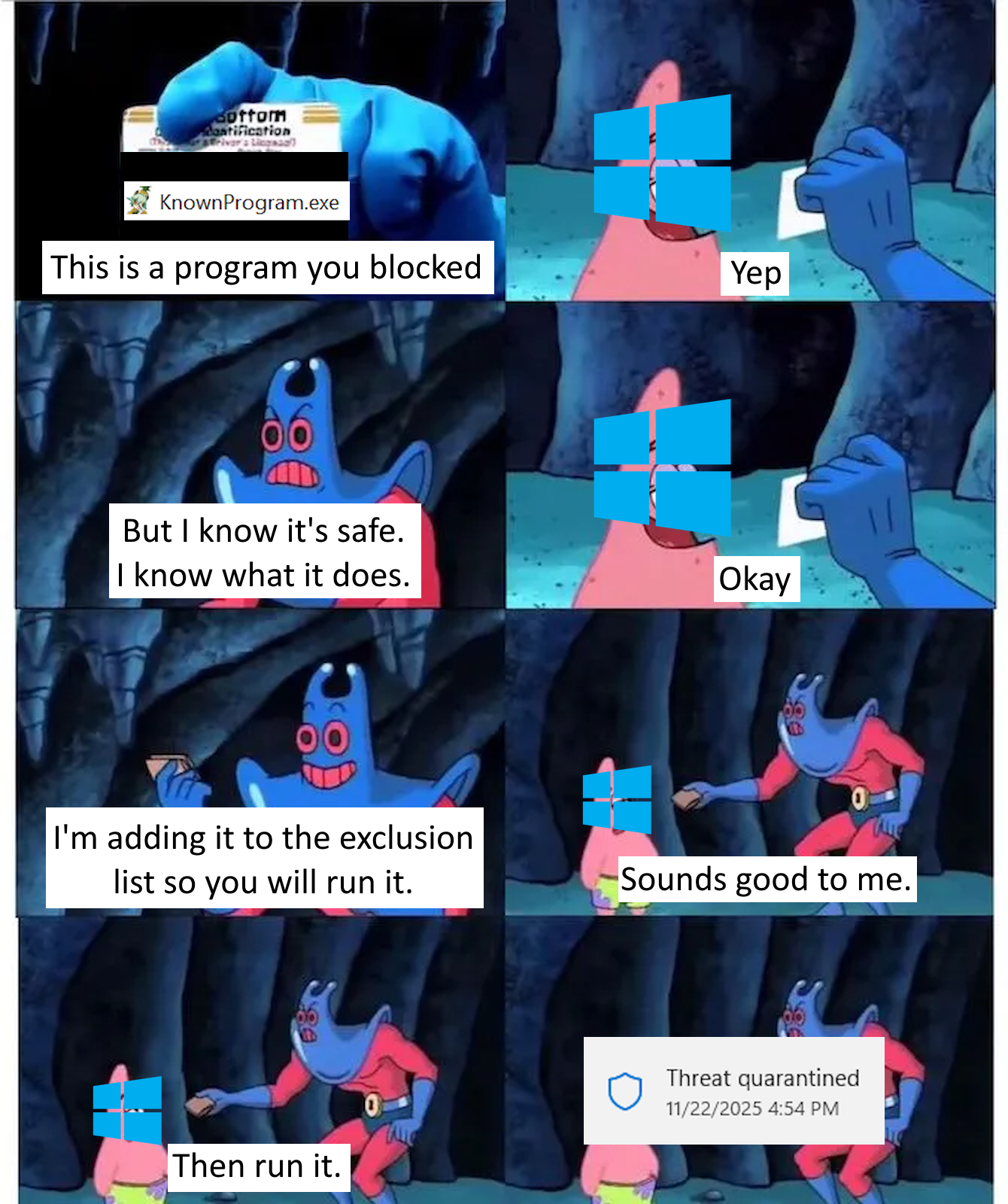
THE ABSOLUTE AUDACITY of Windows to block a program I specifically want to run! 💀 First, Windows has the NERVE to tell me "This is a program you blocked" when I have ZERO recollection of ever doing such a thing! Then when I plead my case like "But I know it's safe! I KNOW WHAT IT DOES!" Windows just shrugs with an "Okay" like some passive-aggressive teenager. So I have to resort to LITERALLY TRICKING THE OPERATING SYSTEM by adding it to the exclusion list! The digital equivalent of putting on a fake mustache and glasses! And Windows just falls for it with "Sounds good to me" only to IMMEDIATELY quarantine it anyway! The relationship between developers and Windows Defender is basically just one long, dramatic soap opera where we're all just trying to run our own code without being treated like criminals! 😭

The Defender Has Become The Chad

The Defender Has Become The Chad
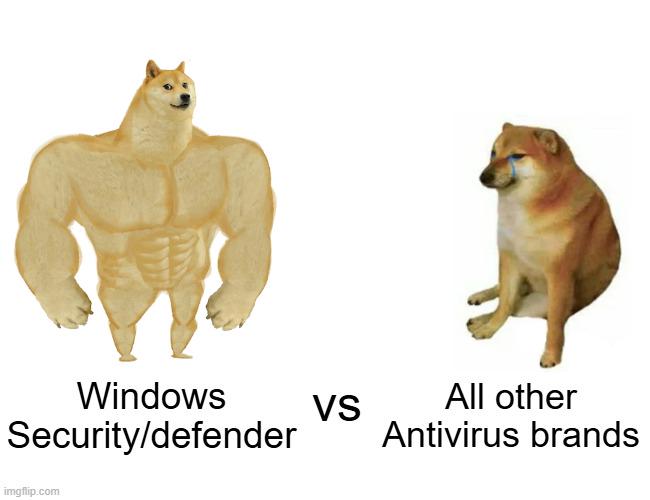
Windows Defender out here flexing those muscles while other antivirus software just sits in the corner eating resources. Remember when we paid for third-party antivirus that would slow your machine to a crawl? Now the built-in option is somehow the chad of the security world. The tables have turned so hard they've got splinters.

Windows Defender's Selective Protection

Windows Defender's Selective Protection
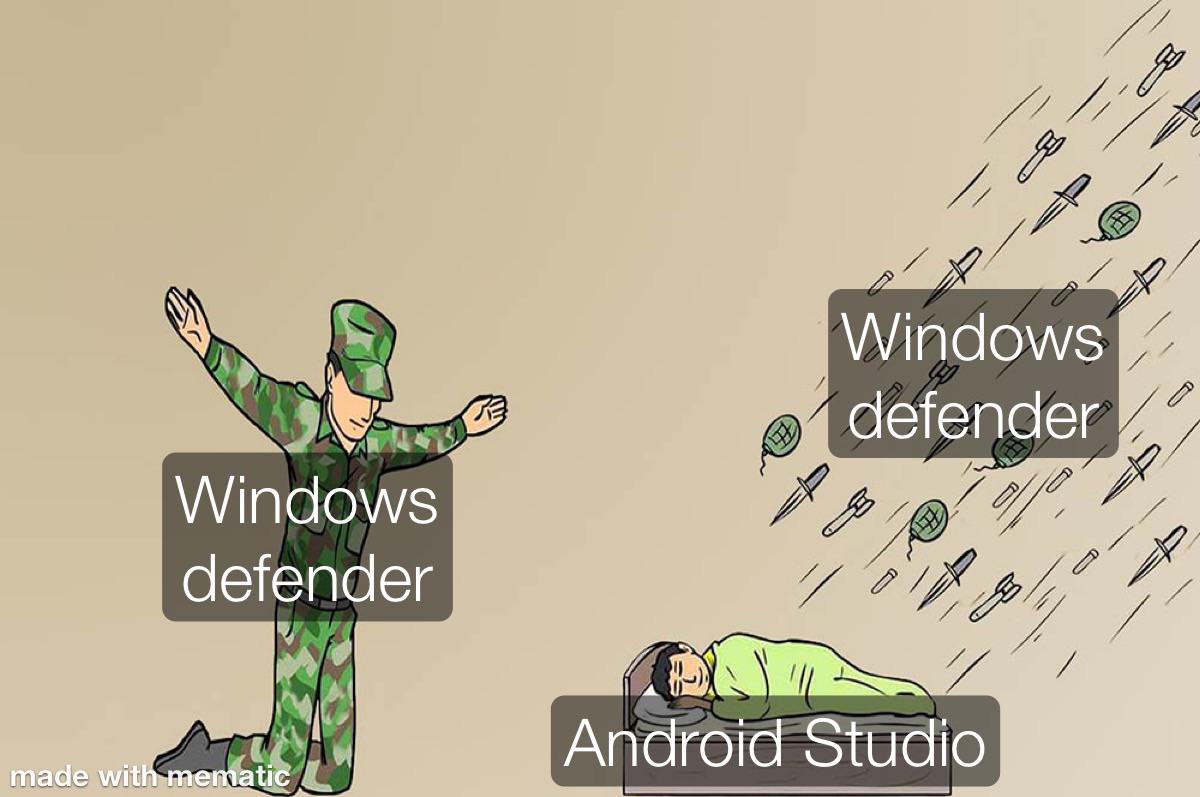
Windows Defender standing there with arms wide open, completely ignoring the barrage of threats raining down on poor Android Studio. Classic Microsoft security theater at its finest. That's why we all end up installing third-party antivirus software despite Windows swearing its Defender is all we need. Meanwhile, Android Studio just lies there, exhausted from consuming 32GB of RAM and still asking for more.