startup Memes

No One Would Notice

No One Would Notice
Nothing says "we made it" quite like slapping a "Rejected by Y Combinator" badge on your startup's website. You know, right next to the SSL certificate and the cookie consent banner. The sheer audacity of turning your biggest rejection into a flex is honestly chef's kiss. It's like wearing a participation trophy to a job interview, except somehow this might actually work because startup culture is delightfully unhinged. The best part? Y Combinator has funded companies like Airbnb, Dropbox, and Stripe, so getting rejected by them is basically a rite of passage. Some of the most successful companies got rejected multiple times before making it. So really, you're in good company. Plus, it shows you actually applied, which is more than most people can say. The hustle is real, and so is the copium.

Posting AI Just Killed Jobs On Linked In

Posting AI Just Killed Jobs On Linked In
Every AI startup founder on LinkedIn acting like they've invented cold fusion when they've just wrapped the Anthropic API in a Next.js app with some Tailwind buttons. The rainbow and sparkles really sell the "revolutionary" part of their pitch deck. Meanwhile, the rest of us are sitting here knowing they're charging $99/month for what's essentially a glorified API call with a UI. But hey, gotta secure that Series A somehow, right?

How To Make Unicorn Startup

How To Make Unicorn Startup
So you want to build the next billion-dollar unicorn? Easy! Just follow these three simple steps: do the impossible, achieve the unthinkable, and casually add "make no mistakes" to your to-do list like it's buying groceries. Because clearly, the secret to startup success is just... not messing up? Revolutionary! Someone tell all those failed startups they simply forgot to check the "make no mistakes" box. The delusion is IMMACULATE. These "vibe coders" really think they can manifest a unicorn valuation through sheer confidence and a complete denial of reality. Zero bugs, zero technical debt, zero failed deployments—just pure, unfiltered perfection. Sure, Jan. Meanwhile, the rest of us are over here with our production incidents and hotfixes, living in the real world where mistakes are basically our middle name.

Actually Crying Inside

Actually Crying Inside
You thought building the product was the hard part? SWEET SUMMER CHILD. Turns out writing clean code and architecting scalable systems is the EASY MODE compared to the soul-crushing reality of having to become a cringe TikTok influencer just to get users. Nothing says "I have a Computer Science degree" quite like doing the Renegade dance to explain your API endpoints. The existential dread hits different when you realize your beautifully crafted SaaS platform needs more viral dance moves than unit tests to survive in 2024. Your Docker containers are perfectly orchestrated, but so are your dance routines now. The pipeline isn't the only thing that needs to be deployed—apparently so does your dignity on social media.

It's Just That Easy

It's Just That Easy
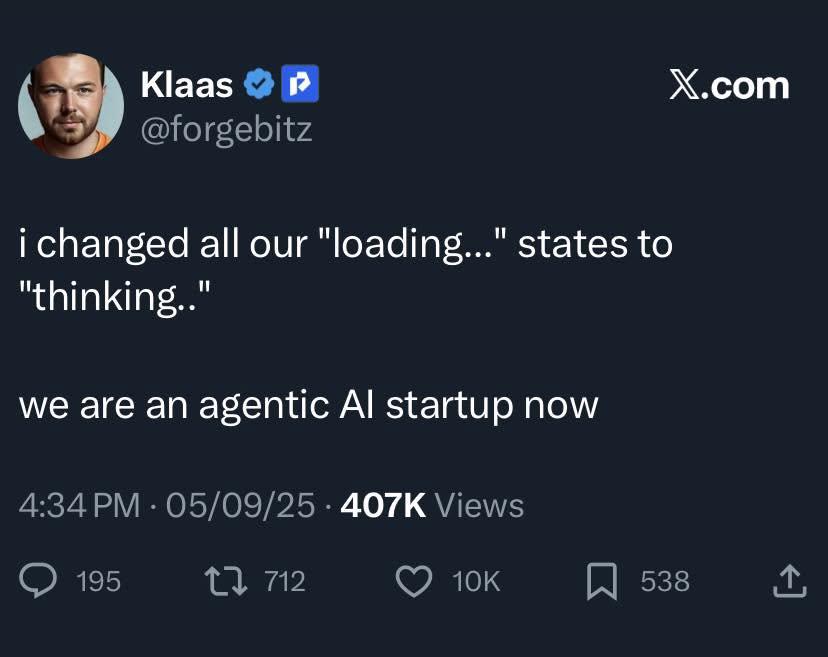
Changed "loading..." to "thinking..." and boom, you're basically OpenAI now. Forget the neural networks, the transformer architecture, the billions in compute costs—just slap a different word in your spinner text and watch the VC money roll in. The bar for calling yourself an AI company has never been lower. Next week they'll probably change "Error 404" to "Temporarily hallucinating" and raise another round.

How It Goes

How It Goes
The startup dream team: a developer who thinks CSS is black magic and a marketer who thinks SEO means "Seriously Excellent Optimism." Neither has any business running a company, but together they form the perfect storm of overconfidence and underpreparedness. The developer can barely center a div but swears they'll build the next unicorn, while the marketer's entire strategy is "we'll go viral." Somehow, this combination has funded more startups than actual qualified teams. VCs see this handshake and immediately start writing checks because apparently incompetence loves company, and the market loves chaos.

Promoting Your Api Tool - Guide For Founders On Reddit

Promoting Your Api Tool - Guide For Founders On Reddit
Oh honey, the AUDACITY of these API tool founders thinking they're slick! They waltz into Reddit's programming subs pretending to be "just another developer" asking innocent questions about Postman alternatives, when SURPRISE – they conveniently have the PERFECT solution they just happened to build! It's like watching someone ask "Does anyone know where I can find good pizza?" while literally wearing a shirt with their pizzeria's logo. The subtlety is absolutely *chef's kiss* nonexistent. Reddit's dev community can smell guerrilla marketing from a mile away, and our poor founder here is sweating bullets realizing their "organic engagement strategy" is about as convincing as a cat pretending it didn't knock over that vase.

Brother From Another Mother

Brother From Another Mother
The ultimate startup power couple: one person who can build anything but couldn't sell water in a desert, and another who could sell ice to penguins but can't tell HTML from a sandwich. Separately, they're walking disasters. Together? They form a vibe startup that'll either revolutionize an industry or burn through VC money in 18 months. No in-between. It's like watching two people with exactly opposite skill trees finally realize they need each other to survive. The engineer's been building "the perfect product" for 3 years with zero users, while the marketer's been promising features that don't exist to investors. Match made in startup heaven.

Every Startup Right Now

Every Startup Right Now
Startups in 2024: "We can't afford competitive salaries or decent benefits, sorry." Also startups: *Drops $500k/month on OpenAI API credits for their chatbot that nobody asked for*. The AI gold rush has VCs throwing money at anything with "agent" in the pitch deck while actual human developers are getting equity that's worth less than Monopoly money. Because why hire three senior engineers when you can subscribe to five different AI tools that hallucinate code and call it "autonomous development"? Fun fact: The average AI agent subscription costs more per month than what some startups pay their junior devs. Priorities, people.

Pooh No!

Pooh No!
When Tigger catches Pooh about to devour some sketchy "vibe coded slop" and absolutely LOSES IT, only for Pooh to hit back with the most devastating flex known to tech Twitter: "Here's how I built a $10k MRR SaaS in 1 week." The sheer AUDACITY. The unhinged confidence. The fact that Pooh's entire business model was probably held together with duct tape and prayers, yet somehow it's printing money while you're still refactoring your side project for the 47th time. Nothing says "I've given up on clean code" quite like eating AI-generated garbage that somehow converts better than your meticulously crafted MVP. The real horror isn't the slop—it's that it WORKS.

Will Be Fun 2 Months Later

Will Be Fun 2 Months Later
Imagine raising TWO HUNDRED MILLION DOLLARS to build your SaaS empire, only to discover your internal team slapped together the same tool in 14 days using duct tape and caffeine. The sheer AUDACITY of that excited developer on the left, proudly announcing they "vibe coded" a solution while the VC-funded founder sits there contemplating every life choice that led to this moment. Plot twist: that internal tool is probably held together by a single SQL query, three bash scripts, and pure spite—but hey, it works! Meanwhile, the $200M version is still in its third sprint planning meeting discussing whether to use microservices or a monolith. The real tragedy? The internal tool will become production because "it's just temporary" (narrator: it was never temporary). Fast forward 2 months and that vibe-coded masterpiece is now the company's core infrastructure with zero documentation, no tests, and the original developer just gave their two weeks notice. Godspeed! 🫡

Token Resellers

Token Resellers
Brutal honesty right here. Everyone's building "AI-powered apps" but let's be real—most of them are just fancy UI layers slapping a markup on OpenAI API calls. You're not doing machine learning, you're not training models, you're literally just buying tokens wholesale and reselling them retail with some prompt engineering sprinkled on top. It's like calling yourself a chef because you microwave Hot Pockets and put them on a nice plate. The term "wrapper" at least had some dignity to it, but "Token Resellers" cuts straight to the bone—you're basically a middleman in the AI supply chain. No shade though, margins are margins, and someone's gotta make those API calls look pretty.