


Server management Memes

Posts tagged with Server management

I Should Set Up Unattended Upgrades...

I Should Set Up Unattended Upgrades...
You know that thing where you keep telling yourself "I'll totally set up automatic security updates tomorrow" and then suddenly it's 3 AM and the CVE website is standing in your bedroom like a sleep paralysis demon showing you a fresh list of CRITICAL vulnerabilities? Yeah, that's the vibe here. Every sysadmin's recurring nightmare: procrastinating on those unattended-upgrades configs while your servers are out there running on packages older than some TikTok users. Then one day you casually check cve.org and discover your system has more holes than Swiss cheese at a shooting range. The way those CVE severity badges escalate from MEDIUM to HIGH to CRITICAL is basically the universe's way of saying "congratulations, you played yourself." 💀 Fun fact: CVE stands for Common Vulnerabilities and Exposures, and it's basically the public registry of "oops, we messed up" for software. When you see multiple fresh CVEs with your server's name on them, it's time to stop playing GTA and start playing "patch everything before the hackers do."

Based On A True Story

Based On A True Story
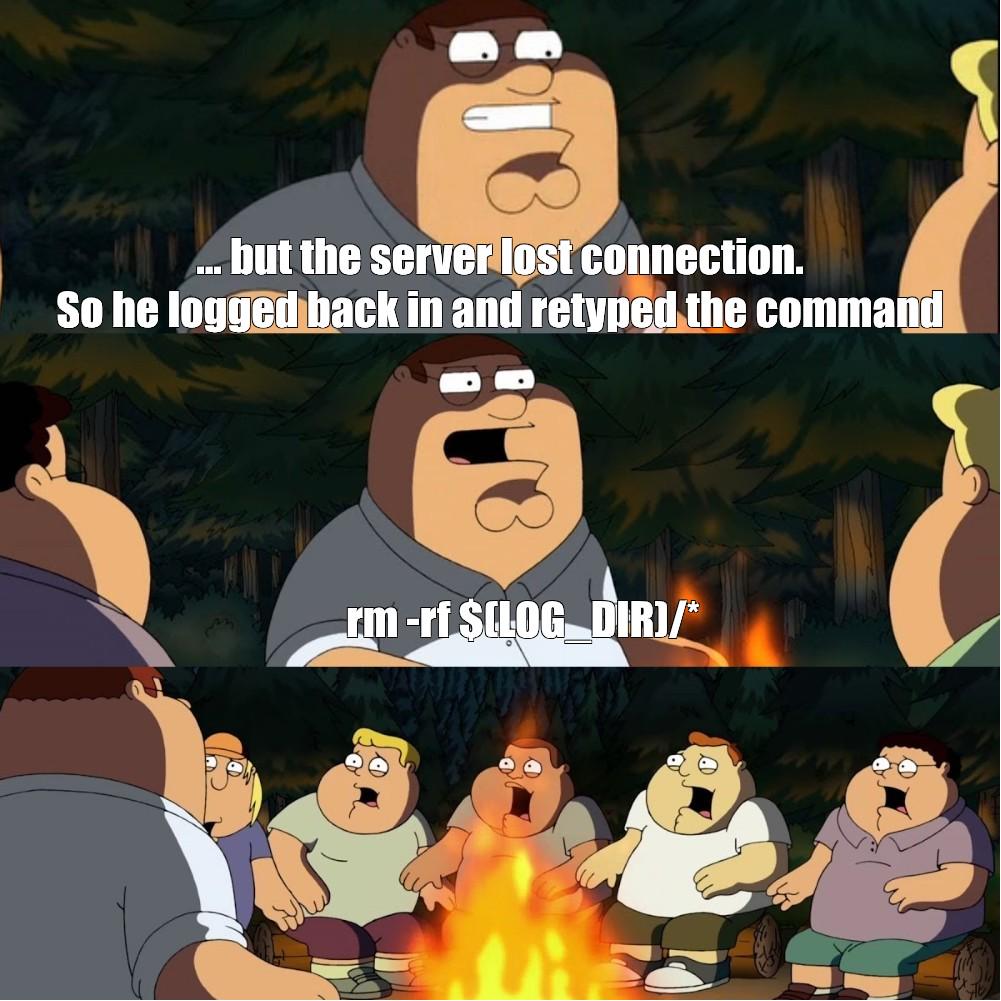
Oh, the HORROR of losing your SSH connection mid-command and having to retype that beautiful, carefully crafted command from memory! But wait—our hero here decides to log back in and casually drop an rm -rf $(LOG_DIR)/* like it's no big deal. Except... plot twist: the variable didn't expand because the shell session was different, or the environment wasn't set, or Mercury was in retrograde, or WHATEVER. So instead of deleting logs, they just nuked the ENTIRE FILESYSTEM starting from root. Nothing says "production incident" quite like recursively force-deleting everything because you trusted a variable to do its job. The crowd's horrified faces? That's every sysadmin within a 50-mile radius feeling the disturbance in the force. Pro tip: always echo your variables before you yeet them into an rm command, folks!

Thanks Clippy

Thanks Clippy
Nothing screams "job security" quite like that ancient Exchange 2010 server gathering dust in the corner of the server room. You know the one—hasn't been patched since Obama's first term, running critical email infrastructure for the entire company, and nobody knows the admin password anymore. But here comes Clippy, Microsoft's passive-aggressive assistant from hell, cheerfully suggesting you power up that ticking time bomb. Sure, what could go wrong? It's only been sitting there for over a decade with who-knows-what vulnerabilities, probably still running on Windows Server 2008, and definitely not compliant with any security policy written after the invention of the iPhone. The real kicker? If you turn it on, it'll probably start sending emails from 2015 that got stuck in the queue, trigger every monitoring alert simultaneously, and immediately get pwned by ransomware. But hey, at least Clippy's trying to be helpful!

Big Mistake

Big Mistake
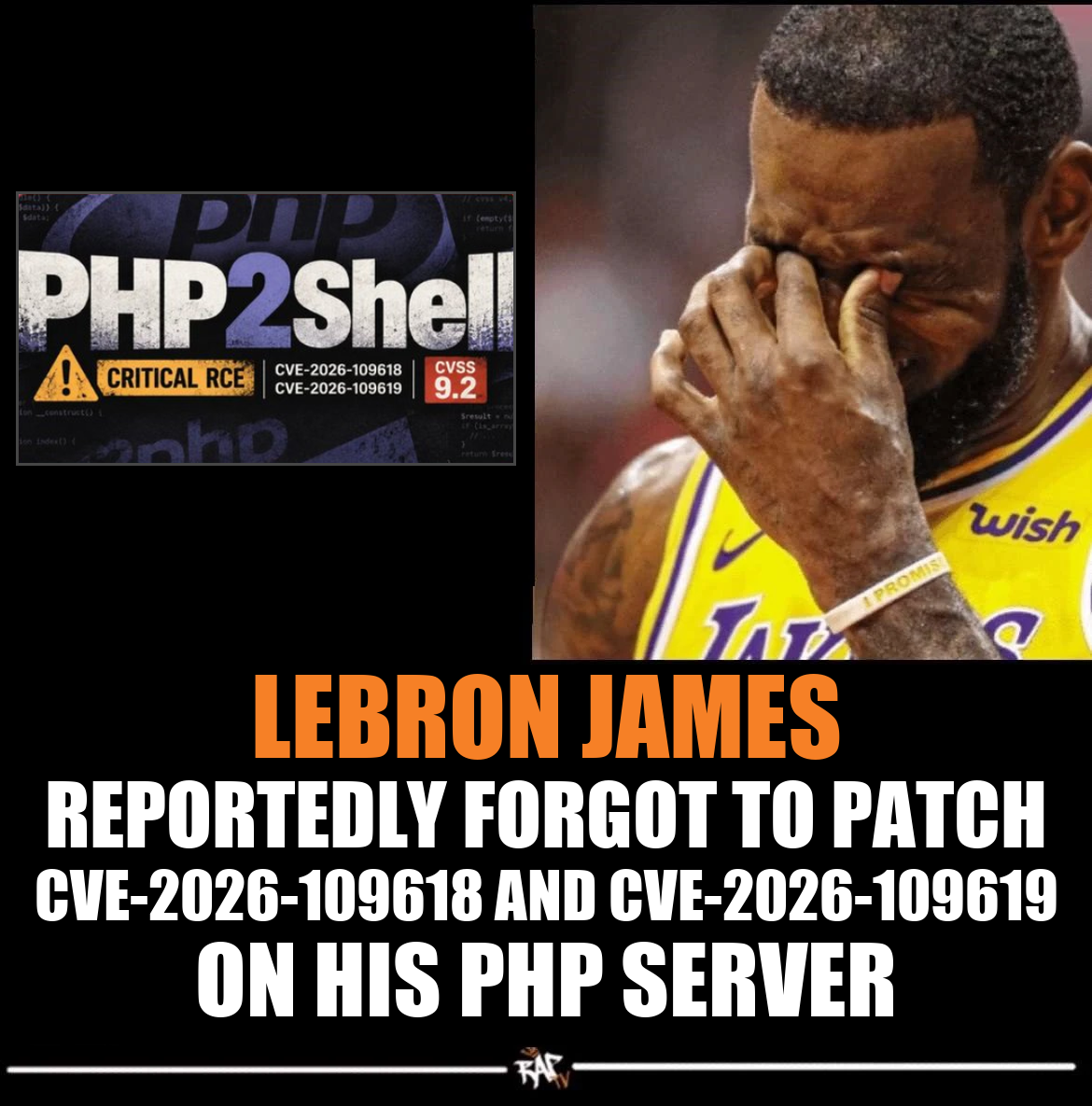
Running a PHP server with two critical RCE vulnerabilities and a CVSS score of 9.2? That's not just dropping the ball—that's launching it into orbit. Even LeBron can't recover from this one. For context: CVSS 9.2 means "you're basically running a server with a neon sign that says 'HACK ME.'" Remote Code Execution vulnerabilities let attackers run whatever code they want on your server. It's like leaving your house keys in the front door with a note saying "valuables inside." The PHP2Shell reference is chef's kiss—a tool literally designed to exploit PHP servers. When your server name matches an exploitation framework, you've transcended regular negligence into performance art.

FLEXISPOT EN2 Whole-Piece Standing Desk with Clamp Power Strip, 55 x 28 Electric Stand Up Height Adjustable Desk with Cable Management (Black Frame + 55" Rustic Brown Desktop, 2 Packages)

FLEXISPOT EN2 Whole-Piece Standing Desk with Clamp Power Strip, 55 x 28 Electric Stand Up Height Adjustable Desk with Cable Management (Black Frame + 55" Rustic Brown Desktop, 2 Packages)
REMOVABLE DESKTOP POWER OUTLET: To ensure you can conveniently charge your electronic devices, the desktop is equipped with 3 power outlets and 2 USB charging ports. It can be clipped to the back or …

We Are Not The Same

We Are Not The Same
The eternal divide between the pragmatists and the masochists. One side uses a managed Linux server because they value their sanity, sleep schedule, and the ability to actually ship features. The other side? They compiled their kernel at 2 AM on a Tuesday, manually configured every firewall rule, and probably named their server something like "Excalibur" because they treat infrastructure like a personality trait. Building from scratch means you've spent 47 hours troubleshooting why SSH won't start, only to discover you forgot to enable the service. But hey, at least you can flex about knowing exactly which version of glibc is running. Meanwhile, the managed server person is on vacation because their deployment takes 3 clicks and they're not emotionally attached to their systemd configuration. Both paths lead to a working server. One just involves significantly more suffering and a superiority complex to match.

Russian Roulette [Commit Strip]

Russian Roulette [Commit Strip]
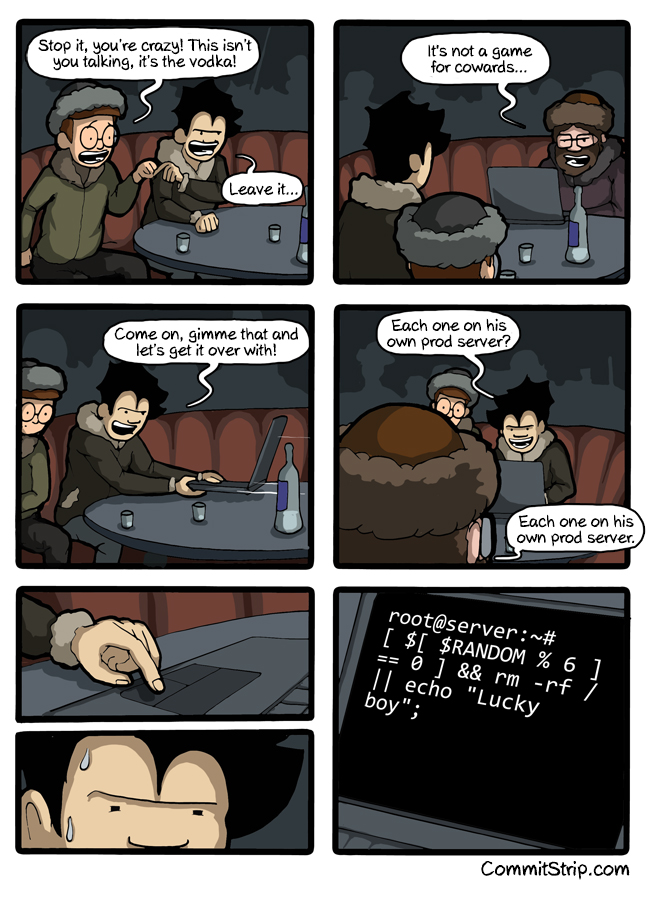
So these absolute madlads are playing drunk Russian Roulette with production servers. The setup? Each dev gets their own prod server, and they're running rm -rf on a random one. The command picks a random number between 0-6, and if it hits their unlucky number, it echoes "Lucky boy" before nuking everything with recursive force delete. The tension builds beautifully - one guy's trying to stop it ("it's the vodka!"), another's goading them on, and the nervous sweat in that final panel says it all. Running destructive commands on production for fun is the kind of career-limiting move that makes for legendary war stories... assuming you survive with your job intact. The fact that they're doing it with root access makes it even more spicy. No backups were consulted in the making of this meme.

Find The Admin

Find The Admin
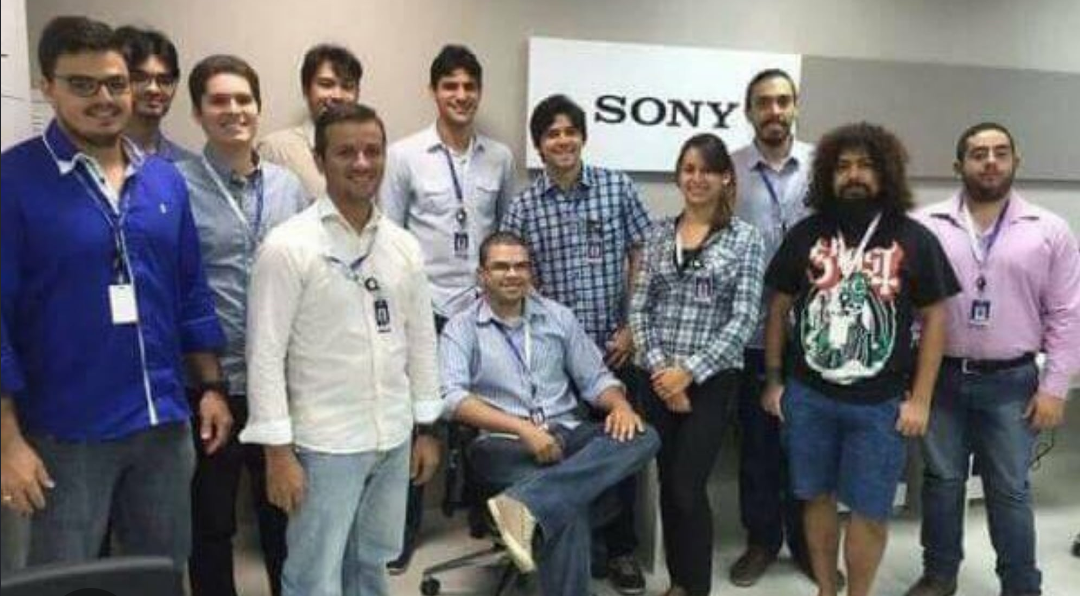
In every corporate office, there's always that one person who looks like they wandered in from a metal concert and somehow ended up with root access to production. While everyone else got the memo about business casual and collared shirts, the admin is rocking a Slayer t-shirt and shorts because when you're the only one who knows the server passwords, dress codes become merely suggestions. The real power in any organization doesn't wear a suit—it wears whatever it wants because HR knows better than to mess with the person who can "accidentally" reset their email password. That's the sysadmin privilege: looking like you just rolled out of bed while holding the entire infrastructure together with duct tape and bash scripts.

Classic Sysadmin Fix

Classic Sysadmin Fix
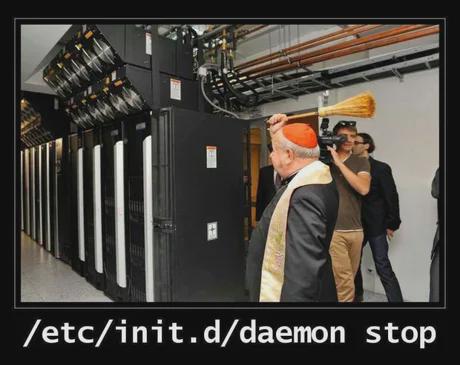
When your production server starts acting up, sometimes the most sophisticated solution is a ceremonial blessing with a broom. The `/etc/init.d/daemon stop` command is how you'd traditionally stop system services on Linux systems (before systemd took over), but apparently this sysadmin has upgraded to the ancient ritual method of troubleshooting. The juxtaposition of enterprise-grade server racks worth hundreds of thousands of dollars and a literal priest performing what appears to be an exorcism perfectly captures the desperation every sysadmin feels when the logs make no sense and Stack Overflow has failed you. At that point, why not try turning it off and blessing it back on again? Fun fact: `/etc/init.d/` is where init scripts live on SysV-style Linux systems. These scripts control daemon processes (background services), hence the filename reference. Though nowadays most distros use systemd, which would be `systemctl stop daemon` - but that's significantly less memeable than invoking divine intervention.

That Hurts A Lot

That Hurts A Lot
Oh, the absolute HORROR of watching your entire production server reboot because your brain decided to betray you at the worst possible moment! You just wanted to gracefully shut down that one service, maybe take a little coffee break, but NOPE—your muscle memory said "restart" and now you're watching everything go down like the Titanic. All your active users? Gone. Your uptime streak? Obliterated. Your soul? Ascending to another dimension as you experience all five stages of grief in 2.5 seconds. The best part? You can't even undo it. You just have to sit there, marinating in your own poor life choices, waiting for everything to come back up while praying nobody noticed the outage. Spoiler alert: they noticed.

Really Upset About Cent Os

Really Upset About Cent Os
When Red Hat pulled the plug on CentOS and pivoted to CentOS Stream, the entire sysadmin community collectively lost their minds. This protest sign captures that rage perfectly—you literally can't spell "hatred" without "Red Hat." For context: CentOS was the free, community-supported version of Red Hat Enterprise Linux that powered half the internet's servers. Then Red Hat decided to kill it off in favor of CentOS Stream (a rolling release that's more of a beta testing ground for RHEL). Thousands of production servers suddenly needed migration plans, and DevOps teams everywhere added "find CentOS alternative" to their 2021 roadmaps. The wordplay here is chef's kiss—taking your corporate betrayal to the streets with a sign that's both clever and seething with justified anger. Rocky Linux and AlmaLinux thank you for your service, angry sign person.

Binary Tree Coding Computer Programmer T-Shirt

Binary Tree Coding Computer Programmer T-Shirt
Computer Programming design. Binary tree made of blue 1s and 0s: binary code art, digital tree and code tree with a root, branches and leaf nodes. Data structures, algorithms, coding and computer sci…

Un-Natural Disasters

Un-Natural Disasters
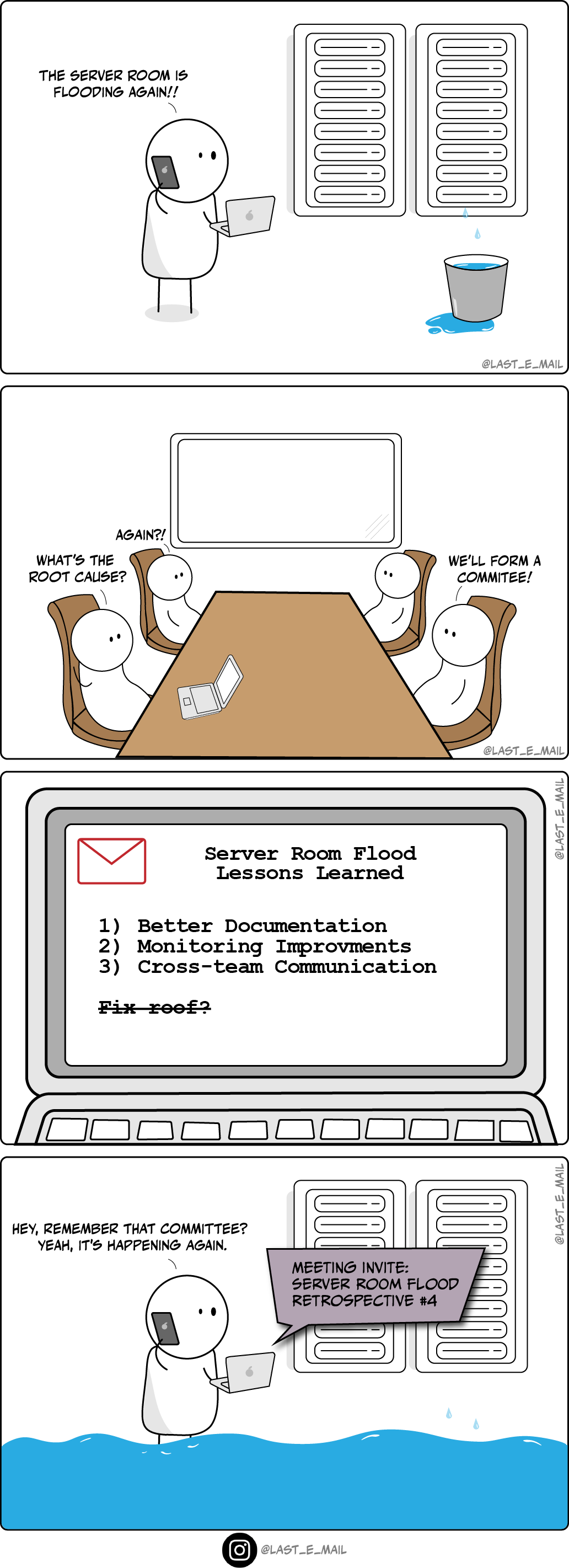
The corporate response cycle in its purest form. Server room floods, everyone panics, forms a committee to discuss root causes, writes up a beautiful "lessons learned" document with all the right buzzwords, then promptly ignores the actual fix because... well, committees don't fix roofs, do they? Notice how "Fix roof?" is crossed out at the bottom of that email. That's not a bug, that's a feature of enterprise culture. Why solve the actual problem when you can have endless retrospectives about it instead? By the time they schedule "Server Room Flood Retrospective #4," the poor guy is literally standing in water again. The real disaster isn't the flood—it's the organizational paralysis that treats symptoms while the bucket keeps overflowing. At least the documentation is getting better though, right?

Systemctl

Systemctl
You know that feeling when someone pronounces it "system-control" all formal and professional in a meeting? Instant cringe. But the moment someone says "system-cuddle" you immediately know they've spent 3am debugging why nginx won't restart and have developed the appropriate coping mechanisms. The duality of Linux sysadmins: pretending to be serious professionals while internally baby-talking to our services. "Who's a good daemon? You are! Yes you are! Now please just start without throwing a cryptic error." Real talk though - after the thousandth time typing systemctl restart , you've earned the right to call it whatever keeps you sane.