

Schema design Memes

Posts tagged with Schema design

All It Has Is A Hammer

All It Has Is A Hammer
When you're desperately trying to explain to Claude AI that your database schema is missing a critical concept, but Claude just keeps slapping JSONB at every single problem like it's the ultimate solution to life, the universe, and everything. Need relational data? JSONB. Need proper normalization? JSONB. Need to store literally anything? Believe it or not, also JSONB. It's giving "when all you have is a hammer, everything looks like a nail" energy, except the hammer is a PostgreSQL data type and the nail is your beautifully architected database that's about to become a glorified document store. Sure, JSONB is flexible and powerful, but maybe—just MAYBE—some things deserve their own proper columns and relationships instead of being yeeted into an unstructured blob of chaos.

Sorry Only One Seventeen Year Old Allowed Per Database

Sorry Only One Seventeen Year Old Allowed Per Database
Day 1 of "vibe coding" and someone already forgot to check if unique constraints are actually necessary. The age field is treating itself like a primary key when it absolutely shouldn't be. Unless you're building a Highlander-themed app where there can be only one 17-year-old in existence, you might want to rethink your database schema. Plot twist: somewhere in production, there's a UNIQUE constraint on the age column, and nobody questioned it during code review. The database is literally saying "sorry kid, position's already filled" to every other teenager trying to sign up. Imagine being the second 17-year-old trying to create an account and getting rejected because someone else had the audacity to be born in the same year as you. Pro tip: Age is not a unique identifier. Neither is "John" or "password123" or your favorite color. Save yourself the embarrassment and use an actual ID field.

One Country One User

One Country One User
When your database schema is so optimized that you're using the country field as a unique identifier. Who needs UUIDs when you can just... limit the entire planet to one user per nation? Someone clearly took "normalization" a bit too literally and decided that countries should have a one-to-one relationship with users. India with 1.4 billion people? Sorry, someone already claimed it. Better luck next reincarnation. Plot twist: The developer probably used country as a primary key thinking "this will never be a problem" and now they're frantically Googling "how to migrate production database without getting fired."

You Know What Would Be Even Funnier

You Know What Would Be Even Funnier
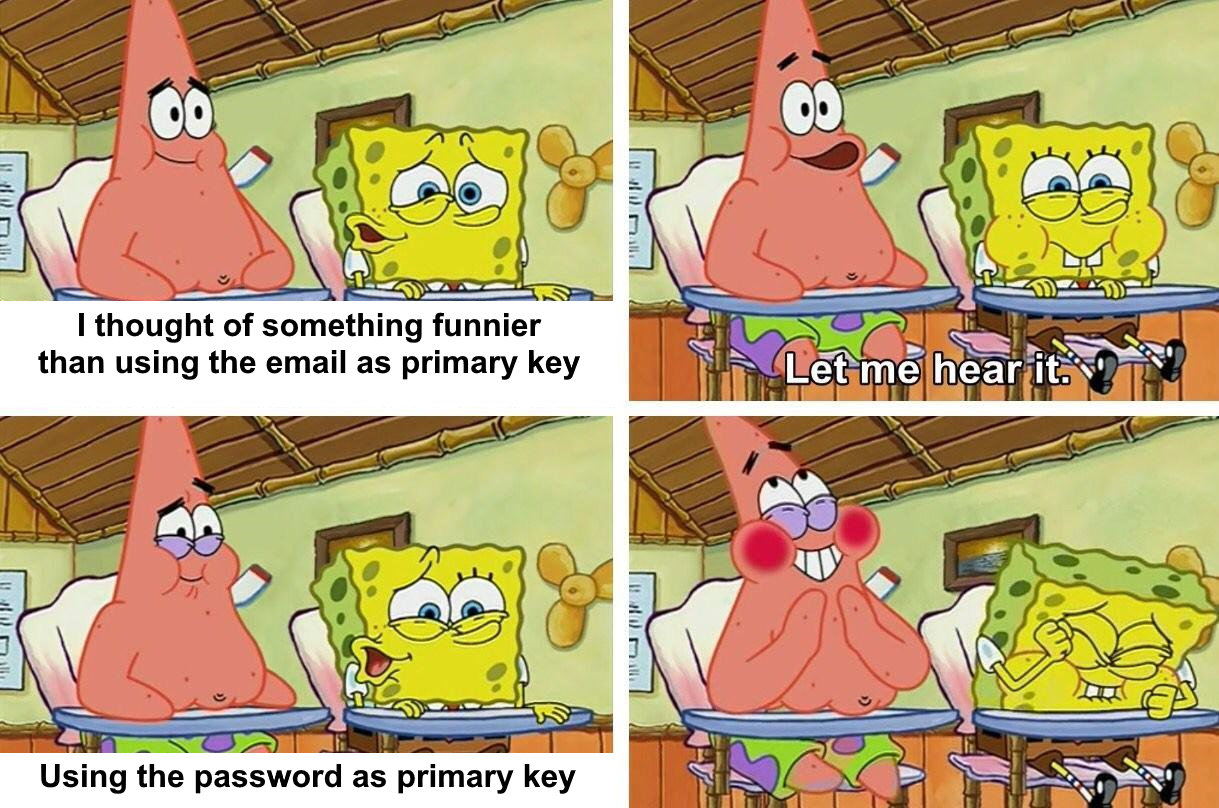
Using email as a primary key is already a terrible idea—what happens when users want to change their email? Cascade updates everywhere, foreign key nightmares, and a database migration that'll haunt your dreams. But sure, let's one-up that disaster by using the password as the primary key. Nothing says "job security through catastrophic technical debt" like having to update every single reference in your database when someone inevitably forgets their password. Also, you'd be storing plaintext passwords, which is basically a resume-building exercise for your next gig after the data breach lawsuit.

Vibe Coders

Vibe Coders
Day 1 of "vibe coding" and you've already hit a database constraint error. Trying to insert age 17 but getting that beautiful "User with this age already exists" message because someone thought making age a unique key was a galaxy brain move. Either their database schema was designed by someone who thinks every 17-year-old is the same person, or they're using age as a primary key instead of, you know, an actual unique identifier like a UUID or auto-incrementing ID. The real crime here isn't the error—it's the database design that allowed this to happen in the first place. Somewhere, a senior dev is crying into their coffee.

What Could Go Wrong

What Could Go Wrong
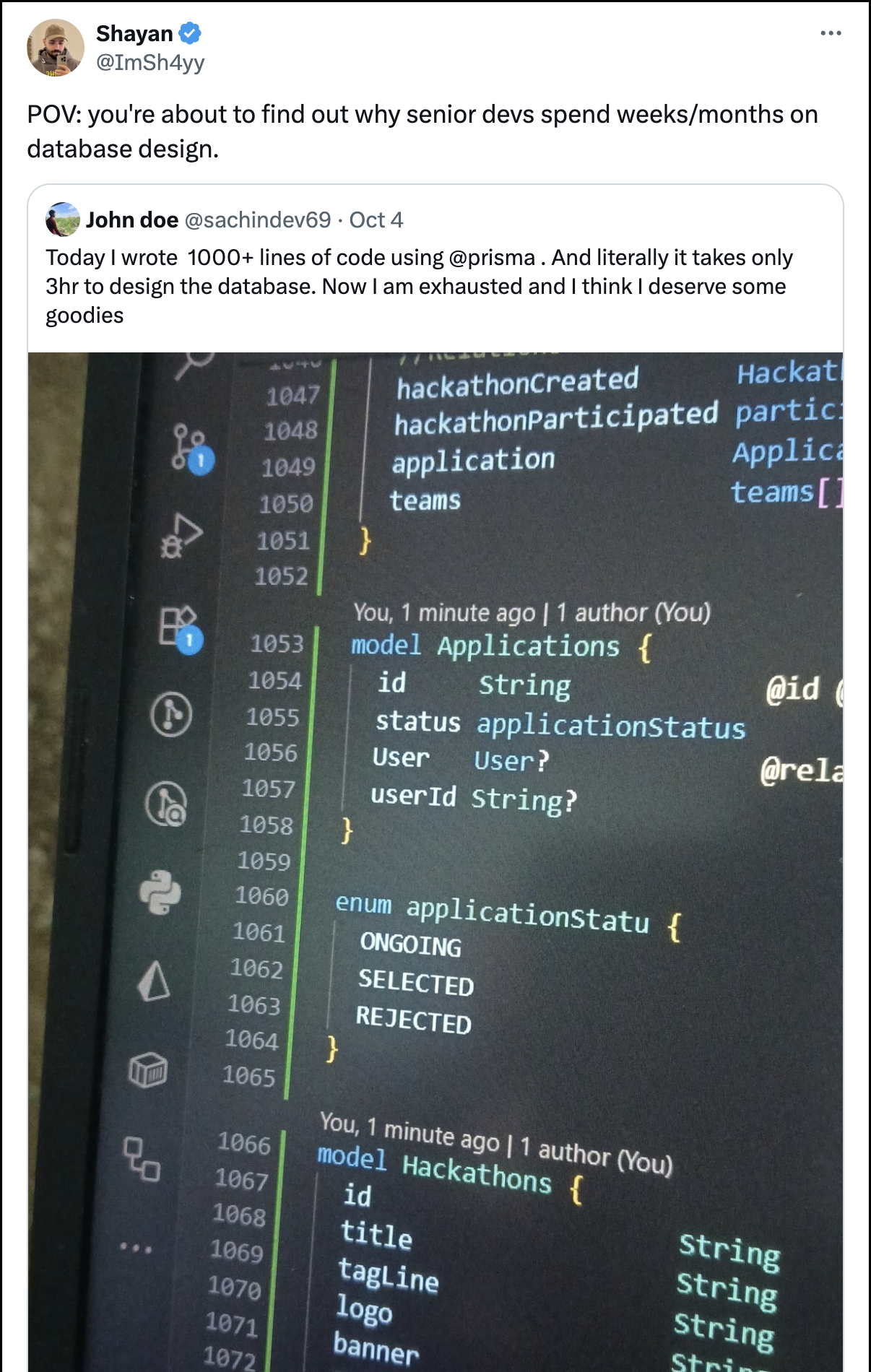
Junior dev: "I designed a database in 3 hours! Give me a medal!" Senior devs: *looking at the schema with User and userId in the same model, nullable fields everywhere, and enums that'll need constant updating* This is why database design takes weeks. The junior's Prisma schema is a ticking time bomb of future migration nightmares, circular dependencies, and queries that'll bring production to its knees when you hit more than 100 users. Six months later, they'll be writing a Medium article titled "How I Survived My First Database Redesign" while the senior devs silently add another gray hair to their collection.

Synology DS223 Home & Office Backup Hub - Centralize Files, Protect Data & Monitor Property (2-Bay Diskless NAS)

Synology DS223 Home & Office Backup Hub - Centralize Files, Protect Data & Monitor Property (2-Bay Diskless NAS)
One Place for All Your Data - Consolidate scattered files from multiple computers, phones and external drives into one accessible hub with 100% ownership · Professional File Collaboration - Share pro…

It Goes Into Postgres

It Goes Into Postgres
Ah, the classic baby shape sorter toy, but make it database . When your data architecture strategy is literally "if it fits, it ships." Junior devs looking at their PostgreSQL database like it's some magical black hole where any data structure can and should go. Who needs schema validation when you have determination and a hammer? PostgreSQL: Technically versatile enough to store your hopes, dreams, and that JSON blob you were too lazy to normalize.

Data Architect Fills In For HR

Data Architect Fills In For HR
When a database architect gets HR access privileges... 💀 Poor Jeffrey just found out he's not VARCHAR(255) compatible. Someone clearly designed their employee table with fixed-width fields and "Jeffrey" has one too many characters for whatever ridiculous constraint they set. This is what happens when you let database purists handle human resources. Next they'll be rejecting candidates because their last names contain SQL-injection risks or their birthdays don't conform to ISO-8601.