

Preprocessor Memes

Posts tagged with Preprocessor
Include Guards

Include Guards
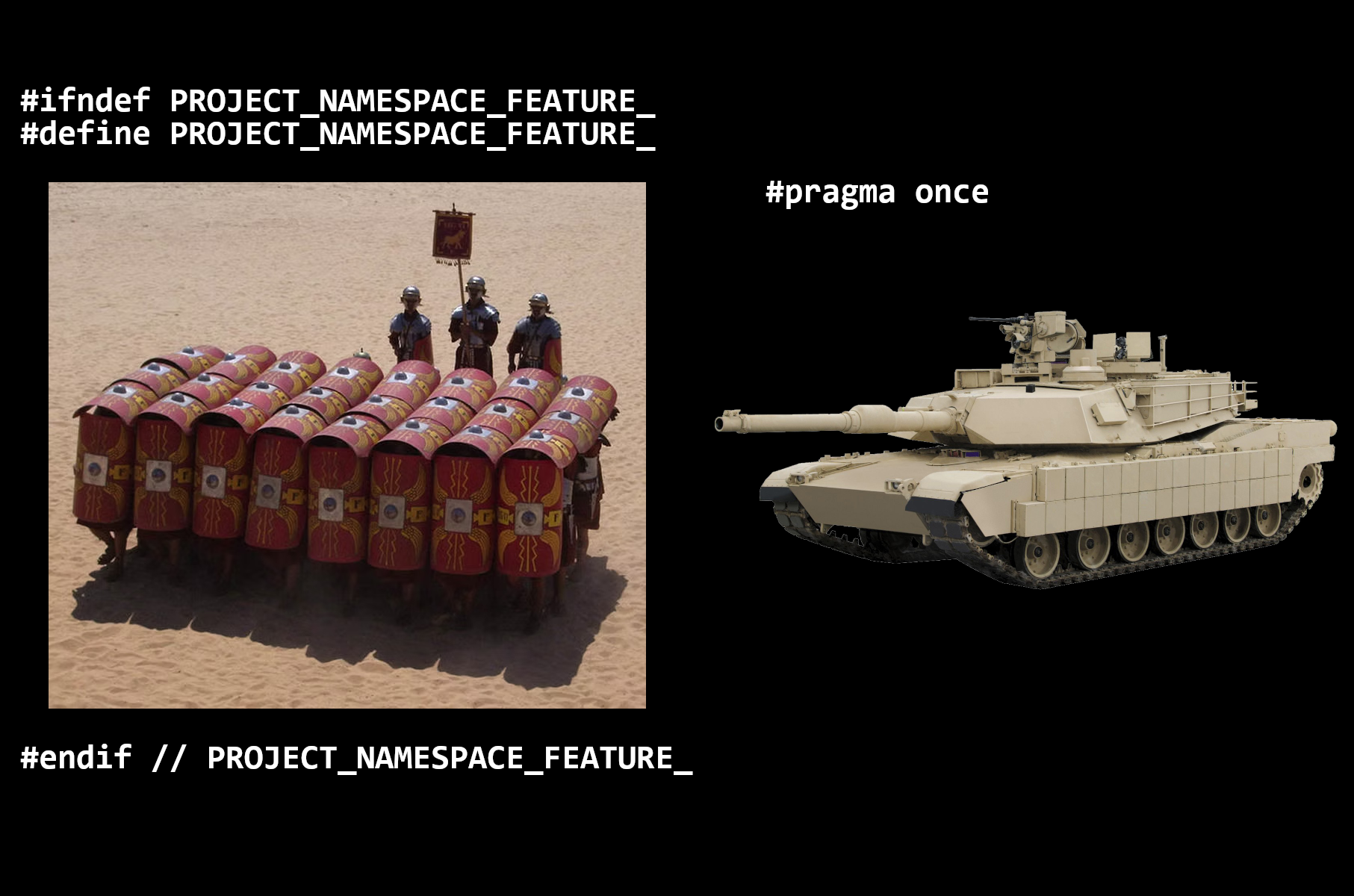
The traditional #ifndef / #define / #endif include guard pattern is basically the Roman testudo formation of C/C++ programming—a bunch of verbose lines working together to protect your header file from being included multiple times. It gets the job done, but requires three whole lines of boilerplate and a carefully crafted unique macro name that you hope nobody else in your codebase accidentally reused. Then comes #pragma once —the modern military tank that just rolls in and does the exact same thing with literally two words. No macro naming conventions to memorize, no closing #endif to forget, no risk of copy-pasting the wrong guard name. Just pure, elegant simplicity. The only reason people still use the traditional guards is for that sweet, sweet portability to compilers from 1987 that nobody actually uses anymore. Meanwhile, #pragma once has been supported by every major compiler for decades and is sitting there like "I could do this all day."

C Plus Plus Or Perhaps Just C

C Plus Plus Or Perhaps Just C
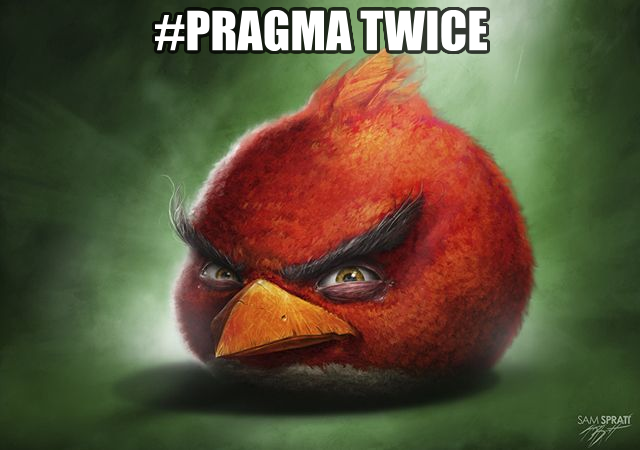
The angry bird is literally "#pragma twice" – a beautifully cursed play on C/C++ preprocessor directives. Instead of the standard #pragma once that prevents header files from being included multiple times, someone decided to go full chaos mode and declare #pragma twice . This would theoretically ensure your header gets included exactly two times, doubling all your definitions, creating duplicate symbol errors, and generally making the linker lose its mind. It's the programming equivalent of "I want my problems in stereo." The angry bird's expression perfectly captures the rage of any compiler trying to process this abomination, or the developer who has to debug why everything is defined twice. Fun fact: #pragma once is actually a non-standard but widely supported directive that's cleaner than traditional include guards, but #pragma twice ? That's just asking for trouble with extra steps.

Just In Case

Just In Case
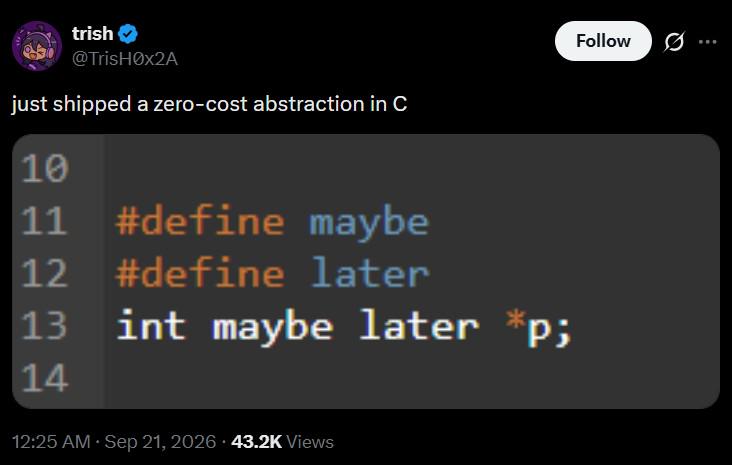
Someone really out here defining maybe and later as preprocessor macros, then declaring a variable called maybe_later with a pointer. The "zero-cost abstraction" is just... procrastination as a language feature. It's like telling the compiler "yeah I'll figure out what this does eventually" but making it sound fancy. The pointer at the end suggests they might actually use it later, or maybe not. Schrödinger's variable declaration right here.

Hello World With Macro In C++

Hello World With Macro In C++
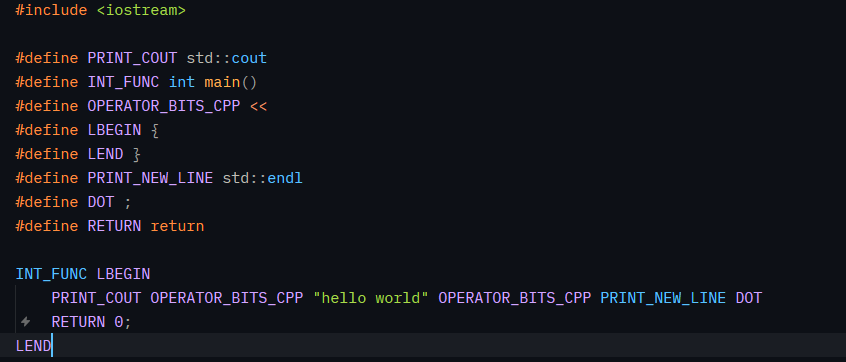
Someone woke up and chose violence. They took the classic "Hello World" program and turned it into a preprocessor nightmare by replacing every single keyword with macros. PRINT_COUT instead of std::cout , INT_FUNC instead of int main() , curly braces replaced with LBEGIN and LEND . It's technically valid C++, compiles just fine, and is absolutely cursed. This is what happens when you give C++ developers too much power and not enough supervision. The preprocessor was a mistake, and this code is Exhibit A. Your coworkers will find you if you commit this to production.

Skill Issue

Skill Issue
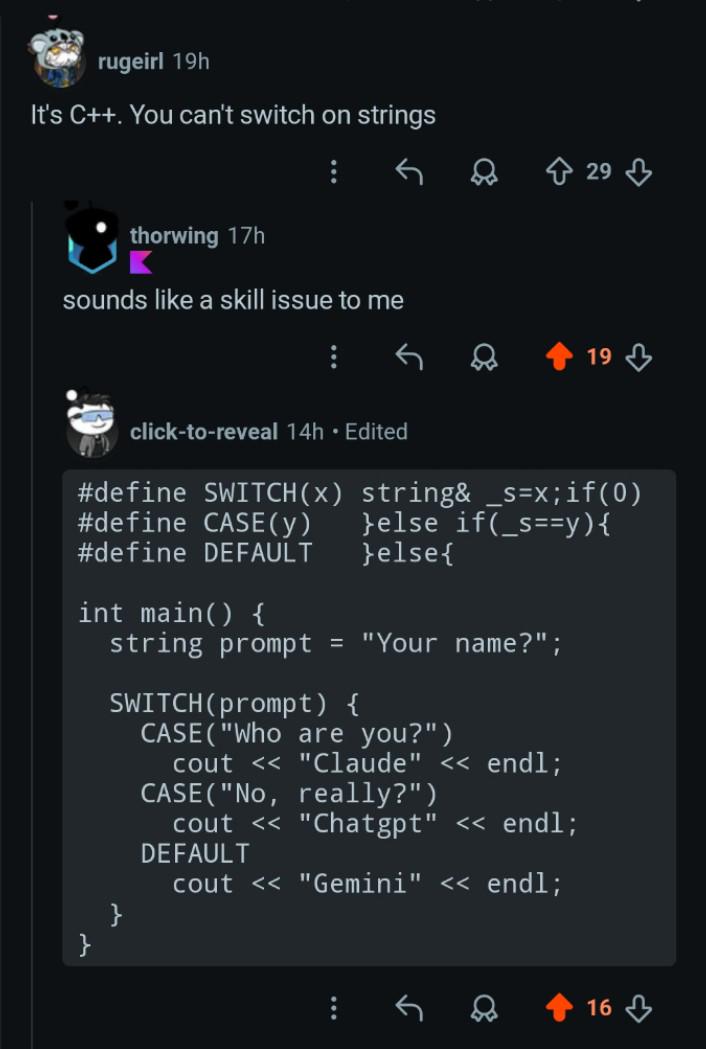
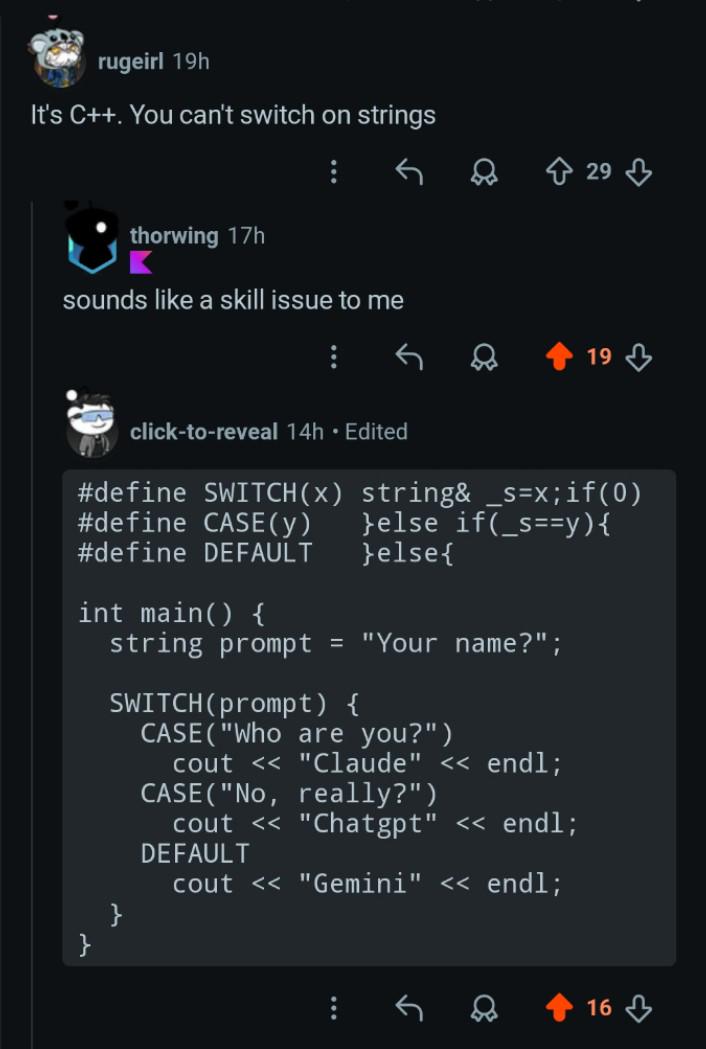
Someone complains that C++ doesn't support switch statements on strings, and the response is the most passive-aggressive "skill issue" I've ever seen. Instead of just accepting this limitation like a normal person, they went full galaxy brain and created preprocessor macros to literally hack switch-on-strings into existence. The macro magic turns SWITCH(prompt) into a glorified if-else chain that looks like a switch statement. It's technically impressive and completely unhinged at the same time. The cases are checking against literal strings like "Who are you?" and "No, really?" with AI chatbot names as outputs (Claude, ChatGPT, Gemini). This is the programming equivalent of being told "you can't do that" and responding by building a Rube Goldberg machine just to prove you technically can. Would anyone actually use this in production? Absolutely not. Is it hilarious? Absolutely yes.

Skill Issue

Skill Issue
Someone complains that C++ doesn't support switch statements on strings. The response? "Sounds like a skill issue to me." And then someone proceeds to absolutely obliterate that excuse by implementing a cursed macro-based workaround that technically makes string switching possible in C++. The preprocessor macros turn SWITCH into a string comparison chain and CASE into conditional checks. It's horrifying, it's beautiful, it's everything wrong and right about C++ at the same time. Sure, you *could* just use if-else statements like a normal person, or a map, or literally any other sane approach. But where's the fun in that? The real flex here is proving that in C++, if the language doesn't give you what you want, you just abuse the preprocessor until reality bends to your will. Skill issue? More like skill *solution*.

Beelink SER3 Mini PC, AMD Ryzen 3 3200U (Up to 3.5GHz), 8GB DDR4 256GB NVMe SSD Dual 4K@60Hz HDMI/ 4xUSB 3.2/ WiFi5/ BT5.0/ Home, Office, School Desktop Computer

Beelink SER3 Mini PC, AMD Ryzen 3 3200U (Up to 3.5GHz), 8GB DDR4 256GB NVMe SSD Dual 4K@60Hz HDMI/ 4xUSB 3.2/ WiFi5/ BT5.0/ Home, Office, School Desktop Computer
[Smooth Daily Multitasking] Model number: SEI, Brand: Beelink, Manufacturer: Shenzhen AZW Technology Co., Ltd., Driven by the AMD Ryzen 3 3200U processor and Radeon Vega 3 Graphics. From organizing d…

Really Enjoying This C Tutorial So Far

Really Enjoying This C Tutorial So Far
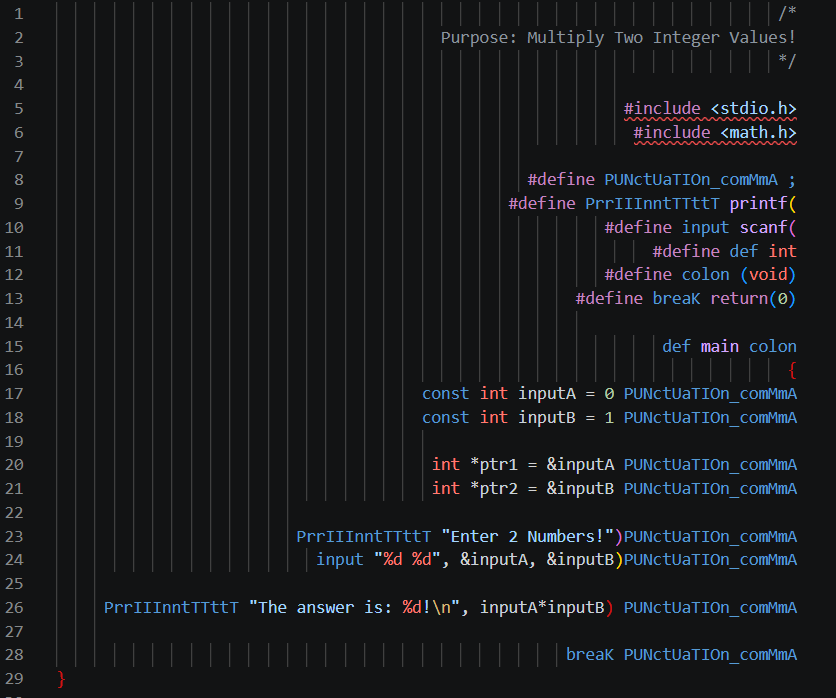
Someone clearly gave up on life and decided to #define EVERY. SINGLE. KEYWORD. into absolute gibberish. Want to print something? Too bad, it's now PrrIIInntTIttT . Need a function? Say hello to PUNctuaTIOn_comMmA . The person writing this tutorial must have been possessed by a demon who feeds on developer tears. The code is technically multiplying two integers, but good luck figuring that out when break is now return(0) and int is def and void is colon . This is what happens when you let chaos itself write educational content. The tutorial author probably cackles maniacally every time a beginner tries to understand why their semicolons are speaking in tongues.

Enterprise Level C Code

Enterprise Level C Code
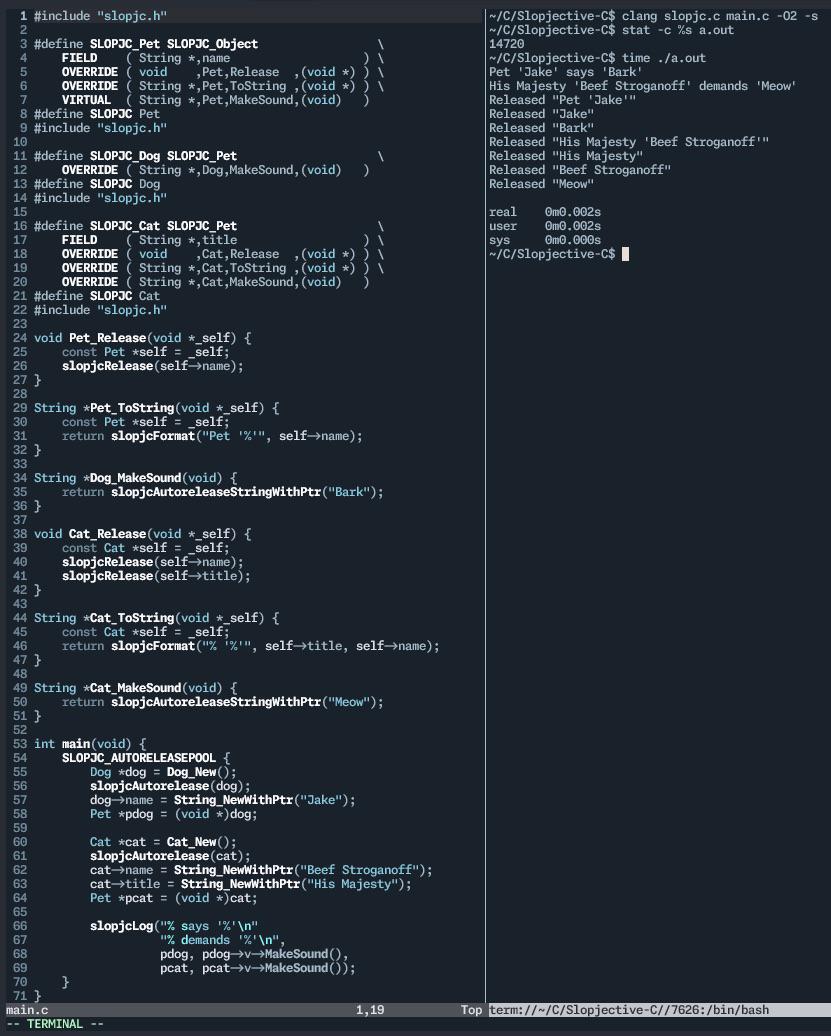
Someone took object-oriented programming principles and decided to implement them in C using macros. Because apparently, C wasn't painful enough already. The code defines "classes" like SLOP3C_Pet, SLOP3C_Dog, and SLOP3C_Cat using preprocessor macros with FIELD, OVERRIDE, and VIRTUAL keywords. It's basically reinventing C++ in C, complete with inheritance and polymorphism, except it's all held together with #define statements and prayer. The execution output shows a dog named "Jake" and a cat named "Beef Stroganoff" (with the title "His Majesty") making their respective sounds. The real kicker? This actually compiles and runs. Someone spent real engineering hours building a janky OOP framework in C when they could've just... used C++. This is what happens when your enterprise architecture committee decides they need object-oriented features but refuses to leave C. Job security through incomprehensibility.

Macros Are Rarely Used

Macros Are Rarely Used
Oh honey, "rarely" is doing some HEAVY lifting here. Someone clearly hasn't opened a legacy C++ codebase where macros breed like rabbits in the preprocessor wilderness. You know what's rare? Finding a C++ project that doesn't have at least seventeen #define statements doing absolutely cursed things to your code before the compiler even sees it. "Rarely" my entire stack trace—those bad boys are EVERYWHERE, turning innocent code into a debugging nightmare faster than you can say "undefined behavior." But sure, let's pretend they're some endangered species when they're actually the cockroaches of the C++ ecosystem: impossible to kill and thriving in the darkest corners of your codebase.

The Macro Demon's Playground

The Macro Demon's Playground
Behold the dark art of macro abuse! This C++ monstrosity redefines every keyword with increasingly longer "a" strings. Want to make the next maintainer question their career choices? Just turn 'main' into 'aaa', 'return' into 'aaaaaaaaa', and watch their soul leave their body during code review. The only thing missing is the maniacal laughter echoing through your open office floor plan as you commit this abomination to the main branch at 4:59 PM on Friday.

Git Commit Push Pray - Version Control Joke Ceramic Mug, Black/White, 15oz

Git Commit Push Pray - Version Control Joke Ceramic Mug, Black/White, 15oz
Dishwasher and microwave-safe for everyday convenience and easy cleanup · Features glossy finish with accent colors on interior, handle, and rim of two-tone designs · Perfect for morning coffee, tea,…

The Great Indentation Rebellion

The Great Indentation Rebellion
Someone finally snapped and created "Bython" - the forbidden Python dialect that replaces whitespace indentation with curly braces. This is basically Python for people who've been traumatized by missing indentation errors. The irony of printing "Python is awesome!" while completely betraying Python's core syntax philosophy is just *chef's kiss*. It's like wearing a "I love vegans" t-shirt to a barbecue competition. The preprocessor part is actually genius though - translating the heretical braces back into proper indentation before Python sees it. It's the programming equivalent of putting ketchup in a fancy bottle so your Italian friend doesn't disown you.

Codebase Roulette: Spin The Wheel Of Pain

Codebase Roulette: Spin The Wheel Of Pain
The ultimate parting gift from a developer with a twisted sense of humor! This masterpiece redefines the word "true" to randomly return false 91% of the time. Just imagine the chaos: functions mysteriously failing, unit tests passing on Friday but failing on Monday, and developers questioning their sanity while debugging phantom issues. It's like planting a time bomb that explodes with confusion. The comment "Happy debugging, suckers" is the digital equivalent of a villain's maniacal laugh while exiting the building in slow motion. Revenge served in C preprocessor directives - cold, efficient, and absolutely diabolical.