node Memes

Ok Well Thanks For Trying

Ok Well Thanks For Trying
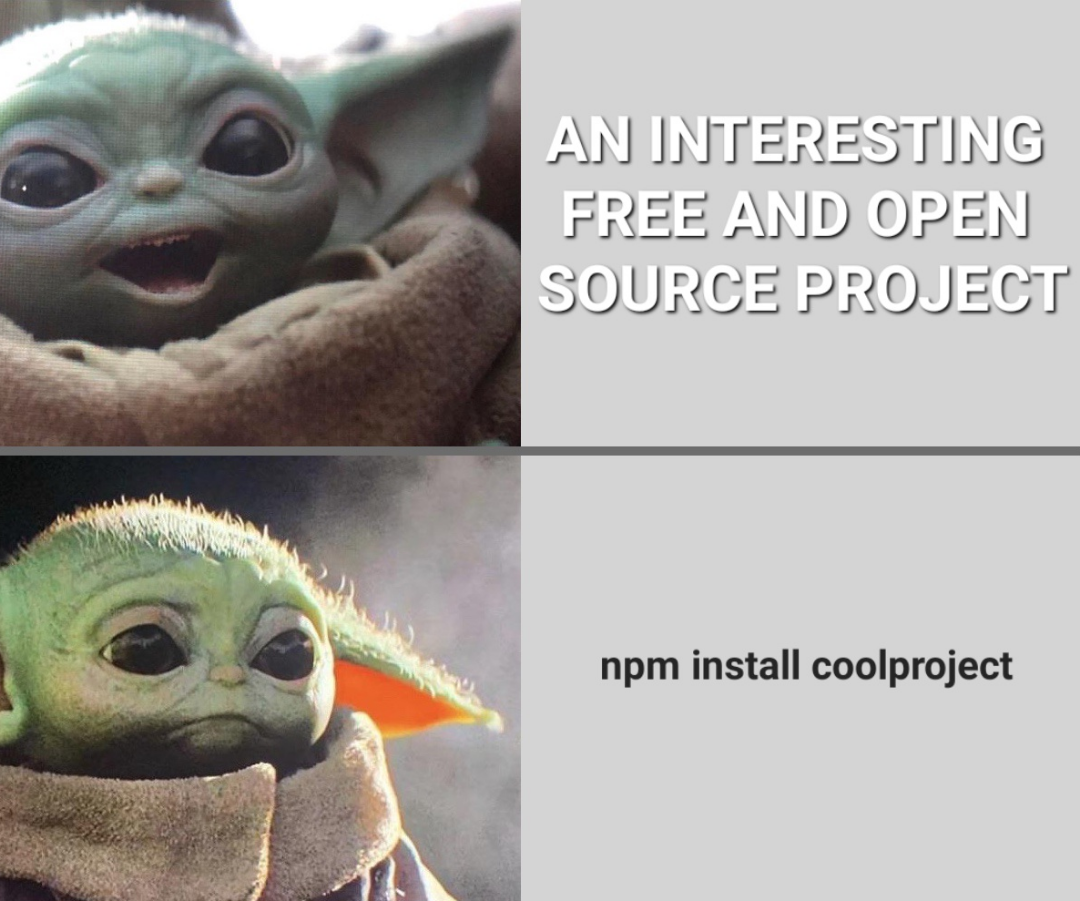
The sheer BETRAYAL when you discover this absolutely gorgeous open source project that could solve all your problems, change your life, and possibly bring world peace... only to run npm install and watch it crumble into a thousand dependency errors like a sandcastle in a tsunami. Nothing quite captures the emotional journey from pure joy to utter despair like Baby Yoda going from adorable excitement to dead-eyed disappointment. You found THE project, the one that does exactly what you need, has a beautiful README, and then... it hasn't been updated since 2019, requires Node 8, and has 47 critical vulnerabilities. Cool cool cool. The worst part? You'll still probably spend the next three hours trying to make it work instead of just writing it yourself from scratch.

Waiting For Zero Days

Waiting For Zero Days
Picture this: It's Christmas Eve, you're cozy by the fireplace, and suddenly you remember you need to install that one npm package for tomorrow's deployment. What could possibly go wrong? Everything. EVERYTHING could go wrong. Because that innocent little package you're installing has decided to bring its entire extended family reunion of dependencies—we're talking hundreds, maybe THOUSANDS of packages flooding into your node_modules like they're storming the Bastille. Your terminal is scrolling faster than a slot machine, and you're just sitting there watching package after package install, each one a potential security vulnerability waiting to ruin your holiday. Meanwhile, Santa's up there on Christmas night, probably also running npm install to manage his naughty/nice list database, experiencing the exact same existential dread. Two forces of nature, united in their shared trauma of dependency hell. The perfect Christmas alliance nobody asked for but everyone in JavaScript land deserves. Fun fact: The average npm package has about 80 dependencies. Merry Christmas, your simple "hello world" app now depends on more code than the Space Shuttle.

I Love Living On The Edge

I Love Living On The Edge
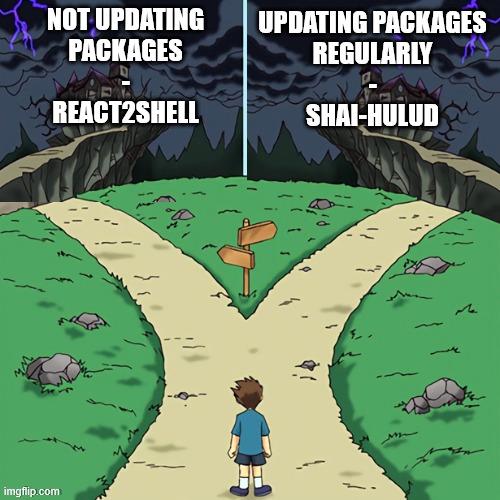
The ultimate developer crossroads: take the left path and risk your entire codebase exploding from ancient vulnerabilities in packages you haven't touched since 2019, or take the right path and watch your build fail spectacularly because some genius decided to push breaking changes in a minor version update. The left side gives you React2Shell vibes—probably running on dependencies so old they remember when jQuery was cool. The right side? Shai-Hulud, the giant sandworm from Dune, representing the chaos that emerges when you run npm update and suddenly 47 things break in production. Both paths lead to pain. Pick your poison: security nightmares or spending your Friday evening debugging why your app suddenly can't find module 'left-pad'.

Absolutely Diabolical

Absolutely Diabolical
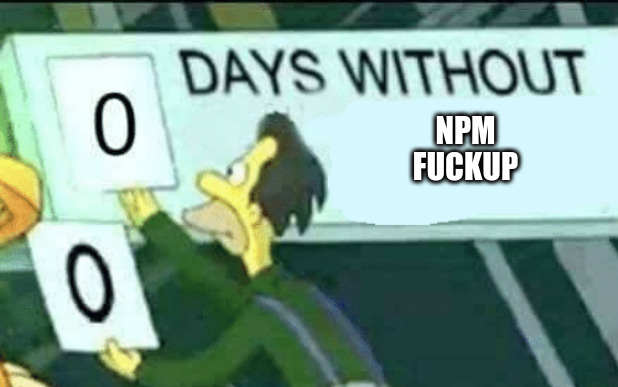
You know that one dev on your team who just wants to watch the world burn? Yeah, they pushed a breaking change to a dependency and reset the "days without npm incident" counter back to zero. Again. The JavaScript ecosystem is held together by duct tape and the prayers of overworked maintainers. One rogue package update and suddenly your entire CI/CD pipeline is screaming at you at 3 AM. The best part? It's always some obscure transitive dependency you didn't even know existed that decides to introduce a breaking change in a patch version. Pro tip: Pin your dependencies. Lock that package-lock.json like your production uptime depends on it. Because it does.

You Have Critical Vulnerabilities

You Have Critical Vulnerabilities
The AUDACITY of npm! You literally just typed npm init and suddenly your pristine, innocent, COMPLETELY EMPTY project is RIDDLED with 17 vulnerabilities?! THE DRAMA! It's like buying a brand new car and immediately getting a notification that your non-existent engine is about to explode. Thanks npm, for giving me trust issues before I've even written a single line of code! The smug cat face is literally all of us trying to smile through the pain while our dependency hell begins before the project even exists. 💀

Npm Install: Summoning The Dependency Demon

Npm Install: Summoning The Dependency Demon
OMG, running npm install is like summoning the DEMON LORD OF DEPENDENCIES from the porcelain throne! 🚽👹 One second you're innocently trying to install a tiny package, and the next your toilet is LITERALLY ERUPTING with hellfire and 37,582 packages you never asked for! And there you are, cowering in the corner, questioning your life choices while your node_modules folder grows large enough to achieve sentience and apply for its own zip code! THE HORROR!

This Dependency Graph Is Giving Me Flashbacks To My Node Modules Folder

This Dependency Graph Is Giving Me Flashbacks To My Node Modules Folder
Content Ambience Healthcare Harvey Al Anysphere Microsoft $3.97 Nebius OpenAl $500B CoreWeave OpenAl to déploy 6 Nvidia agrees gigawatts of AMD GPUs. to invest up to AMD gives OpenAl $100 billion in option to buy up to 160 million shares. OpenAl. Intel AMD " Nvidia $4.5T Oracle spends tens of billions on Nvidia chips. openAl inks a $300 billion cloud deal with Oracle. Nscale Mistral Figure Al Oracle XAl

When You Run Npm Install After 6 Months

When You Run Npm Install After 6 Months
Opening that dusty project after half a year and running npm install is like unleashing ancient demons from a portal to dependency hell. Six months is enough time for half your packages to become "deprecated," three to have "breaking changes," and at least one to be completely abandoned by its creator who's now living off-grid in Montana. The toilet isn't just flushing your code—it's summoning an eldritch horror of conflicting versions and peer dependency warnings that would make Cthulhu weep. And you're just standing there, watching your terminal vomit red text while contemplating your life choices.

Added "Security"

Added "Security"
Ah yes, the pinnacle of security: "Let me just ask this AI if your SQL injection attack looks suspicious." It's like putting a security guard at the bank entrance who needs to call his mom before deciding if the guy in the ski mask with a gun is a threat. The best part is storing the DB credentials right there in plain text. Nothing says "enterprise-grade security" like exposing your entire database to anyone who can read code.

Stop Over Engineering (And Start Over Exploiting)

Stop Over Engineering (And Start Over Exploiting)
Nothing says "I trust my users completely" like letting them run raw SQL queries directly against your production database. This code is basically saying "Here's the keys to my database kingdom, please don't DELETE FROM users WHERE 1=1." It's the digital equivalent of leaving your front door wide open with a sign that says "Please don't steal anything." Security teams everywhere just felt a disturbance in the force, as if millions of injection vulnerabilities suddenly cried out in terror.

Please Don't Install Malware Using NPM

Please Don't Install Malware Using NPM
Ah yes, the JavaScript ecosystem's finest moment: people literally typing npm i malware and hitting enter. The package is 9 years old, hasn't been updated since, and somehow still claims 12 victims weekly. This is why we can't have nice things in the npm registry. Some dev probably thought "surely nobody would be dumb enough to install something LITERALLY called malware" and yet here we are, with a steady heartbeat on that download graph. Those 12 weekly downloads are either security researchers, extremely curious cats with disposable VMs, or the same intern who keeps running rm -rf / "just to see what happens."

If Anything Can Be Written In JavaScript

If Anything Can Be Written In JavaScript
The ultimate cosmic horror for system admins everywhere. Galactus, devourer of worlds, has demands that would make Cthulhu shudder: rewriting the Linux kernel in JavaScript. Just imagine - your mission-critical infrastructure running on a language where [] + [] equals an empty string and [] + {} equals "[object Object]". The kernel panics would be replaced with "undefined is not a function" and your uptime would be measured in milliseconds. No wonder they couldn't negotiate. Some prices are too high, even for the survival of humanity.