

Mainframe Memes

Posts tagged with Mainframe

Spaghetti Anyone

Spaghetti Anyone
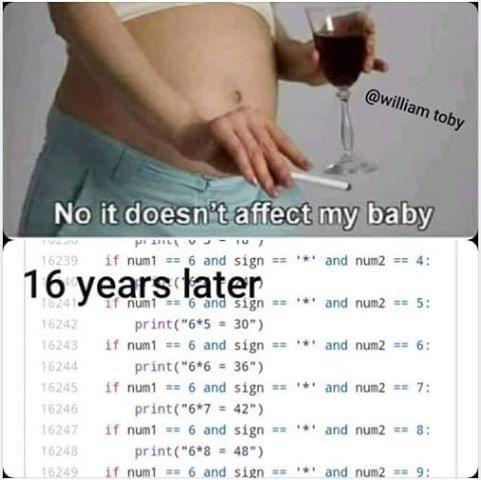
COBOL, the language that's been around since 1959 and somehow still runs critical banking systems worldwide. The title "Spaghetti Anyone" is chef's kiss because COBOL is basically the OG spaghetti code generator—those GOTO statements and nested IF-THEN-ELSE blocks create such tangled messes that even the original programmer needs a map to navigate their own code. The innocent excitement here is hilarious because anyone who's actually worked with COBOL knows it's like voluntarily choosing to debug assembly language while wearing oven mitts. Fun fact: during the Y2K crisis and again in 2020 when unemployment systems crashed, governments literally had to beg retired COBOL programmers to come back because nobody under 60 knows this ancient tongue anymore. That excitement is about to turn into existential dread real quick.

He Said The Pay Is Good

He Said The Pay Is Good
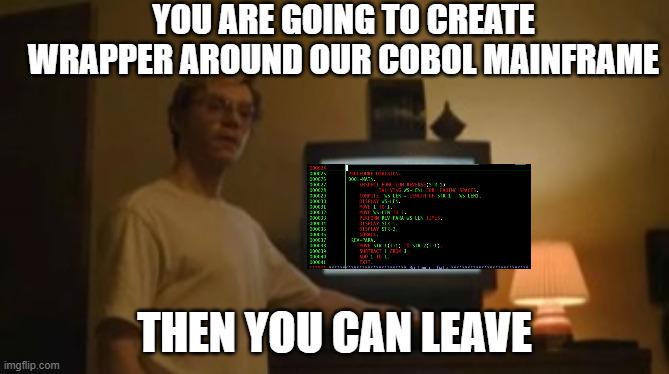
Nothing screams "danger pay" quite like being told you'll be wrapping a COBOL mainframe system. For context, COBOL is a language from 1959 that's still running critical banking and government systems because nobody dares touch them. Creating a wrapper means you're building a modern interface around ancient, undocumented spaghetti code that predates the moon landing. The "then you can leave" energy is perfect because this is genuinely one of those nightmare scenarios where the compensation better be astronomical. You're essentially being asked to become an archaeologist, translator, and diplomat all at once—deciphering cryptic business logic written by programmers who are probably retired (or worse, still maintaining it). The code comments? Non-existent. The documentation? "Ask Jerry, but he left in 1987." Fun fact: COBOL still powers about 43% of banking systems and processes roughly 95% of ATM transactions. So yeah, the pay should be good, because you're literally keeping civilization's financial infrastructure from collapsing.

The Todo That Outlived Its Author

The Todo That Outlived Its Author
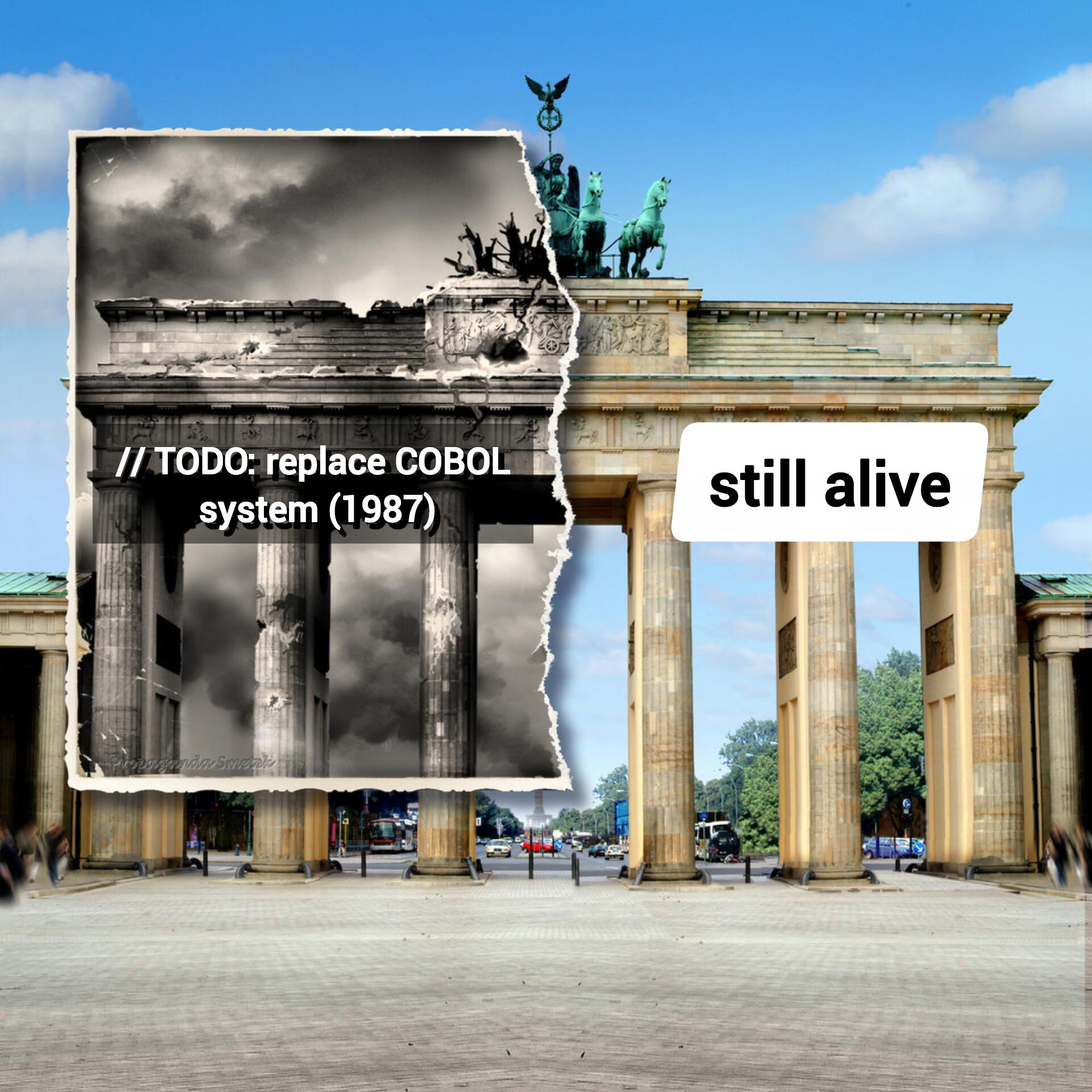
Nothing says "legacy code" quite like a TODO comment from 1987 asking you to replace a COBOL system. The programmer who wrote that comment? Probably retired to a beach somewhere in 2005. The COBOL system? Still chugging along like it's got something to prove. Banks and financial institutions are basically archaeological sites at this point. Somewhere deep in their infrastructure, there's a COBOL mainframe handling billions of dollars in transactions, held together by duct tape, prayers, and the three remaining people on Earth who can read the code. That TODO comment has watched empires fall, the internet rise, and JavaScript frameworks come and go every 3 months. The best part? Nobody's touching it. Why? Because it works. And in programming, "if it ain't broke, don't fix it" is less of a guideline and more of a survival instinct. That COBOL system will probably outlive us all.

Got Tired Of React… So I Tried Going Back To Cobol

Got Tired Of React… So I Tried Going Back To Cobol
When the React fatigue hits so hard you're seriously considering mainframe development from 1959. Nothing says "I'm done with JavaScript framework churn" quite like eyeing a language that predates the moon landing. The irony? COBOL devs are actually in crazy demand because banks still run on code older than most developers' parents. Meanwhile React just released its 47th breaking change this week and you're debugging why useEffect fired twice on mount again. But let's be real—the guy's girlfriend (React) is right there looking perfect, and he's still distracted by COBOL's... dinosaur logo? That's the developer life: always wondering if the grass is greener with some ancient enterprise technology that pays $200/hour to maintain legacy banking systems.

Calyders 500 PCS Cute Small Business Thank You Stickers, Repeat Customer Favorites, Packaging & Shipping Stickers for Online Retailers

Calyders 500 PCS Cute Small Business Thank You Stickers, Repeat Customer Favorites, Packaging & Shipping Stickers for Online Retailers
SUFFICIENT QUANTITY: - You will get 500 pieces of irregular gift stickers in total. Premium quantity to meet your daily creative, custom gifts, and handmade for different business. · EASY TO TEAR AND…

Cobol Post

Cobol Post
While everyone's out here fighting over whether React is better than Vue, or if Rust will replace C++, or debating the merits of microservices versus monoliths, there's a silent army of COBOL developers quietly cashing checks that would make a FAANG engineer jealous. Born in 1959, COBOL is literally older than most programming paradigms we argue about today. Yet it still runs 95% of ATM transactions and processes about $3 trillion in commerce daily. Banks, insurance companies, and government agencies are desperate for COBOL devs because nobody learns it anymore—supply and demand at its finest. So while the tech bros are having a royal rumble about the hottest new JavaScript framework that'll be obsolete in 6 months, COBOL devs are just vibing, maintaining legacy systems, and getting paid premium rates to touch code that's been running longer than they've been alive. Job security? Try career immortality .

Cobol Post

Cobol Post
While everyone's fighting over whether React is better than Vue or if TypeScript is worth the hassle, COBOL developers are just sitting there eating their lunch, completely unbothered, making six figures maintaining banking systems from 1972. The language is older than most developers' parents, yet it still runs 95% of ATM transactions and 80% of in-person transactions. Banks literally can't find enough COBOL programmers, so they're paying obscene amounts to anyone who knows it. Meanwhile, the rest of us are rewriting our apps in the framework-of-the-month for the third time this year. Job security? More like job immortality. Those mainframes aren't going anywhere.

It's Not Exactly What It Seems Like With Old Tech

It's Not Exactly What It Seems Like With Old Tech
While everyone's out here having a full-blown brawl over React vs Vue, microservices vs monoliths, and whether tabs or spaces will end civilization, there's some guy peacefully eating his lunch while maintaining a COBOL system that's been running since before the internet had opinions. The real kicker? That COBOL dev is probably making bank because there are like 12 people left on Earth who know how to maintain those ancient mainframes that still process 95% of ATM transactions and credit card swaps. Banks literally can't afford to let these systems die, so they're stuck paying premium rates for developers who learned programming when punch cards were still a thing. Meanwhile, the "modern stack" crowd is too busy fighting about which JavaScript framework will be obsolete next Tuesday to notice they're reinventing the wheel for the 47th time this year. Job security? That COBOL dev has it in spades while the rest of us are one npm audit away from an existential crisis.

I Am Not Ready For This!!

I Am Not Ready For This!!
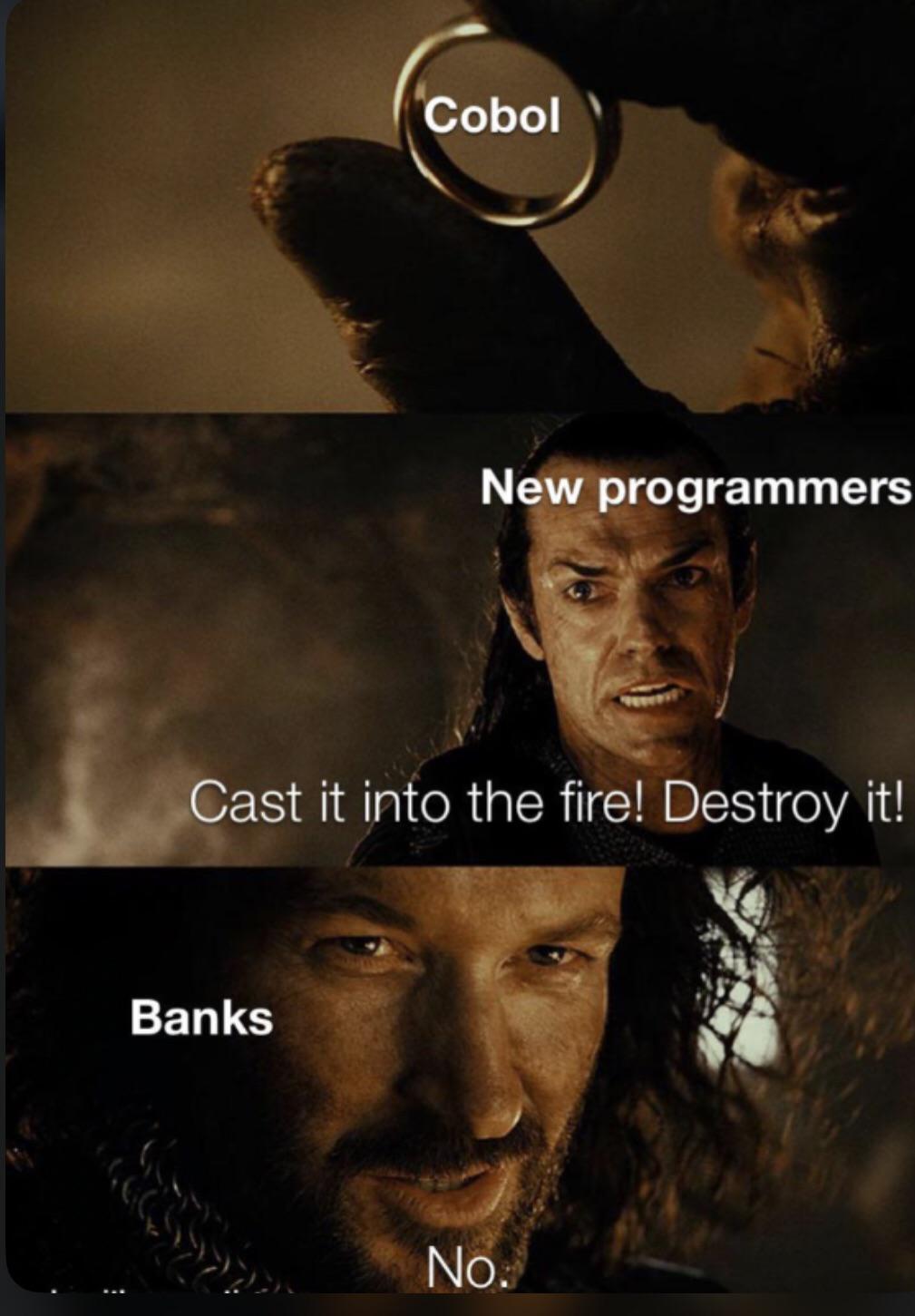
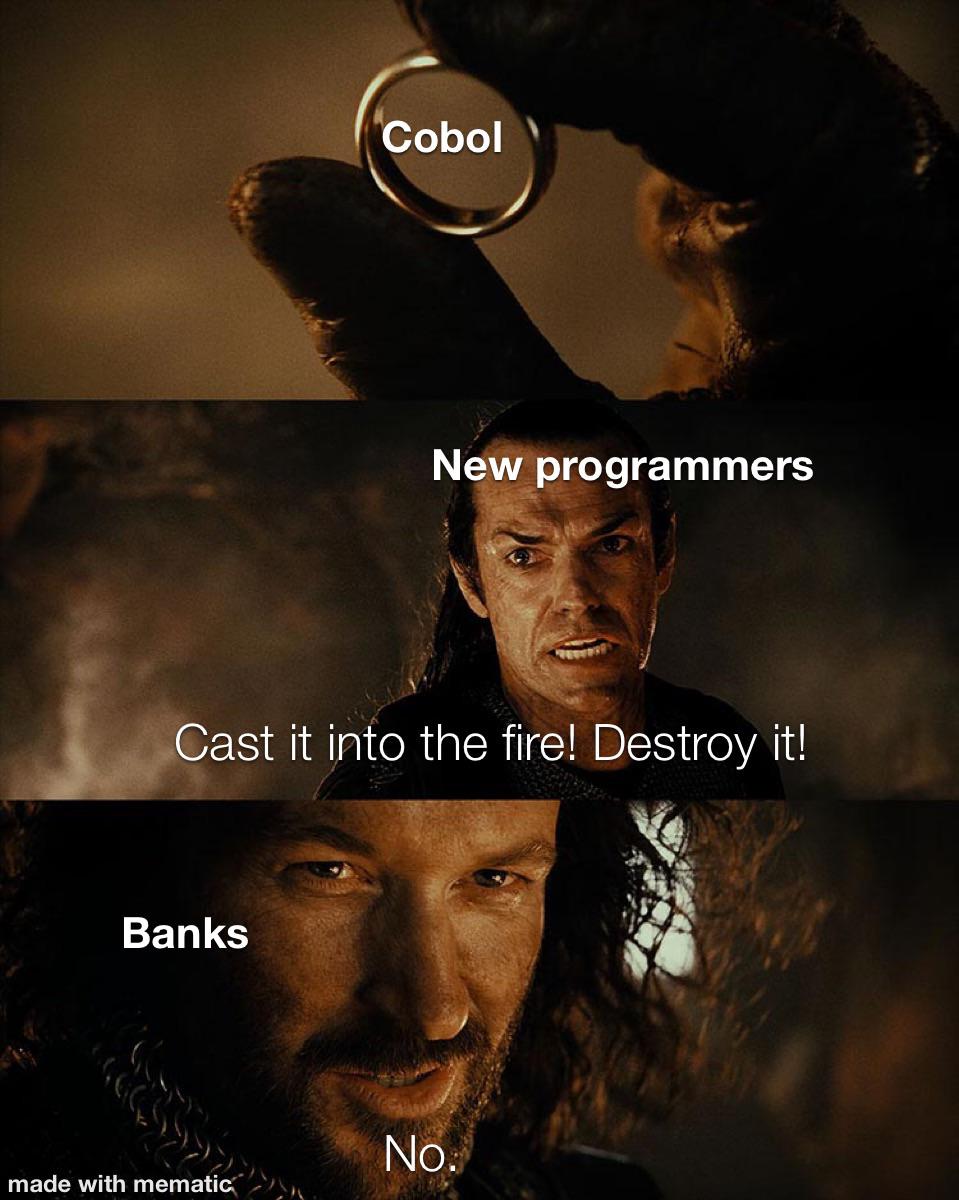
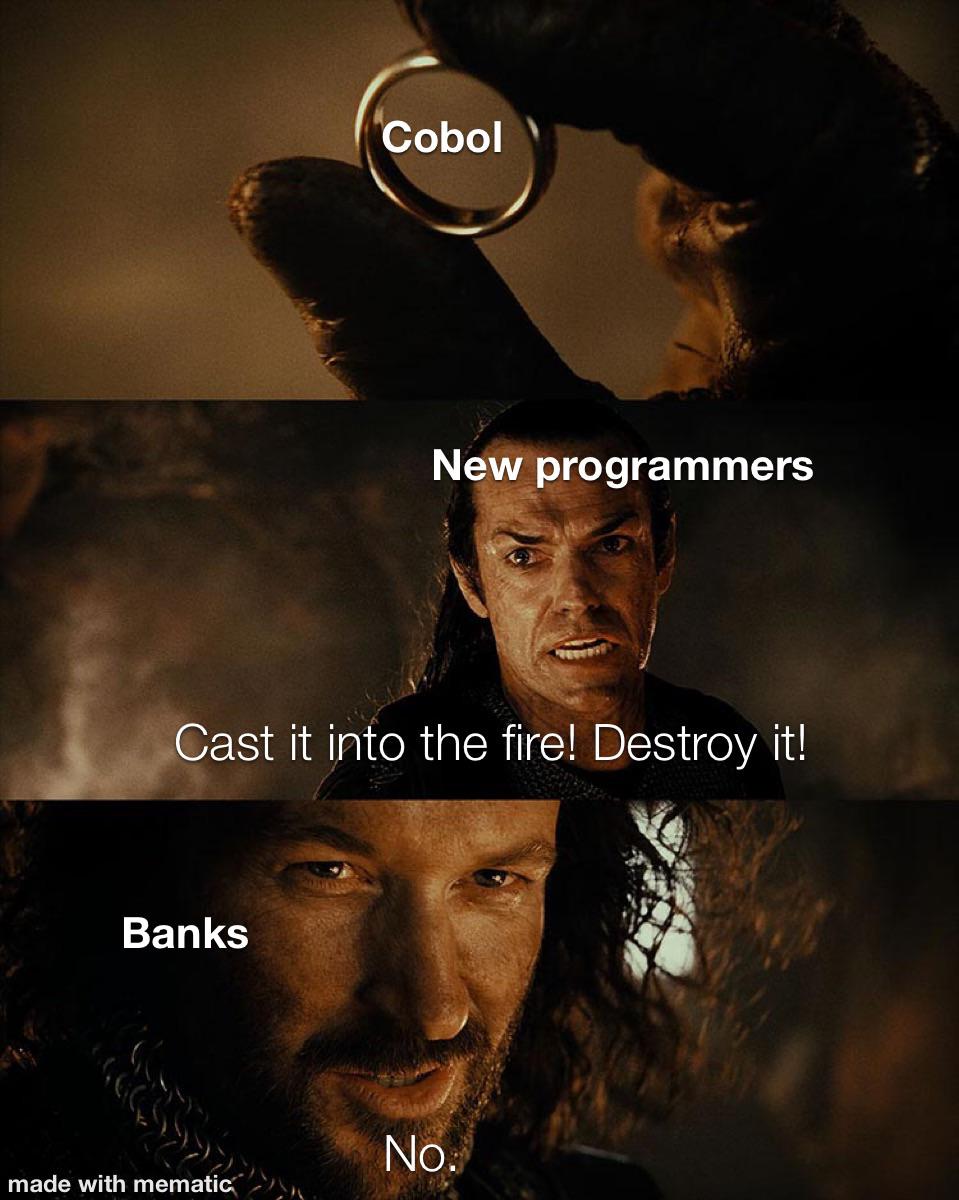
When you're fresh out of bootcamp learning React and TypeScript, then someone casually mentions COBOL and you're like "what's that?" only to watch senior devs collectively lose their minds. For context: COBOL (Common Business-Oriented Language) was created in 1959 and is still running critical banking systems, insurance companies, and government infrastructure worldwide. We're talking billions of transactions daily on code older than your parents. The problem? Nobody wants to learn it, everyone who knows it is retiring, and banks are desperately clinging to these systems because rewriting them would be like performing open-heart surgery on a patient running a marathon. New programmers see it as ancient history that should be extinct. Banks see it as the immovable foundation of global finance that cannot be destroyed without triggering financial apocalypse. The cognitive dissonance is *chef's kiss*. Fun fact: There are an estimated 220 billion lines of COBOL still in production today. That's roughly 43% of all banking systems. Sleep tight! 💀

Banks Love COBOL

Banks Love COBOL
The entire financial world runs on COBOL code written when dinosaurs roamed the earth. New programmers see this ancient language and want it burned at the stake, but banks cling to it like Gollum with the precious ring. Why rewrite millions of lines of working code when you can just pay COBOL developers obscene amounts of money instead? The banking industry's motto: "If it's broken enough to work for 60 years, don't fix it."

Cobol: The One Ring Of Banking

Cobol: The One Ring Of Banking
Young devs want to burn COBOL with fire, but banks cling to it like Gollum's precious. Why? Because those 60-year-old mainframes still process $3 trillion in daily transactions . Try migrating that legacy code and watch your career evaporate faster than VC funding in a recession. The ultimate job security isn't knowing the latest JavaScript framework—it's being the last person alive who remembers how to maintain that ancient COBOL system nobody dares to replace.

Multigenerational Tech Debt

Multigenerational Tech Debt
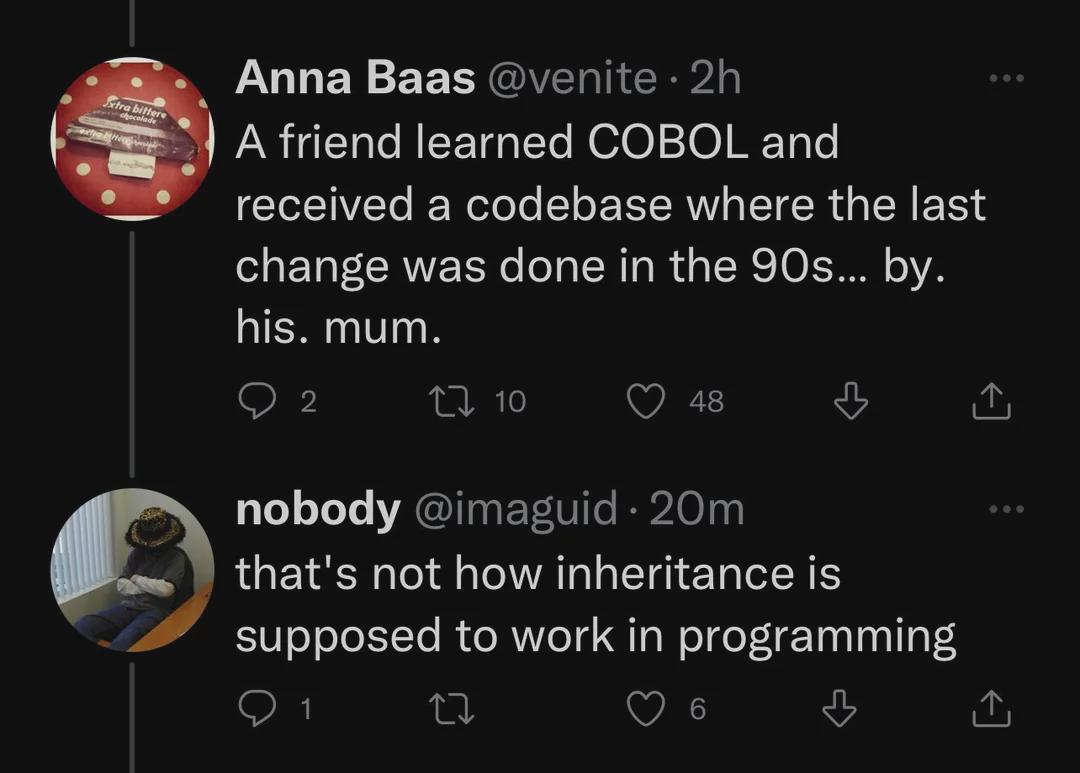
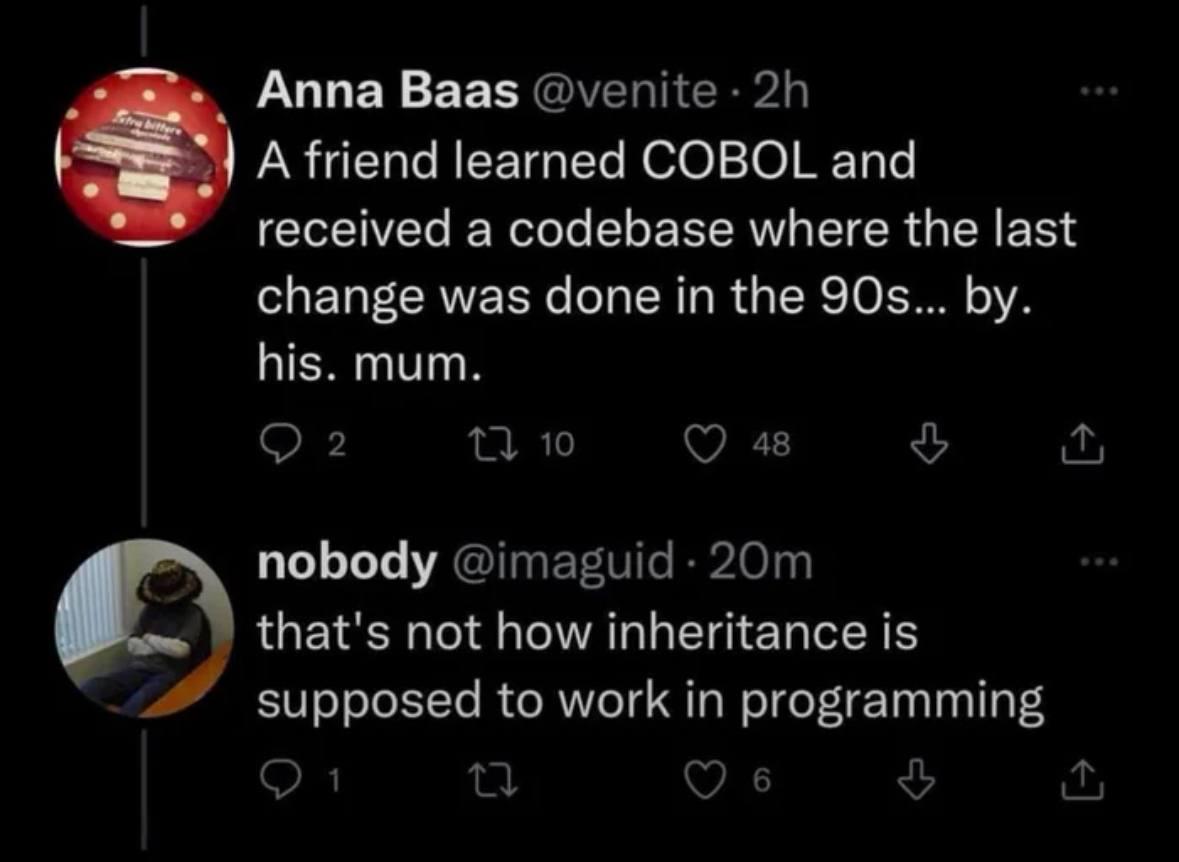
The true family business - legacy COBOL code! Someone's friend just inherited a codebase last touched by mom in the 90s, while the reply cleverly points out this isn't the kind of inheritance pattern they teach in CS class. Nothing says job security like maintaining 30-year-old code written by your actual parent. The family that codes together, stays locked in maintenance hell together. If your resume says "COBOL" in 2023, banks are already throwing money at you while sobbing uncontrollably.

NordVPN

NordVPN
Encrypt your traffic on public Wi-Fi, stream from anywhere, and cover up to ten devices with one plan. 30-day money-back guarantee.

Inherit Tense: When Family Trees Meet Inheritance Trees

Inherit Tense: When Family Trees Meet Inheritance Trees
Two types of inheritance in the wild: OOP inheritance where classes inherit properties, and then there's the family kind where you inherit legacy COBOL code last touched by someone's mother in the 90s. Talk about technical debt with actual family drama! This poor soul didn't just inherit methods and properties—they inherited decades-old spaghetti code with a side of maternal guilt. And somewhere, a CS professor is crying because this is definitely not what they meant by "parent-child relationships" in class diagrams.