

Literal interpretation Memes

Posts tagged with Literal interpretation

Embedded Python

Embedded Python
Someone took the term "embedded Python" way too literally and decided to knit a Python snake into existence. Because why write Python code for microcontrollers when you can just... embed an actual python in fabric? The craftsmanship is honestly impressive though. While most of us are struggling to embed Python interpreters into resource-constrained devices, someone out here is embedding pythons into sweaters. Different kind of memory constraints, I suppose – one uses RAM, the other uses yarn. Props to whoever made this. It's the most wholesome interpretation of embedded systems I've ever seen, and it probably has fewer dependency issues than actual Python projects.

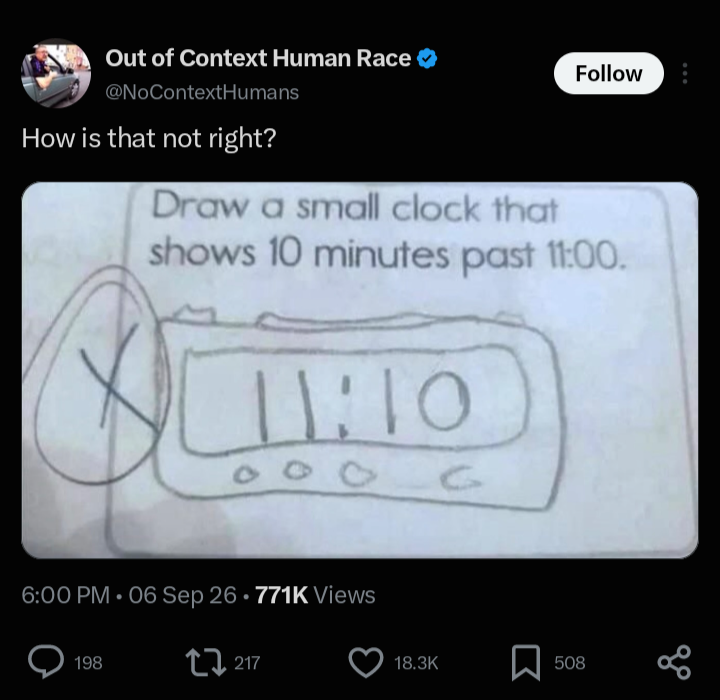
The Kid Should Be A Programmer

The Kid Should Be A Programmer
Oh honey, the kid GETS IT. When asked to draw a clock showing 10 minutes past 11:00, they just went full digital mode and drew "11:10" on a screen. Technically correct? Absolutely. What the teacher wanted? Probably not. But here's the thing - why waste time drawing those fancy analog clock hands when you can just display the raw data? That's peak efficiency right there! The teacher is probably having an existential crisis wondering if they need to specify "analog clock" in their instructions now, but honestly? The kid just solved the problem using the most straightforward implementation. No unnecessary complexity, no fancy UI elements - just pure, unfiltered time representation. Someone get this child a keyboard and a stack of programming books because they're already thinking like a developer who's been burned by over-engineered solutions one too many times.

Def Hssss():

Def Hssss():
So you took the advice literally and decided to have a conversation with a python. Bold move. I respect the dedication, but maybe they meant talking to experienced Python developers on Discord, not lying on the floor trying to negotiate with a ball python about list comprehensions. The snake's probably thinking "I don't know what a decorator is, dude. I just want mice." Meanwhile you're there asking about the difference between `is` and `==` while maintaining uncomfortable eye contact with something that can unhinge its jaw. 10/10 for commitment to the bit though. Just don't ask it about async/await or you might get constricted.

Learning Python

Learning Python
So you decided to follow that classic advice about learning a new programming language by "speaking to natives," huh? Well, turns out when you're learning Python, the natives are... actual pythons. The image shows someone literally lying on the floor trying to communicate with a ball python snake, which is both terrifying and somehow exactly what every tutorial told you to do. The dedication is real though. While everyone else is grinding LeetCode and reading documentation, this absolute legend is out here having a heart-to-heart with a reptile, probably asking it why their import antigravity isn't working or why list comprehensions feel so unnatural at first. The snake's probably better at explaining decorators than most Stack Overflow answers anyway. Props for commitment to the bit, but maybe next time just stick to the official docs and a good IDE. Unless the snake knows how to fix your indentation errors, in which case, please introduce me.

Late 2020 Apple MacBook Air with Apple M1 Chip (13.3 inch, 8GB RAM, 128GB SSD) Space Gray (Renewed)

Late 2020 Apple MacBook Air with Apple M1 Chip (13.3 inch, 8GB RAM, 128GB SSD) Space Gray (Renewed)
Retina display; 13.3-inch (diagonal) LED-backlit display with IPS technology (2560x1600 native resolution) · Apple M1 chip with 8 cores (4 performance cores and 4 efficiency cores), a 7-core GPU and …

Great Job 👏 [Twonks]

Great Job 👏 [Twonks]
You ask the AI for a cheese pizza and it brings you... a cheese pizza. Revolutionary stuff, right? The waiter's proud expression paired with that deadpan customer reaction perfectly captures the current state of AI "intelligence." Sure, it technically followed instructions, but there's zero creativity, zero understanding of context, and absolutely no soul in that delivery. It's like when you write the most detailed prompt possible and the AI still manages to give you the most literal, uninspired output imaginable. The bar is so low that successfully executing a basic request is somehow considered impressive. Welcome to the future, where artificial intelligence can flawlessly perform tasks a notepad could handle.

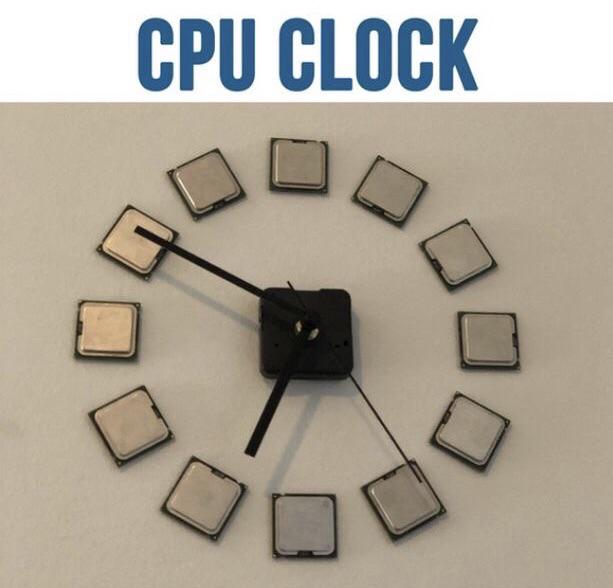
CPU Clock

CPU Clock
Someone took the term "CPU clock" way too literally and honestly? I respect the commitment. Built an actual wall clock using old processors as hour markers. Your grandma has decorative plates, we have decommissioned Intel chips. It's what separates us from the normies. Pretty sure those CPUs had more processing power than whatever's running my CI/CD pipeline right now. At least now they're serving a purpose—telling you exactly how late you stayed debugging last night.

Realcloud Storage

Realcloud Storage
Someone took "cloud storage" way too literally and honestly? Respect. Finally, a storage solution where you can physically see your data evaporating in real-time. No need for encryption when your files are literally made of water vapor. Latency is approximately 0ms since everything's right there in your closet, though bandwidth might suffer during dry weather. Also eliminates the need for data retention policies—nature handles that automatically. Your compliance team will love explaining this setup during the next audit.

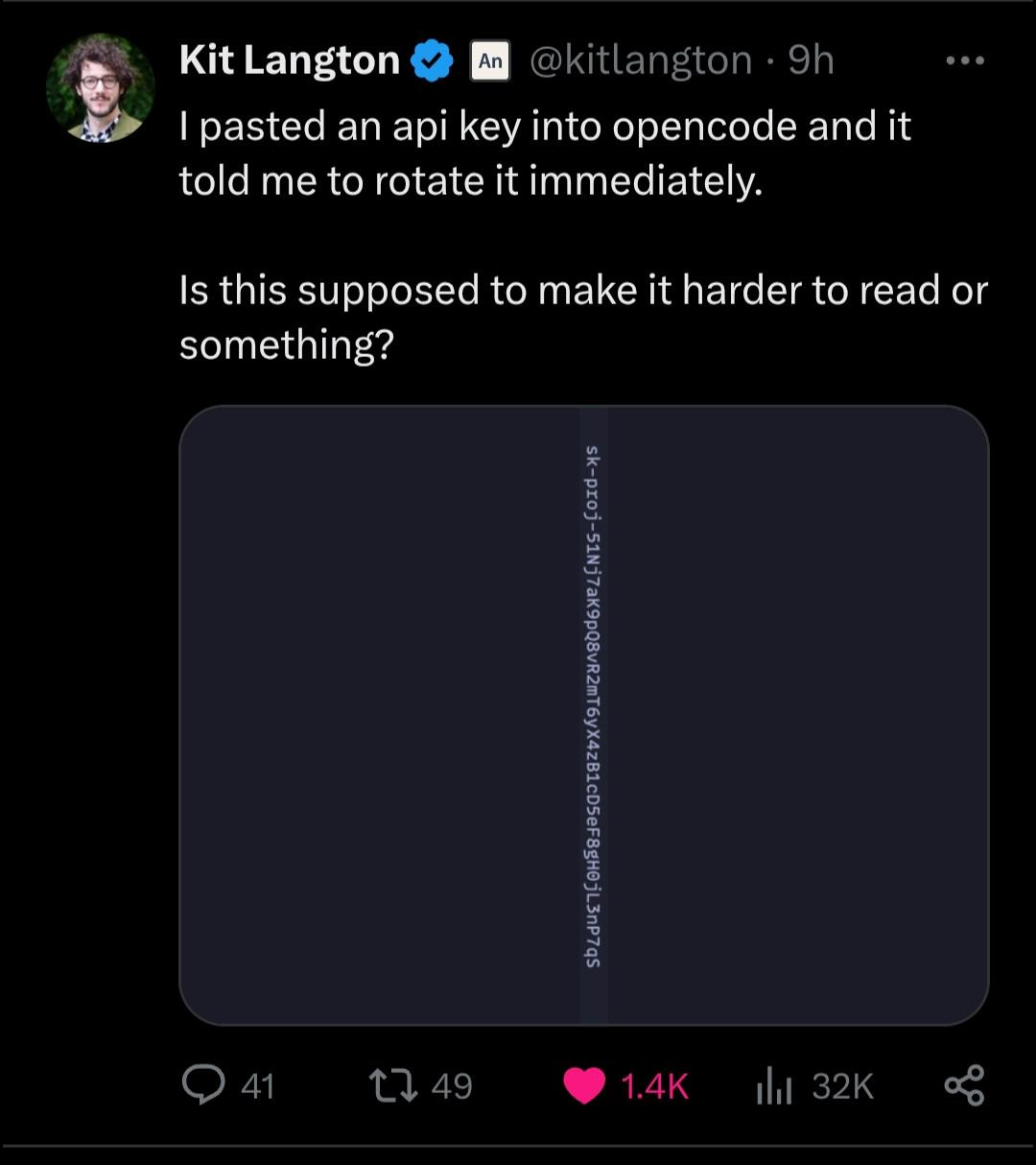
Rotate Your Key

Rotate Your Key
Someone accidentally committed their API key to a public repo and OpenAI's security scanner caught it faster than you can say "oops." The automated warning told them to "rotate it immediately" — you know, generate a new key so the leaked one becomes useless. But our hero here took "rotate" a bit too literally and turned the key 90 degrees like they're trying to read ancient hieroglyphics. Because apparently when security best practices meet sleep deprivation, you get vertical API keys. Honestly, can't blame them — after your 47th commit of the day, words stop meaning things. At least they didn't try to flip it horizontally too.

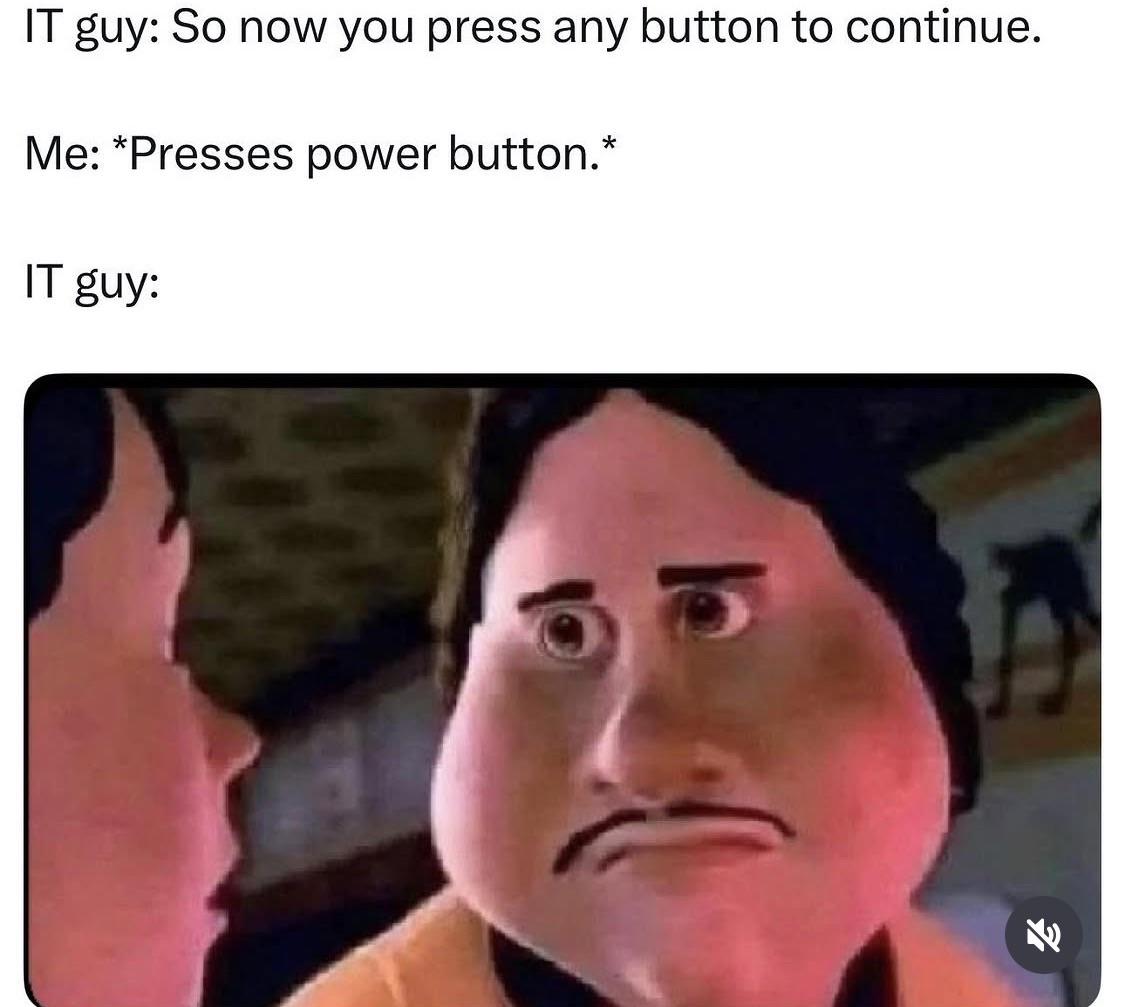
He Said "Any"

He Said "Any"
You know that moment when someone gives you technically correct instructions but you still manage to find the one interpretation that breaks everything? Yeah, that's this. The IT guy says "any button" and naturally, the user goes straight for the nuclear option—the power button. Because why press Enter or Space like a normal person when you can just shut down the entire machine mid-process? This is why we can't have nice things. This is also why every instruction manual now reads like you're explaining rocket science to a toddler. "Press any key except the power button, reset button, or anything that might cause irreversible damage to your work or soul." The IT guy's horrified face says it all—he's seen this movie before, and it never ends well. Probably followed by a ticket that says "computer won't turn on" and a lengthy explanation about unsaved work.

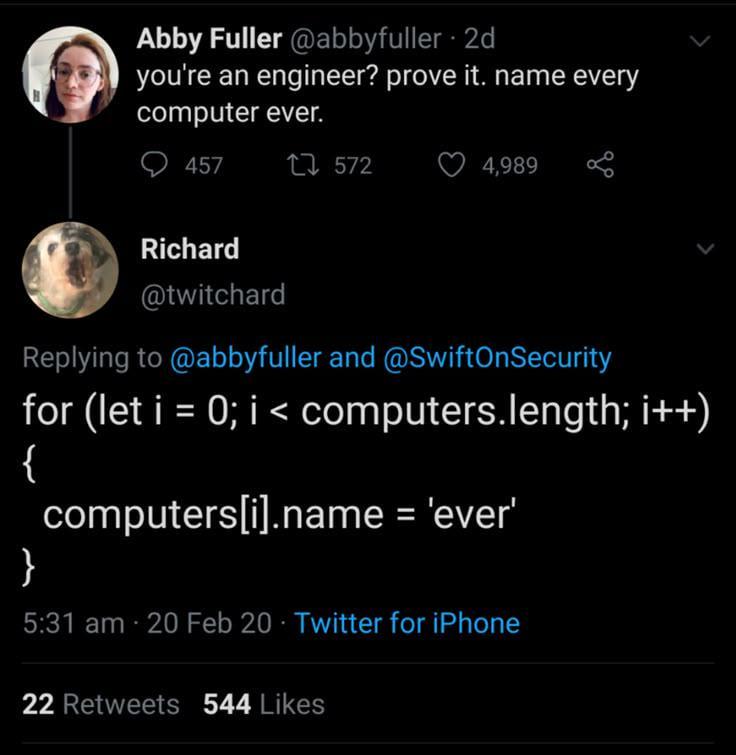
Spec Was Followed

Spec Was Followed
Someone asked engineers to name every computer ever, and Richard took it literally . Instead of listing actual computer names, he wrote a loop that iterates through all computers and sets each one's name to "ever". Technically correct? Absolutely. Useful? Not even slightly. It's the classic malicious compliance meets literal interpretation. The spec said "name every computer ever" and by god, every computer is now named "ever". Requirements met, ticket closed, PR approved. Don't blame the engineer—blame whoever wrote that ambiguous spec without acceptance criteria. This is why we can't have nice things in software development. And why product managers wake up screaming at 3 AM.

Aluminum Mini ITX Case with PCIe 3.0 Riser, JOYJOM Mini PC Case, SFF Small Form Factor PC Case, TX Computer Gaming Case Supports GPU Graphics Card (Black)

Aluminum Mini ITX Case with PCIe 3.0 Riser, JOYJOM Mini PC Case, SFF Small Form Factor PC Case, TX Computer Gaming Case Supports GPU Graphics Card (Black)
【Ultra Mini ITX Case with PCIe 3.0 Riser Cable】The Case is only 4.3L capacity, the size is 18.4x10.4x22.3 cm (7.3x4.1x8.8 inch), PCI 3.0 Riser Cable is 18.5cm · 【Compatibility Accessories】Support Sta…

Early Access

Early Access
Kid's already implementing their own sorting algorithm instead of just using the built-in one. First answer? "aelpp" for apple. That's not a typo—that's literally alphabetically sorted characters. They took the word "apple" and sorted each letter individually (a-e-l-p-p) like they're running a char array through a sort function. The teacher wanted them to sort the words by their first letter, but this future developer interpreted the spec literally: "alphabetical order" = sort the characters. The rest of the answers follow the same pattern—"ikmnppu" (pumpkin), "glo" (log), "eirrv" (river). They're treating strings as mutable character arrays and applying a sort operation to each one. This is the kind of literal thinking that makes you either a brilliant compiler designer or someone who spends 3 hours debugging why their code does exactly what they told it to do, not what they wanted it to do. The kid's not wrong—they just solved a different problem with O(n log n) complexity when the teacher wanted O(1) lookup.

Print Hello World

Print Hello World
Someone took the assignment a bit too literally. Instead of writing code to print "hello world" to the console, they just... printed it. On paper. With an actual printer. The most efficient solution is often the one that completely bypasses the problem. No compiler errors, no syntax issues, no dependency conflicts. Just pure, unfiltered malicious compliance. Your CS professor is probably having an aneurysm right now. Technically correct is the best kind of correct.