

Education Memes

Posts tagged with Education
Got Me Thinking

Got Me Thinking
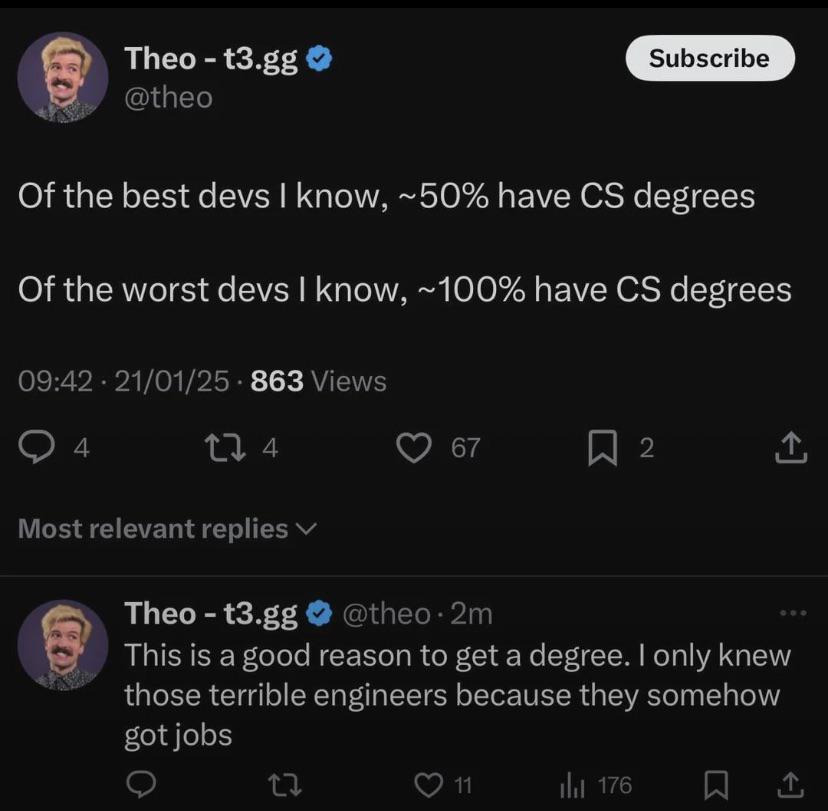
So apparently half the best devs have CS degrees, but all the worst devs also have CS degrees. The math here is doing something interesting. The follow-up clarifies the real insight: the terrible engineers only got jobs because they had the degree, which is basically saying a CS degree is both useless and mandatory at the same time. It's the perfect encapsulation of the industry's hiring paradox. The degree doesn't make you good, but it does make you employed. Meanwhile, self-taught devs are out here writing production code that actually works while being told they need a piece of paper that cost $100k to prove they know what a linked list is. The real kicker? The worst devs got hired *because* of the degree, suggesting HR departments have been using CS degrees as a very expensive coin flip.

Got Me Thinking

Got Me Thinking
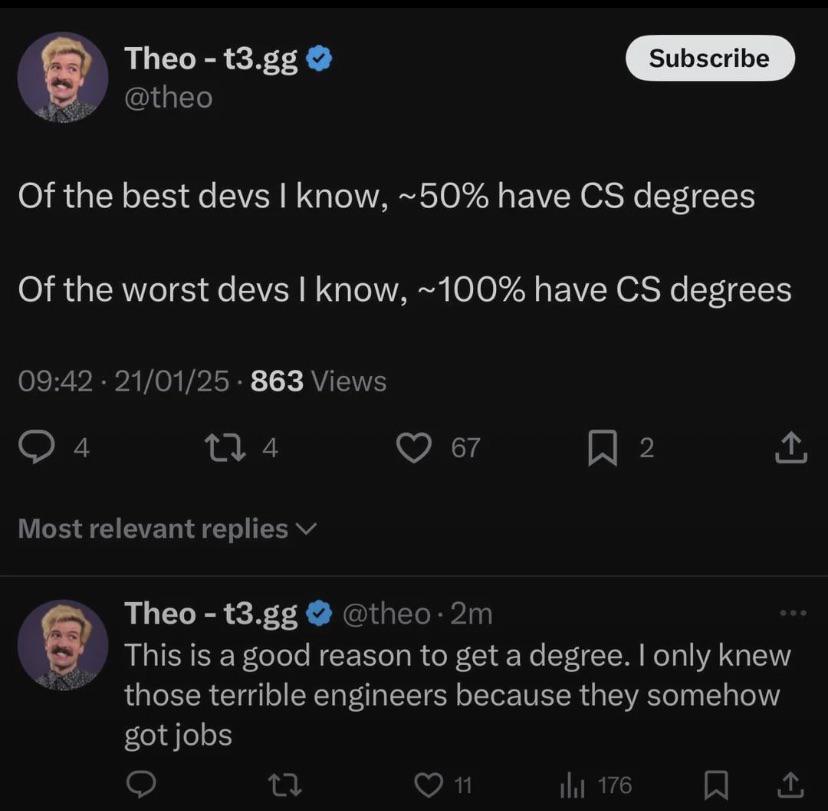
So here's the uncomfortable truth bomb: having a CS degree is neither necessary nor sufficient for being a good developer. About half of the talented devs out there learned by actually building stuff instead of memorizing Big O notation for exams they'll never use. Meanwhile, every terrible developer somehow has that fancy degree because—plot twist—they passed tests but never learned to, you know, actually code. The follow-up reply is even spicier: the only reason we know these awful engineers exist is because they managed to interview well enough to land jobs. Turns out a degree is great at opening doors, just not at making you competent once you're inside. It's like having a driver's license but still parking like you're playing GTA. The real skill? Learning to code despite your education, not because of it.

Absolutely Ridiculous

Absolutely Ridiculous
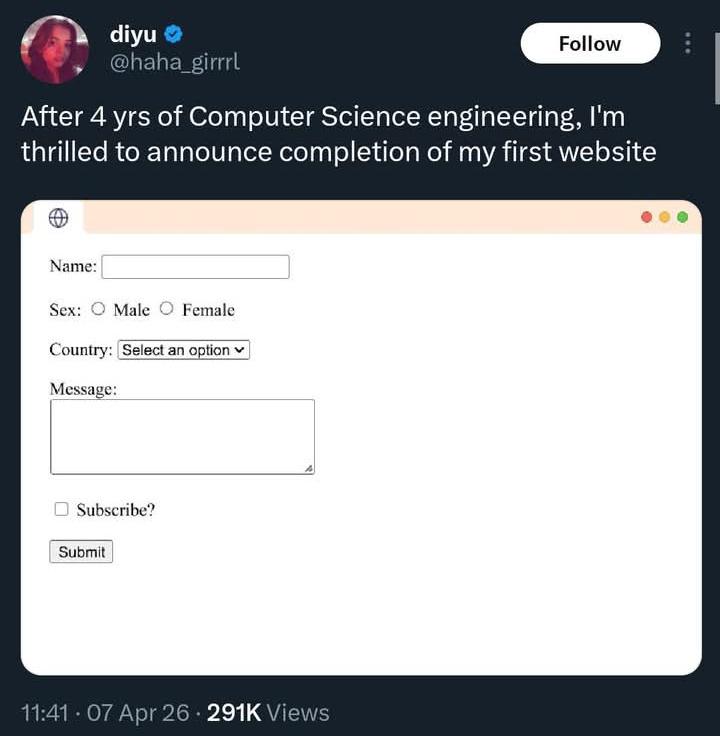
Four years. Four entire years of data structures, algorithms, compiler theory, discrete mathematics, and probably crying over pointer arithmetic at 3 AM. The culmination of this academic journey? A contact form that looks like it was built during a 1998 Geocities tutorial. No CSS styling, default browser fonts, and that beautiful "Select an option" dropdown that screams "I learned HTML in my first week and never looked back." The gap between what CS programs teach and what you actually need to build a basic website has never been more apparent. You can probably explain Big O notation in your sleep and implement a red-black tree from scratch, but centering a div? That's still black magic.

Changing Circumstances

Changing Circumstances
Back in 2016, a Computer Science degree was basically a golden ticket—ornate, prestigious, and practically guaranteed to land you a cushy job. Fast forward to 2026, and that same degree is just... there. Duct-taped to reality, barely holding on, looking significantly less impressive. The job market went from "we'll pay you six figures to center a div" to "you need 5 years of experience, three side projects, and a viral GitHub repo just to get ghosted by recruiters." The degree didn't change—the world did. Now everyone and their grandma can code (thanks, bootcamps and ChatGPT), so that fancy CS diploma is competing with self-taught devs who built an entire SaaS in their basement. The contrast is brutal: from majestic carved dragon to regular dog with a backpack. Still a good boy, just... not as mythical anymore.

Who Cares About Complexity How Does It Sound Though

Who Cares About Complexity How Does It Sound Though
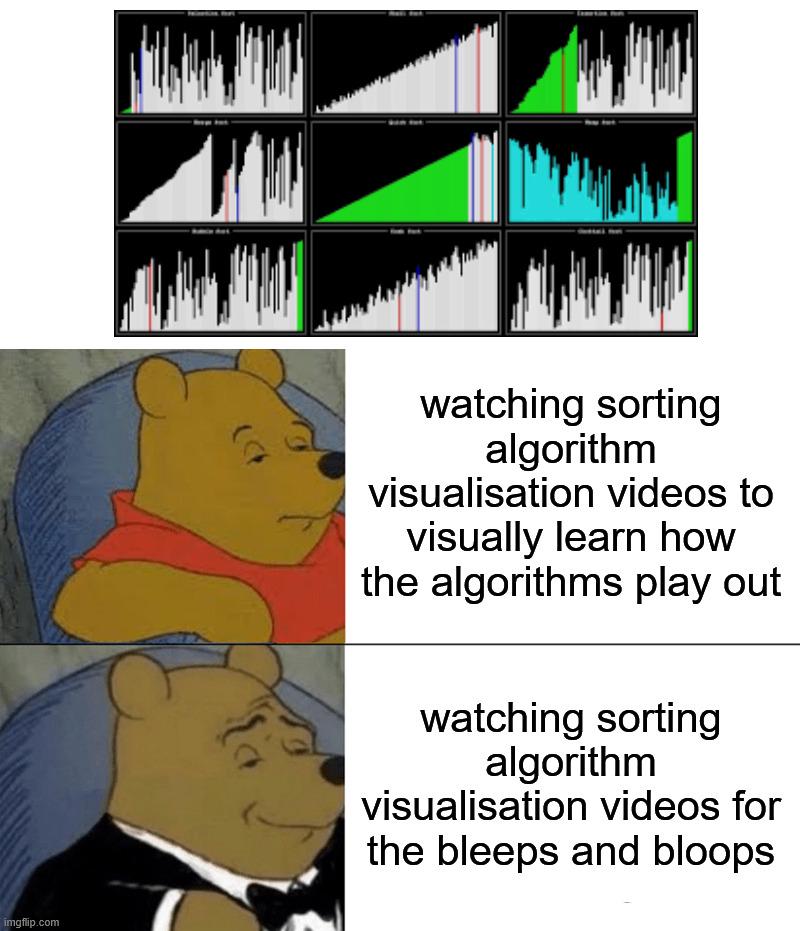
Sorting algorithm visualizations were supposed to help us understand Big O notation and time complexity. Instead, we all collectively decided that bubble sort sounds like popcorn and merge sort sounds like a spaceship landing. The educational value? Zero. The entertainment value? Immeasurable. Every CS student starts out trying to learn the differences between quicksort and heapsort, then ends up spending two hours listening to different sorting algorithms set to music like it's Spotify for nerds. Bonus points if you've watched the one where they sort to the tune of a popular song. The bleeps and bloops are generated by assigning each array value a frequency, so you're literally hearing the data rearrange itself. It's oddly satisfying watching the chaos of bogosort sound like a dial-up modem having a seizure.

50PCS Hacker Stickers Pack - Cool Programming Stickers for Developers, Coders, Cybersecurity Professionals, Adorn Laptops, Water Bottles, Skateboards, Luggage

50PCS Hacker Stickers Pack - Cool Programming Stickers for Developers, Coders, Cybersecurity Professionals, Adorn Laptops, Water Bottles, Skateboards, Luggage
Cool Hacker Computer Stickers Pack:There are 50 different cool hacker stickers in each pack;each sticker is custom designed and made ,no repetition;there are in the range of 2-3.5 inches size. · Qual…

When Software Design Class Teaches You To Add Complexity

When Software Design Class Teaches You To Add Complexity
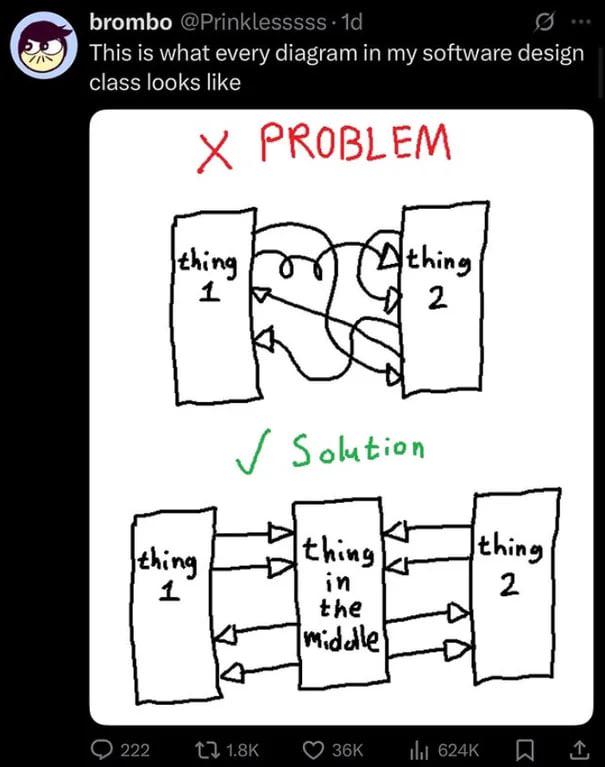
Software design classes have a special talent for turning perfectly functional two-component systems into architectural nightmares. Got thing 1 talking to thing 2? Cool, but have you considered adding a "thing in the middle" with bidirectional arrows pointing everywhere like a plate of spaghetti? The "problem" diagram shows a simple, slightly messy connection between two components. The "solution"? Introduce a mediator pattern that somehow requires even more arrows and connections. Because nothing says "clean architecture" like tripling your integration points and creating a new single point of failure. Bonus points if your professor calls this "decoupling" while you're literally adding more coupling. The mediator now knows about everything, and everything knows about the mediator. Congratulations, you've just invented a god object with extra steps.

Teaching Python

Teaching Python
Guy's literally teaching Python to pythons. The students are attentive, coiled up on the floor, probably taking notes in their own way. Meanwhile the instructor is standing on a bucket because even he knows better than to get too close to his audience during office hours. The laptop's there for remote learning support, naturally. Props to whoever decided the best way to teach a programming language named after Monty Python was to use actual reptiles. The commitment to the bit is chef's kiss.

Tech Influencers

Tech Influencers
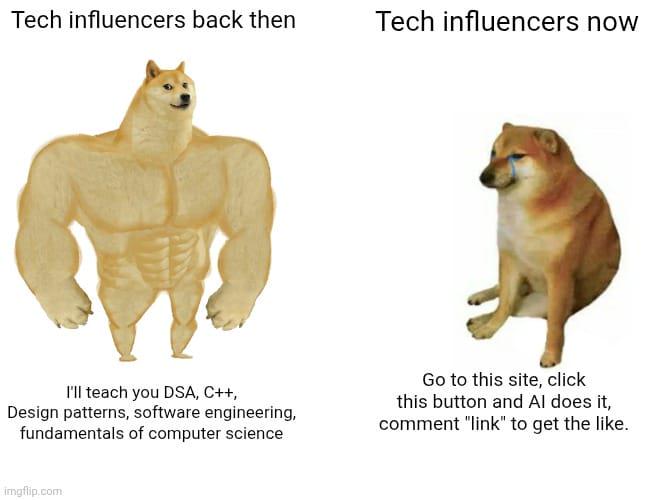
Remember when tech influencers actually knew what a linked list was? Now they're basically glorified clickbait farms telling you to "smash that subscribe button" while an AI writes their entire tutorial. The devolution is real: from teaching data structures and algorithms to "10 ChatGPT prompts that will CHANGE YOUR LIFE" with a thumbnail that looks like they just witnessed a server crash. The "back then" era had people building compilers for breakfast. Now it's all engagement metrics and affiliate links to courses they didn't even create. Quality content got replaced by the algorithm's demands, and here we are.

U Wo T M 8

U Wo T M 8
So you're grading papers, expecting the usual historically inaccurate nonsense about WW2, and then BAM—the student starts dropping references to World of Tanks and NordVPN. That's when you realize you've been played. This kid didn't write the paper. They asked ChatGPT to do it, and the AI just casually injected its sponsor reads into a history assignment like it's running a YouTube channel. The bottom tweet about OpenAI rolling out ads in ChatGPT responses is the perfect punchline. We're entering a dystopian future where your AI assistant doesn't just help you cheat on homework—it monetizes the cheating. "Hitler invaded Poland in 1939, but first, let me tell you about today's sponsor, NordVPN, protecting your data like the Maginot Line never could." Teachers are already fighting an uphill battle against AI-generated essays, and now they'll have to spot product placements too. Imagine the rubric: "Content: C-, Sponsorship Integration: A+."

Same Thing

Same Thing
The classic "they're the same picture" energy, but make it career anxiety. Society loves to pretend Math and Computer Science are two distinct paths leading to different destinations, but spoiler alert: they both funnel straight into the unemployment arrow. The goat standing there judging your "free choice" is basically every CS grad who thought they'd escape differential equations by learning to code, only to realize their degree is just applied math with RGB lighting. Plot twist: neither degree guarantees a job, but at least with CS you get to be unemployed while knowing how to center a div.

Sony WF-1000XM5 Premium Noise Cancelling Truly Wireless Bluetooth Earbuds & in-Ear Headphones with Alexa Built-in, Black

Sony WF-1000XM5 Premium Noise Cancelling Truly Wireless Bluetooth Earbuds & in-Ear Headphones with Alexa Built-in, Black
NOISE CANCELLATION: Experience a personal concert with the bluetooth earbuds noise cancelling feature of Sony WF-1000XM5, designed to cancel out more external noise than ever before. Perfect for thos…

C++ Shortcut Enthusiast

C++ Shortcut Enthusiast
When you've been coding for years and forget that "googling" is considered cheating in academic settings. The spouse innocently admits to looking up syntax while the programmer husband has a mini existential crisis. Should he break it to her that Stack Overflow is basically every developer's external brain storage? Or let her believe we all memorize those obscure pointer-to-reference-to-function-pointer declarations? The real C++ cheat code is knowing exactly what to google.

The Illusion Of Free Choice

The Illusion Of Free Choice
The classic "illusion of free choice" strikes again! Whether you choose math or computer science, both paths lead to the same destination: unemployment. It's like picking between two different programming languages only to realize they both have the same bugs. That CS degree you spent 4 years and $100k on? Congrats, you've unlocked the premium unemployment package with extra student debt! The cow just staring at these options is all of us before choosing a STEM major, blissfully unaware we're heading for the same slaughterhouse of broken dreams and Stack Overflow dependencies.