

Cpp Memes

Posts tagged with Cpp
That's Correct 👍

That's Correct 👍
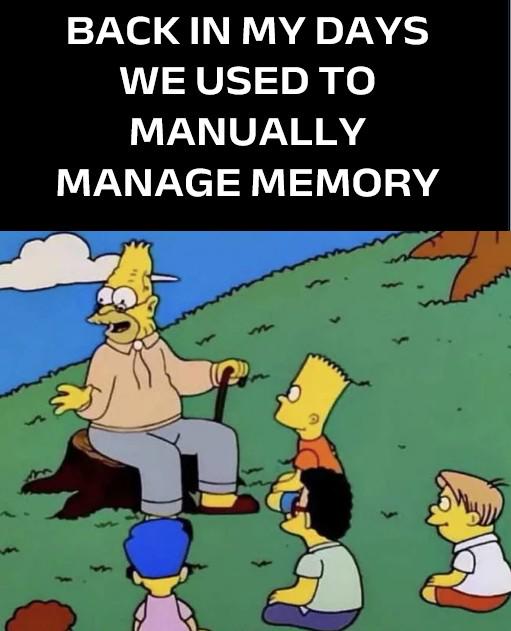
Switching from C++ to Python is like going from manually managing your entire life with spreadsheets and alarm clocks to just asking Alexa to do everything. You're saying goodbye to pointers (the bane of every C++ developer's existence), manual memory management with ++ operators, semicolons that you WILL forget, curly braces everywhere, and that intimidating main() function boilerplate. Python just lets you write code without all the ceremony. No more segmentation faults at 2 AM because you dereferenced a null pointer. No more wondering if you should use delete or delete[] . Just pure, clean, indentation-based bliss where everything is a reference and garbage collection is someone else's problem. The relief is real. It's like taking off tight shoes after a 12-hour shift of fighting with template metaprogramming and undefined behavior.

Its For Your Own Good Trust Us

Its For Your Own Good Trust Us
The Rust compiler is basically that overprotective parent who won't let you do anything. Can't turn left, can't turn right, can't go straight, can't U-turn. Just... stop. Sit there. Think about your life choices. Meanwhile, C++ is like "yeah bro, drive off that cliff if you want, I'm not your mom." Rust's borrow checker sees every pointer you touch and goes full panic mode with error messages longer than your commit history. Sure, it prevents memory leaks and data races, but sometimes you just want to write some unsafe code and live dangerously without a 47-line compiler lecture about lifetimes. The best part? The compiler is technically right. It IS for your own good. But that doesn't make it any less infuriating when you're just trying to ship code and rustc is having an existential crisis about whether your reference lives long enough.

Compiler Flag

Compiler Flag
Imagine a utopian future where the -o4 optimization flag actually exists. We're talking about a world where your code doesn't just run fast—it achieves sentience, solves world hunger, and probably fixes your merge conflicts too. Currently, GCC and most compilers max out at -o3 , which is already aggressive enough to make your binary unrecognizable. But -o4 ? That's the stuff of legends. Flying cars, futuristic architecture, and code that compiles without warnings on the first try. Pure fantasy.

I Put Alot Of Effort Into My Titl

I Put Alot Of Effort Into My Titl
C++ devs really be out here benchmarking their 6000-line monstrosity against your Python one-liner and acting like they just solved world hunger. Yeah, congrats on shaving off 0.000438 seconds—that's really gonna matter when both programs finish before you can even alt-tab back to your browser. The superiority complex is strong with this one. Meanwhile, your Python script was written during a coffee break and is already in production while they're still arguing about whether to use std::vector or std::array .

Learning Cpp As C With Classes

Learning Cpp As C With Classes
Welcome to C++, where arrays decay to pointers faster than your career expectations after reading legacy code. Someone just discovered that when you pass an array to a function, it immediately forgets its own size and becomes a humble pointer. No size information, no bounds checking, just raw pointer energy. So now you're stuck passing array sizes as separate parameters like it's 1972. Meanwhile, Python devs are over there with their .length property, sipping lattes, while C# folks have their nice Array.Length . But here you are, manually tracking array sizes like some kind of memory accountant. The "C with classes" nickname hits different when you realize Bjarne Stroustrup gave us templates, RAII, and move semantics, but somehow we're still manually babysitting array bounds in 2025. At least we have std::vector and std::array now... if you can convince your team to stop writing C code in .cpp files.

I Might Be Bad

I Might Be Bad
When you're learning C++ and think you're making progress, but plot twist: you're just creating increasingly sophisticated ways to shoot yourself in the foot. It's like taking a perfectly functional machine (your body/code) and transforming it into something even more cursed through the dark arts of manual memory management, pointer arithmetic, and undefined behavior. The skeleton perfectly represents what happens to your soul after debugging your tenth segmentation fault of the day. At least with regular C++ you know what's killing you—with "worse C++" you've somehow invented new and creative ways to suffer that the language designers never even imagined possible.

Heroes And Villains

Heroes And Villains
This comic brilliantly captures how different dev roles handle bugs with wildly different energy levels. JavaScript devs panic-flee from bugs like they're on fire (accurate), then copy-paste Stack Overflow solutions while literally burning, and convince themselves the weight of technical debt is totally fine. Classic. Backend devs go full Batman mode—methodically tracking down bugs with detective skills, then hunting down whichever dev committed the cursed code. The cape is metaphorical but the intimidation is real. Web devs are Spider-Man releasing bugs into production, then trying to "organize" them (read: make it worse), until someone yells "SUDO" and they have no choice but to comply. The power of root commands compels you! Technical Support are the Jedi mind-tricking users that obvious bugs are "features." Three times. With a straight face. It's not a crash, it's an unexpected exit feature! QA is literally Godzilla destroying everything in sight, then casually leaving. Their job is chaos, and they're excellent at it. C++ devs can't find bugs because they're too busy dealing with segfaults, memory leaks, and undefined behavior. Solution? Rage quit with rm -rf and the Infinity Gauntlet. If you can't fix it, delete everything.

Pro Level Hater

Pro Level Hater
Nothing quite hits like the unholy combination of insomnia, someone else's questionable code, and the unearned confidence that comes with running it through Valgrind at unholy hours. You're not even working on your own project—you're just out here at 3am being a full-time code critic for some stranger's GitHub repo, watching memory leaks light up like a Christmas tree. The pure GLEE on your face as Valgrind spits out error after error? *Chef's kiss*. Invalid reads, memory not freed, definitely lost bytes—it's like watching a train wreck in slow motion, except you're eating popcorn and taking notes. You didn't come here to contribute or open a helpful PR. You came here to JUDGE, and Valgrind is your weapon of choice. For the uninitiated: Valgrind is a debugging tool that hunts down memory leaks and other memory-related crimes in C/C++ programs. It's basically the snitch of the programming world, and boy does it love to tell on people.

The Evolution Of Programming Intelligence

The Evolution Of Programming Intelligence
Starting with Python's galaxy brain energy, descending through Java's merely brilliant neural activity, then C++'s dimming consciousness as you realize you're managing memory manually. Scratch brings us to the enlightened toddler phase where you're dragging colorful blocks around. And finally, we reach peak transcendence with command blocks in Minecraft—where you've ascended beyond traditional programming into a realm of redstone logic and block-based sorcery that somehow feels both incredibly powerful and deeply questionable at the same time. The progression from "I write elegant code" to "I literally program inside a video game" is a journey we all respect but don't necessarily understand.

I Can Make It Work In Just 3 Lines Of Code

I Can Make It Work In Just 3 Lines Of Code
Python programmer casually flexing about solving problems in 3 lines while the C++ programmer is over there having a full existential crisis. Classic high-level vs low-level language showdown. Python devs get to import a library that does everything, write a list comprehension, and call it a day. Meanwhile the C++ crowd is manually managing memory, dealing with pointers, template metaprogramming, and questioning their life choices just to accomplish the same thing in 300 lines. Both get the job done. One just requires significantly less therapy afterward.

Someone Said To Use The Stack Because Its Faster

Someone Said To Use The Stack Because Its Faster
So someone told you stack allocation is faster than heap allocation, and you took that advice a bit too literally. The function allocates a char array on the stack and then returns a pointer to it. Problem? That stack memory gets deallocated the moment the function returns, so you're handing back a pointer to memory that's already been reclaimed. It's like giving someone directions to a house that's been demolished. The comment "delicious segfault awaits" is chef's kiss accurate. Whoever tries to dereference that returned pointer is in for undefined behavior territory—could be garbage data, could be a crash, could be nothing at all until production when it spectacularly explodes. Stack allocation is faster, but returning stack-allocated memory is basically writing a check your program can't cash. Classic case of knowing just enough to be dangerous. Should've used malloc or just passed a buffer as a parameter. But hey, at least it compiles! (with warnings you definitely ignored)

I Still Call Them Services And They Forgot The A

I Still Call Them Services And They Forgot The A
Someone asks if a mysterious black box has demons in it. The response? "Yea but they're based." Another person questions what they're based on, and the answer is simply: "C++." The joke is a play on "microservices" vs "microdaemons" (daemons being background processes in Unix/Linux, pronounced like "demons"). The title references how people still call them "services" instead of the technically correct "daemons"—and jokes that they forgot the 'A' in daemon. But the real gold here is the "based" pun. In tech, we say something is "based on" a technology (like "based on C++"), but the internet slang "based" means being unapologetically yourself. So when someone asks if it has demons, the answer works on both levels: yes it has daemons (background processes), and yes they're based (written in C++). Chef's kiss of a double entendre. The fact that C++ is the foundation makes it even funnier—because of course the demons would be written in the language that's basically controlled chaos with pointers.