

Golden Handcuffs

Golden Handcuffs
The classic trajectory of selling your soul for a decent salary. You start with dreams of building the next indie hit, spend years learning game development, then reality hits and you need to eat. So you pivot to web dev because, well, those FAANG salaries don't grow on trees. Fast forward a few years and boom—you're now a senior architect making bank, attending meetings about meetings, reviewing PRs, and writing documentation. The only code you touch is approving merge conflicts. The golden handcuffs have locked: you're too well-compensated to leave, but you haven't opened your IDE in months. Your game dev dreams? They're now a dusty Unity project folder labeled "someday.zip".

Inline SQL

Inline SQL
Drake rejecting raw SQL strings because of ORM trust issues? Nah, too mainstream. But writing SQL queries as inline CSS classes using TailwindSQL? Now that's the galaxy brain move we didn't know we needed. TailwindSQL takes the utility-first philosophy to its logical extreme: why write SELECT * FROM users when you could write class="select-all from-users where-active" ? It's like someone looked at Tailwind CSS's 47-character class strings and thought "you know what databases need? This energy." The best part? You get all the SQL injection vulnerabilities of raw queries with the verbose readability of Tailwind classes. It's the worst of both worlds, perfectly balanced. Your DBA will love debugging select-* from-orders join-users on-id where-status-eq-pending limit-10 offset-20 in production at 3 AM.

Random Sad Story Of The Software Developer

Random Sad Story Of The Software Developer
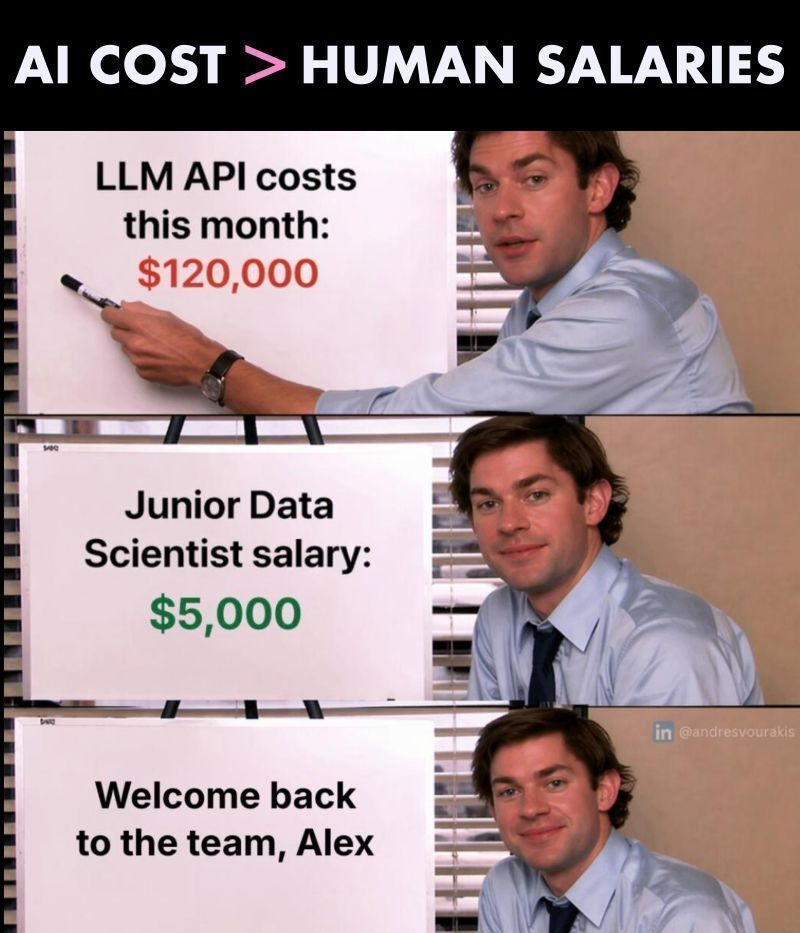
You spend years grinding through CS degrees, bootcamps, and LeetCode problems, dreaming of that stable software dev career with good pay and job security. But then the tech industry hits you with a triple threat: first comes the AI hype making everyone panic about whether their job will exist in 5 years, then the mass layoffs sweep through like Thanos snapping away entire engineering teams, and finally economic uncertainty makes companies freeze hiring and cancel projects. Meanwhile, you're just standing there like that kid watching their dreams get absolutely destroyed by reality. The timing couldn't be worse either - just when AI tools like ChatGPT and Copilot start getting good enough to make junior devs sweat, companies decide they need to "optimize costs" and suddenly your carefully planned career path looks more like a game of Russian roulette. The irony? We're the ones who built the AI that's now being used to justify cutting our positions.

To Lower And To Upper Aren't As Innocent As They Seem Just Saying

To Lower And To Upper Aren't As Innocent As They Seem Just Saying
Using toLowerCase() or toUpperCase() in your conditional logic? That's some big brain energy right there. Most devs just slap these methods on strings for case-insensitive comparisons without a second thought, but the real ones know this is a minefield of locale-specific chaos waiting to explode. The Turkish İ problem is legendary: in Turkish locale, the uppercase of 'i' is 'İ' (with a dot), not 'I', and lowercase 'I' becomes 'ı' (without a dot). So your innocent if (userInput.toLowerCase() === "admin") suddenly breaks when deployed in Turkey. There's also the German ß that uppercases to "SS", and Greek sigma has different lowercase forms depending on position. Unicode is wild, and these methods respect locale by default in some languages. Pro tip: use toLocaleUpperCase() or toLocaleLowerCase() when you actually care about proper linguistic handling, or better yet, use case-insensitive comparison methods that don't mutate strings. The lion knows what's up.

According To My Experience

According To My Experience
Oh, the AUDACITY of family members who think your programming degree doubles as a CompTIA A+ certification! Just because you can debug a recursive function at 2 AM doesn't mean you magically know why Aunt Karen's printer is possessed by demons. Sure, you COULD probably figure it out—turn it off and on again, check if it's actually plugged in, sacrifice a USB cable to the tech gods—but let's be crystal clear: your ability to architect microservices has ZERO correlation with your desire to troubleshoot hardware from 2003. The real plot twist? You'll still end up fixing it anyway because saying no to family is apparently harder than solving LeetCode hard problems.

Mongo Bleed Is Web Scale

Mongo Bleed Is Web Scale
A critical MongoDB vulnerability that sat dormant for 8 years (2017-2025) just got discovered, letting attackers yank out heap data like passwords and API keys through a malformed zlib request. The bug was literally committed in June 2017 and merged into production. The fix? Written in December 2025. That's an 8-year nap. But here's the kicker: there are over 213,000 potentially vulnerable MongoDB instances exposed to the internet. The punchline? "ensuring that this exploit is web scale ." 😂 For context, "web scale" is a legendary meme from a satirical video where someone hilariously defends MongoDB's design choices with buzzwords. Now it's come full circle—MongoDB's vulnerability is literally web scale with 213k+ exposed instances. MongoDB also claims "no evidence" of exploitation despite the bug being trivially simple for 8 years. Sure, Jan. Oh, and they haven't apologized yet. Classic.

Prediction Build Failed Pending Timeline Upgrade

Prediction Build Failed Pending Timeline Upgrade
Made a bold prediction on October 25th, 2025 that everyone would be "vibe coding" video games by end of 2025. Fast forward to December 14th, 2025—still waiting on that timeline upgrade. The real kicker? Dude's favorite pastime is proving people wrong, yet somehow managed to prove himself wrong in under two months. That's what I call efficient failure. The CI/CD pipeline of bad takes. When your prediction has a shorter lifespan than a JavaScript framework, you know you've achieved something special.

This Explains Everything

This Explains Everything
The Twilight meme format strikes again, but this time it's uncomfortably accurate. You know you've crossed into true developer territory when your lifestyle is literally indistinguishable from a vampire's. Nocturnal schedule? Check. Surviving on caffeine instead of actual food? Check. Recoiling from natural light like it's acid? Double check. The best part is how we've all normalized this. "Oh yeah, I just debugged for 14 hours straight without eating, totally normal Tuesday." Meanwhile our non-programmer friends think we're some kind of cryptid species. They're not entirely wrong—we do emerge from our dark caves (home offices) only when absolutely necessary, blinking confusedly at the sun like it personally offended us. Plot twist: vampires probably have better work-life balance than most devs in crunch mode.

When You Turn On Your PC I Want You To See This

When You Turn On Your PC I Want You To See This
Nothing says "good morning" quite like a Windows lock screen that's been absolutely demolished by graphics driver corruption. That beautiful beach scene has been transformed into a Picasso painting that nobody asked for, with chunks of the screen deciding to take a vacation to different coordinates. The GPU is basically having an existential crisis, rendering artifacts like it's trying to open a portal to another dimension. Could be a dying graphics card, corrupted VRAM, or maybe Windows Update decided to "helpfully" install the wrong driver at 3 AM last night. Either way, your display is serving major glitch art vibes. The Gru reaction perfectly captures that moment of pure disgust when you realize your day is starting with troubleshooting instead of coffee. Time to boot into safe mode, DDU that driver, and pray to the silicon gods that it's just software and not a $500 GPU replacement situation.

My Wife Gets Me

My Wife Gets Me
When your wife instantly diagnoses the REAL problem like a senior developer reviewing your pull request. Meimei (the kid) couldn't lock the door, and instead of assuming the door is broken like a normal person would, wife immediately goes full root-cause-analysis mode: "....is something wrong with the door?" But our programmer hero? Nah, straight to the REAL issue: "User error on the 12 year old." Because let's be honest, 99% of bug reports are just PEBKAC (Problem Exists Between Keyboard And Chair). The door works FINE, the API is FLAWLESS, the code is PERFECT—it's always the user who doesn't know how to lock a door properly. This is the energy of every developer who's ever had to explain to someone that turning it off and on again actually DOES solve the problem. She gets it. She truly gets it. Relationship goals, honestly.

Amen

Amen
Someone literally got </head> and <body> HTML tags tattooed on their neck and back. Because apparently, proper semantic markup isn't just for your code anymore—it's a LIFESTYLE CHOICE. The commitment to web standards is absolutely unhinged and I'm here for it. Nothing says "I live and breathe HTML" quite like permanently inking closing tags on your actual human body. The tattoo artist probably charged extra for the forward slash. And yes, before you ask, the opening tags are presumably somewhere we can't see, because even tattoo placement needs to follow proper HTML structure or the browser—I mean, your body—won't render correctly. 💀

How Can A Fix Create Multiple Issues

How Can A Fix Create Multiple Issues
You know that magical moment when you fix ONE tiny bug and suddenly your codebase transforms into a hydra? Cut off one head and SEVENTY-THREE MORE sprout in its place! Congratulations, you've just achieved the impossible: negative productivity. That brief moment of pure joy when the tests pass and you feel like a coding god? GONE. Replaced by the soul-crushing realization that your "fix" has awakened ancient bugs that were peacefully sleeping in the depths of your codebase. It's like you accidentally kicked over a hornet's nest made entirely of edge cases and race conditions. The best part? You can't even undo it now because you've already committed and pushed. Welcome to debugging hell, population: you and your 73 new friends.