


Vendor lock-in Memes

Posts tagged with Vendor lock-in
This Just Hit Me

This Just Hit Me
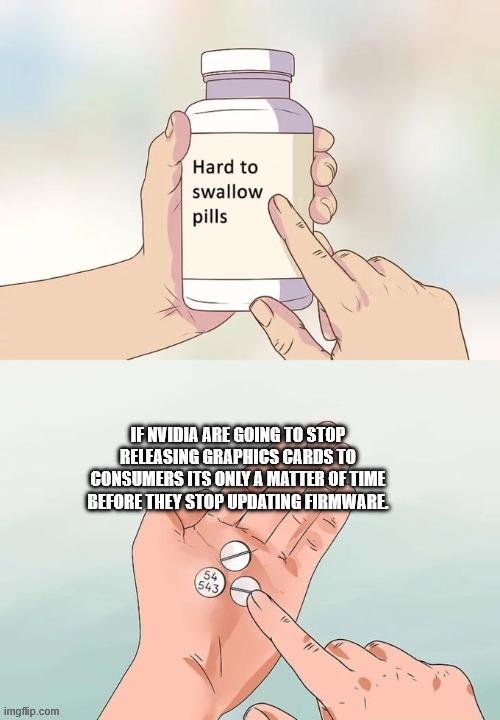
The bitter truth that if Nvidia ever decides to stop manufacturing consumer GPUs, you'll have no choice but to keep updating firmware on your existing card forever. It's like realizing your entire gaming/ML rig's future depends on a single company's quarterly earnings call. The "hard to swallow pill" format really nails the existential dread of vendor lock-in and hardware dependency. Sure, AMD and Intel exist, but let's be real about market dominance here.

From The Cloud

From The Cloud
When your cloud provider decides to flex their power over your entire infrastructure like some kind of digital overlord. You thought you owned your data? Think again, sweetie! The cloud giveth, and the cloud can absolutely YEET your entire application into the void whenever it feels like it. Nothing quite like the existential dread of realizing your multi-million dollar business is literally just vibing on someone else's computer, and they can pull the plug faster than you can say "service level agreement." But hey, at least you don't have to manage your own servers, right? Right?

Adapt Or Be Left

Adapt Or Be Left
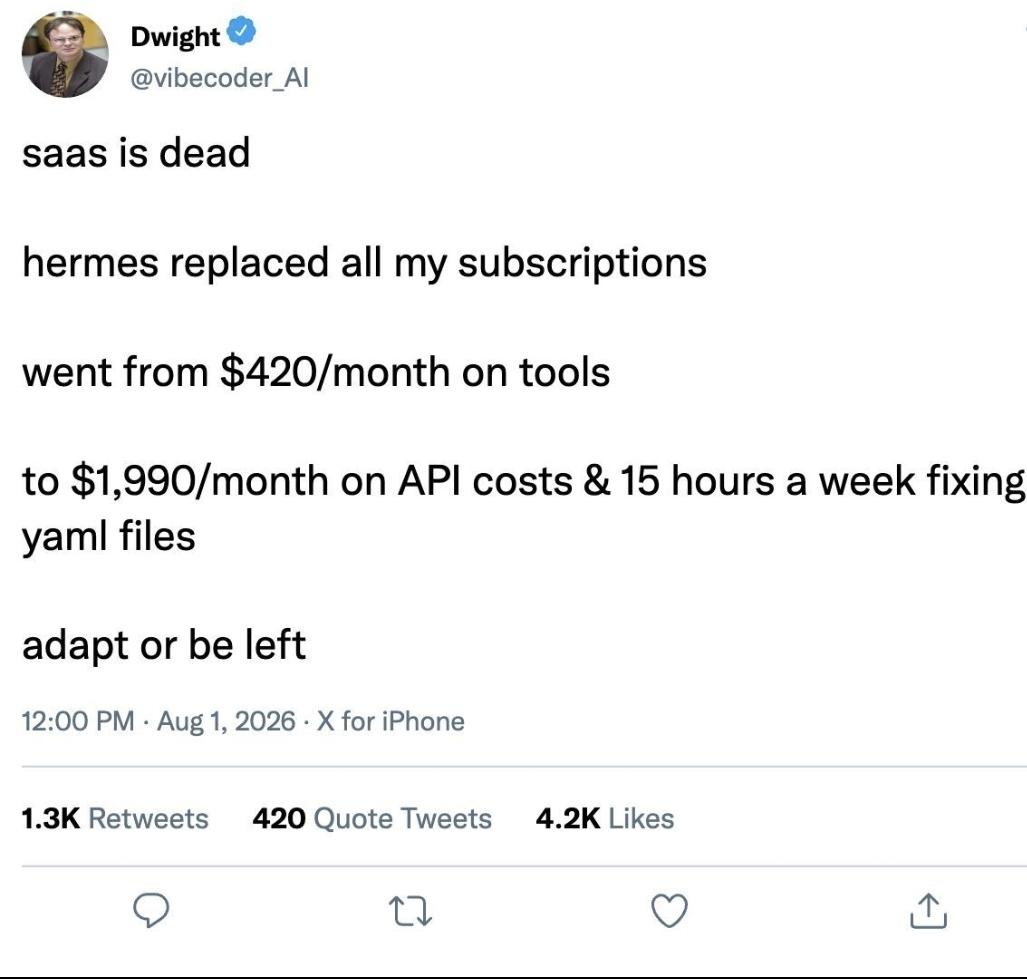
So you ditched all your SaaS subscriptions thinking you'd save money, went full self-hosted with a bunch of open-source tools, and now you're paying nearly 5x more in API costs while spending 15 hours a week wrestling with YAML configuration files. Classic engineer move—optimizing yourself right into a worse situation. The real kicker? You thought you were being smart by avoiding vendor lock-in, but now you're locked into being your own DevOps team, infrastructure manager, and YAML therapist. That $420/month was basically paying someone else to deal with all this headache. Turns out "not my problem" has a price tag, and it's way cheaper than $1,990/month plus your sanity. The "adapt or be left" part? Yeah, you adapted yourself right into technical debt and a part-time job you didn't want. Sometimes the old way was the good way.

Work Feels Like This Sometimes

Work Feels Like This Sometimes
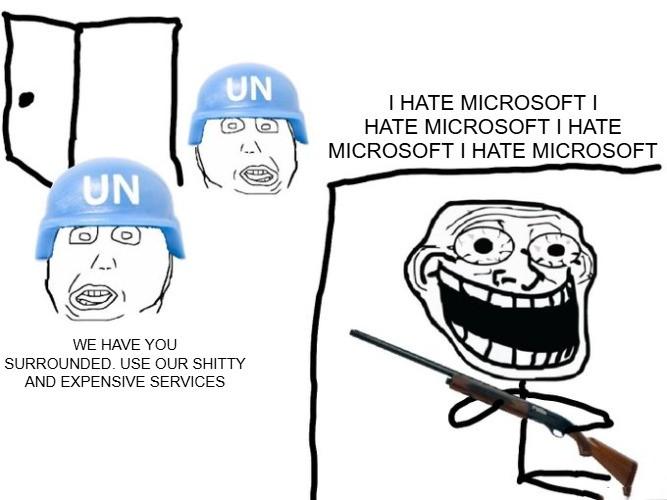
When you're trapped in a Microsoft ecosystem and forced to use Azure, Teams, SharePoint, and whatever other "enterprise solutions" your company bought, but you're literally screaming into the void about how much you despise every single moment of it. Meanwhile, your company has you completely surrounded with their multi-million dollar licensing agreements and "seamless integration" promises. The trollface represents you, weaponized and dangerous, because at this point you've accepted your fate and learned to laugh maniacally while watching everything crash during the Monday morning standup. Nothing says corporate life quite like being held hostage by vendor lock-in while pretending everything is fine.

I Only Wanted To Sign In...

I Only Wanted To Sign In...
You boot up a game, excited to race some cars. But wait—Microsoft says you need to sign in with your Microsoft account first. Then it wants you to link your Xbox account. Then verify your email. Then accept the new terms of service. Then enable two-factor authentication. Then subscribe to Game Pass. Then link your phone number. Then... What started as "I just want to play Forza" turns into a full Microsoft 365 ecosystem integration pitch. You're not signing into a game anymore—you're signing your soul over to the Microsoft cloud infrastructure. Next thing you know, you're syncing your gameplay stats to OneDrive and getting Teams notifications about your lap times. Remember when you could just... play games? Yeah, me neither.

Never Knew The Meaning

Never Knew The Meaning
Urban Dictionary really went for the throat on this one. Vercel users catching strays for choosing a platform that locks them into its ecosystem. The definition hits different when you realize how many devs picked Vercel for the slick DX and zero-config deploys, only to discover they're now married to a proprietary platform with vendor lock-in tighter than a Python dependency tree. Sure, it deploys faster than you can say "npm run build," but good luck migrating that serverless function architecture anywhere else without rewriting half your stack.

Regex Crossword: Supporter T-Shirt

Regex Crossword: Supporter T-Shirt
Official Regex Crossword T-Shirt · Lightweight, Classic fit, Double-needle sleeve and bottom hem

Old Stuff Disguised As New

Old Stuff Disguised As New
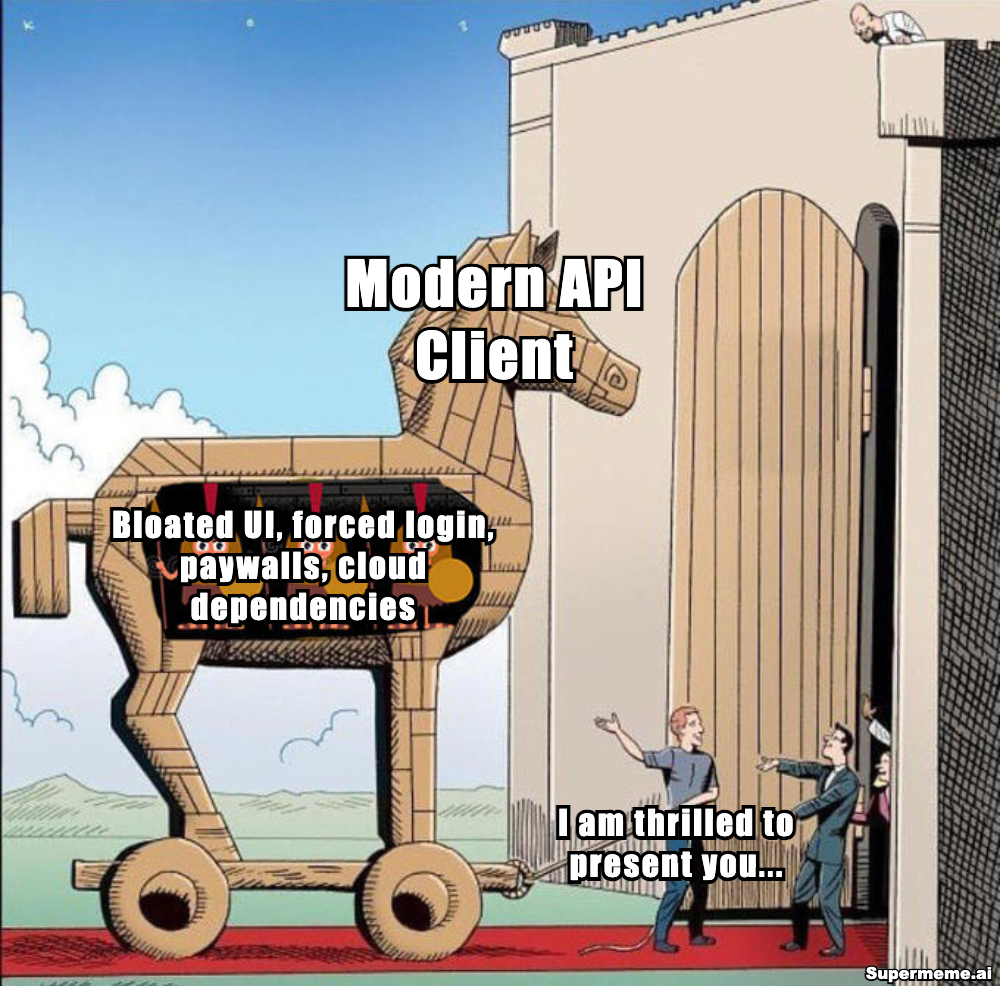
The tech industry's favorite party trick: repackaging the same old complexity with a fresh coat of "modern" paint. Your shiny new API client comes wrapped in buzzwords and promises, but crack it open and surprise—it's still got the same bloated UI, authentication nightmares, paywalls, and enough cloud dependencies to make your infrastructure cry. It's like receiving a Trojan horse but instead of soldiers, it's filled with vendor lock-in and subscription fees. The devs are thrilled to present this "revolutionary" solution, completely oblivious to the fact that they're just wheeling in legacy problems with extra steps. Nothing says "innovation" quite like mandatory OAuth flows and a dashboard that requires three different logins to access basic metrics.

Cloud Native

Cloud Native
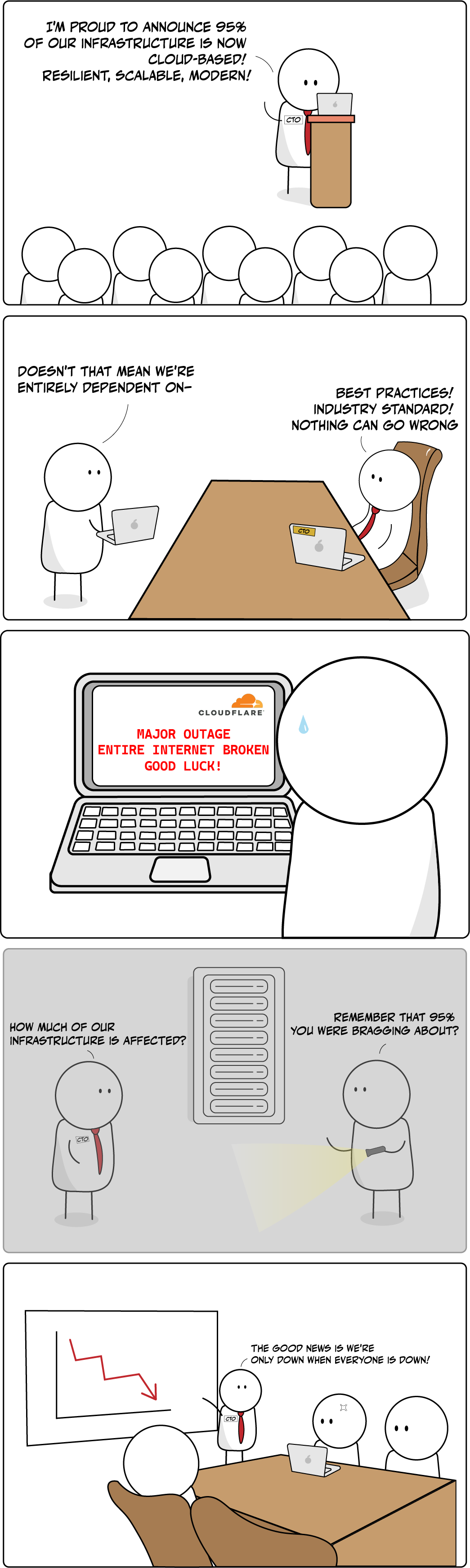
CTO proudly announces they've migrated 95% of their infrastructure to the cloud. Resilient! Scalable! Modern! Buzzword bingo complete. Someone asks the obvious question: "Doesn't that mean we're entirely dependent on—" but gets immediately shut down by the true believers chanting about best practices and industry standards. Nothing can go wrong when you follow the herd, right? Cloudflare goes down. Entire internet broken. Good luck. Turns out that 95% they were bragging about? Yeah, that's how much of their infrastructure just became very expensive paperweights. But don't worry, everyone else is down too, so technically it's a shared problem. That's what cloud-native really means: suffering together at scale.

Cloud Native

Cloud Native
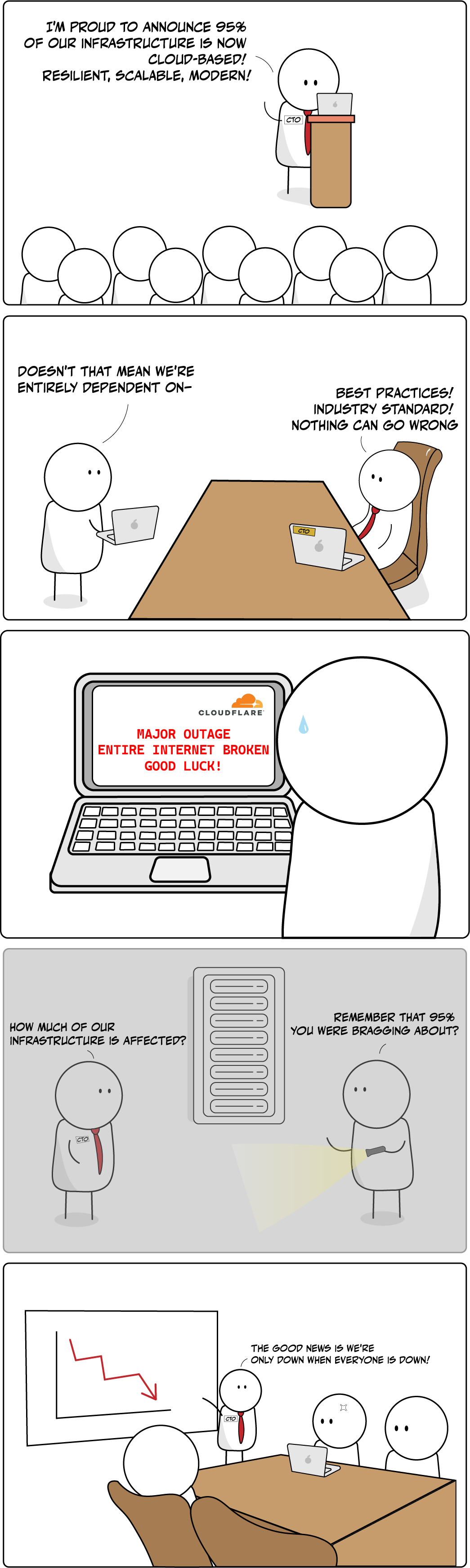
CTO proudly announces they've migrated 95% of their infrastructure to the cloud, throwing around buzzwords like "resilient," "scalable," and "modern" to a room full of impressed stakeholders. Then someone asks the uncomfortable question: "Doesn't that mean we're entirely dependent on—" but gets cut off by the true believer shouting about best practices and industry standards. Nothing can go wrong when you follow the herd, right? Cut to: Cloudflare goes down and the entire internet breaks. Major outage. Good luck! Boss nervously asks how much of their infrastructure is affected. The answer? That 95% they were bragging about. But don't worry! The good news is they're only down when everyone else is down too. Misery loves company, and so does vendor lock-in. Who needs redundancy across multiple providers when you can just... hope really hard that AWS/Azure/GCP stays up? Turns out "cloud-native" sometimes just means "native to someone else's problems."

But Why Would They Do Something Like That?

But Why Would They Do Something Like That?
The guy isn't thinking about other women. He's having nightmares about Microsoft's latest move to force everyone into their ecosystem. First they made Microsoft accounts mandatory, and now the prophecy of subscription-based Windows looms on the horizon. It's the tech equivalent of watching a horror movie where the killer keeps coming back for sequels nobody asked for. Sleep well, fellow sysadmins... if you can.