Segmentation fault Memes

Posts tagged with Segmentation fault
Who's Gonna Tell Him

Who's Gonna Tell Him
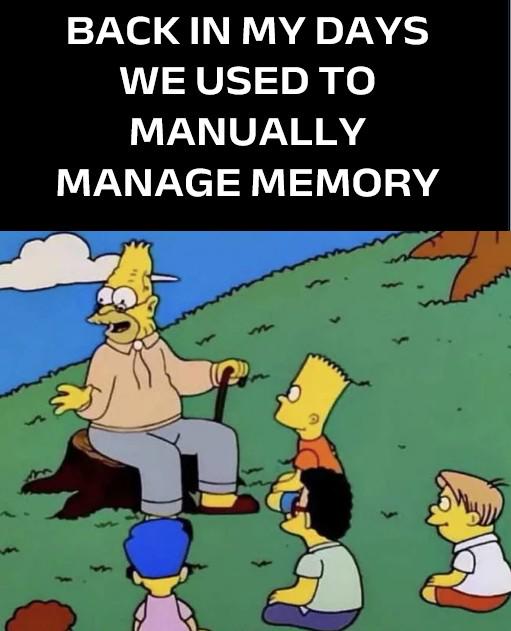
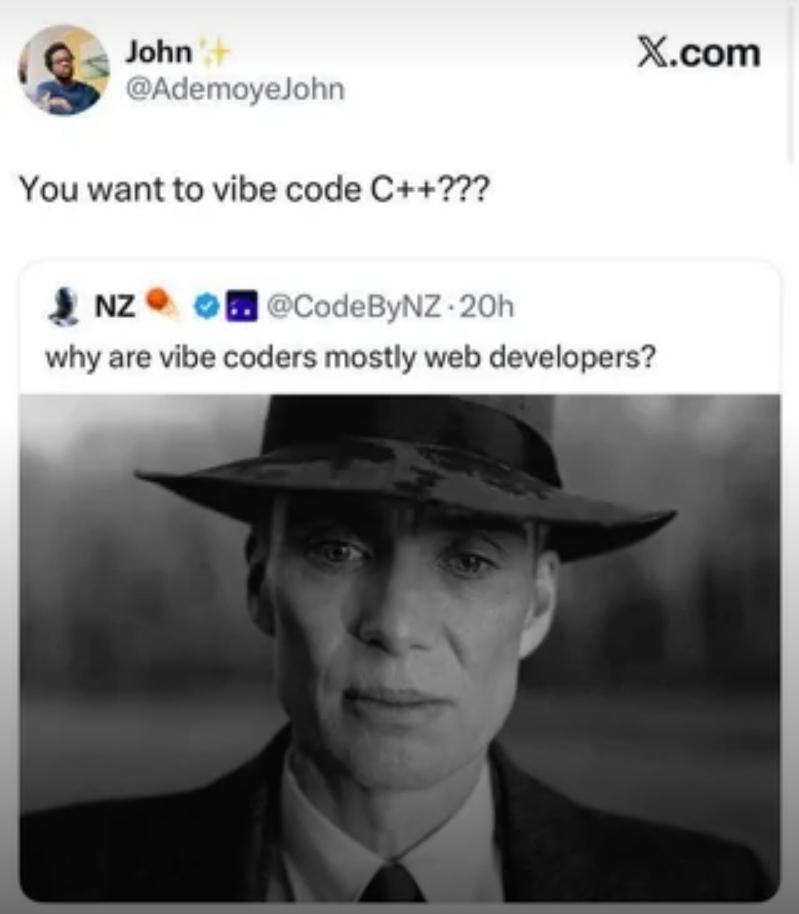
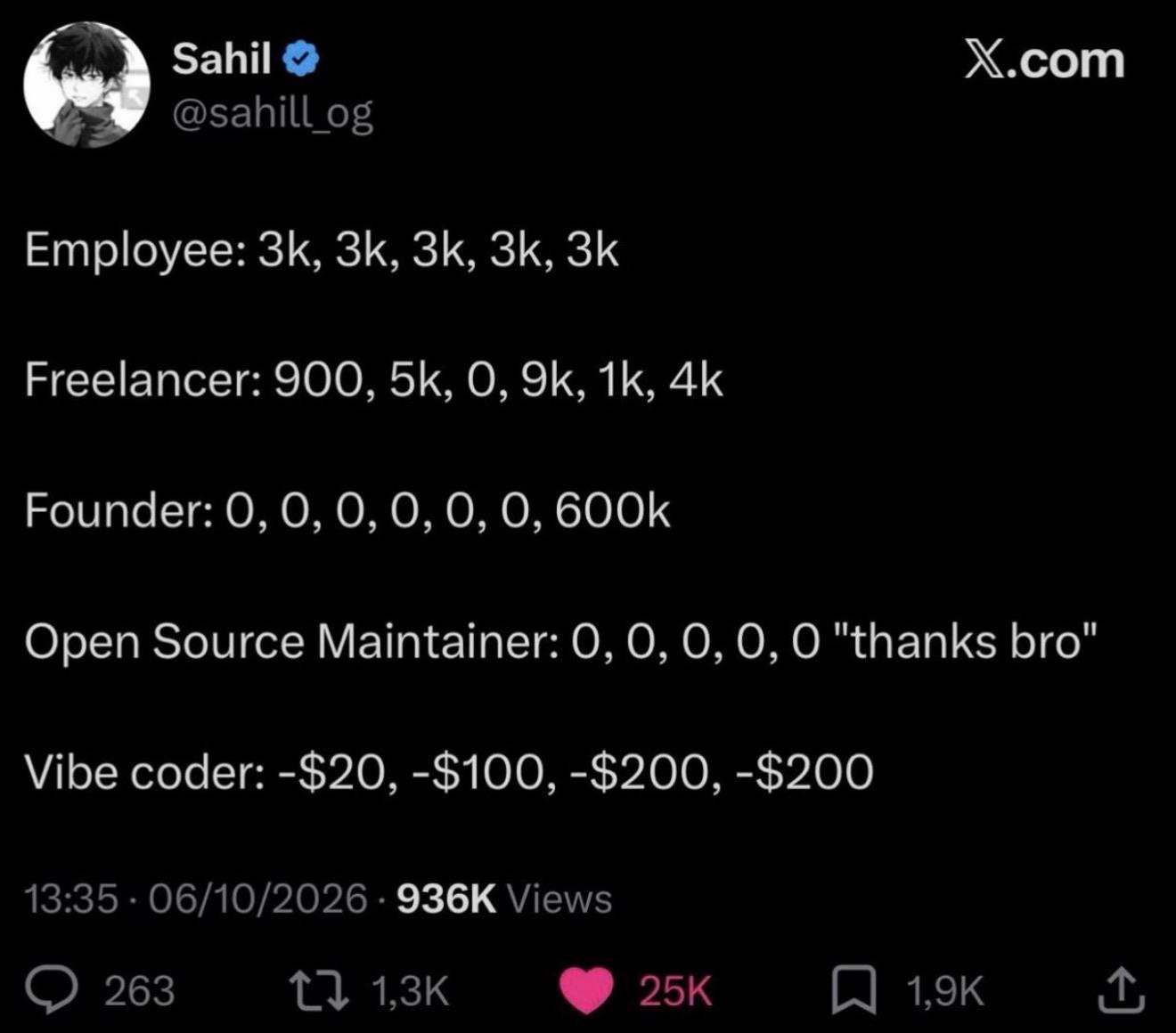
Someone asks if you want to "vibe code C++", and another dev innocently wonders why vibe coders are mostly web developers. The answer? Because nobody who's wrestled with segmentation faults, memory leaks, and template error messages spanning 500 lines would ever describe C++ as "vibing." Web devs get to npm install their way through life while C++ devs are manually managing memory like it's 1985. The Oppenheimer stare says it all—you don't vibe with C++, you *survive* it. It's less of a vibe and more of a Stockholm syndrome situation where you eventually convince yourself that undefined behavior builds character.

Who's Gonna Tell Him

Who's Gonna Tell Him
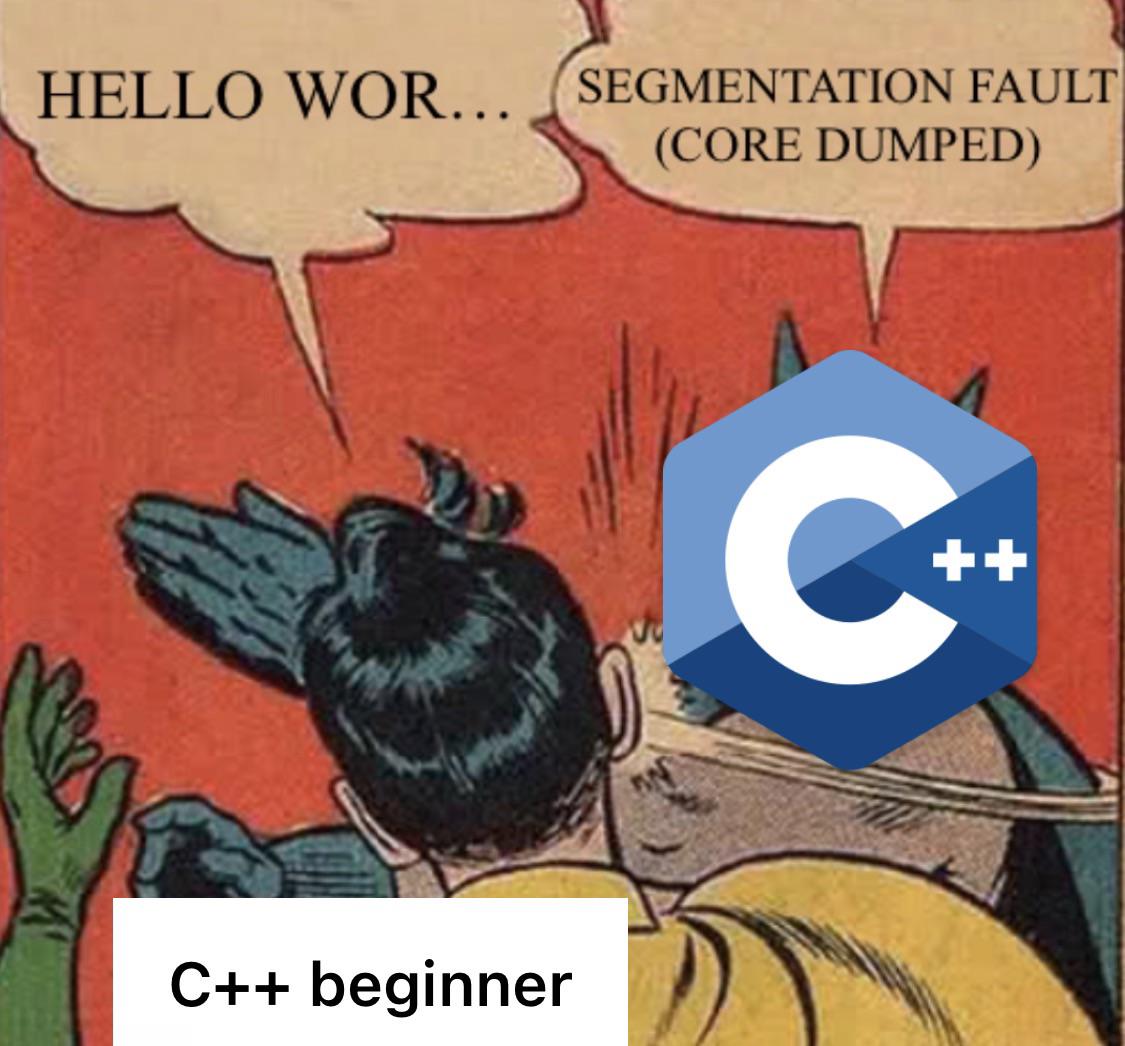
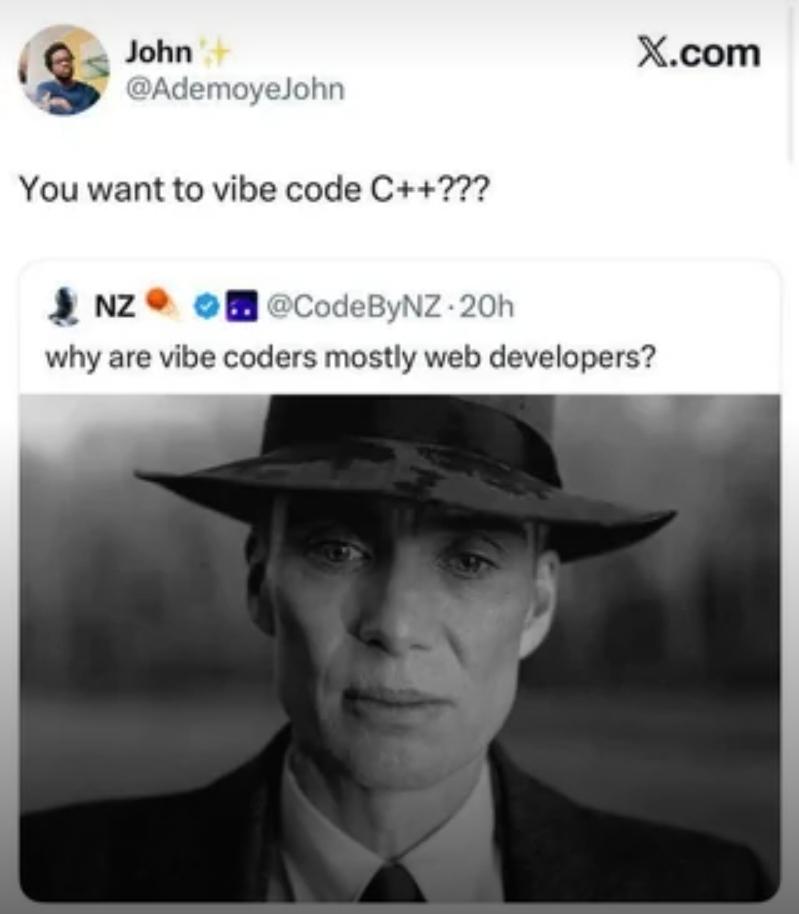
Someone asking if you want to "vibe code C++" is like asking if you want to "chill while getting waterboarded." C++ doesn't vibe—it demands blood sacrifices, segmentation faults at 3 AM, and a PhD-level understanding of template metaprogramming just to print "Hello World" without invoking undefined behavior. The response? "Why are vibe coders mostly web developers?" Translation: because web devs work in languages that don't actively hate them. They get to npm install their way to happiness while C++ developers are still debugging why their destructor called itself recursively and summoned Cthulhu. You can't "vibe" with a language that makes you manually manage memory like you're a janitor cleaning up after a frat party. Web devs are vibing because their biggest problem is which JavaScript framework died this week, not whether their pointer arithmetic just corrupted the entire stack.

Dev Phobia Words Evolution

Dev Phobia Words Evolution
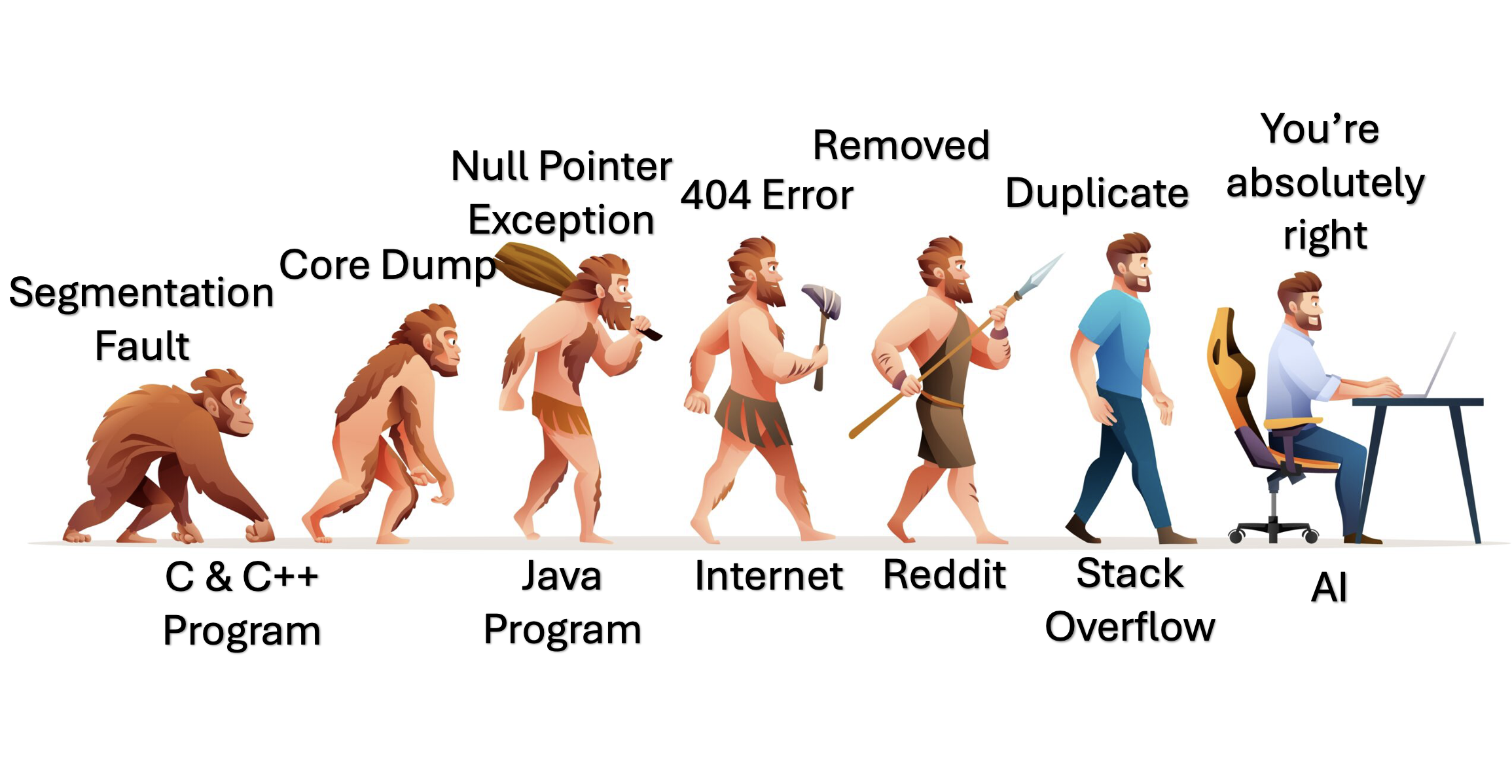
The evolution of developer terror, beautifully visualized. Starting with the prehistoric C/C++ era where "Segmentation Fault" and "Core Dump" made you question your entire existence, we progress through Java's "Null Pointer Exception" phase (complete with a club, because that's how subtle it feels). Then the internet age blessed us with "404 Error" and "Removed" (RIP your favorite library), followed by Reddit's "Duplicate" stamp of shame when you dare ask a question. Stack Overflow brings us "You're absolutely right" – the most passive-aggressive phrase in programming, usually followed by someone explaining why you're actually completely wrong. Finally, we reach peak civilization: AI confidently telling you "You're absolutely right" while generating code that compiles but somehow opens a portal to another dimension. The scariest part? We trust it anyway because it sounds so convincing. The real horror isn't the errors themselves – it's how polite the warnings have become while still destroying your soul.

I Have To Admit He Has A Point

I Have To Admit He Has A Point
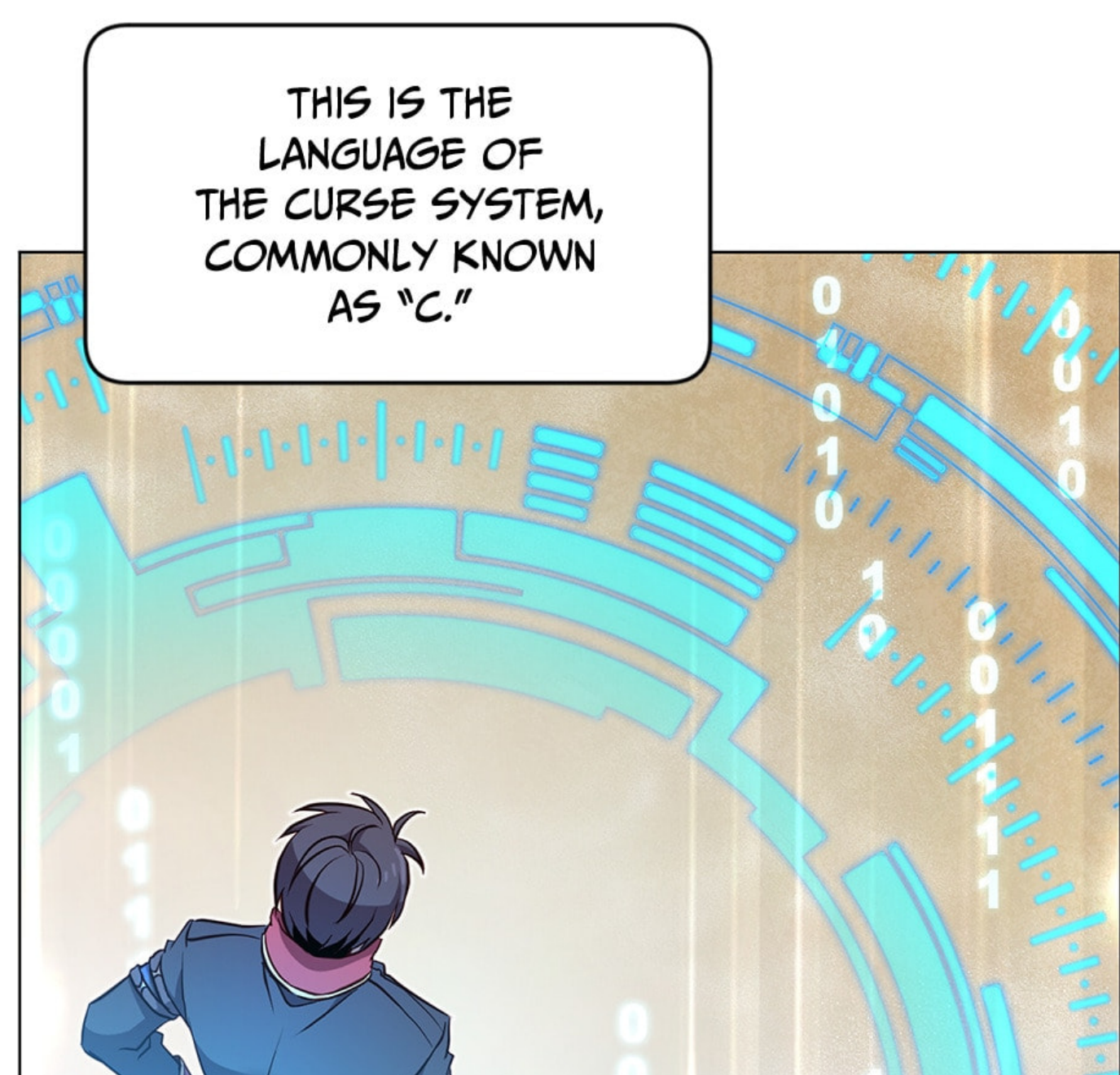
Someone's out here treating C like it's some ancient evil language from a dystopian sci-fi universe, and honestly? The energy is correct. Calling it "the language of the curse system" is the most dramatic yet accurate description of C I've ever heard. It's the programming equivalent of finding an ancient tome that grants you immense power but also slowly drains your life force through segmentation faults and buffer overflows. Sure, C gave birth to pretty much everything we use today, but it also gave us manual memory management, pointer arithmetic nightmares, and the eternal question: "Did I remember to free() that?" It's like respecting your grandpa who built the family business with his bare hands but also refuses to use a smartphone and insists everything was better when you had to walk uphill both ways to compile your code.

I Might Be Bad

I Might Be Bad
When you're learning C++ and think you're making progress, but plot twist: you're just creating increasingly sophisticated ways to shoot yourself in the foot. It's like taking a perfectly functional machine (your body/code) and transforming it into something even more cursed through the dark arts of manual memory management, pointer arithmetic, and undefined behavior. The skeleton perfectly represents what happens to your soul after debugging your tenth segmentation fault of the day. At least with regular C++ you know what's killing you—with "worse C++" you've somehow invented new and creative ways to suffer that the language designers never even imagined possible.

In A While, Pointer Pile

In A While, Pointer Pile
When you forget to free your memory in C/C++, the garbage collector doesn't come to save you—it's just you and your memory leaks in the wild west of manual memory management. The figure is having an existential crisis over leaking a memory reference, while the demonic "WHEEZE" face is cackling "See ya later, allocator!" because that memory is now lost forever in the heap. It's like forgetting to close the fridge door, but instead of spoiled milk, you get a slowly dying application that your users will absolutely blame you for.

Wouldn't Have Happened With Rust

Wouldn't Have Happened With Rust
Caveman programmer sitting in his prehistoric cave, debugging code that probably caused the extinction event outside, while smugly thinking "wouldn't have happened with Rust." The irony of using Stone Age hardware to advocate for memory-safe languages is just... *chef's kiss*. Meanwhile, his RGB gaming setup runs on actual fire. Safety first, I guess.

The C Compiler's Diabolical Indifference

The C Compiler's Diabolical Indifference
Oh. My. GOD. The AUDACITY of C compilers!!! 😱 While normal compilers will SCREAM at you with 47 error messages for a missing semicolon, C compiler sees you dereferencing a NULL pointer and just goes "*(int*)0 = 0; GOOD LUCK" with a smug little wink. It's like handing a toddler scissors and saying "have fun storming the castle!" Pure CHAOS ENERGY. Your program is about to crash so spectacularly that NASA will detect the explosion from space, but C compiler's just like "not my problem, sweetie! 💅" This is why C programmers wake up with cold sweats at 2am wondering if they've accidentally created a time bomb.

C Doesn't Make Runtime Errors

C Doesn't Make Runtime Errors
The C language doesn't accidentally create runtime errors—it gives you just enough rope to hang yourself with pointers and memory management, then stands back to watch the chaos unfold. It's like driving without seatbelts by design. "Segmentation fault? That's not a bug, that's a feature!" Sure, you can write blazing fast code, but at what cost? Your sanity and three days of debugging why your program randomly crashes when the moon is waxing gibbous.

Holy C: The Divine Programming Language

Holy C: The Divine Programming Language
When the textbook writers finally speak the truth! C truly is divine - created on the 8th day when Dennis Ritchie looked at assembly and said "let there be pointers." Meanwhile, C++ is apparently what happens when the programming gods have a rebellious phase. The memory management struggles are indeed a test of faith. Segmentation faults are just digital sins we must atone for.

The Language Learning Spectrum Of Pain

The Language Learning Spectrum Of Pain
The eternal language transition struggle, perfectly captured! C++ devs pick up Python like it's a vacation—suddenly no memory management, no pointers, and indentation actually matters? What a breeze! Meanwhile, Python devs trying C++ are basically attempting to swallow a shotgun. "What do you mean I have to manually free memory? SEGMENTATION FAULT AGAIN?!" Nothing says "welcome to C++" quite like contemplating your life choices at 3 AM while debugging a pointer error that shouldn't even exist.

C++ In One Video

C++ In One Video
The initial excitement of "LEARN C++ IN ONE VIDEO" quickly dissolves into horror when you notice the video length: 2:52 / 35040:04 . That's right—nearly four years of continuous playback! The facial expressions perfectly capture that moment when you realize mastering pointers, memory management, and template metaprogramming isn't quite the quick weekend project you'd hoped for. The background text listing concepts like "Constructors Destructors" and "Static Encapsulation" is just the compiler rubbing salt in your segmentation fault.