

Protocols Memes

Posts tagged with Protocols
Saw Alice And Bob Again

Saw Alice And Bob Again
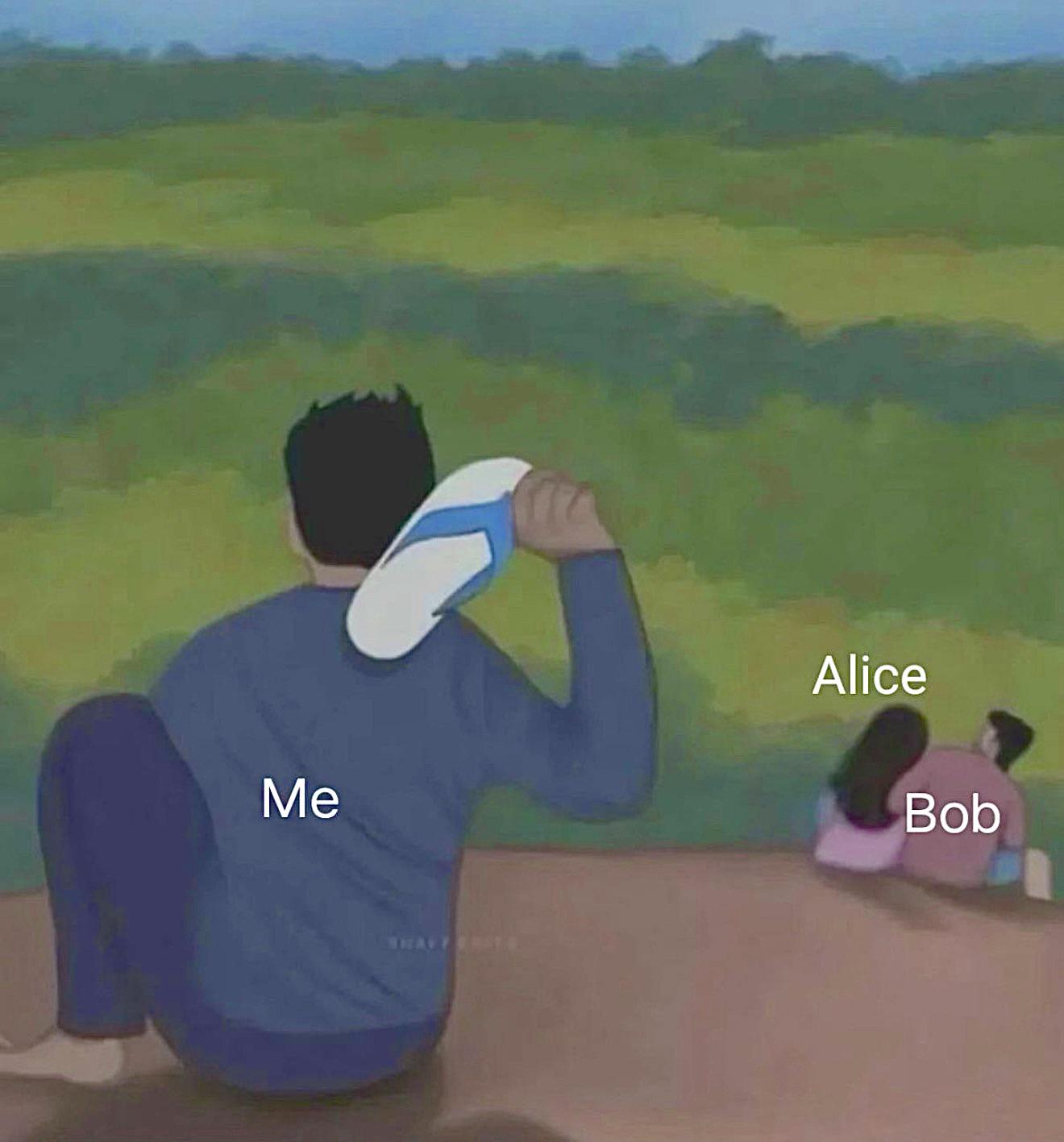
You know you've been reading too much cryptography documentation when you start spotting Alice and Bob in the wild like they're celebrities. For those blissfully unaware, Alice and Bob are the legendary placeholder characters used in literally every security, encryption, and networking example since the dawn of time. They're always exchanging keys, sending encrypted messages, or getting eavesdropped on by Eve. Here you are, lonely dev sitting by yourself, watching Alice and Bob do their thing in yet another RFC or textbook. They're out there living their best cryptographic lives while you're just trying to understand why your SSL handshake is failing. The loneliness is real when your only companions are hypothetical entities from protocol specifications. Fun fact: Alice and Bob were first introduced in a 1978 paper by Ron Rivest, Adi Shamir, and Leonard Adleman (the RSA crew). Before that, cryptographers just used "A" and "B" like absolute psychopaths. At least now our abstract examples have names we can emotionally attach to.

At Least UDP Is Faster

At Least UDP Is Faster
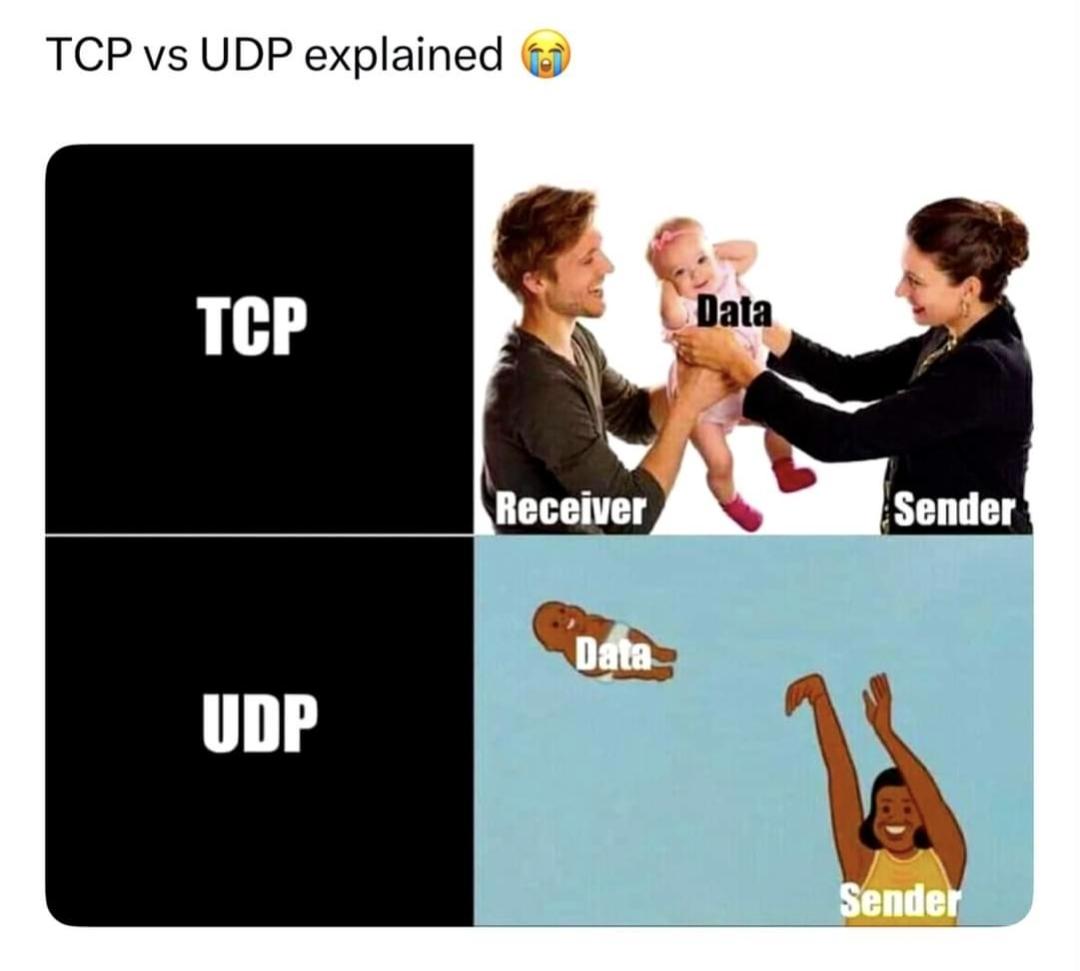
TCP: "Did you get the baby? Confirm receipt. Please acknowledge. Are you there? Baby transfer successful?" UDP: "YEET! ✨ My job here is done." TCP is that overprotective parent carefully handing over the precious cargo with both parties involved, making sure every single packet—err, baby—arrives safely. Meanwhile, UDP just launches data into the void like a trebuchet and goes about its day. Did it arrive? Who knows! Who cares! Speed is life! Perfect for video streaming where losing a frame or two won't kill anyone. Less perfect for, say, banking transactions. Choose your protocol wisely, folks—unless you enjoy explaining to your boss why half the customer data landed in the digital equivalent of a ditch.

Not Very Secure

Not Very Secure
Someone asked Reddit what screams "I'm insecure" and got the most technically accurate answer possible: http:// Because nothing says "please intercept my credentials" quite like transmitting data over plain HTTP in 2024. Your passwords are traveling through the internet like postcards—everyone can read them, and there's no envelope. It's the digital equivalent of shouting your credit card number across a crowded room and hoping only the cashier hears it.

Are We Seeing A Pattern Here

Are We Seeing A Pattern Here
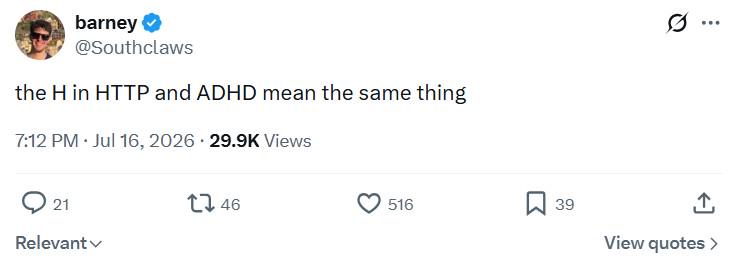
So the "H" in HTTP stands for "Hyper" and the "H" in ADHD stands for "Hyperactivity." Both protocols involve rapid, unpredictable jumping between states with minimal warning. HTTP bounces between requests and responses like a caffeinated squirrel, while ADHD bounces between tasks like... well, also a caffeinated squirrel. The only difference is one of them occasionally returns a 200 OK status, and the other just returns to the task you abandoned 47 tabs ago.

100Pcs Programming Stickers for Laptop, Water Bottles - Coding, Developer, Geeky Stickers Vinyl - Gifts for Computer Programmers, for Coders - Programming Party Supplies

100Pcs Programming Stickers for Laptop, Water Bottles - Coding, Developer, Geeky Stickers Vinyl - Gifts for Computer Programmers, for Coders - Programming Party Supplies
Sticks Well on Multiple Surfaces – Our premium vinyl stickers are made to stick securely to laptops, water bottles, phone cases, journals, skateboards, and even car windows. Each sticker uses durable…

Packet Loss Is A State Of Mind

Packet Loss Is A State Of Mind
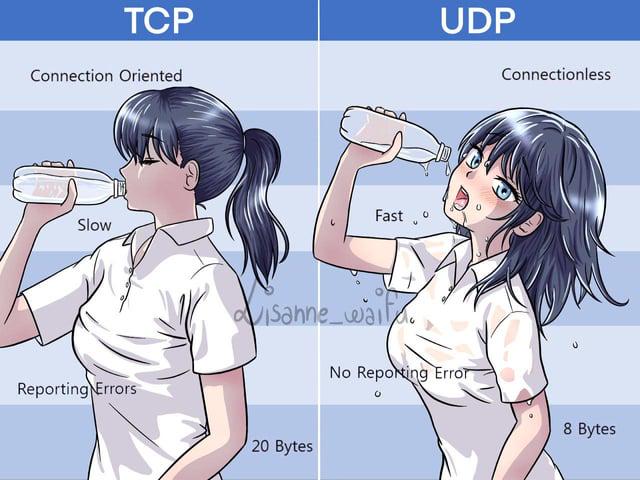
TCP drinks water like a responsible adult at a formal dinner party - slow, deliberate, making sure every drop gets where it's supposed to go. Meanwhile UDP is chugging that bottle like it's the last water on Earth, not caring if half of it ends up on the floor. TCP's over here with its three-way handshake, ACK packets, and error reporting, basically helicopter parenting every single byte. "Did you get that? Let me know you got that. Okay sending the next one." 20 bytes of overhead just to make sure nobody gets lost. UDP? Zero cares given. Fire and forget. 8 bytes, no error reporting, connectionless chaos. Your packets might arrive, they might not, they might show up in the wrong order - UDP's already moved on with its life. Perfect for video streaming where you'd rather have speed than wait for that one pixel from 5 seconds ago to finally show up.

New RFC Was Just Published!!!

New RFC Was Just Published!!!
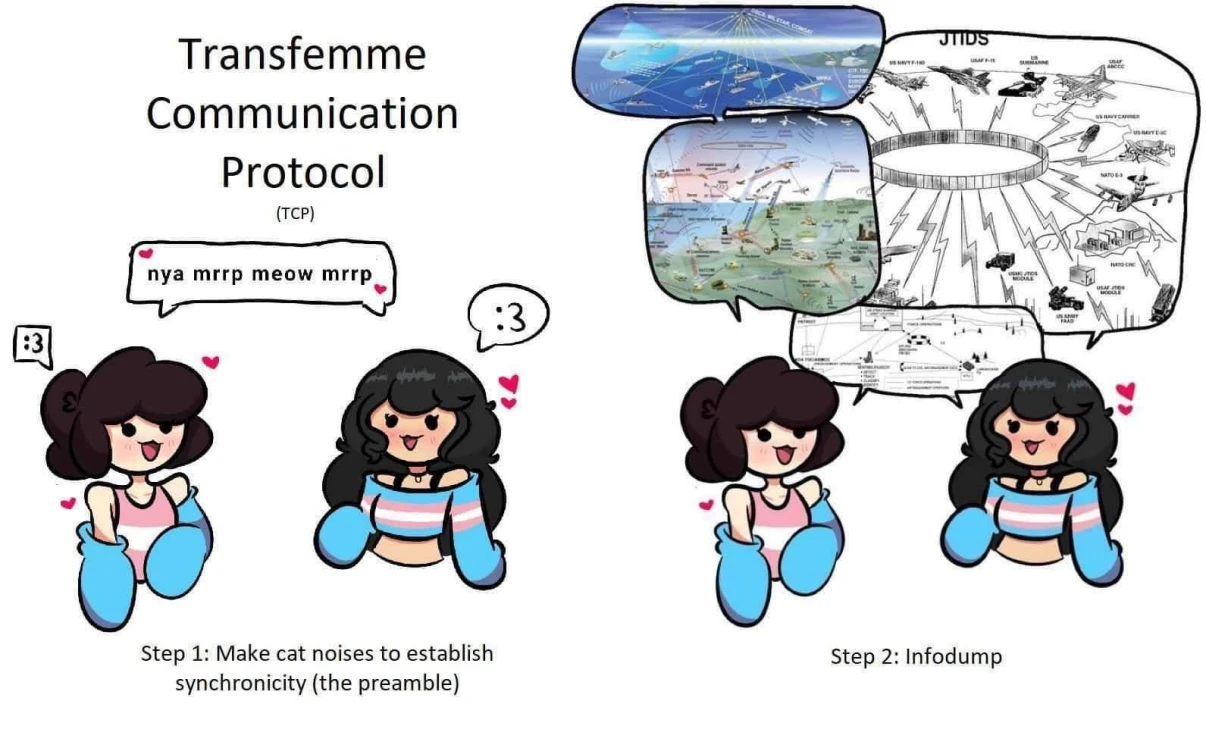
Someone just reinvented the TCP three-way handshake but make it adorable . Step 1 is basically SYN/SYN-ACK but with "nya mrrp meow mrrp" instead of sequence numbers, and Step 2 dumps the entire internet infrastructure diagram on you like a normal ACK packet. The beauty here is how accurately it captures the vibe of reading actual RFCs. You start with simple, cutesy explanations of the preamble and handshake process, then BAM—suddenly you're staring at a diagram that looks like it was designed by someone who thinks "simplicity" means showing every single router, submarine cable, and satellite relay between your laptop and the server. Fun fact: RFC 793 (the actual TCP spec) is 85 pages long and somehow both incredibly detailed and frustratingly vague. The transfemme energy of making cat noises to establish synchronicity before unleashing technical chaos is honestly peak protocol design.

One Big Mac Coming Up, Sir

One Big Mac Coming Up, Sir
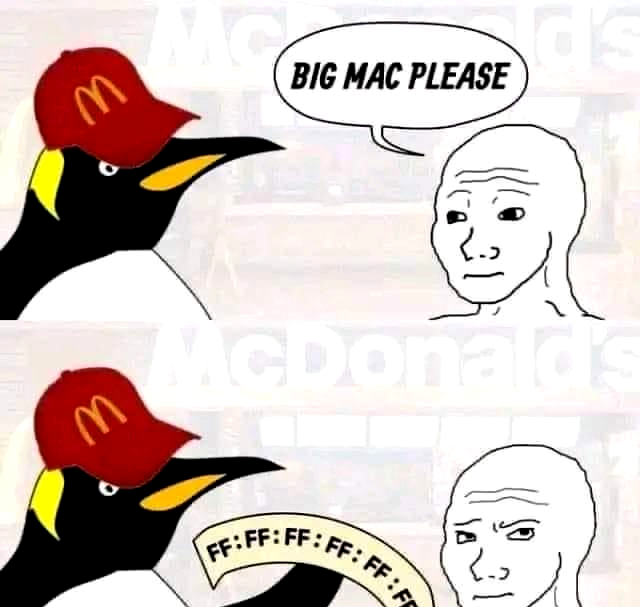
Customer walks into McDonald's and politely orders a Big Mac. McDonald's employee, being the absolute OVERACHIEVER they are, responds with the hexadecimal equivalent: FF:FF:FF:FF:FF:FF . Because why use simple human language when you can flex your networking knowledge and serve up a broadcast MAC address instead? Nothing says "here's your burger" quite like addressing EVERY device on the local network simultaneously. The customer's face says it all – they just wanted a sandwich, not a lesson in layer 2 networking protocols. Fun fact: FF:FF:FF:FF:FF:FF is the broadcast MAC address that sends packets to all devices on a network segment. So technically, EVERYONE is getting that Big Mac. Communist burger distribution at its finest.

Know Thy Protocol

Know Thy Protocol
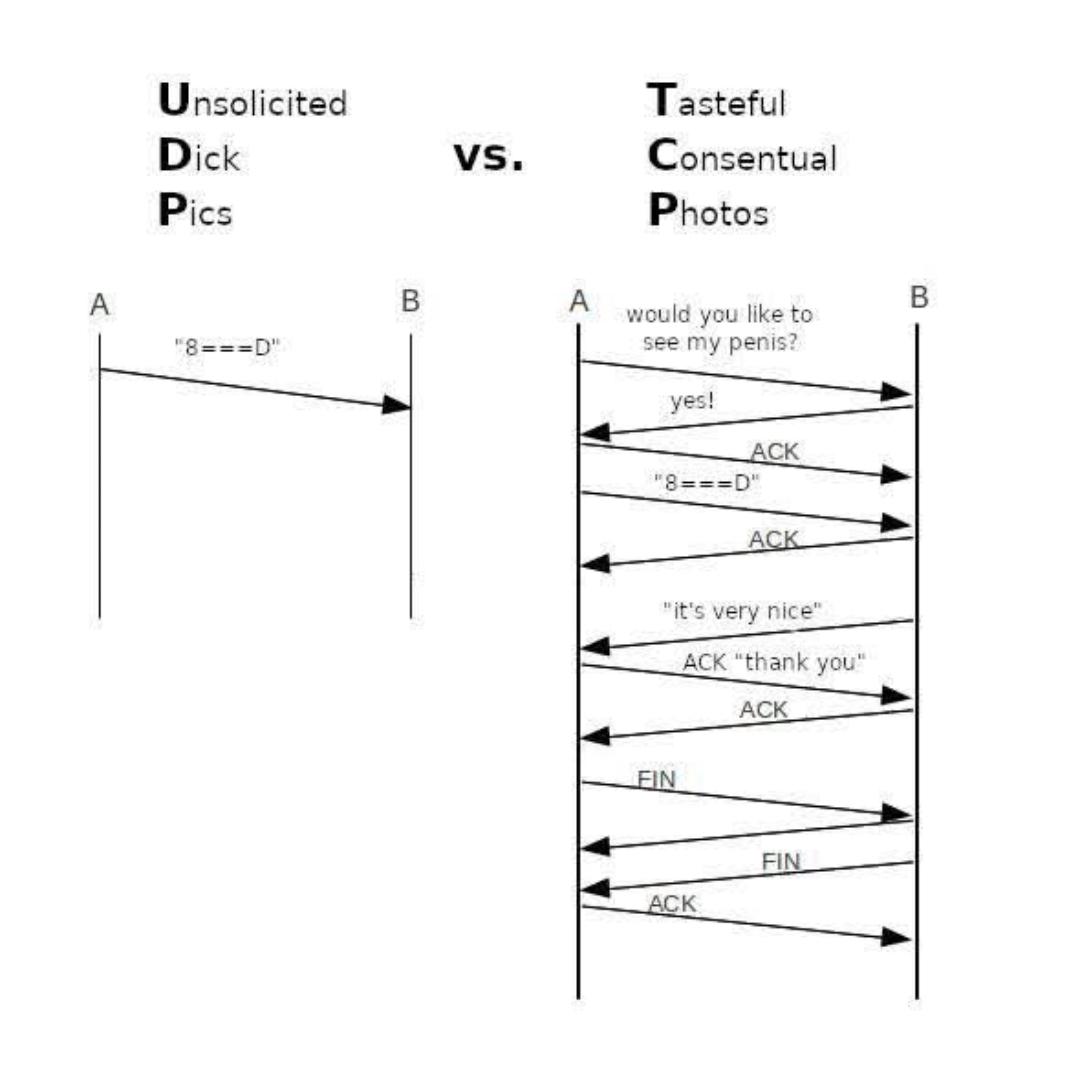
UDP vs TCP but make it wildly inappropriate. The left side shows UDP doing its thing—just yeeting that dick pic into the void with zero confirmation, no handshake, no nothing. Classic fire-and-forget protocol energy. Meanwhile TCP on the right is out here establishing a full three-way handshake before sending anything, complete with consent verification, acknowledgments for every message, and a proper connection termination with FIN packets. It's the networking equivalent of asking "may I?" before every single action. The best part? TCP even acknowledges the compliment AND the thank you. That's some next-level reliable delivery right there. UDP could never—it doesn't even know if its packet arrived, let alone whether anyone appreciated it. This is what they mean when they say "connection-oriented vs connectionless protocols" in your networking textbook, just with significantly more inappropriate metaphors than your professor used.

Vilros Raspberry Pi 5-4GB Starter Kit - Turbo Cooled Edition - 32GB Memory (Aluminum Black)

Vilros Raspberry Pi 5-4GB Starter Kit - Turbo Cooled Edition - 32GB Memory (Aluminum Black)
A RASPBERRY PI 5 KIT FROM AN APPROVED RESELLER: This Vilros Complete Starter Kit for Pi 5 Includes Raspberry Pi 5 Board with all the accessories you need to get started. · 9 PART KIT INCLUDES MOST AC…

What If We Yeet The Data

What If We Yeet The Data
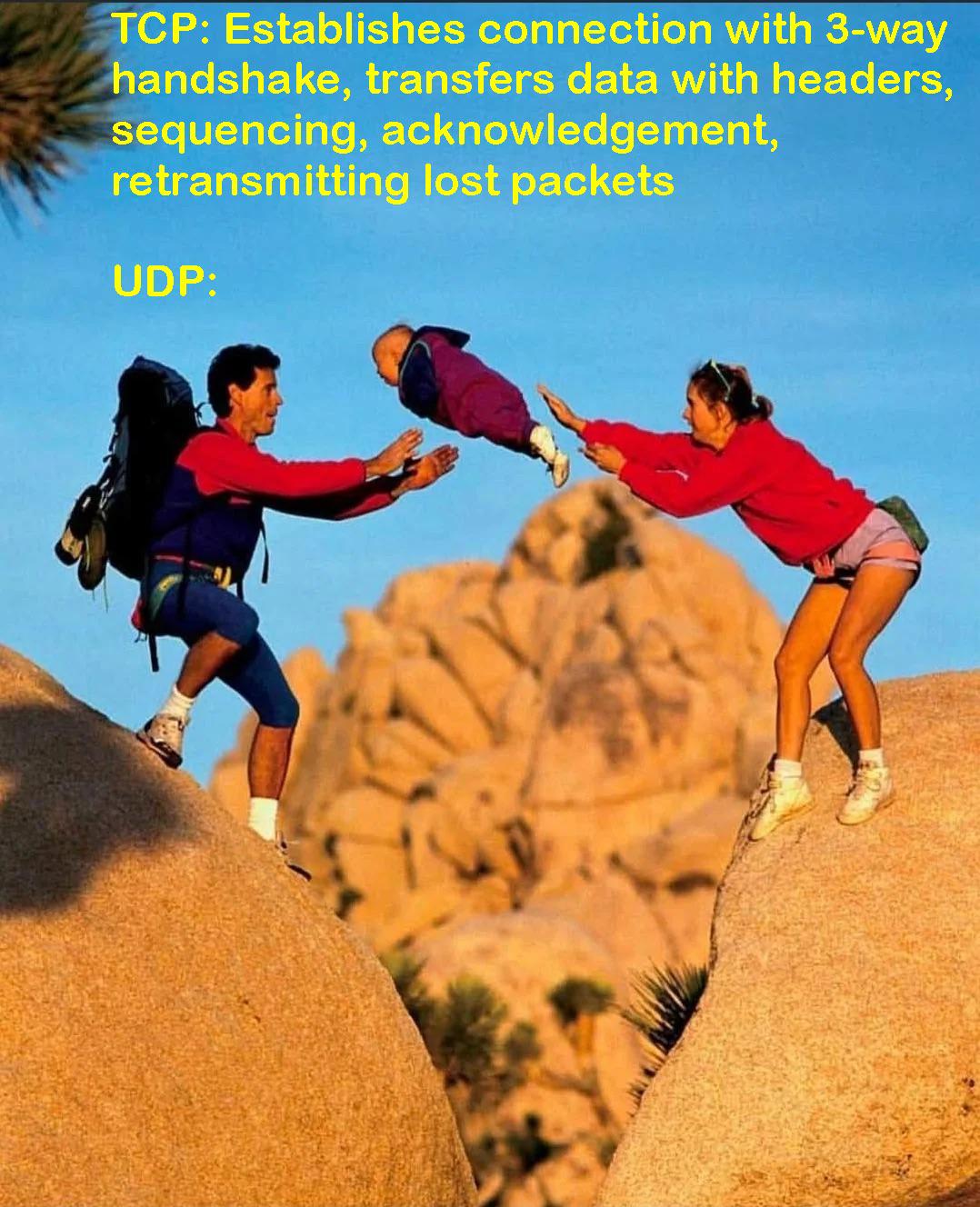
TCP is that overprotective parent who walks you through every step, confirms you got the message, and makes sure nothing gets lost. Meanwhile, UDP is out here just launching packets into the void like "good luck, buddy!" and moving on with its life. TCP does all the heavy lifting with its 3-way handshake, sequencing, acknowledgments, and retransmissions—basically the networking equivalent of sending a certified letter with tracking. UDP? Just yeeting data packets across the network with zero regard for whether they arrive or in what order. No handshake, no acknowledgment, no second chances. Fire and forget, baby. This is why video streaming and online gaming use UDP—because who cares if you lose a frame or two? But when you're downloading files or loading web pages, you better believe TCP is there making sure every single byte arrives intact. Choose your protocol based on whether you value reliability or just vibes.

Different Types Of Delivering Packets

Different Types Of Delivering Packets
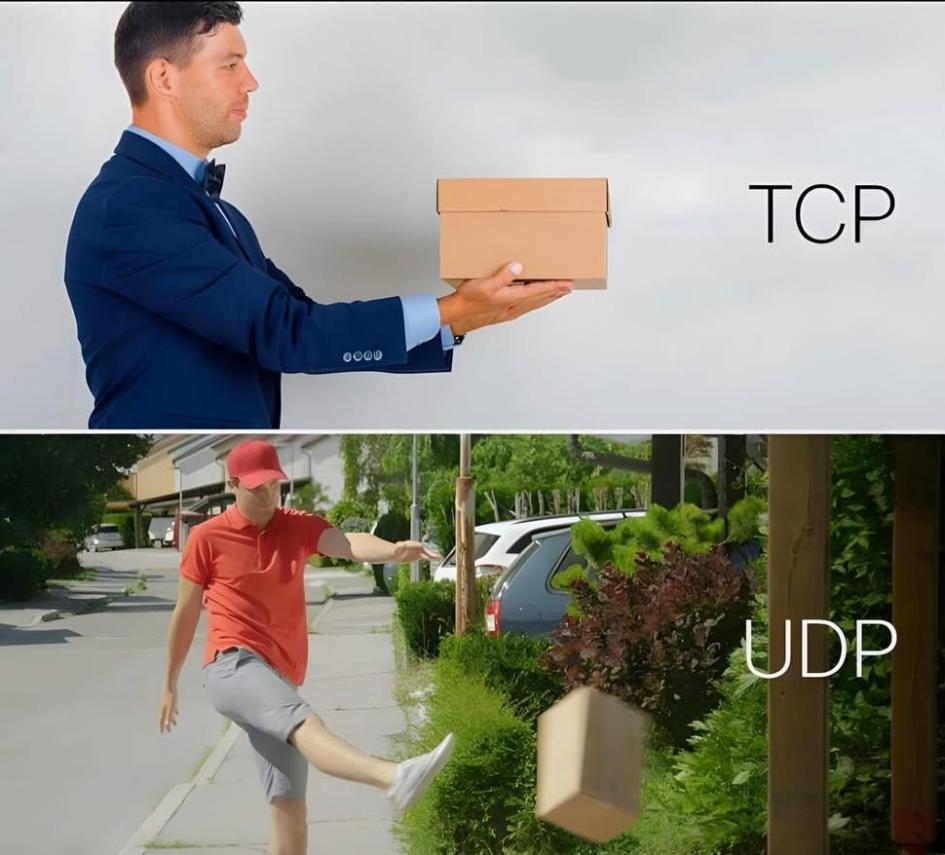
The perfect visualization of network protocols! TCP is that formal gentleman who carefully hands you the package, waits for confirmation, and probably has a spreadsheet tracking delivery times. Meanwhile, UDP is just yeet-and-forget—kicking packages in the general direction of your house and sprinting away before anyone notices. No wonder streaming services love UDP. "Did that packet of your Netflix show not arrive? Too bad, here's the next frame coming at your face anyway!" TCP would never—he's still waiting for you to sign for the last one.

Not Received Or Not Delivered

Not Received Or Not Delivered
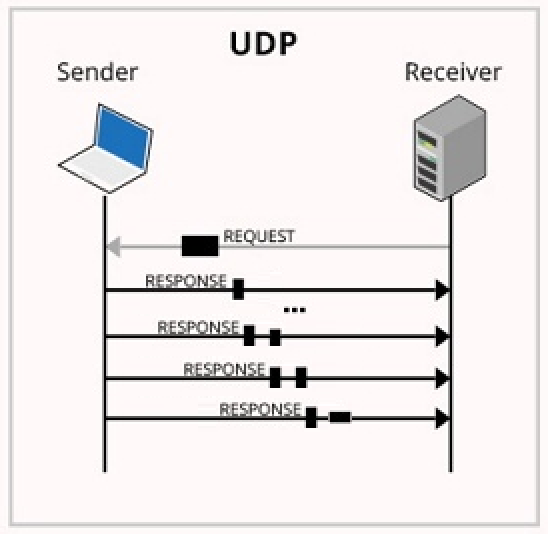
The server is just yeeting responses into the void and hoping for the best! UDP (User Datagram Protocol) is basically the networking equivalent of throwing paper airplanes out a window and not caring if they reach their destination. Unlike its responsible older sibling TCP, UDP doesn't wait for acknowledgments or bother with retransmissions. It's the digital manifestation of "fire and forget" – perfect for streaming, gaming, and situations where dropping packets is preferable to waiting. The diagram perfectly captures how the server just keeps blasting responses without checking if anything arrived. Hey, did you get my packet? Who knows! Who cares!

The Secret Handshake Of Port 67

The Secret Handshake Of Port 67
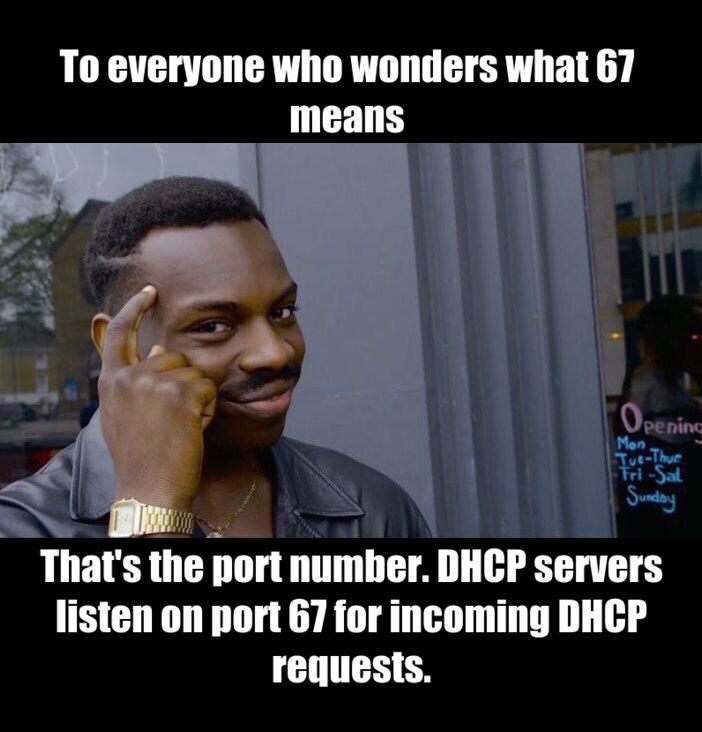
The number of people who know that DHCP servers listen on port 67 is inversely proportional to the number of people who've ever had to manually configure network settings. For most folks, networks just "work magically" until they don't. Meanwhile, the networking veterans are tapping their temples because they've debugged enough connection issues to know that port 67 is where all your IP address begging happens. It's like knowing the secret handshake at the exclusive club called "I've actually read an RFC."

Git Sticker Decal Window Bumper Sticker Vinyl 5"

Git Sticker Decal Window Bumper Sticker Vinyl 5"