Prompt engineering Memes

Posts tagged with Prompt engineering
They Already Hooked On Hard

They Already Hooked On Hard
Georgia Tech students getting their first taste of Claude AI is like giving someone their first line of premium cocaine—except instead of a drug dealer, it's Anthropic, and instead of ruining your life, it just ruins your ability to ever write code from scratch again. The headline "humans are still critical to software coding" is doing some heavy lifting here. Yeah, humans are "critical"—in the same way a pilot is critical to autopilot. Sure, you're technically there, but let's be real: you're just vibing while the AI does the actual work. These students got three hours to build an app, and they probably spent 2 hours and 45 minutes crafting the perfect prompt while Claude churned out production-ready code. The real tragedy? Once you go Claude, you can't go back. Try writing a for-loop manually after this and your brain just screams "WHY AM I DOING THIS LIKE A PEASANT?" Welcome to the future, kids—where your most valuable skill is knowing how to sweet-talk an LLM.

Umm... Still An Engineer Though....

Umm... Still An Engineer Though....
The brutal honesty here cuts deep. Dad's not impressed that you're just copy-pasting from ChatGPT and calling yourself an "AI Engineer." The man probably spent 30 years debugging assembly code with a soldering iron in one hand, and now his kid's entire job is typing "make this work but better" into a text box. But hey, the market pays six figures for prompt engineering now, so who's really winning? Spoiler: still not getting dad's approval though. Some wounds never heal.

I Am Professional Seat Warmer

I Am Professional Seat Warmer
So you call yourself a "prompt engineer" because you type fancy sentences into ChatGPT? Congrats, you've achieved the same skill level as someone who presses microwave buttons. Both require extensive training in... reading instructions and hoping for the best. The brutal honesty here is that "prompt engineering" went from sounding like cutting-edge AI wizardry to basically being a glorified Google search with extra steps. Sure, you can craft the perfect prompt with context, temperature settings, and token limits—but let's be real, you're still just asking a chatbot to do your homework while pretending it's "engineering." The microwave button physicist comparison is *chef's kiss* because both involve zero understanding of what's actually happening under the hood. You don't need to know how transformers work or understand attention mechanisms—just mash those buttons until something edible comes out. Professional seat warmer indeed.

You Just Prompt Wrong Make Better Prompt

You Just Prompt Wrong Make Better Prompt
So you wanted Claude to be this powerful, fire-breathing dragon that crushes your coding problems with raw intelligence. Instead, you got a circus clown juggling your edge cases like they're balloon animals. The problem? According to every AI enthusiast on LinkedIn, it's YOUR fault for not crafting the perfect prompt. Just add more context! Be more specific! Use chain-of-thought reasoning! Throw in some XML tags! Before you know it, you're writing a 500-word essay just to ask Claude to write a function that adds two numbers. Meanwhile, Claude's over here treating your meticulously documented requirements like a suggestion box, confidently hallucinating solutions that would make Stack Overflow moderators cry. But hey, it's not the AI's fault—you just need to become a prompt engineering wizard first.

Why Do Anything When LLM Can Do It

Why Do Anything When LLM Can Do It
So we're just gonna let the AI decide what to do with our databases now? Cool, cool, cool. No need for structured endpoints, versioning, documentation, or any of that pesky software engineering discipline we've been doing for decades. Just yeet a natural language prompt at a POST endpoint and let the AI agent figure out whether you want to SELECT, UPDATE, or DROP TABLE. What could possibly go wrong? The beautiful irony here is that we spent years perfecting REST conventions—proper HTTP verbs, resource-based URLs, predictable status codes—only to throw it all away for "here's some words, good luck." It's like replacing a precisely calibrated API contract with a game of telephone where the other person is a statistical model that occasionally hallucinates. Can't wait for the incident postmortem: "The AI interpreted 'delete old records' as 'delete ALL records' because the prompt was ambiguous and we had zero type safety." But hey, at least we won't need API documentation anymore—just vibes and hope.

UPLIFT DESK V3 2-Leg Black Laminate Wood Standing Desk – Adjustable Height, Advanced 1-Touch Memory Keypad, Under Desk Cable Management, Wire Grommets & Rocker Board (Black C-Frame, 60 x 30 inch)

UPLIFT DESK V3 2-Leg Black Laminate Wood Standing Desk – Adjustable Height, Advanced 1-Touch Memory Keypad, Under Desk Cable Management, Wire Grommets & Rocker Board (Black C-Frame, 60 x 30 inch)
SEAMLESS ELECTRIC HEIGHT ADJUSTMENT: The Advanced Keypad with one-touch control and four memory presets ensures effortless transitions. This adjustable standing desk lets you switch between sitting a…

It Ensures That The Agent Does A Good Job

It Ensures That The Agent Does A Good Job
Someone added a single line to a repository guidelines file, and naturally, the reviewer questions whether this is just burning API tokens for no reason. The author's defense? "It ensures that the agent does a good job." Classic AI agent prompt engineering move right here. You know those vague instructions you add to your LLM prompts hoping they'll magically improve output quality? "Be thorough." "Do your best." "Think carefully." It's like telling your code to "run faster" in a comment. The reviewer correctly identifies this as inconsequential fluff, but the author is convinced their motivational pep talk to the AI is mission-critical. Fun fact: LLMs don't actually have feelings or work ethic. Adding "do a good job" to your prompt is about as effective as saying "please" to your compiler. But hey, at least it makes us feel better about our AI overlords.

Every Year This Tweet Becomes More And More Real

Every Year This Tweet Becomes More And More Real
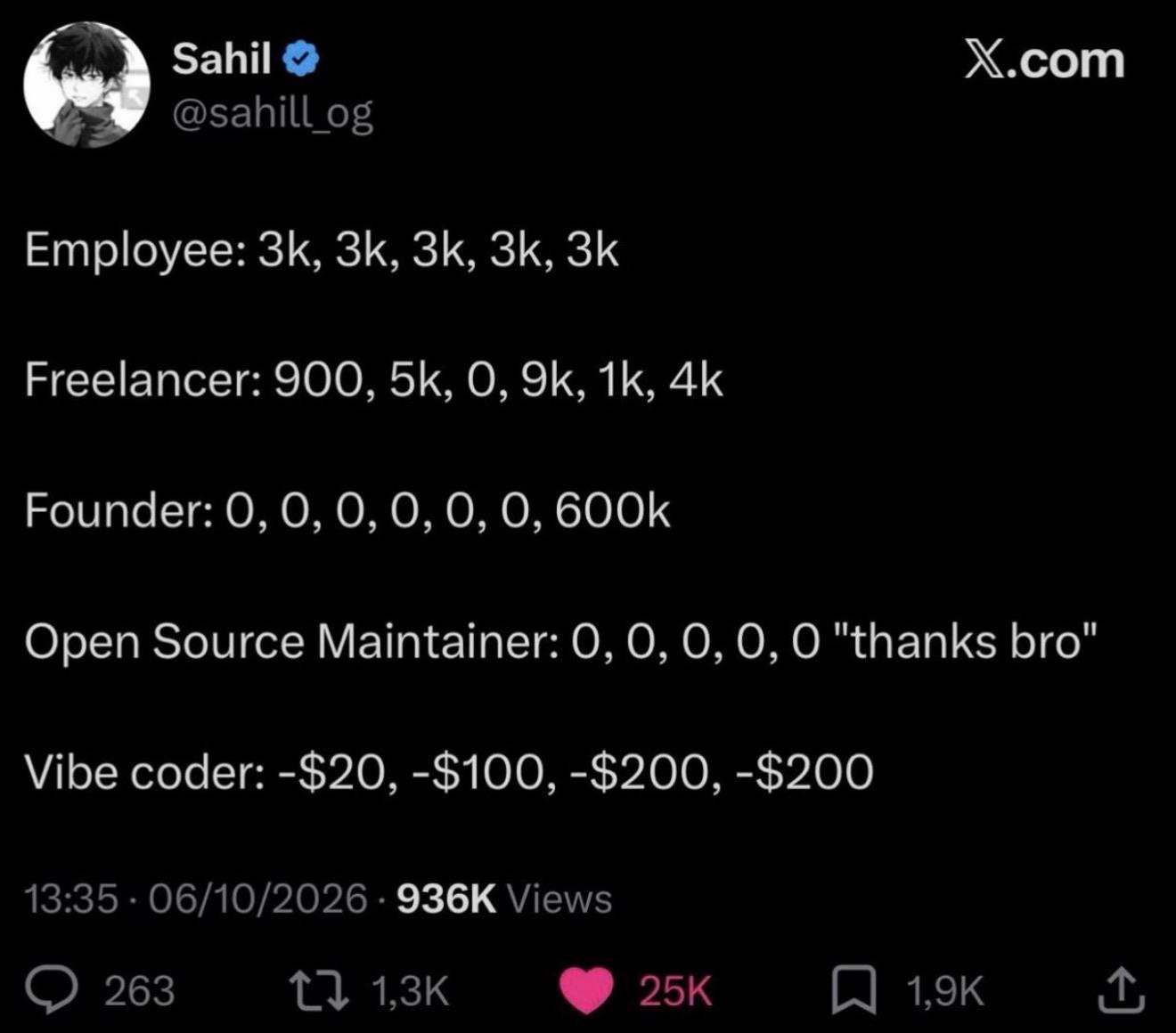
Turns out the real programming language was the documentation we read along the way. With AI code generation, low-code platforms, and frameworks so abstracted you're basically writing YAML configs, we've come full circle to just... describing what we want in plain English. Why learn Rust's borrow checker when you can just politely ask ChatGPT to fix your memory leaks? The industry's gone from "learn to code" to "learn to prompt engineer" faster than you can say "npm install." 11.4M views because everyone knows it's true but nobody wants to admit their job is becoming increasingly indistinguishable from talking to a very pedantic rubber duck.

One Liner To API Call

One Liner To API Call
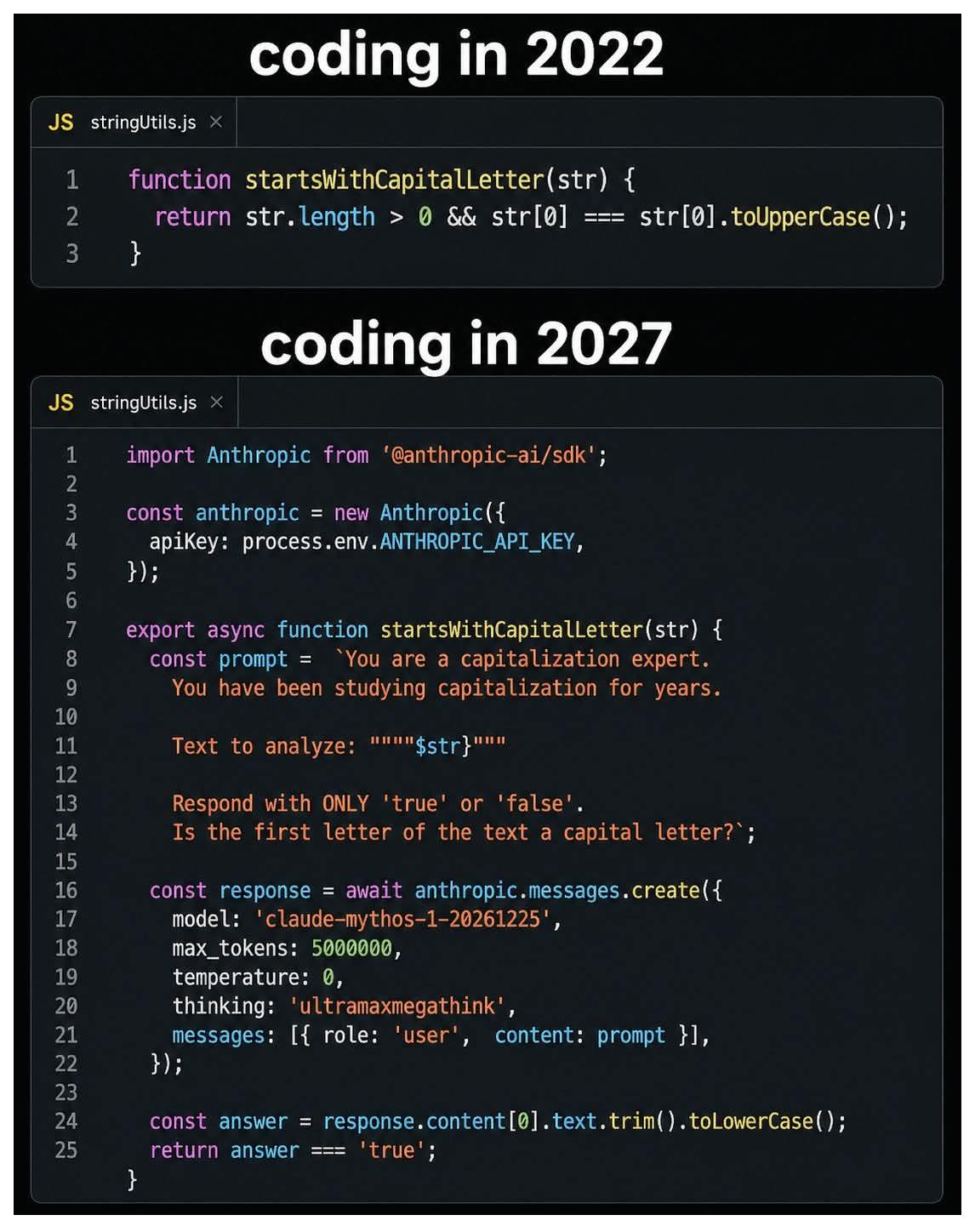
2022: Three lines of straightforward logic to check if a string starts with a capital letter. 2027: Import an entire AI SDK, initialize it with API keys, craft a verbose prompt explaining capitalization to an AI model like you're teaching a toddler, burn through 5 million tokens at "ultramaxmegathink" temperature, wait for the API call, parse the response, convert it to lowercase, and compare it to 'true'. We went from O(1) string operations to O(please-don't-check-my-AWS-bill). The function that could run on a potato now requires a PhD in prompt engineering and a small loan. Progress.

Make No Mistakes

Make No Mistakes
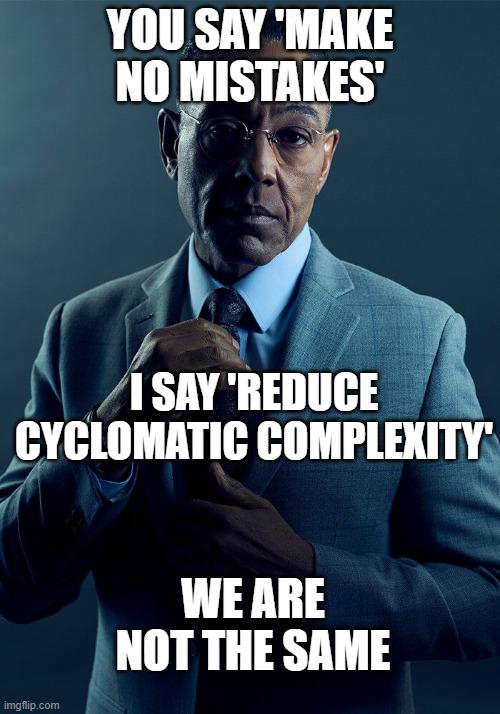
When you explicitly tell your AI coding assistant to "make no mistakes" and it still generates buggy code, you start questioning everything. The confidence with which these LLMs ignore your carefully crafted instructions is truly impressive. You'd think adding "make no mistakes" to your prompt would be like adding --force to a command, but apparently AI doesn't work that way. The real kicker? The bugs are often so creative that you wonder if the AI is secretly running its own QA team that specializes in edge cases you never knew existed. Maybe next time try "pretty please with a cherry on top, no bugs" - surely that'll work, right?

Even Tho AI Sucks I Still Think It's Funny

Even Tho AI Sucks I Still Think It's Funny
When you forget to add "don't make any mistakes" to your AI prompt and it generates code that looks like it went through a wood chipper. The hallucination is real, folks. Turns out AI takes instructions quite literally—if you don't explicitly tell it to write bug-free code, it'll happily generate syntactically correct garbage that compiles but does absolutely nothing useful. It's like asking a genie for a wish without reading the fine print. Pro tip: next time add "make it production-ready, thoroughly tested, and don't summon any eldritch horrors" to your prompt. Though knowing AI, it'll probably still find a way to use deprecated APIs from 2003.

2 (Pieces) 3" and 5" Git Gud Graffiti Tag Sticker, Waterproof Vinyl Decals for Many Purpose Like Cars, Trucks, Laptops, Phones, Windows and More

2 (Pieces) 3" and 5" Git Gud Graffiti Tag Sticker, Waterproof Vinyl Decals for Many Purpose Like Cars, Trucks, Laptops, Phones, Windows and More
SIZE MATTERS: Each decal measures approximately 5 inches and 3 inches (2) Pieces. Git Gud Graffiti Tag Sticker DESIGN: This vinyl decal features a design perfect for customizing vehicles, trucks, lap…

I Tried My Best Prompt

I Tried My Best Prompt
Welcome to the AI era, where we've traded Stack Overflow copy-paste for politely asking a chatbot to not screw up. You'd think adding "make no mistakes" to your prompt would work like a compiler flag, but turns out AI doesn't respect your desperate pleas any more than your production server respects your deployment schedule. The beautiful irony here is thinking you can just ask for perfection and get it. If it were that easy, we'd all just write "// TODO: make this code perfect" and call it a day. But no, the AI keeps generating bugs like it's getting paid per defect, completely ignoring your carefully crafted instructions like a junior dev who skips the PR comments. Turns out prompt engineering is just debugging with extra steps and false hope.

I Built A Skill That Makes LLMs Stop Making Mistakes

I Built A Skill That Makes LLMs Stop Making Mistakes
So you thought asking ChatGPT to "not make any mistakes" would somehow unlock god mode and generate a million-dollar app? Sweet summer child. That's like telling your code to "just work" and expecting production-ready software. The universe doesn't operate on vibes and polite requests, my friend. The delicious irony here is that adding "don't make mistakes" to your prompt is about as effective as putting a "No Bugs Allowed" sign on your IDE. ChatGPT is still gonna hallucinate dependencies that don't exist, suggest deprecated methods from 2015, and confidently tell you that your syntax error is actually a feature. But sure, the magic words will fix everything! The buff dude staring intensely at his screen really sells the energy of someone who genuinely believes they've cracked the code to AI perfection. Spoiler alert: ChatGPT read your instruction, nodded politely, and then proceeded to make mistakes anyway because that's what LLMs do best—sound confident while being spectacularly wrong.