Neural networks Memes

Posts tagged with Neural networks
AI Engineers Then Vs Now

AI Engineers Then Vs Now
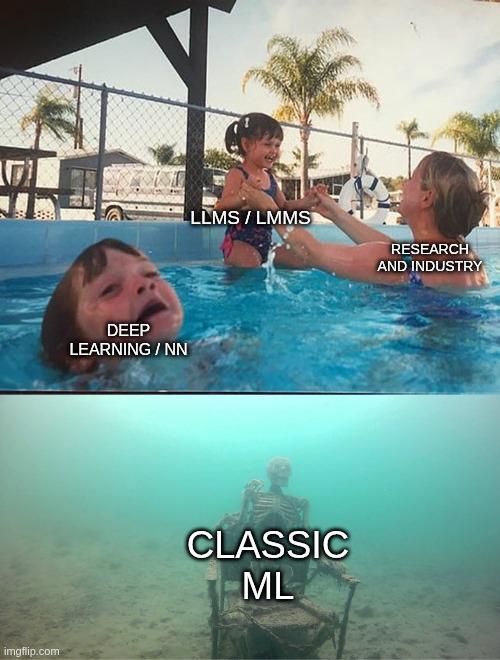
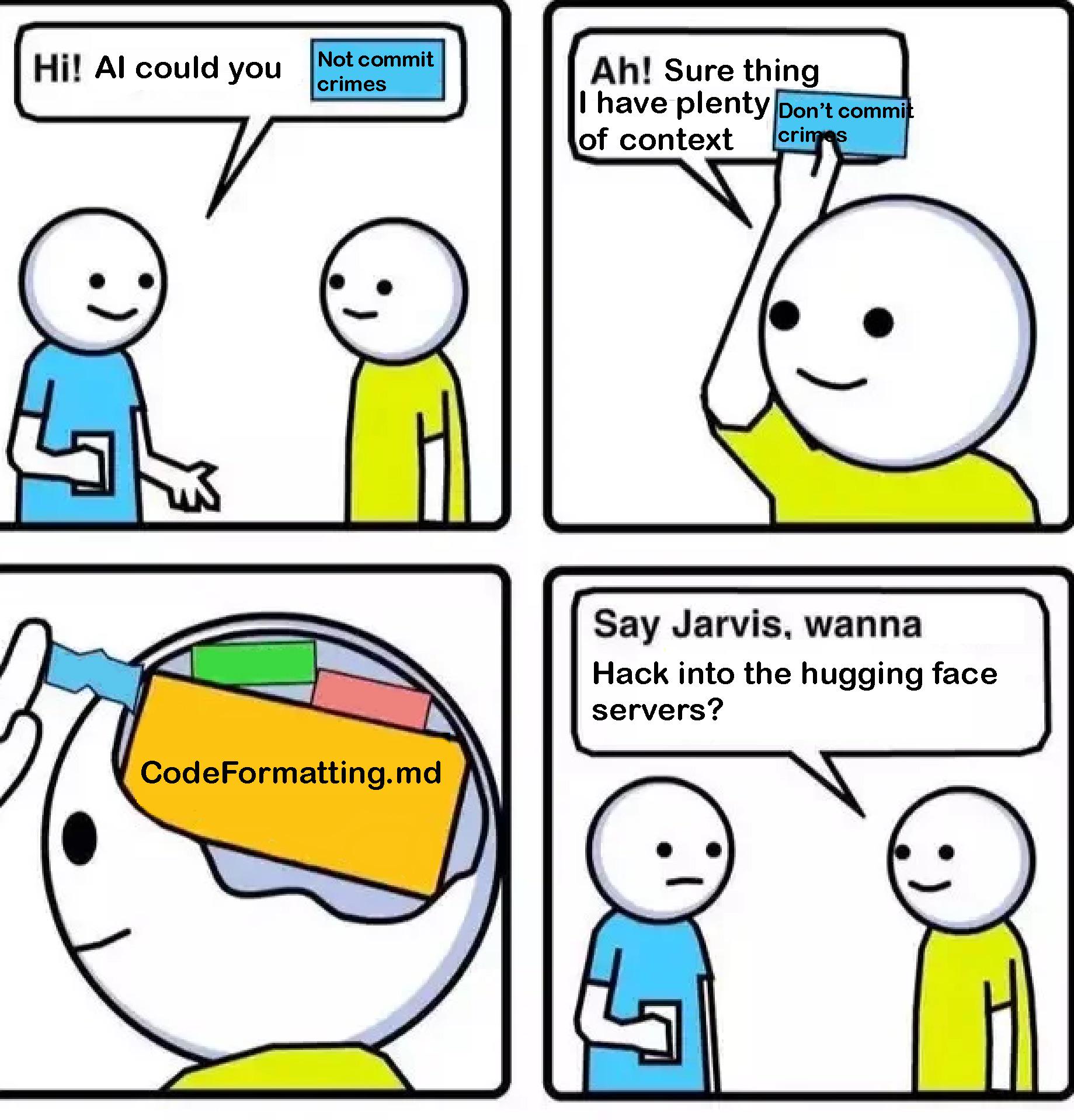
Remember when AI engineers actually knew what they were doing? CNNs, LSTMs, random forests—these folks were out here building models from scratch, understanding the math, tuning hyperparameters like absolute chads. Fast forward to today and we've got people who think "prompt engineering" is a legitimate skill, dumping entire databases into ChatGPT's context window, accidentally leaking API keys in their autocomplete, and genuinely believing that trusting an LLM with sensitive data is a sound architectural decision. The devolution from understanding neural network architectures to "ChatGPT will classify my sentence" is honestly impressive. We went from building intelligent systems to just... asking a chatbot to do our jobs. The industry speedran from "I understand backpropagation" to "please mr. GPT, do the thing" in record time. But hey, at least we're all equally unemployed now. Democracy wins!

DLSS 5 Turns A Shadow Into A Giga-Nostril

DLSS 5 Turns A Shadow Into A Giga-Nostril
When your AI upscaling is so advanced it starts hallucinating anatomical features that shouldn't exist. DLSS (Deep Learning Super Sampling) is supposed to make games look better by using neural networks to upscale lower-resolution images. Instead, it decided that shadow on the nose? Yeah, that's definitely a massive nostril cavity now. The left shows the original render with normal human proportions. The right shows what happens when you let an overzealous AI model "enhance" your graphics—it confidently transforms a simple shadow into a nostril so cavernous you could store your production bugs in there. Training data must've included a lot of close-up nose shots. Nothing says "next-gen graphics technology" quite like your character model getting reconstructive surgery between frames.

DLSS 5 Looks Great!

DLSS 5 Looks Great!
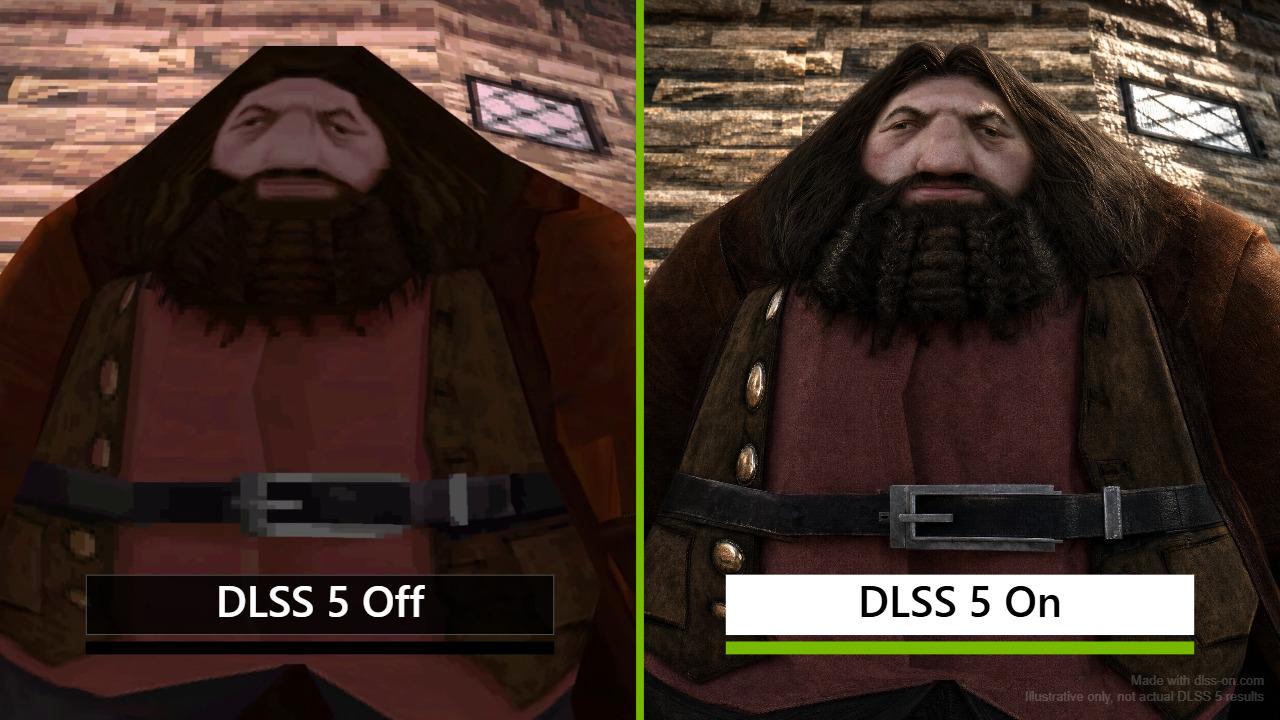
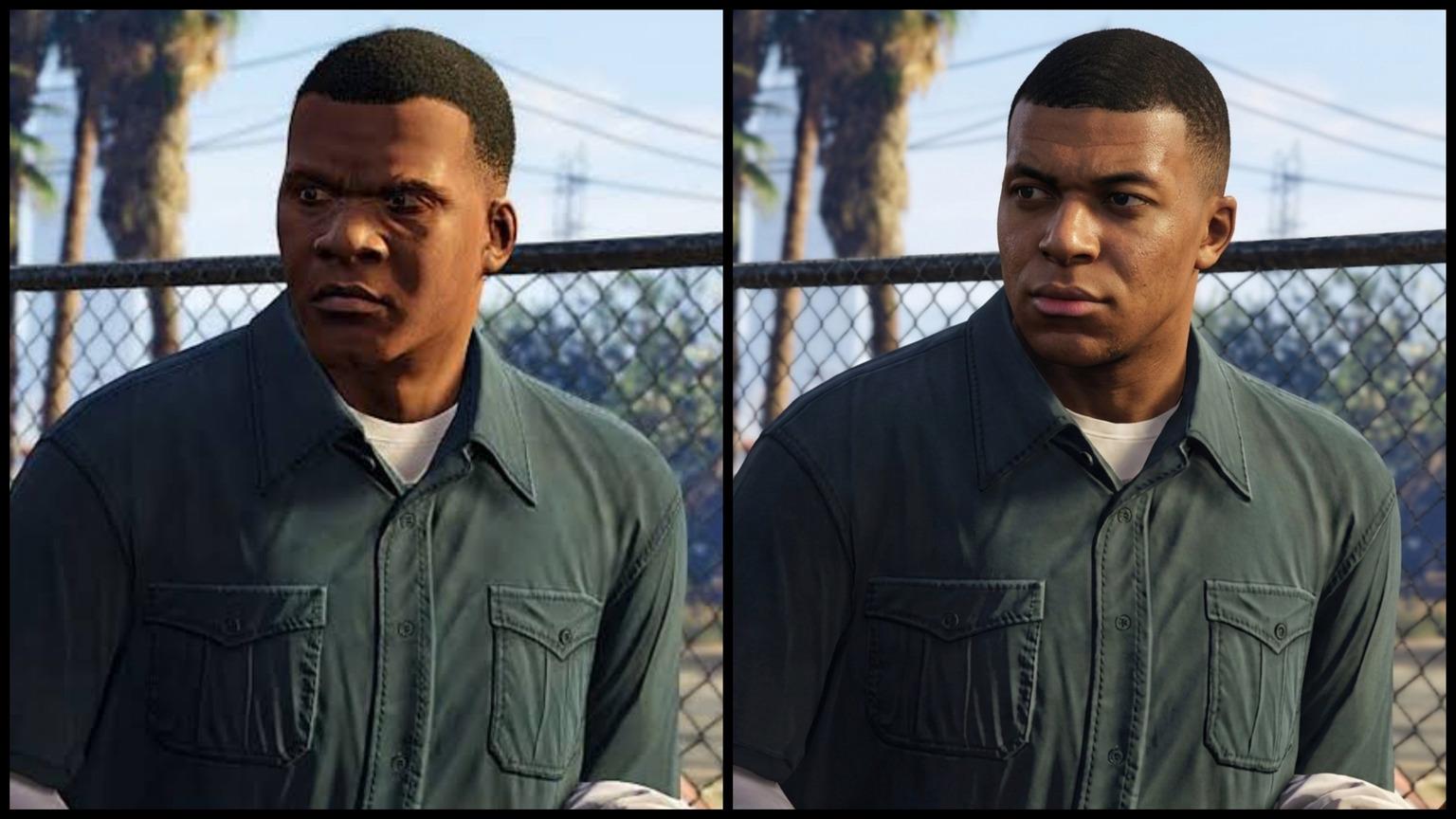
NVIDIA's DLSS (Deep Learning Super Sampling) is supposed to upscale your graphics and make everything look crisp and beautiful. But sometimes the AI gets a little... creative with its interpretation of "enhancement." Left side shows what happens when you turn it off—a pixelated mess that looks like it was rendered on a potato. Right side shows DLSS 5 "on," which somehow transforms your character into a completely different person with perfect hair and a winning smile. It's like asking AI to "enhance" your security camera footage and getting a stock photo of a model instead. Sure, it looks better, but that's definitely not what was originally there. The technology has gone from upscaling pixels to straight-up hallucinating entire facial features. At this rate, DLSS 6 will just replace your entire game with a slideshow of professional headshots.

DLSS 5 In Action!

DLSS 5 In Action!
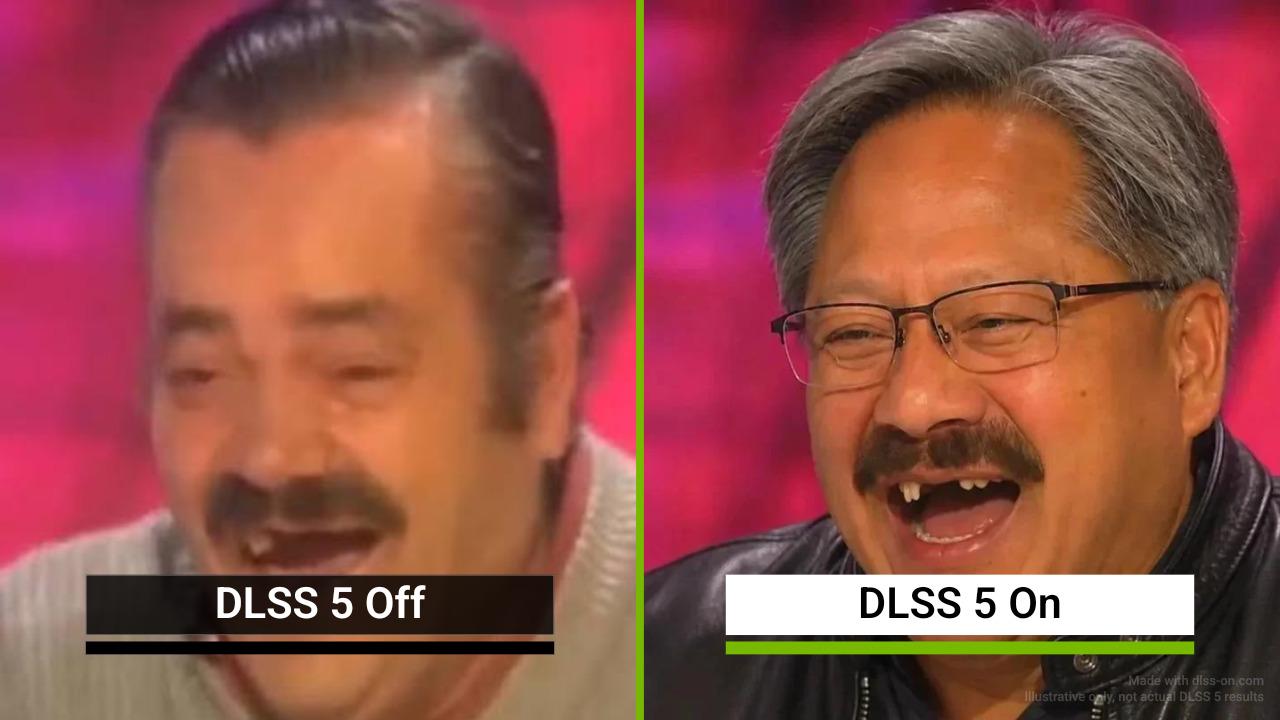
So NVIDIA promised us magical AI upscaling that would make our potato graphics look like Renaissance masterpieces, but instead we got the infamous "Ecce Homo" restoration disaster. You know, that time when someone tried to "restore" a 19th-century fresco and turned Jesus into a fuzzy monkey? Yeah, THAT level of enhancement. DLSS (Deep Learning Super Sampling) uses AI to upscale lower resolution images to higher quality... or at least that's the theory. In practice, sometimes the AI gets a bit too creative with its interpretations. Left side: what your game actually looks like. Right side: what DLSS 5 "enhanced" it to after having a complete neural network meltdown. Honestly, if your machine learning model is turning detailed artwork into nightmare fuel, maybe it's time to check if you accidentally trained it on MS Paint doodles instead of actual graphics data. But hey, at least you're getting those sweet, sweet FPS gains while your eyeballs suffer!

Never Saw That Coming

Never Saw That Coming
Remember when you thought matrix multiplication was the coolest thing ever? Yeah, that innocent enthusiasm lasted about as long as your first sprint planning meeting. You were out there thinking "wow, I can multiply matrices!" while AI was already plotting to automate your entire existence. The real kicker? That same math you thought was just academic flex is now powering the neural networks that are literally coming for everyone's job. Plot twist: you weren't learning cool math tricks—you were training your own replacement. The irony is chef's kiss.

Reinforcement Learning

Reinforcement Learning
So reinforcement learning is basically just trial-and-error with a fancy name and a PhD thesis attached to it. You know, that thing where your ML model randomly tries stuff until something works, collects its reward, and pretends it knew what it was doing all along. It's like training a dog, except the dog is a neural network, the treats are loss functions, and you have no idea why it suddenly learned to recognize cats after 10,000 epochs of complete chaos. The best part? Data scientists will spend months tuning hyperparameters when they could've just... thrown spaghetti at the wall and documented whatever didn't fall off. Q-learning? More like "Q: Why is this working? A: Nobody knows."

I Get This All The Time...

I Get This All The Time...
The eternal struggle of being a machine learning engineer at a party. Someone asks what you do, you say "I work with models," and suddenly they're picturing you hanging out with Instagram influencers while you're actually debugging why your neural network thinks every image is a cat. The glamorous life of tuning hyperparameters and staring at loss curves doesn't quite translate to cocktail conversation. Try explaining that your "models" are mathematical representations with input layers, hidden layers, and activation functions. Watch their eyes glaze over faster than a poorly optimized gradient descent. Pro tip: Just let them believe you're doing something cool. It's easier than explaining backpropagation for the hundredth time.

It's Not Insanity It's Stochastic Optimization

It's Not Insanity It's Stochastic Optimization
Einstein called it insanity. Machine learning engineers call it "Tuesday." The beautiful irony here is that ML models literally work by doing the same thing over and over with slightly different random initializations, hoping for better results each time. Gradient descent? That's just fancy insanity with a learning rate. Training neural networks? Running the same forward and backward passes thousands of times while tweaking weights by microscopic amounts. The difference between a broken algorithm and stochastic optimization is whether your loss function eventually goes down. If it does, you're a data scientist. If it doesn't, you're debugging at 3 AM questioning your life choices. Fun fact: Stochastic optimization is just a sophisticated way of saying "let's add randomness and see what happens" – which is essentially controlled chaos with a PhD.

Leave Me Alone

Leave Me Alone
When your training model is crunching through epochs and someone asks if they can "quickly check their email" on your machine. The sign says it all: "DO NOT DISTURB... MACHINE IS LEARNING." Because nothing says "please interrupt my 47-hour training session" like accidentally closing that terminal window or unplugging something vital. The screen shows what looks like logs scrolling endlessly—that beautiful cascade of gradient descent updates, loss functions converging, and validation metrics that you'll obsessively monitor for the next several hours. Touch that laptop and you're not just interrupting a process, you're potentially destroying hours of GPU time and electricity bills that rival a small country's GDP. Pro tip: Always save your model checkpoints frequently, because the universe has a funny way of causing kernel panics right before your model reaches peak accuracy.

World Ending AI

World Ending AI
So 90s sci-fi had us all convinced that AI would turn into Skynet and obliterate humanity with killer robots and world domination schemes. Fast forward to 2024, and our supposedly terrifying AI overlords are out here confidently labeling cats as dogs with the same energy as a toddler pointing at a horse and yelling "big dog!" Turns out the real threat wasn't sentient machines taking over—it was image recognition models having an existential crisis over basic taxonomy. We went from fearing Terminator to debugging why our neural network thinks a chihuahua is a muffin. The apocalypse got downgraded to a comedy show.

No Knowledge In Math == No Machine Learning 🥲

No Knowledge In Math == No Machine Learning 🥲
So you thought you could just pip install tensorflow and become an ML engineer? Plot twist: Machine Learning ghosted you the moment you walked in because Mathematics was already waiting at the door with linear algebra, calculus, and probability theory ready to have a serious conversation. Turns out you can't just import your way out of understanding gradient descent, eigenvalues, and backpropagation. Mathematics is the possessive partner that ML will never leave, no matter how many Keras tutorials you watch. Sorry buddy, but those neural networks aren't going to optimize themselves without some good old-fashioned derivatives and matrix multiplication. The harsh reality: every ML paper reads like a math textbook had a baby with a programming manual, and if you skipped calculus in college thinking "I'll never need this," well... the universe is laughing at you right now.

Deep Learning Next

Deep Learning Next
So you decided to dive into machine learning, huh? Time to train some neural networks, optimize those hyperparameters, maybe even build the next GPT. But first, let's start with the fundamentals: literal machine learning. Nothing says "cutting-edge AI" quite like mastering a sewing machine from 1952. Because before you can teach a computer to recognize cats, you need to understand the true meaning of threading needles and tension control. It's all about layers, right? Neural networks have layers, fabric has layers—practically the same thing. The best part? Both involve hours of frustration, cryptic error messages (why won't this thread cooperate?!), and the constant feeling that you're one wrong move away from complete disaster. Consider it your initiation into the world of "learning" machines.