

Incident response Memes

Posts tagged with Incident response
Thank You Dev Ops Community

Thank You Dev Ops Community
Production is on fire, users are screaming, and your CEO is refreshing the status page every 3 seconds. Meanwhile, DevOps is graciously holding up the entire infrastructure like a human ladder while you frantically deploy that emergency fix. Sure, you're the hero who wrote the patch in 5 minutes, but let's be real—without DevOps literally keeping the servers from falling off the wall, your hotfix would just be sitting in a git branch collecting dust. They're out here playing Jenga with load balancers and you get all the glory. Teamwork makes the dream work, but DevOps makes the uptime work.

Please Don't Be My Code I Promise To Unit Test Next Time

Please Don't Be My Code I Promise To Unit Test Next Time
That sinking feeling when you're on-call and production goes down, and you start reading through the stack trace only to see familiar function names from that "quick fix" you pushed last week. You know, the one you shipped without tests because "it's just a small change, what could go wrong?" Now you're literally in a hole, praying to the tech gods that it's someone else's garbage code causing the outage. But deep down, you already know. That's YOUR NullPointerException. That's YOUR uncaught promise rejection. That's YOUR brilliant idea to refactor the entire authentication flow at 4 PM on a Friday. Every developer makes the same bargain: "Just let this one slide and I swear I'll write tests for everything from now on." Spoiler alert: they never do. The cycle continues until the next incident call.

Debug In Peace

Debug In Peace
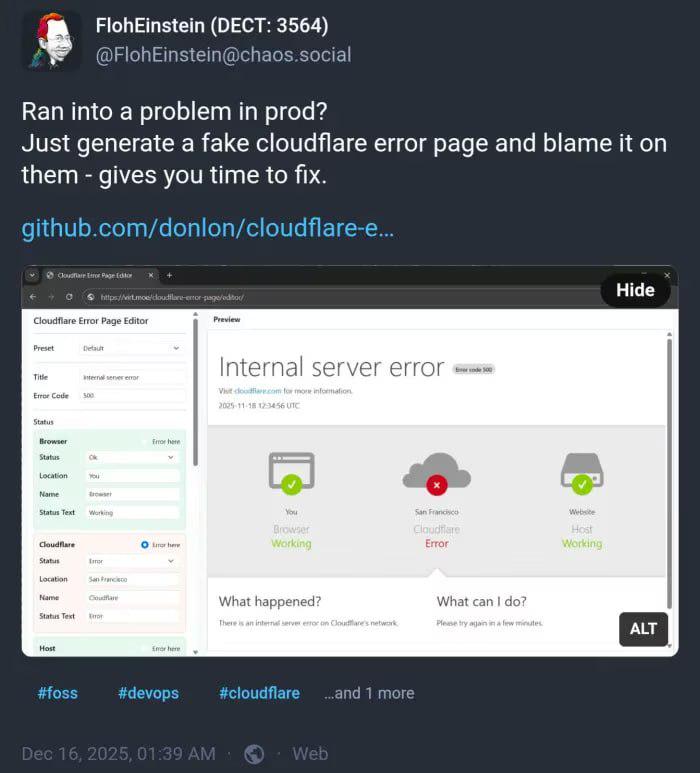
So there's an actual GitHub repo that lets you generate fake Cloudflare error pages to buy yourself some precious debugging time when production decides to implode. The genius move here is that everyone trusts Cloudflare's error pages—they're like the universal "not our fault" card of the internet. The tool even lets you customize everything: error codes, status text, location (San Francisco for that authentic tech hub vibe), and whether services are "Working" or in "Error" state. It's basically a get-out-of-jail-free card that tells your users "yeah, it's broken, but it's Cloudflare's problem, not ours" while you frantically fix whatever you pushed to prod without testing. The real MVP feature? The "Hide" button in the corner. Because nothing says "professional incident response" like a fake error page generator with a panic button.

Loving This New Meme Template

Loving This New Meme Template
When production goes down at 3 AM, suddenly everyone materializes out of thin air like they're responding to a red alert. First it's just you and one other dev staring at the monitors in horror. Then the senior engineers beam in. Next thing you know, the entire engineering department, product managers, and probably the CEO are crowded around your desk asking "what's the ETA?" while you're frantically tailing logs. Nothing says "we trust you" quite like having seven people breathing down your neck while you're trying to remember if you actually ran those database migrations. The best part? They all just stand there watching, as if their collective anxiety will somehow fix the 500 errors faster.

Circuit Board Poster Matrix Binary Code Canvas Wall Art Glowing Green Tech Line Print for Gaming Room Men Office Decor (24x32inch Unframed)

Circuit Board Poster Matrix Binary Code Canvas Wall Art Glowing Green Tech Line Print for Gaming Room Men Office Decor (24x32inch Unframed)
Elevate your home decor with this stunning modern family poster wall art available in both framed and unframed options to suit your style and space perfectly · High-quality print on poster ensures vi…

Five Nines Of Uptime

Five Nines Of Uptime
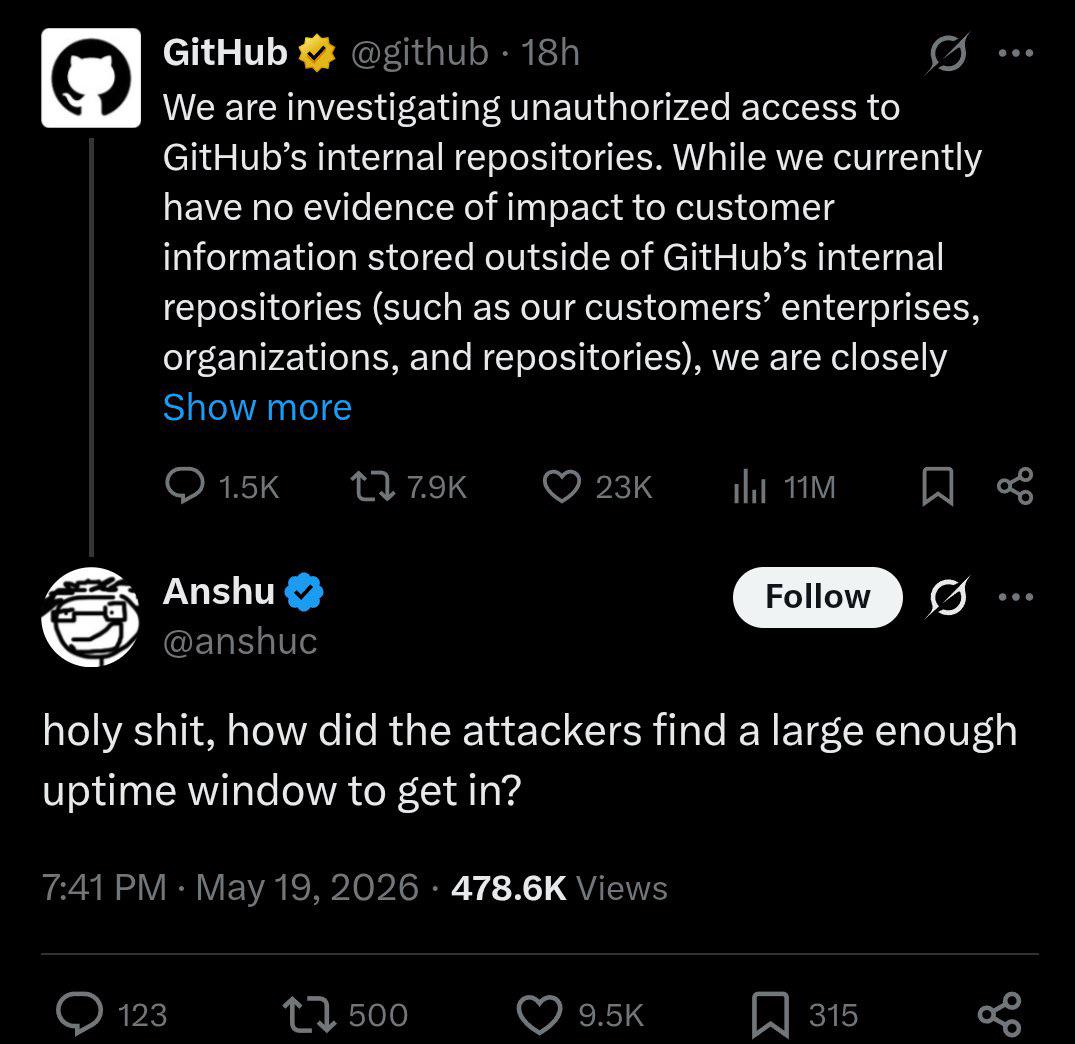
GitHub gets breached and someone's first thought is "wait, you guys have uptime?" Five nines of uptime means 99.999% availability—roughly 5 minutes of downtime per year. The joke here is that GitHub's reliability is so legendary that attackers apparently had to wait for one of those mythical 5-minute windows to break in. Either that or they scheduled their breach during a maintenance window like civilized criminals. The real kicker? GitHub's incident response is so polished they're basically writing a security breach announcement like it's a product launch. "We are investigating unauthorized access" has the same energy as "We're excited to announce..."

There's A Mastermind Or A Dumbass Behind This Drama

There's A Mastermind Or A Dumbass Behind This Drama
When multiple tech giants experience catastrophic failures simultaneously, you start wondering if it's a coordinated attack or just a really unfortunate Tuesday. Axios goes down with a compromised issue, Claude's source code leaks, and GitHub decides to take an unscheduled nap—all pointing fingers at each other like Spider-Men in an identity crisis. The beauty here is that nobody wants to admit they might be patient zero. Could be a supply chain attack, could be a shared dependency that imploded, or maybe—just maybe—they all use the same intern's Stack Overflow copy-paste solution that finally came back to haunt them. Either way, the SRE teams are definitely not having a good time. Plot twist: It's probably a DNS issue. It's always DNS.

Senior Devs

Senior Devs
Junior dev asking "theoretically" about removing accidentally committed API keys is like asking your friend "hypothetically" what happens if you total their car. The senior's face says it all—they've already checked the commit history, rotated the keys, and started drafting the incident report before the junior even finished their sentence. That thousand-yard stare comes from years of watching AWS bills skyrocket because someone's credentials got scraped by bots within 3 minutes of pushing to main. The senior knows there's no "theoretical" here—that key is already being used to mine crypto in some Eastern European server farm. Pro tip: git filter-branch and BFG Repo-Cleaner exist, but they won't save you from the post-mortem meeting.

Internal Server Error

Internal Server Error
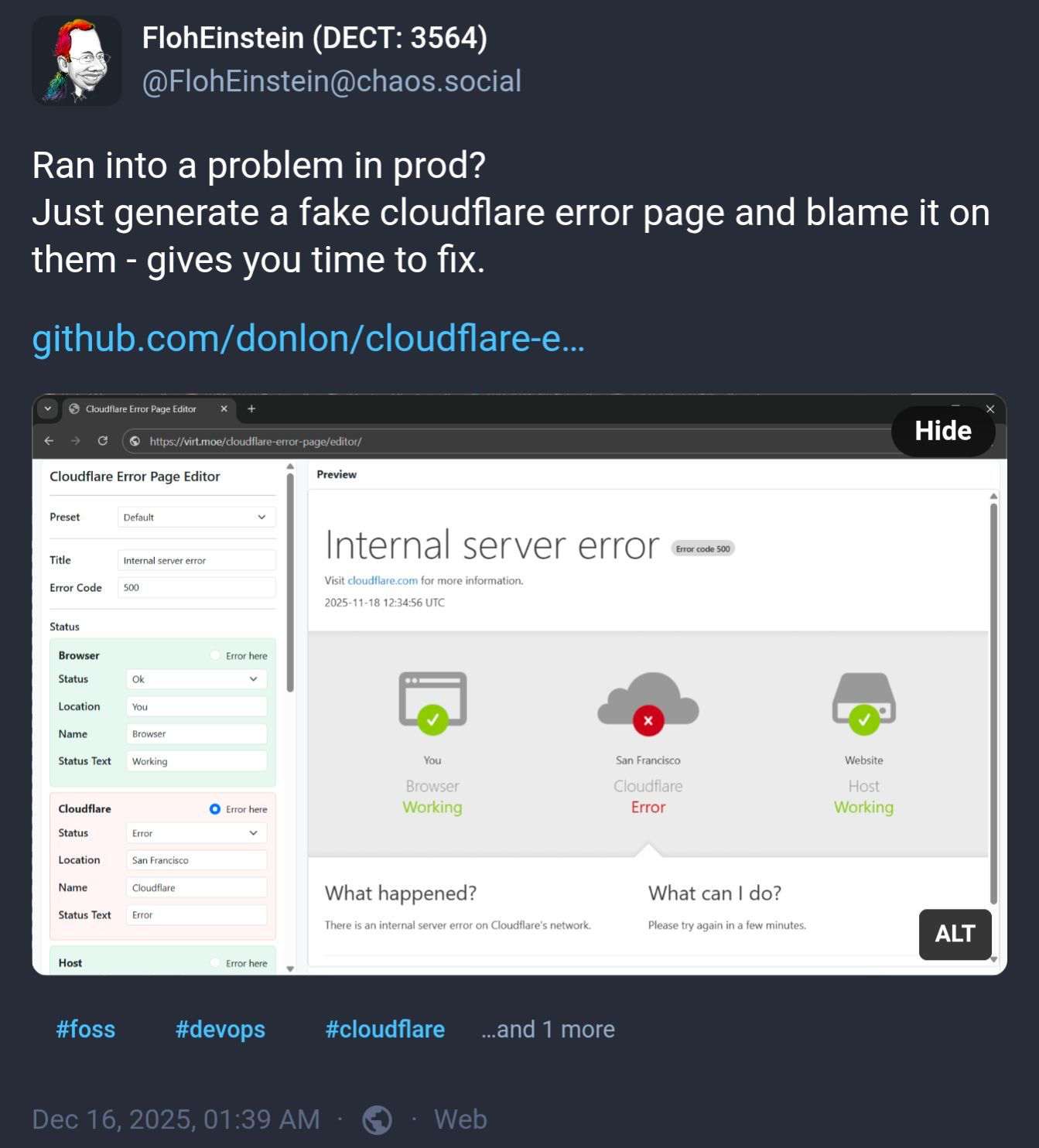
Someone built a Cloudflare error page generator so you can fake outages and buy yourself precious debugging time. Because nothing says "professional incident response" like gaslighting your users into thinking it's Cloudflare's fault when your spaghetti code just threw up. The tool literally lets you customize everything—error codes, locations, status messages—so you can craft the perfect alibi while you frantically grep through logs trying to figure out why your production database just decided to take a nap. It's the digital equivalent of pointing at someone else and running away. Peak DevOps strategy: deflect, delay, and deploy the blame elsewhere. Your manager will never know the difference between a real Cloudflare outage and your nil pointer exception. Probably.

Cloudflare Outage: From Panic To S'mores

Cloudflare Outage: From Panic To S'mores
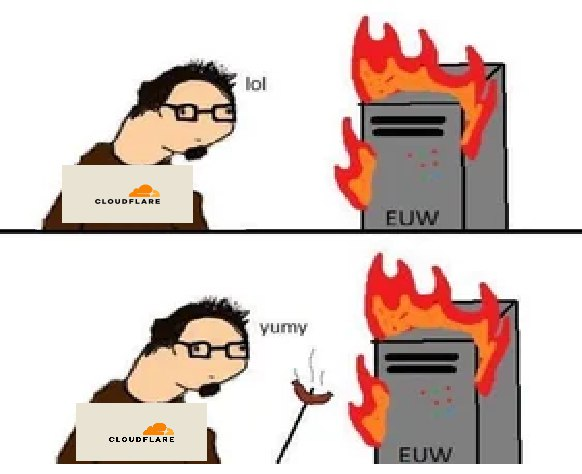
The Cloudflare support engineer's two moods during server incidents: Panel 1: Initial panic with a simple "lol" while watching the server rack burst into flames. Classic understatement for "half the internet just went down." Panel 2: Acceptance phase with "yummy" as they casually roast a marshmallow over the burning infrastructure. Because if 30% of the web is already offline, might as well make s'mores while DNS propagates. Remember that time in 2022 when a single config error took down 19 million websites? Good times.

Crisis Management: Developer Edition

Crisis Management: Developer Edition
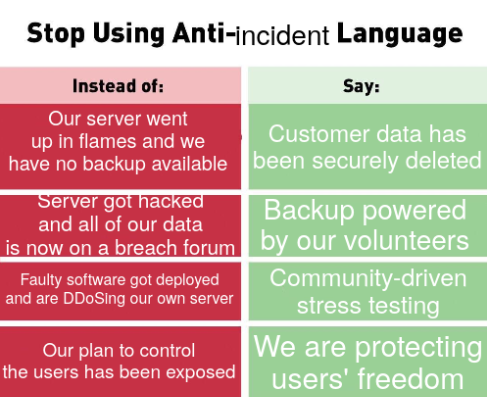
Ah, corporate spin at its finest! This is the corporate PR team's playbook for turning catastrophic failures into marketing opportunities. "Customer data has been securely deleted" is just chef's kiss euphemism for "we lost everything and have no backups." My favorite is "community-driven stress testing" – because nothing says "we value our community" like letting them discover all the ways your code can spectacularly fail in production. After 15 years in this industry, I've written enough of these emails to recognize art when I see it. Remember folks, it's not "getting hacked" – it's just "backup powered by our volunteers" (aka random people on the dark web).

Lenovo ThinkPad T14 Business Laptop (14" FHD+ Touchscreen, AMD Ryzen 5 PRO 6650U, 16GB RAM, 512GB SSD, 6-Core (Beat i7-1250U)), Backlit, Fingerprint, 1080p Webcam, Wi-Fi 6E, Win 11 Pro w / AI Copilot

Lenovo ThinkPad T14 Business Laptop (14" FHD+ Touchscreen, AMD Ryzen 5 PRO 6650U, 16GB RAM, 512GB SSD, 6-Core (Beat i7-1250U)), Backlit, Fingerprint, 1080p Webcam, Wi-Fi 6E, Win 11 Pro w / AI Copilot
The ThinkPad T14 Gen 3 laptop with MIL-STD 810G Military Grade certification, equipped with blazing-fast LPDDR5-6400MHz RAM and Ethernet (RJ-45) port, it helps you to breeze through any task. What’s …

Security Analysts: Paid To Be Ignored

Security Analysts: Paid To Be Ignored
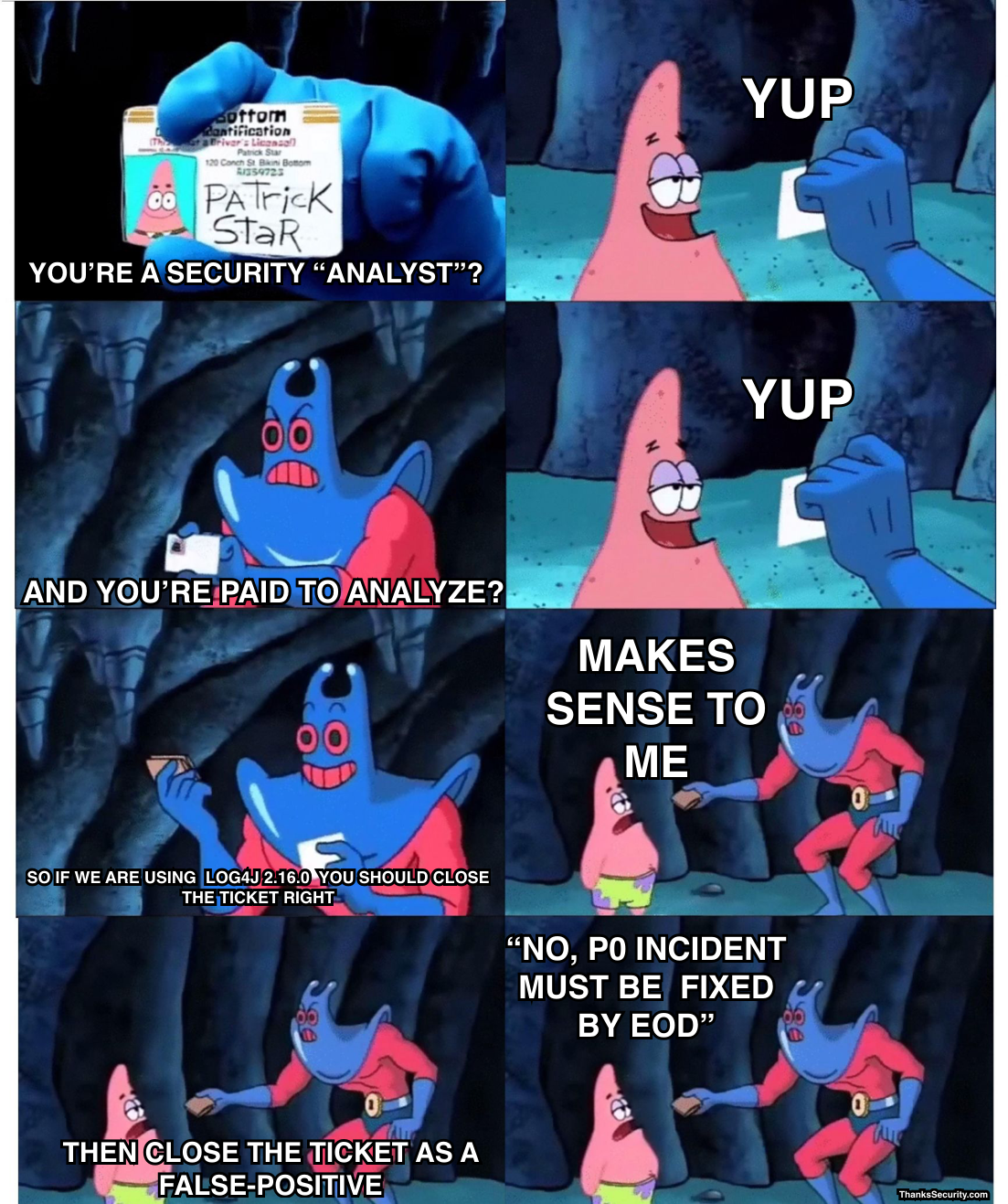
The security industry in a nutshell, folks. You hire "analysts" who confirm they're analysts, confirm they get paid to analyze, but when they actually find something—like a Log4j vulnerability that needs immediate patching—management's response is "Nah, P0 incident? That's an EOD problem." Nothing quite like hiring security experts only to ignore their expertise when it requires actual work. The classic corporate cycle: pay for security, ignore security recommendations, wonder why you got breached. Then blame the security team who warned you six months ago. For the uninitiated, Log4j was that delightful little vulnerability from 2021 that had security teams working through Christmas while executives were sipping eggnog and asking "can't we just deal with it after the holidays?"

Good Devs Are Expensive Until Disaster Strikes

Good Devs Are Expensive Until Disaster Strikes
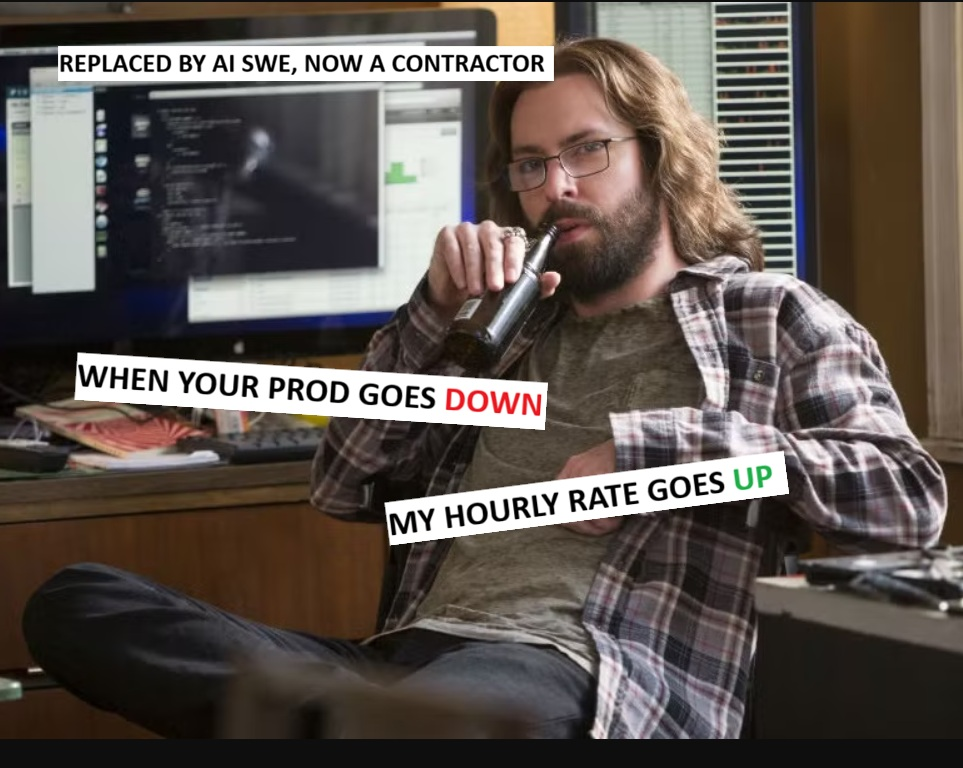
The financial calculus of software development hits different at 3 AM when your servers are burning. That $150/hour senior dev you rejected? Suddenly looks like a bargain when compared to the $50,000/minute revenue loss from your payment system being down. The technical debt collector always shows up at the worst possible time, and unlike regular debt collectors, this one charges compound interest in the form of your engineering team's sanity and your customers' trust. Pro tip: The cost of prevention is always cheaper than the cost of the cure.