Graphics programming Memes

Posts tagged with Graphics programming
How To Make A Game

How To Make A Game
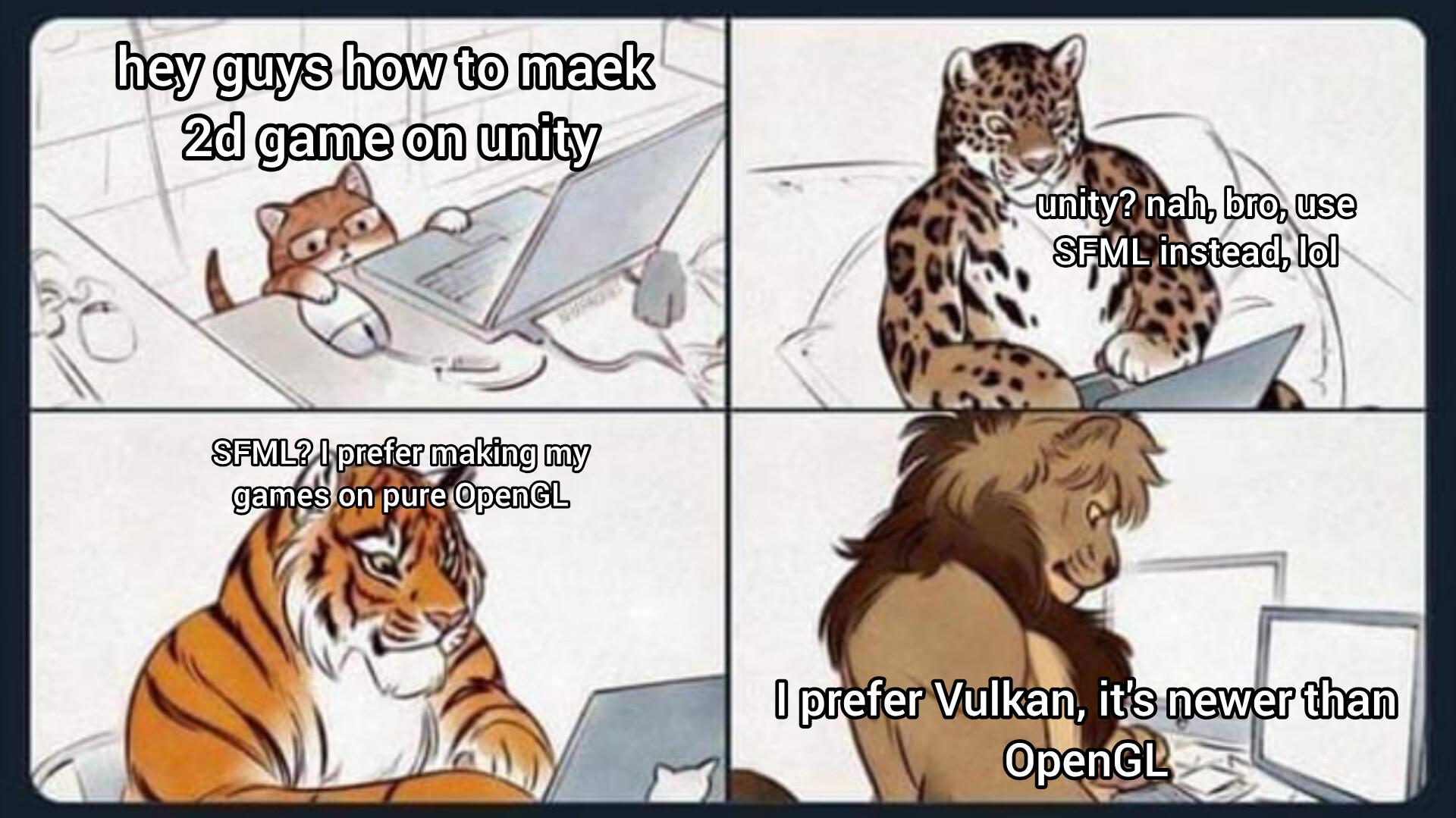
Game dev gatekeeping at its finest. Someone innocently asks how to make a 2D game in Unity, and suddenly everyone's a graphics API purist. Unity? Too mainstream. SFML? Child's play. OpenGL? Still too easy. Vulkan? Now we're talking—because nothing says "I want to make a simple 2D game" like manually managing GPU memory and writing 1000 lines of boilerplate just to render a triangle. The progression here perfectly captures the game dev community's obsession with doing things the hard way. Each animal represents a different level of masochism, with the final one basically suggesting you should write your own graphics driver while you're at it. Fun fact: by the time you finish setting up Vulkan for your 2D platformer, Unity devs have already shipped three games and retired.

How Far We've Come

How Far We've Come
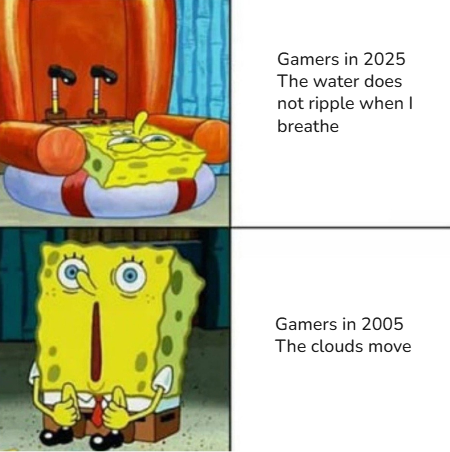
We've reached peak civilization where gamers in 2025 are absolutely LOSING THEIR MINDS over hyper-realistic water physics that doesn't ripple when you breathe near it, meanwhile gamers in 2005 were literally ascending to heaven because the CLOUDS MOVED. THE. CLOUDS. MOVED. Twenty years ago, we saw a cloud drift across the sky and thought we were living in the Matrix. Now we're out here critiquing whether the subsurface scattering on water droplets accurately reflects the protagonist's emotional state. The audacity of modern gaming expectations is truly a masterpiece of human evolution. From "OMG DYNAMIC WEATHER" to "why doesn't my breath create realistic condensation patterns?" — what a journey we've been on.

Reality Bending Shader Bug

Reality Bending Shader Bug
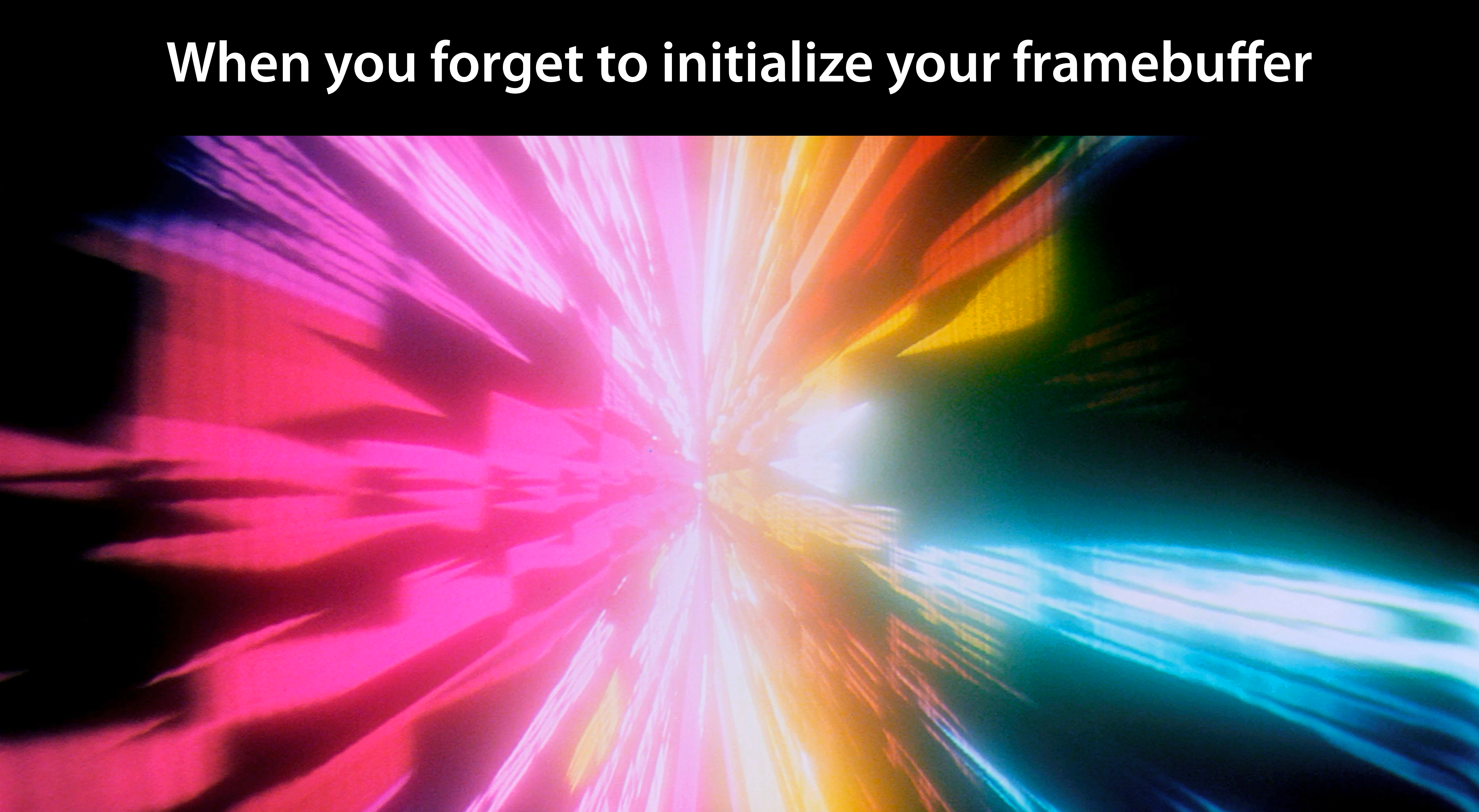
Forgetting to initialize your framebuffer is like opening a portal to the void where uninitialized memory becomes abstract art. Your screen just starts reading whatever random garbage was left in GPU memory, creating these psychedelic interdimensional vortexes that would make a rave organizer jealous. The GPU basically goes "you didn't tell me what to draw, so I'll just use whatever cosmic radiation happens to be floating around in this memory address." Sometimes it's black, sometimes it's a rainbow explosion, and sometimes it looks like you're traveling through hyperspace. It's the graphics programming equivalent of leaving variables uninitialized in C and wondering why your integer is 2,847,293,847. The best part? Half the time you'll convince yourself it's a feature and spend 3 hours trying to recreate it intentionally.

The Vulkan Pipeline

The Vulkan Pipeline
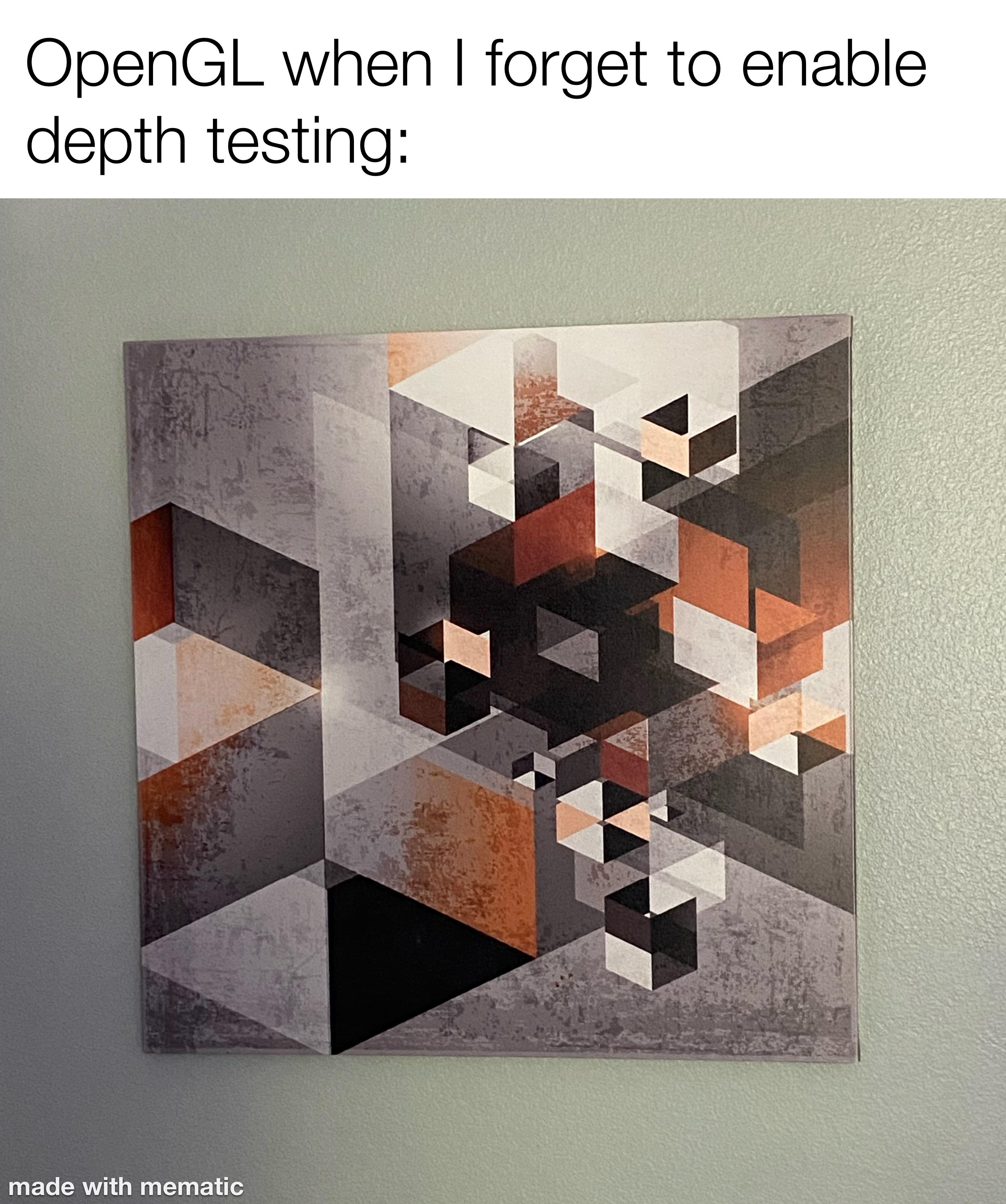
You start with some innocent vertex data, assemble it into something recognizable, shade it nicely, rasterize it into pixels, add your fragment shader... and then suddenly you're staring at a glitched-out nightmare that looks like someone dumped a bucket of corrupted VRAM onto your screen. Because you forgot to clear the depth buffer. Again. Vulkan's graphics pipeline is basically a "draw the rest of the owl" tutorial where every single step requires 500 lines of boilerplate and one tiny mistake anywhere in the chain turns your beautiful 3D model into abstract art that would make Picasso weep. The progression from wireframe to final render perfectly captures how things go from "I understand this" to "what eldritch horror have I summoned" real quick. Fun fact: Vulkan gives you so much control that you can shoot yourself in the foot in approximately 47 different ways before you even draw a triangle. OpenGL devs think they have it rough until they try to set up a Vulkan render pass.

Graphics Programming Be Like

Graphics Programming Be Like
Graphics programming in a nutshell: want to render a simple triangle? Cool, first you'll need to set up your rendering context, initialize the graphics API, configure the viewport, create and compile vertex and fragment shaders, set up vertex buffer objects, define vertex attributes, configure the rendering pipeline, handle coordinate transformations, and maybe sacrifice a goat to the GPU gods. The triangle with the gradient is a beautiful touch—it's literally THE first thing every graphics programmer renders (hello, OpenGL tutorials!), yet getting there requires understanding matrix mathematics, shader languages, and about seventeen layers of abstraction. You're not just drawing a triangle; you're orchestrating a symphony of GPU commands that would make a backend developer weep.

Meme Made With Pure Hate After Hours Of Debugging

Meme Made With Pure Hate After Hours Of Debugging
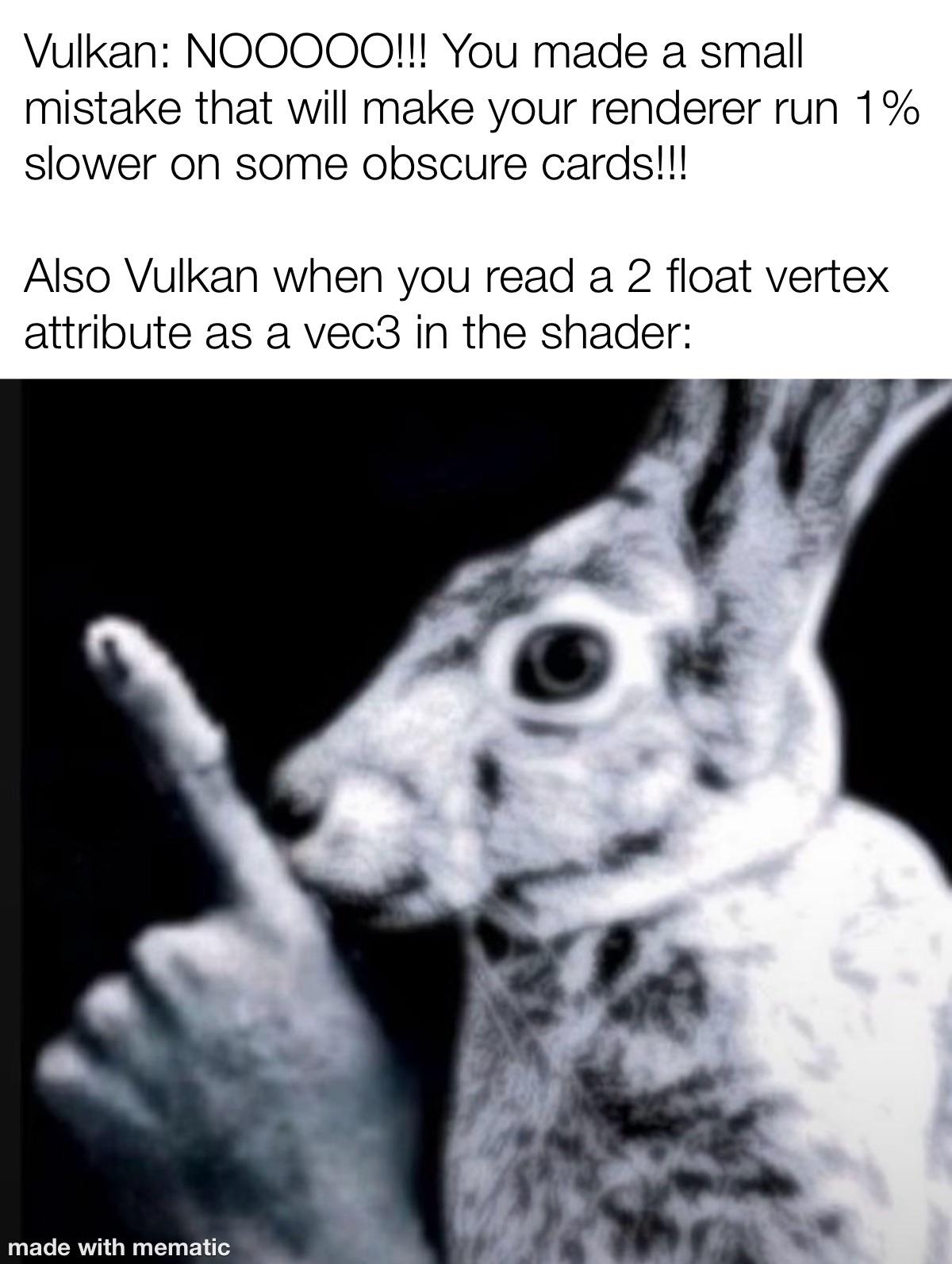
Graphics programmers know true suffering, and Vulkan is their personal tormentor. You spend hours hunting down why your render performance dropped by 1%, only to discover you accidentally declared a vertex attribute as vec2 (2 floats) when the shader was expecting vec3 (3 floats). The GPU just shrugs and does... something. Probably nothing good. For context: Vulkan is a low-level graphics API that gives you incredible control over the GPU, which also means it gives you incredible ways to shoot yourself in the foot. Unlike friendlier APIs that might warn you about type mismatches, Vulkan is like "sure buddy, read garbage memory, see if I care." The shader expects 3 coordinates but gets 2? Congratulations, your third value is now whatever random data happened to be in memory. Undefined behavior is the best behavior, right? The "pure hate" in the title is palpable. You can feel the developer's soul leaving their body as they realize their multi-hour debugging session was caused by a single missing float component. Graphics programming: where a tiny typo costs you your sanity and 1% performance on some random GPU from 2015.

NordVPN

NordVPN
Encrypt your traffic on public Wi-Fi, stream from anywhere, and cover up to ten devices with one plan. 30-day money-back guarantee.

LOD Be Like...

LOD Be Like...
Level of Detail (LOD) systems are supposed to gracefully reduce polygon count as objects get farther from the camera. In theory, it's a smooth transition. In practice? You get this absolute unit of a caracal going from majestic wild cat to eldritch horror and back to normal like it's having an existential crisis. Game devs spend weeks tweaking LOD transitions so players don't notice the mesh swaps. Then you turn your camera slightly and your companion NPC's face collapses into a lovecraftian nightmare for exactly one frame. Ship it, we'll call it a feature. Fun fact: LOD was invented in the 1970s, and we're still fighting the same battle—making 3D models look good while not melting your GPU. Some things never change, we just have fancier ways to mess them up now.

Glass Gives Me Nightmares

Glass Gives Me Nightmares
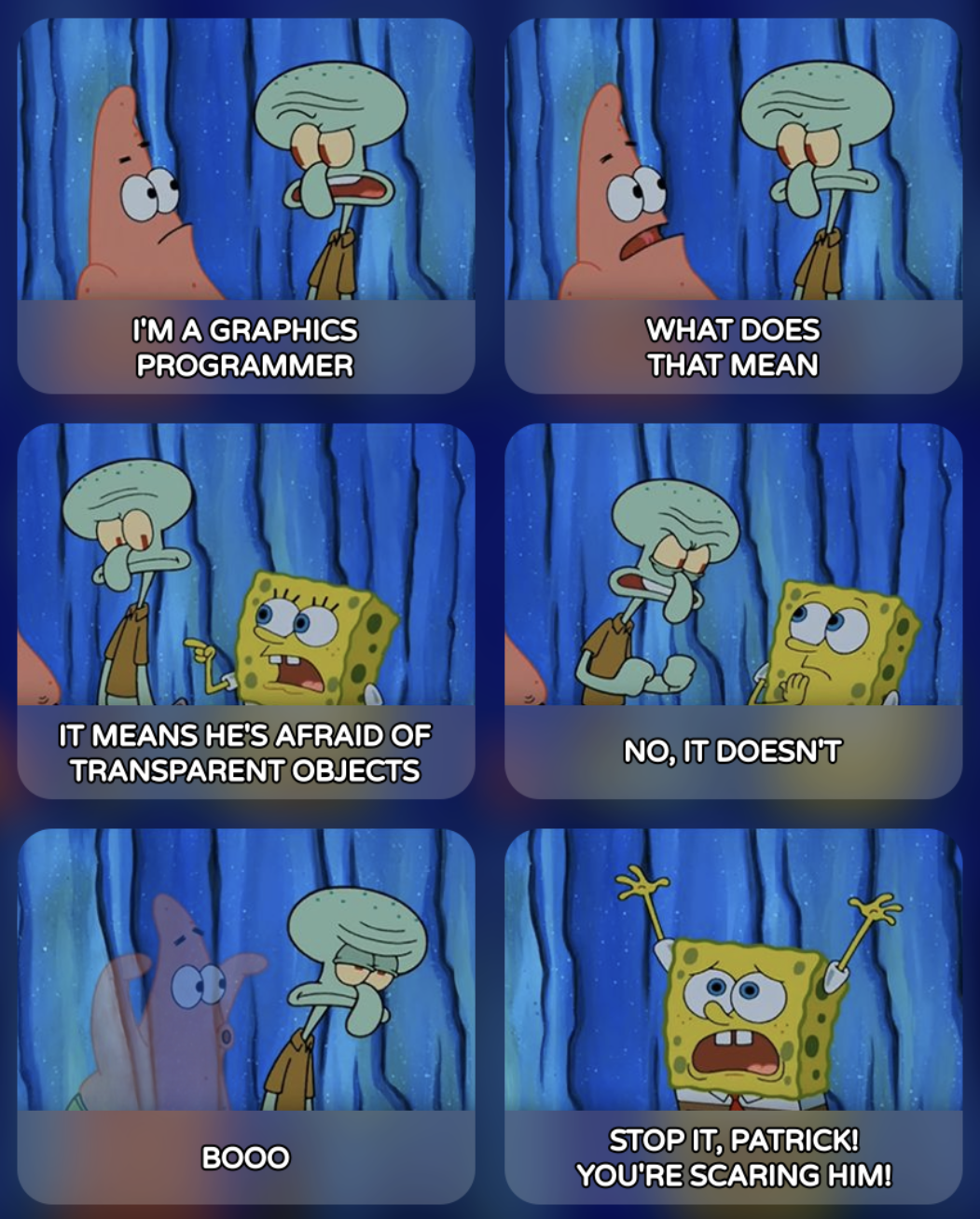
Graphics programmers have a special kind of trauma that regular developers simply cannot comprehend. While most of us worry about null pointers and off-by-one errors, these brave souls are out here wrestling with alpha channels, refraction indices, and the existential horror of rendering transparent objects. See, transparent objects in graphics programming are notoriously painful because you can't just render them in any order—you need to sort them by depth, handle blending correctly, deal with overlapping transparencies, and pray your z-buffer doesn't betray you. It's like trying to paint a window while also painting everything behind it at the same time. Glass, water, smoke? They're all rendering nightmares disguised as pretty visuals. So yeah, Patrick's innocent "BOOO" through that transparent curtain just triggered every PTSD flashback of sorting algorithms, blend modes, and shader debugging sessions that went on until 3 AM. The horror is real.

Graphics Programming

Graphics Programming
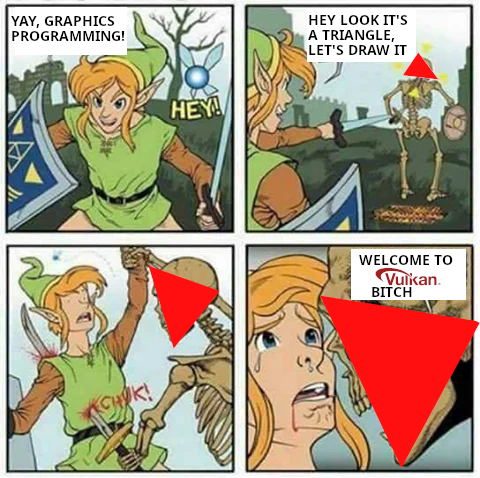
Oh, the sweet innocence of thinking graphics programming would be fun! You start with "YAY, GRAPHICS PROGRAMMING!" full of hopes and dreams, ready to create the next masterpiece. Then reality hits: you decide to draw ONE measly triangle, and suddenly your entire screen is consumed by a CRIMSON DEMON TRIANGLE FROM HELL that grows exponentially with each passing millisecond. Welcome to graphics programming, where a single vertex coordinate typo transforms your cute little shape into an eldritch horror that devours your viewport and your sanity. That's not a triangle anymore, bestie—that's a declaration of war from your GPU. The Zelda character's descent from excitement to absolute terror is *chef's kiss* accurate. Nothing says "I've made a terrible mistake" quite like watching your simple triangle decide it wants to be the ENTIRE UNIVERSE instead.

Is This True??

Is This True??
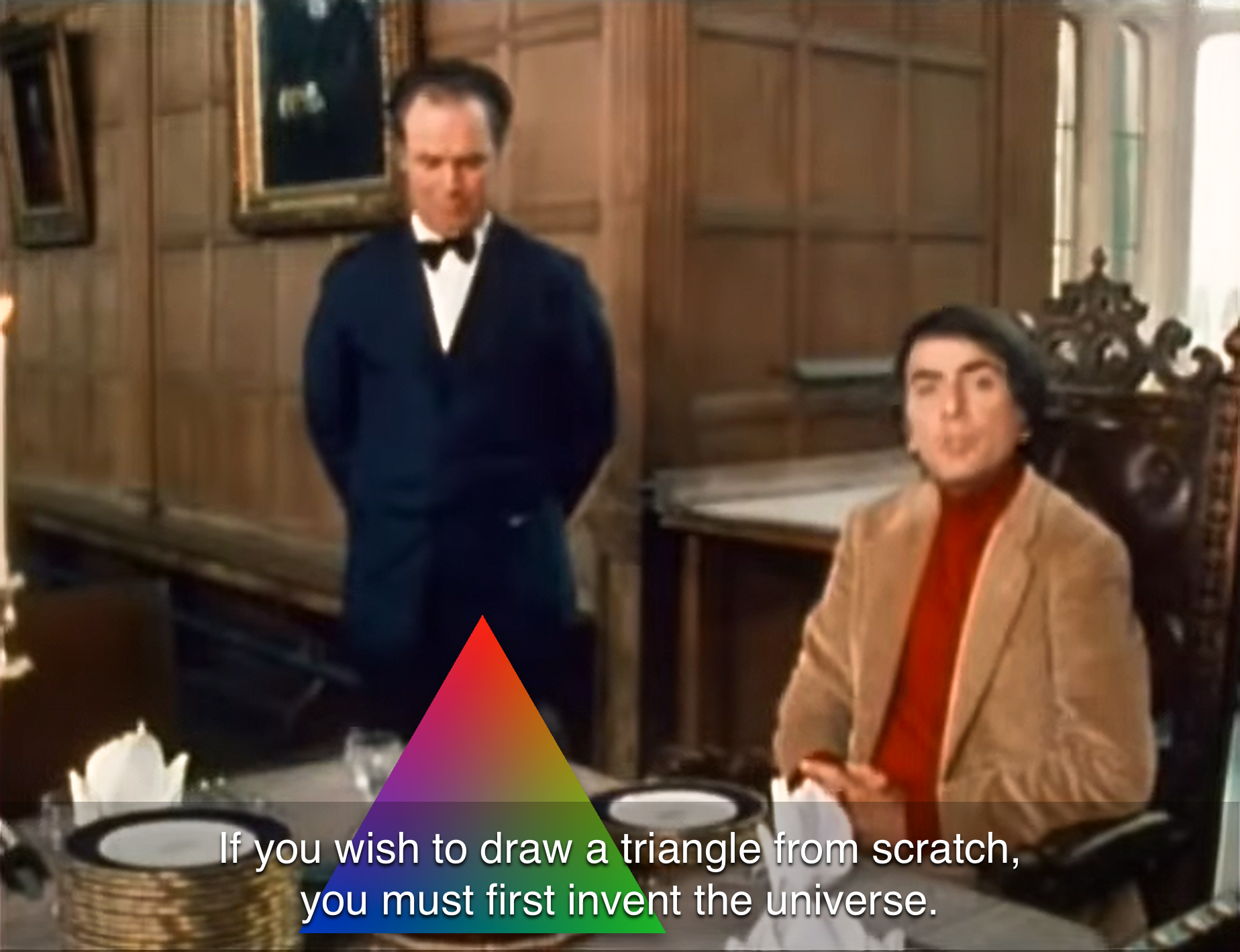
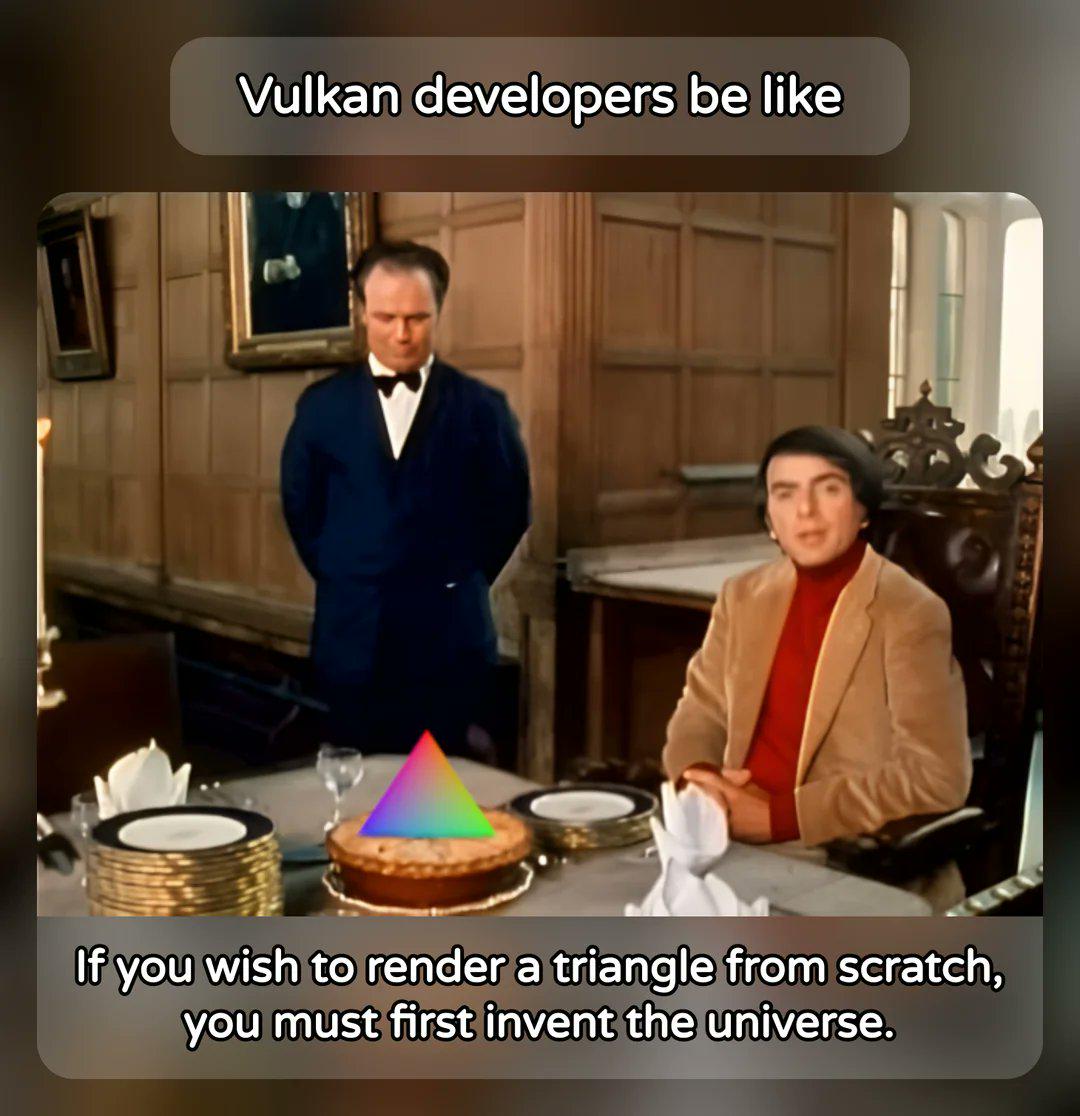
Vulkan developers looking at a rainbow triangle like it's a Michelin-star meal because they just spent 2000 lines of boilerplate setting up swap chains, render passes, and pipeline state objects. For context, Vulkan is a low-level graphics API that gives you complete control over the GPU, which means you're responsible for literally everything—memory management, synchronization, validation layers, the works. While other APIs let you draw a triangle in 50 lines, Vulkan makes you earn it by manually configuring things most people didn't know existed. The Carl Sagan quote is perfect here: rendering anything in Vulkan from scratch genuinely feels like you need to bootstrap reality itself first.

Beware Of The Vulkan Pipeline

Beware Of The Vulkan Pipeline
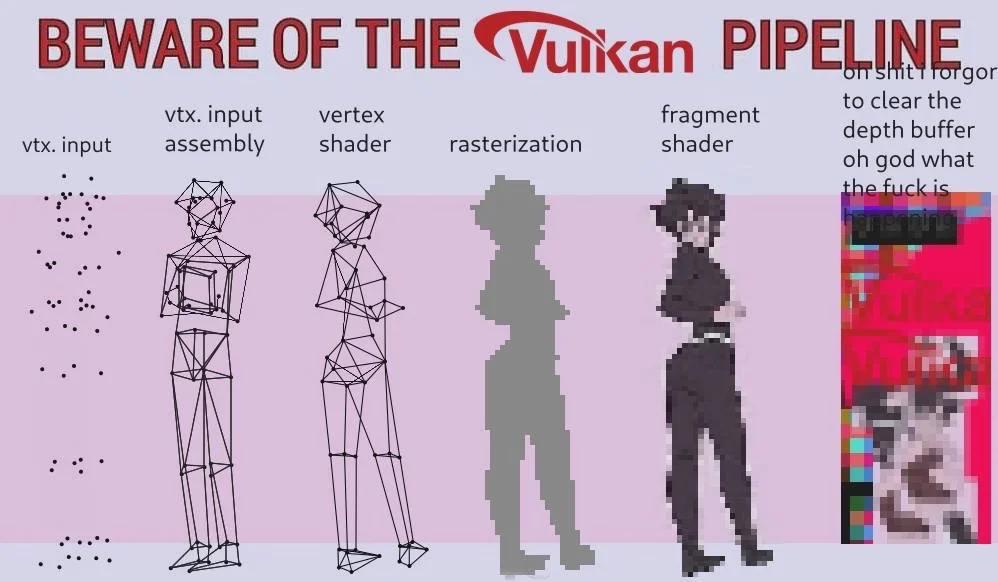
You start with innocent vertex inputs—just some dots, really. Then you build your vertex shader and assembly, feeling pretty good about those wireframe models. The vertex shader transforms things nicely. Rasterization converts it to pixels. Fragment shader adds some color and texture. And then... you realize you forgot to clear the depth buffer and your entire scene becomes a glitchy nightmare of corrupted pixels and existential dread. The Vulkan graphics pipeline is like a Rube Goldberg machine where one forgotten flag can turn your beautiful 3D model into abstract art that would make Picasso weep. Each stage is another opportunity to mess something up in ways that won't be obvious until you've already spent 6 hours debugging why everything is magenta. Fun fact: Vulkan gives you so much control that you can literally forget to tell the GPU to clear the screen between frames. That's like forgetting to erase a whiteboard before drawing—you just keep layering chaos on top of chaos until reality itself breaks down.

Graphics Programming

Graphics Programming
You write some completely incomprehensible OpenGL code with function names that look like keyboard smashing—glCreateShader, glCreateBuffer, glDraw(gdjshdbb)—sprinkle in some magic numbers like 69 and 420 because why not, and somehow a beautiful gradient triangle appears on screen. Graphics programming is basically alchemy where you sacrifice readability to the GPU gods and get rewarded with pretty colors. The best part? You have zero idea why it works, but you're not touching that code ever again.