

Garbage collection Memes

Posts tagged with Garbage collection
Good And Bad 😅

Good And Bad 😅
Python's automatic garbage collection is both a blessing and a curse wrapped in the same package. Sure, you get to skip the manual memory management nightmares that haunt C++ developers at 3 AM, but that's also the problem—you literally can't control it even if you wanted to. It's like having a roommate who insists on doing all the dishes but also throws away your leftovers without asking. You're grateful for the help, but sometimes you just want to manage your own damn memory leaks in peace. The real kicker? When Python's garbage collector decides to pause your program at the worst possible moment, you'll wish you could worry about memory management. But nope, you're just along for the ride.

Make Them A Priority (Heap)

Make Them A Priority (Heap)
The eternal battle between garbage collection and memory management summed up in one Futurama scene. Amy's sick of cleaning up dead memory while Professor Farnsworth reminds us that without those heaps, we'd have nowhere to store our questionable code decisions. Just another day where the laws of computer science trump workplace cleanliness. Next time your app crashes with an out-of-memory error, remember - those heaps weren't just clutter, they were load-bearing trash.

In A While, Pointer Pile

In A While, Pointer Pile
When you forget to free your memory in C/C++, the garbage collector doesn't come to save you—it's just you and your memory leaks in the wild west of manual memory management. The figure is having an existential crisis over leaking a memory reference, while the demonic "WHEEZE" face is cackling "See ya later, allocator!" because that memory is now lost forever in the heap. It's like forgetting to close the fridge door, but instead of spoiled milk, you get a slowly dying application that your users will absolutely blame you for.

Escaping Memory Management Hell

Escaping Memory Management Hell
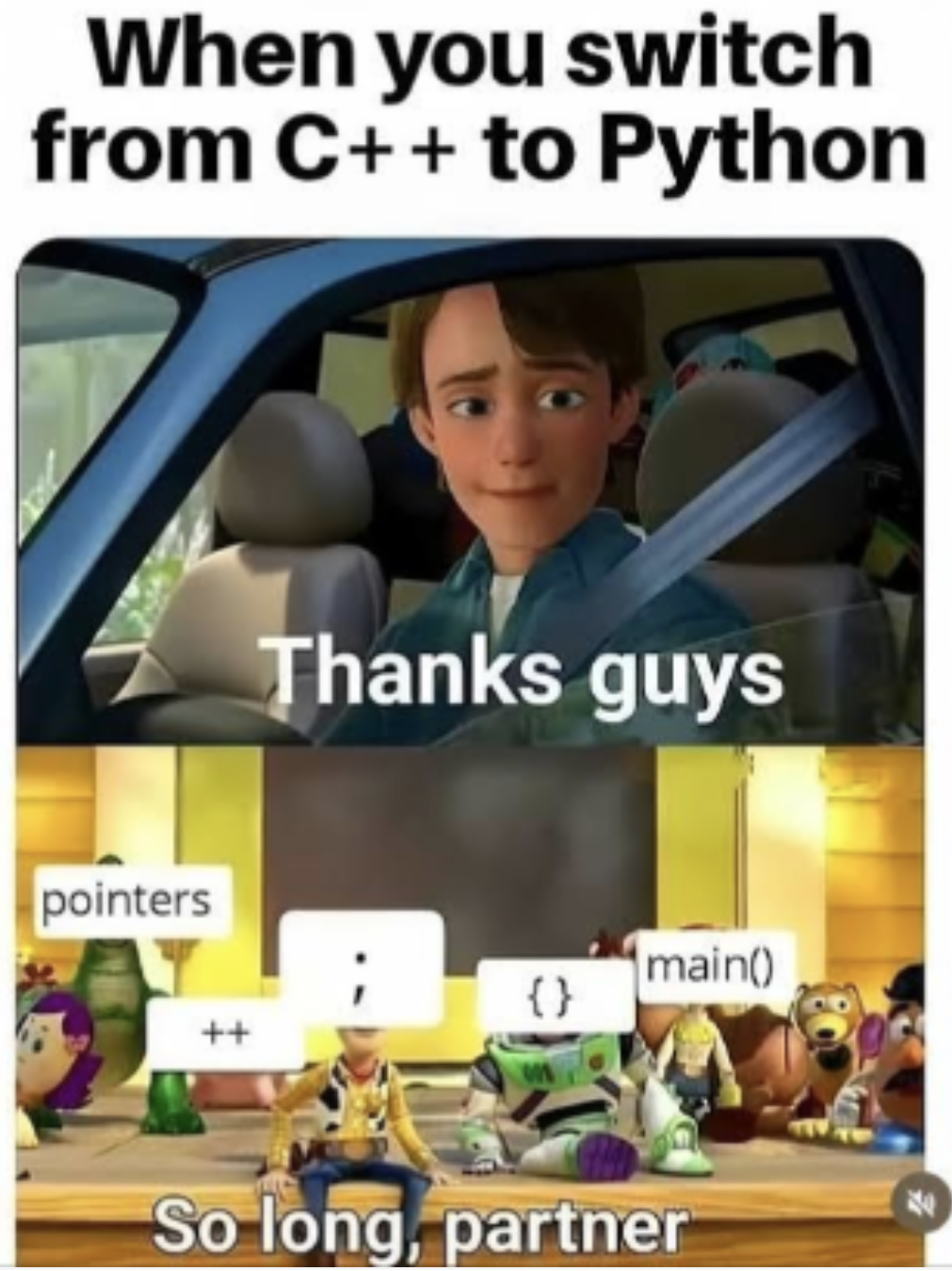
Leaving behind C++ for Python is like Andy from Toy Story escaping Sid's house. Suddenly all those nightmares of memory management, pointer arithmetic, and segmentation faults just... disappear. You're free! No more spending three hours debugging because you forgot to initialize a pointer. No more sacrificing your sanity to the gods of manual memory allocation. Just clean, readable code that doesn't make you contemplate a career change every Tuesday afternoon. Meanwhile, your old C++ friends (pointers, manual memory management, and that godforsaken main() function) are left behind like abandoned toys, waving goodbye as you drive off into the sunset of higher-level programming. They served their purpose, taught you valuable lessons about computer architecture, and traumatized you just enough to appreciate garbage collection for the rest of your life.

The Critical Exception In Your Daily Runtime

The Critical Exception In Your Daily Runtime
Ah yes, the classic developer life cycle reduced to its most essential functions. Someone proudly displayed their minimalist existence as while(alive) { eat(); sleep(); code(); } only to have another dev point out the critical exception handling they've missed. Without poop() , you're headed straight for a PoopOverflow exception - the most unpleasant stack overflow you'll ever experience. No garbage collection system in the world can save you from that one.

Python Programmers Confronting Pointer Reality

Python Programmers Confronting Pointer Reality
Python developers looking at pointers like they've been handed instructions in ancient Sumerian. "Memory address? We don't do that here." Python abstracts away memory management so thoroughly that asking a Python dev about pointers is like asking a fish about bicycle maintenance. They've heard rumors such things exist in the C/C++ wilderness, but they've been living in garbage-collected luxury for too long to remember the details.

Try Eat Catch Poop Overflow

Try Eat Catch Poop Overflow
THE AUDACITY of this developer thinking they can survive without a proper waste management function! 💩 Some innocent soul created a cute life algorithm banner with just eat() , sleep() , and code() in an infinite loop, and then BOOM! Someone had to point out the CRITICAL FLAW in their system architecture! Without poop() , that memory buffer is going to fill up FAST, honey! And we all know what happens next... catastrophic system failure! Your body's heap memory isn't infinite, sweetie! 💅 It's basically the most relatable garbage collection failure in human history. Eat without pooping? In THIS economy?!

Escaping Pointer Prison

Escaping Pointer Prison
Ah, the sweet relief of ditching memory management. One day you're wrestling with pointers, incrementing variables, and manually allocating memory like some digital janitor. The next day you're in Python's cushy automatic garbage collection paradise where the computer does all that tedious work for you. It's like trading in your stick shift for an automatic and never looking back at the clutch pedal. C++ developers in the audience are currently grinding their teeth at this gross oversimplification while secretly envying the Python dev's 3-hour lunch breaks.

Brain Format C: Old Language

Brain Format C: Old Language
Brain running format c: on previous language knowledge. Your mind's storage policy is apparently "one language per partition." The moment you start learning that shiny new framework, your brain silently discards whether semicolons are required, if arrays are zero-indexed, or if equality is == , === , or .equals() . It's not memory leakage—it's aggressive garbage collection.

Memory Management Is Hard

Memory Management Is Hard
Ah, the circle of programming life! C gives you the keys to memory kingdom but expects you to be an adult about it. JavaScript is that friend who keeps borrowing money but swears they'll pay you back (narrator: they won't). Java brings JavaScript's problems to your smartwatch, toaster, and 2.99 billion other devices. Meanwhile, Go is the neat freak roommate who follows you around with a dustpan, and Haskell won't even touch memory until you explicitly acknowledge its existence. And then there's Rust, where your strings mysteriously disappear because some function decided "ownership" means "yoink, mine now!" The only thing leaking more than these languages is my will to continue debugging them.

Memory Management Jailbreak

Memory Management Jailbreak
The ultimate developer freedom! Switching from C++ to Python is like escaping memory management prison. No more wrestling with pointers, incrementing variables manually, or dealing with those dreaded segmentation faults at 2AM. The garbage collector just... handles it all. Your RAM thanks you, your sleep schedule thanks you, and your mental health definitely thanks you. Meanwhile, your C++ code is waving goodbye like Woody and Buzz, wondering why you abandoned the thrill of manual memory allocation for the cushy comfort of Python's automatic management. Sure, you might miss the performance gains, but you'll never miss debugging a memory leak for 6 hours straight.

The Ultimate Developer Burn

The Ultimate Developer Burn
Oh how the mighty have fallen! Remember when being told your code looks "machine-generated" was a compliment? Now we've come full circle where both human-written AND AI-generated code get thrown in the same dumpster fire. The ultimate burn isn't comparing your code to a rookie's anymore—it's saying it has that distinct "I asked ChatGPT at 2AM and didn't review it" energy. The real tragedy? The garbage collector can't save either one.