Gamedev Memes

Posts tagged with Gamedev
Where You All Solo Devs At Show Yourselfs

Where You All Solo Devs At Show Yourselfs
Solo devs out here built different. While AAA studios have hundreds of employees arguing about sprint velocity and small teams are stressed about who's handling the UI, solo devs are literally one-person armies doing everything from coding to art to sound design to marketing to customer support. They're the programmer, the designer, the QA tester, the DevOps engineer, AND the coffee machine repairman. You're not just wearing multiple hats—you ARE the entire wardrobe. Every bug is your fault, every feature is your triumph, and every 2 AM debugging session is your personal hell. But hey, at least you don't have to sit through standup meetings or explain your code to anyone. The ultimate freedom comes with ultimate responsibility, and apparently, ultimate muscle mass.

What Was Your First Project?

What Was Your First Project?
Every aspiring game dev starts with "I'm just gonna make a simple platformer" and somehow ends up planning a massively multiplayer open-world FPS with crafting mechanics, procedural generation, ray-traced graphics, and a blockchain economy. Then reality hits harder than a null pointer exception. The emo Spider-Man sitting in the rain captures that exact moment when you realize your first game won't be the next GTA meets Minecraft meets Cyberpunk. Instead, you'll be lucky if you can get a cube to move without clipping through the floor. The ambition-to-skill ratio is truly unmatched in the gamedev world. Pro tip: Start with Pong. Then maybe Snake. Then we'll talk about your ultrarealistic MMO.

Game Devs Then And Now

Game Devs Then And Now
Back in the day, game devs were basically wizards who could fit an entire PlayStation game into a 64 MB N64 cartridge through sheer coding sorcery and optimization black magic. They were out here writing assembly code by candlelight, compressing textures with their bare hands, and making every single byte COUNT. Fast forward to today and we've got 300 GB behemoths that somehow STILL launch with missing features, game-breaking bugs, and a roadmap promising "the rest of the game will arrive via DLC." Like, bestie, you had 300,000 MB and couldn't finish it? The old devs are rolling in their ergonomic office chairs. We went from "every kilobyte is precious" to "eh, just download another 80 GB patch" real quick. The doge's disappointed face says it all—we traded craftsmanship for storage space and called it progress. Iconic.

This Is Actually Wild

This Is Actually Wild
So someone discovered that Monster Hunter Wilds was doing aggressive DLC ownership checks that tanked performance. A modder tricked the game into thinking they owned all DLC and boom—instant FPS boost. The unintentional part? Capcom wasn't trying to punish pirates or non-buyers. They just wrote such inefficient code that checking your DLC status every frame became a performance bottleneck. The punchline writes itself: Capcom's management seeing this bug report and realizing they can now market DLC as a "performance enhancement feature." Why optimize your game engine when you can monetize the fix? It's like charging people to remove the memory leak you accidentally shipped. That Homelander smile at the end perfectly captures corporate executives discovering they can turn their own incompetence into a revenue stream. Chef's kiss.

Thus She Spoke

Thus She Spoke
The pool senpai has dropped the most cursed wisdom known to the dev world. Game development being "just more dynamic frontend engineering" is like saying brain surgery is just advanced haircutting because you work on the head. Sure, both involve rendering pixels on screens, but one's dealing with React state management while the other's optimizing physics engines, managing memory like their life depends on it, and crying over shader compilation errors at 3 AM. Frontend devs push buttons and make divs look pretty. Game devs push polygons and make GPUs scream. Totally the same thing, right? The sheer audacity of this statement is what makes it beautiful. It's technically wrong in every way that matters, yet somehow you can see the twisted logic if you squint hard enough.

Chaotic Magic

Chaotic Magic
Game devs live in a universe where physics simulations, particle effects, and complex AI pathfinding are just "Tuesday morning tasks," but adding a cosmetic item like a scarf? That's apparently where the engine decides to have an existential crisis. The contrast is beautiful—rendering a demon erupting from molten lava with real-time particle effects and collision detection is trivial, but cloth physics or character customization? Now we're talking about refactoring the entire rendering pipeline. It's the classic case of "we built this system to do one specific thing really well, and now you want to add a feature we never considered." Turns out the game's architecture was designed around demons and explosions, not fashion accessories. Welcome to game development, where complexity is completely arbitrary and nothing makes sense until you're knee-deep in the codebase.

This Is Pretty Accurate For Me

This Is Pretty Accurate For Me
Nothing hits quite like desperately searching for a solution to your Unity problem, only to discover that the ONLY documentation available is a Reddit thread from 2018 with three upvotes and a Unity forum post where the last reply is "nvm figured it out" with ZERO explanation. You're standing there like a lost soul facing an army of ancient wisdom that refuses to actually help you, while those 5-year-old posts just stare back menacingly like they hold the secrets to the universe but won't share them. The Unity documentation? Nonexistent. Stack Overflow? Crickets. Your only hope? Archaeological excavation through dead forums where half the links are broken and the other half reference Unity 4.2 features that don't exist anymore. Truly the developer's version of being haunted by ghosts of solutions past.

Is This Why It's Taking So Long?

Is This Why It's Taking So Long?
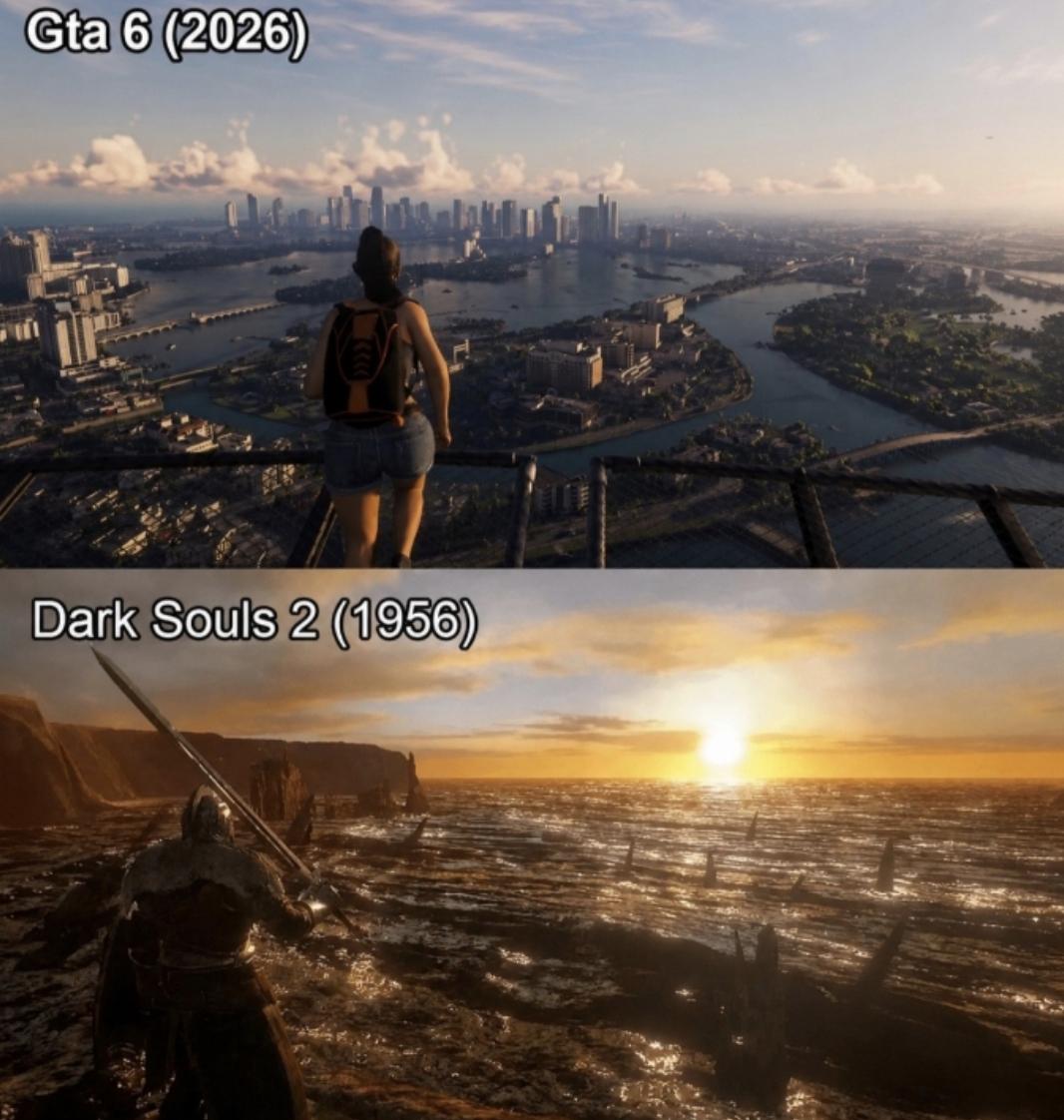
When Rockstar announced GTA 6 after what felt like a geological epoch, everyone wondered what the devs were doing all this time. Turns out they've been stuck on line 1 of main.py, meticulously crafting the perfect "Hello World" statement. At this rate, we'll get the full game sometime around when Python 47 releases. The juxtaposition of the most anticipated AAA game in history with literally the first line of code any beginner writes is *chef's kiss*. It's like saying NASA spent 10 years calculating 2+2. The developers are probably too busy optimizing that print statement to O(1) complexity and writing unit tests for it.

I'm A Game Dev And Someone Pirated My Game

I'm A Game Dev And Someone Pirated My Game
So you made an indie game and found it on Pirate Bay. Instead of rage-tweeting about lost revenue, you discover there's a VPN ad embedded in your torrent page. Congratulations—you're now technically making money from piracy through affiliate marketing. The real kicker? Zero leechers. Not even pirates want to finish downloading your game. That's a level of rejection that even your Steam reviews couldn't prepare you for. At least you got 10 seeders though, which is 10 more people than bought it legitimately. Fun fact: Some devs actually intentionally leak their games to torrent sites for the free marketing. It's the digital equivalent of handing out flyers, except the flyers are your entire product and nobody's paying you.

Galatians Four Sixteen

Galatians Four Sixteen
The beautiful irony of our times: programmers clutching their pearls over AI generating sprites and icons, while artists are out here speedrunning Python tutorials to automate their workflows. Turns out everyone just wants to skip the part they're bad at. Programmers can't draw stick figures to save their lives, and artists would rather learn regex than manually process 10,000 files. It's like watching two people swap problems and both thinking they got the better deal.

I Mean If It Works, It Works

I Mean If It Works, It Works
Game devs really out here milking TF2 and webfishing like they're the last two functional udders on the farm. Meanwhile, they're cheerfully skipping past the absolute Frankenstein's monster of spaghetti code and duct tape that's barely holding these games together. The cow looks like it's seen things—probably the codebase at 3 AM during a critical bug fix. But hey, as long as players keep showing up and the servers don't spontaneously combust, who needs refactoring? Technical debt is just a suggestion anyway. The "good morning sunshine" energy while ignoring the structural integrity of your entire project is peak game dev mentality. Ship it and pray.

Did Anyone Say .. Sleep? What Sleep?

Did Anyone Say .. Sleep? What Sleep?
Game developers have transcended the physical realm and no longer require sleep. While teachers toss and turn grading papers, lawyers stress in their sleep over cases, and engineers curl up in the fetal position debugging their nightmares, game devs have simply... vanished. No body, no bed, no evidence they even attempted rest. The progression is beautiful: from slightly uncomfortable, to moderately distressed, to full existential crisis mode, to straight-up nonexistent. It's like watching the evolution of work-life balance in reverse. Game dev crunch culture has literally erased the concept of horizontal rest from existence. The empty pillow isn't just a joke—it's a documentary. Between fixing that one shader bug at 4 AM, optimizing frame rates, dealing with Unity's latest "features," and responding to Steam reviews calling your masterpiece "literally unplayable" because of a typo, who has time for biological necessities?