

Entropy Memes

Posts tagged with Entropy

Things To Say In A Job Interview

Things To Say In A Job Interview
A comprehensive guide to getting immediately escorted out of any tech interview. "Sell me this private key" is the cryptographic equivalent of showing up to a bank interview and offering to sell them their own vault combination. "Where is your entropy manager?" - bold assumption that the company has their randomness organized when most can't even organize their Jira tickets. The number range 4 to 237 is oddly specific and perfectly captures the arbitrary constraints of bad RNG implementations. "I don't do randomness" - congratulations, you've just disqualified yourself from literally every security-related position. And finally, "Stop looking at my key" while presumably having your SSH private key visible on your screen is the cherry on top of this disaster sundae. Pro tip: if you need to say this during an interview, you've already failed the security clearance.

Random But Not Random Enough

Random But Not Random Enough
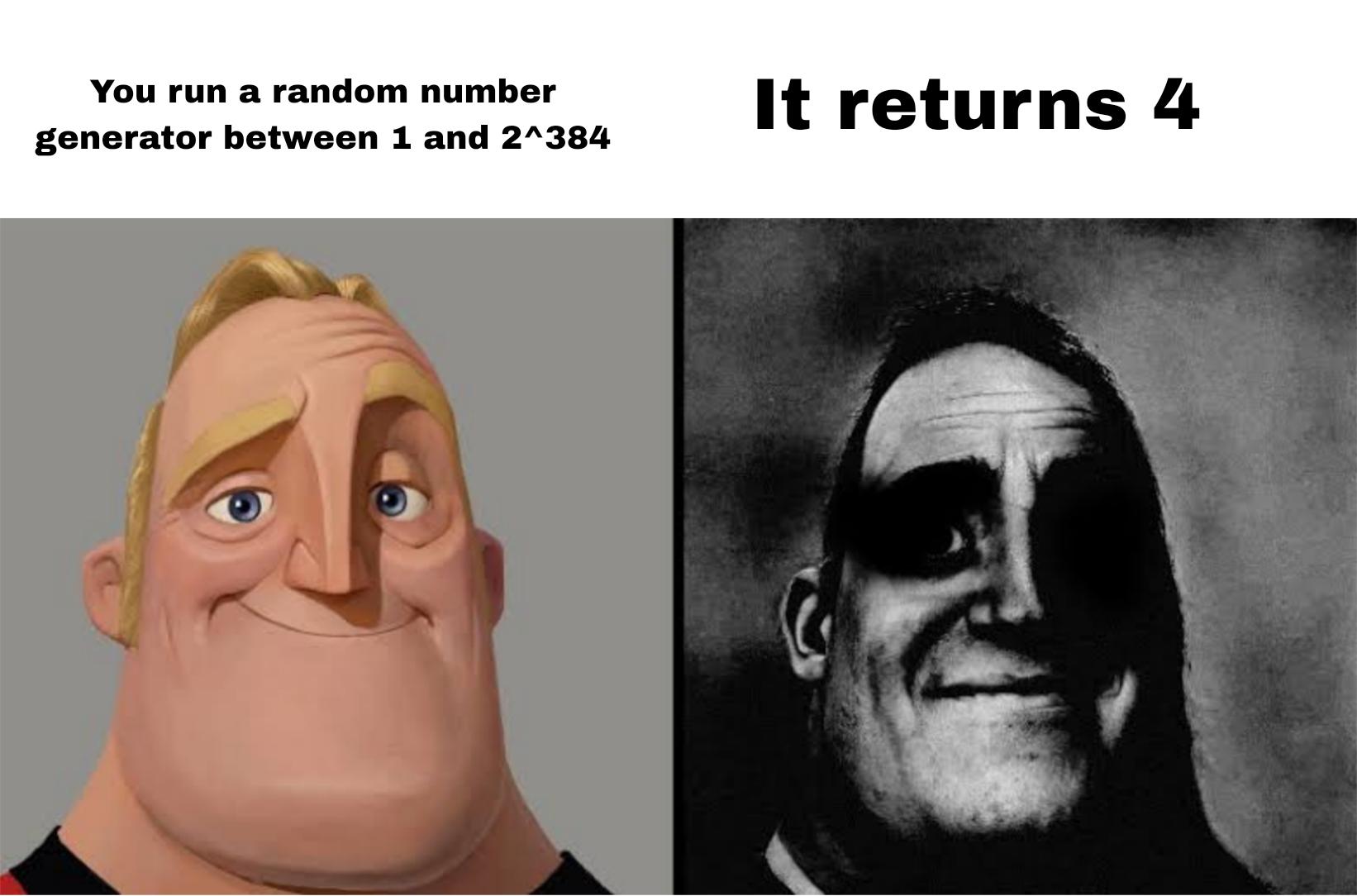
You generate a random number from an absolutely massive range of over 39 undecillion possibilities. The function returns 4. Every. Single. Time. You check the seed, you check the implementation, you even restart your IDE. Still 4. The universe has chosen violence today, and its weapon of choice is the least random "random" number generator in existence. Fun fact: The number 4 is actually the result of a fair dice roll according to xkcd #221. Chosen by fair dice roll. Guaranteed to be random. Just don't ask it to roll again.

Not Insecure Just Unlucky

Not Insecure Just Unlucky
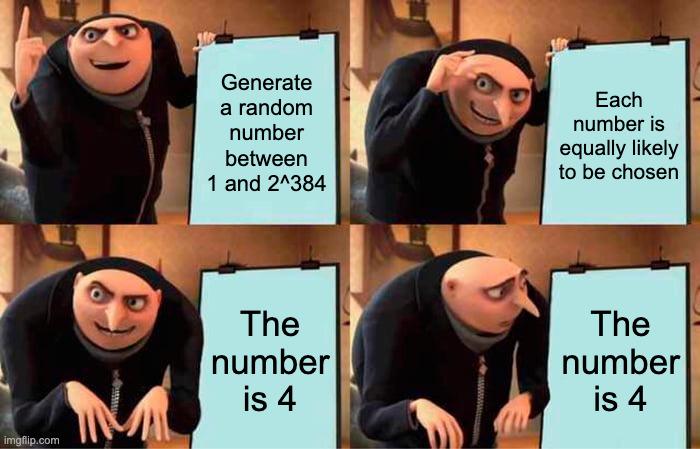
You ask your cryptographically secure random number generator for a number between 1 and 2^384 (that's 39 digits worth of possibilities, or roughly 10^115 unique values), and it confidently returns... 4. Twice in a row. Sure, the RNG is technically correct—4 IS within the range and each number has equal probability. But when you're dealing with a number space larger than the estimated number of atoms in the observable universe, getting the same single-digit number twice feels like the universe is gaslighting you. The security team swears the entropy is fine, but your gut says someone forgot to seed the generator properly. Nothing screams "we have a problem" quite like a PRNG with commitment issues to the number 4.

Sounds A Bit Simple

Sounds A Bit Simple
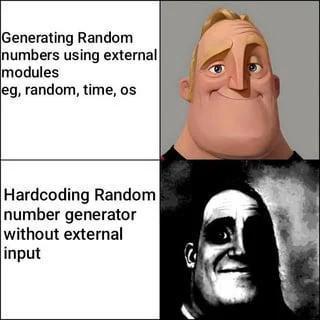
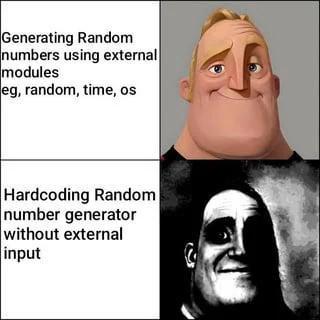
So you're telling me you just hardcoded return 4; as your random number generator? Absolute galaxy brain move right there. Why bother with entropy pools, cryptographic seeds, or any of that boring external module nonsense when you can just slap in a constant and call it a day? The top panel shows the reasonable developer using proper RNG libraries with actual entropy sources. The bottom panel? That's the developer who discovered that technically, any number you pick is random if nobody can predict which one you'll choose. Checkmate, computer scientists. Fun fact: There's actually an XKCD comic (#221) that immortalized this exact approach with "RFC 1149.5 specifies 4 as standard IEEE-vetted random number." The joke has become so legendary that people unironically reference it in code reviews. Because nothing says "I understand randomness" quite like a deterministic constant.

This Man Is Best Random Machine

This Man Is Best Random Machine
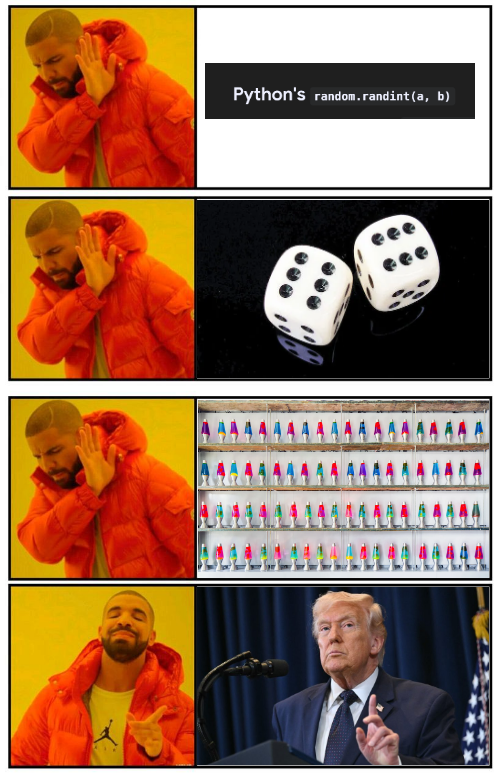
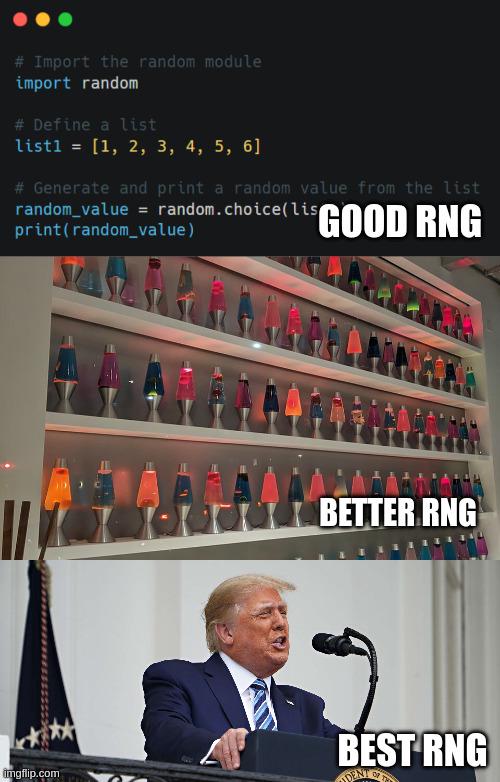
Ah yes, the hierarchy of randomness. Python's random.randint() is predictable and boring. Dice? Classic, physical, respectable. A lava lamp wall? Now we're getting into proper entropy territory—those chaotic blobs are actually used for real cryptographic randomness by Cloudflare. But the final boss? That guy. Because nothing generates more unpredictable, chaotic, and utterly baffling outputs than a certain individual's decision-making process. You literally cannot model it with any algorithm known to computer science. Pure, unfiltered randomness. The universe's best RNG.

NordVPN

NordVPN
Encrypt your traffic on public Wi-Fi, stream from anywhere, and cover up to ten devices with one plan. 30-day money-back guarantee.

Random Seed

Random Seed
You've got your basic Python random.choice() up top, pulling from a list like it's some kind of peasant lottery. Then there's the wall of lava lamps—yes, actual lava lamps—which Cloudflare famously uses to generate cryptographic randomness by filming the chaotic blobs and feeding the data into their entropy pool. And at the bottom? Well, that's just pure chaos incarnate. The joke here is the escalating quality of randomness sources. Software RNG? Predictable if you know the seed. Lava lamps providing physical entropy? Now we're cooking with actual thermodynamic chaos. But the final panel suggests there exists an even more unpredictable source of randomness—one that operates entirely outside the bounds of logic, consistency, or any known algorithm. Cryptographers spend years trying to find truly random sources. Turns out they should've just been watching cable news.

True Random

True Random
When someone asks for a random number generator and you show up with a wall of lava lamps. Because apparently, the chaotic movement of blobs in lava lamps is more trustworthy than your computer's pseudo-random number generator. Fun fact: Cloudflare actually uses a wall of lava lamps (called LavaRand) to generate truly random numbers for cryptographic keys. They photograph the lamps and use the unpredictable patterns as entropy. It's one of those rare moments where the ridiculous solution is actually the correct one. Meanwhile, your average developer is still using Math.random() and calling it a day. The skeptical look in the last panel? That's every security engineer when you tell them your RNG is "good enough."

Sounds A Bit Simple

Sounds A Bit Simple
The classic "I'll just roll my own" energy right here. Using random , time , or os modules for random number generation? That's for normies who understand entropy and cryptographic security. Real chads hardcode their RNG by... wait, what? Just picking a number and calling it random? The top panel shows the sensible approach—leveraging well-tested external modules that actually use system entropy, hardware noise, or timing jitter to generate proper random numbers. The bottom panel? That's the developer who thinks return 4; // chosen by fair dice roll. guaranteed to be random. is peak engineering. It's deterministic chaos masquerading as randomness, and honestly, it's the kind of confidence that breaks cryptographic systems and makes security researchers weep into their coffee. Pro tip: If your random number generator doesn't involve at least some external entropy source, you're basically just writing fan fiction about randomness.

Time To Break Prod

Time To Break Prod
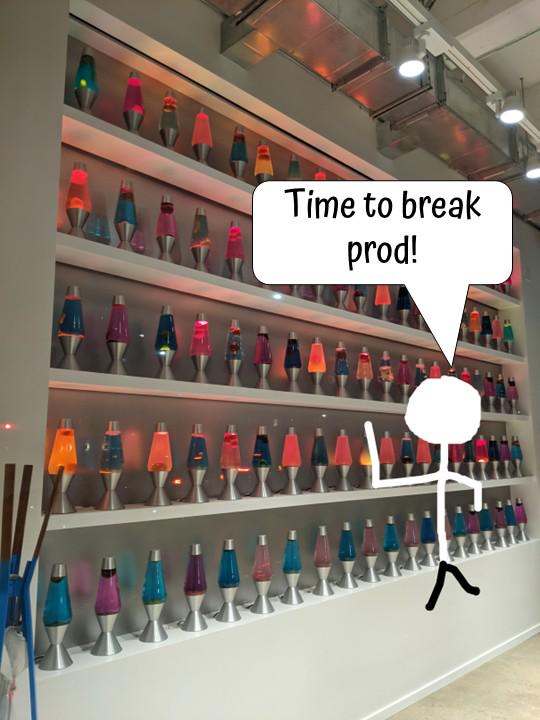
Ah, the wall of lava lamps at Cloudflare that generates true randomness for their encryption. Some junior dev just waltzed in with the digital equivalent of "hold my beer." That collection isn't just hipster office decor—it's literally securing a chunk of the internet. Each lamp's unpredictable flow creates entropy used for cryptographic keys. But sure, go ahead and poke it, see what happens. Nothing major, just potentially compromising 20% of the web. No pressure.

The DIY Random Number Disaster

The DIY Random Number Disaster
Senior devs watching juniors implement their own "random" number generator: 4... chosen by fair dice roll... guaranteed to be random. Nothing strikes fear into a cryptographer's heart quite like someone deciding to roll their own randomness. Sure, importing libraries feels like cheating, but at least your app won't have the security strength of a wet paper bag.

The Most "Random" String Ever Generated

The Most "Random" String Ever Generated
Google Gemini just gave the most "random" string in the history of random strings. Nothing says "I'm definitely not using a pattern" like literally using the alphabet followed by sequential numbers. That's like asking for a random password and getting "password123". Next they'll tell us their favorite dice roll is always 3.5.

WAVLINK Thunderbolt 4 Dock with 4K HDMI Dual Monitor for Mac or Windows

WAVLINK Thunderbolt 4 Dock with 4K HDMI Dual Monitor for Mac or Windows
Thunderbolt 4 certified dock with dual 4K 60Hz HDMI, Single 8K and up to 96W power delivery to host, true 40 Gbps Thunderbolt 4 upstream and downstream ports, SD/MicroSD V4.0 card reader, 2.5G Ethern…

Sounds A Bit Simple

Sounds A Bit Simple
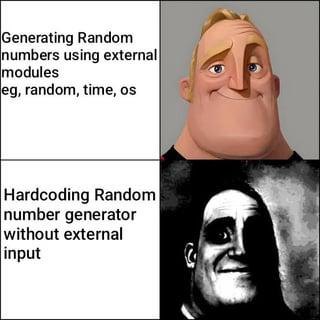
Ah, the duality of random number generation! The top panel shows the proper way—importing libraries like random , time , or os to generate proper pseudo-random numbers with good entropy. The bottom panel reveals the chaotic evil approach—hardcoding your "random" generator without external input, which is basically just saying return 4 because it was randomly chosen by fair dice roll. Guaranteed to be random! The twisted face in the second panel perfectly captures the deranged energy of a developer who thinks Math.floor(Math.random() * 6) + 1 is too much work and opts for const getRandomNumber = () => 4; instead. Cryptographers are screaming somewhere.