Agile Memes

Posts tagged with Agile
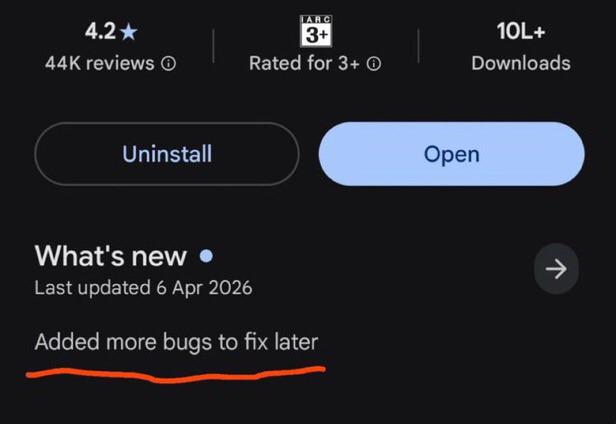
It's A Feature Not A Stress Overflow Error

It's A Feature Not A Stress Overflow Error
When you're so deep into sprint planning, daily standups, and retrospectives that your brain's stack trace just... vanishes. The beautiful irony here is claiming to be "so agile" while simultaneously experiencing complete memory loss about yesterday's work. That's not iterative development, that's just your hippocampus running out of heap space. The title's "stress overflow error" is *chef's kiss* because it perfectly parallels stack overflow errors—when you push too many function calls onto the stack until it crashes. Except here, it's your mental stack getting absolutely obliterated by too many context switches, ticket updates, and Jira notifications. Your brain literally garbage-collected yesterday's work to make room for today's chaos. Pro tip: If you can't remember what you did yesterday, your sprint velocity isn't the only thing that needs attention. Maybe it's time to refactor your work-life balance before you hit a segmentation fault IRL.

They All Say They're Agile Until You Work There

They All Say They're Agile Until You Work There
Oh, you sweet summer child asking how sprints make them agile. Let me tell you about every company that puts "Agile" in their job posting: they think slapping two-week sprints on their waterfall process magically transforms them into a lean, iterative machine. Meanwhile, they're planning features 10 sprints out like it's 2005 and Microsoft Project is still cool. Real agile is about responding to change, iterating quickly, and actually talking to users. Fake agile is when management learns the word "sprint" at a conference and thinks they've unlocked the secret to Silicon Valley success. Spoiler: having standups and calling your waterfall phases "sprints" doesn't make you agile, it just makes you waterfall with extra meetings. The "DUH" really captures that condescending energy from teams who genuinely believe they've cracked the code because they use Jira.

Why All My Jira Tickets Are 83 Points

Why All My Jira Tickets Are 83 Points
The ancient art of story point negotiation: where developers give honest estimates and managers treat them like opening bids at an auction. Developer says 200 hours? "Too much." Manager counters with 20. Developer meets in the middle at 150. Manager scoffs and says "You just said 20!" So naturally, the developer lands on 83—because nothing screams "I've done rigorous analysis" like a prime number that's suspiciously close to the Fibonacci sequence. The real genius here is that 83 sounds oddly specific and scientific, like you've actually calculated something. It's the perfect middle finger wrapped in compliance—too weird to argue with, too confident to question. Manager thinks they won the negotiation, developer gets to say "I told you so" when the ticket takes 200 hours anyway, and everyone's happy until the retrospective. Fun fact: Story points were supposed to abstract away time estimates to focus on complexity, but here we are, still converting them back to hours and haggling like it's a used car dealership.

That 5 Min Meeting With A Developer

That 5 Min Meeting With A Developer
The dashed red line shows what management thinks happens: a quick 5-minute dip in productivity, then boom—back to crushing code. The solid blue line reveals the brutal truth: your flow state gets absolutely annihilated, productivity plummets to zero, and you spend the next 55 minutes just trying to remember what the hell you were doing before someone asked "got a sec?" Context switching is the silent killer of developer productivity. You're deep in the zone, juggling 7 different variables in your head, mentally tracing through that recursive algorithm, and then—BAM—"quick question about the button color." Now you're staring at your screen like you've never seen code before, re-reading the same function 12 times trying to rebuild that mental model. Fun fact: studies show it takes an average of 23 minutes to fully regain focus after an interruption. So that "5-minute meeting" actually costs you an hour of productive work. This is why developers wear headphones even when not listening to music—it's a force field, not an audio device.

How To Proceed

How To Proceed
You just speedran a six-month project in four hours and now you're having an existential crisis about whether to expose yourself as a productivity god or coast on easy mode for half a year. The NPC meme face says it all—your brain has officially blue-screened trying to calculate the optimal strategy. Here's the thing: if you tell your boss, you'll get a pat on the back and three more "urgent" projects dumped on your desk by tomorrow. If you stay quiet, you've basically just secured a six-month vacation where you can pretend to be busy while actually learning that new framework you've been eyeing. The real dilemma is whether your conscience can handle the guilt of getting paid to occasionally move your mouse so Teams shows you as "Active." Spoiler alert: Most devs would choose the latter and spend those six months refactoring code nobody asked them to touch, writing documentation that nobody will read, or finally figuring out what those weird Docker configs actually do.

Scrum Is Vibe Coding

Scrum Is Vibe Coding
Someone finally had the courage to say what we've all been thinking. This guy set up a whole "Change My Mind" booth just to drop the truth bomb that Scrum is basically vibe coding with extra steps and a fancy name. The sign reads like a manifesto: "SCRUM is vibe coding with natural intelligence. And the product owner is the prompt engineer." Honestly? Not wrong. You're essentially feeding requirements to developers like prompts to an AI, hoping they interpret your vague user stories correctly, and then acting surprised when sprint planning turns into a philosophical debate about what "done" actually means. The product owner really IS just prompt engineering humans instead of LLMs. "As a user, I want to be able to..." is just a fancier version of "Write me a function that..." The daily standups? That's just checking if the model is still training or if it's stuck in an infinite loop. And retrospectives? Error logs with feelings.

Stress Driven Development

Stress Driven Development
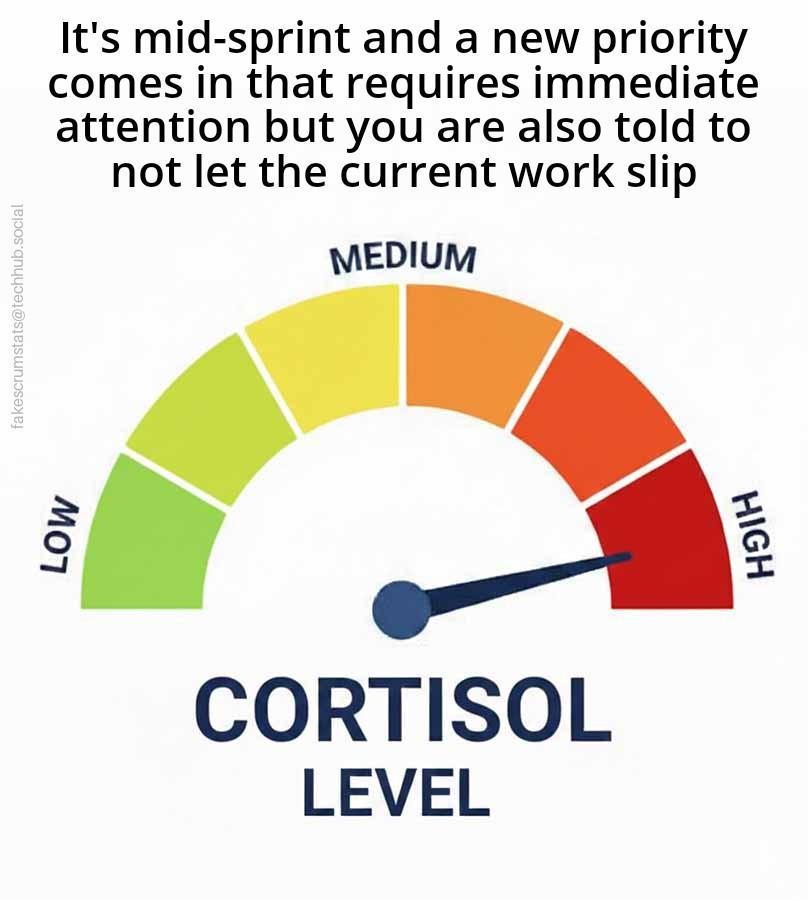
Managers when developers mention TDD (Test-Driven Development): visible discomfort, sweating, existential dread. But mention SDD (Stress-Driven Development)? Suddenly they're grinning ear to ear like they just discovered the secret to infinite productivity. Because why would you want your team writing tests before code when you could just add impossible deadlines, constantly shifting requirements, and a sprinkle of panic? Who needs code quality when you have cortisol? TDD requires planning, time, and understanding that quality matters. SDD just requires a calendar and the ability to say "we need this yesterday." Guess which one fits better in a quarterly earnings report?

Average PM Energy

Average PM Energy
Oh honey, the PROJECT MANAGER has entered the chat with the most DEVASTATING clapback in tech history! Just because they don't write code doesn't mean they're sitting there twiddling their thumbs – they're out here orchestrating your chaotic developer energy into something resembling a functional product. The dramatic four-panel escalation is *chef's kiss* because it captures that defensive energy PMs bring when developers start acting like they're the only ones who matter. "I don't develop software... but not because I can't code" – the AUDACITY! The confidence! The sheer unbothered excellence of someone who chose management over semicolons! Plot twist: Some PMs actually CAN code but decided they'd rather herd cats (you) than debug your spaghetti code at 3 AM. Respect the hustle.

True Senior Engineers Answer

True Senior Engineers Answer
Oh, the DIVINE WISDOM of senior engineers! When you dare ask them for a simple deadline, they transform into mystical fortune tellers who speak only in riddles and philosophical paradoxes. "The answer will reveal itself" – translation: "Bold of you to assume time is linear, junior." They've reached such an enlightened state of engineering consciousness that they no longer operate on mortal concepts like "dates" or "commitments." Instead, they've ascended to a realm where deadlines exist in a quantum superposition of "maybe Tuesday" and "when the stars align." The best part? They're not even wrong! After years of watching "two-week projects" turn into six-month odysseys, they've learned that giving ANY specific date is basically signing a blood oath with the demo gods. So they just... don't. Truly, this is the wisdom that comes with surviving a thousand production incidents.

Once You Complete Ahead Of Time

Once You Complete Ahead Of Time
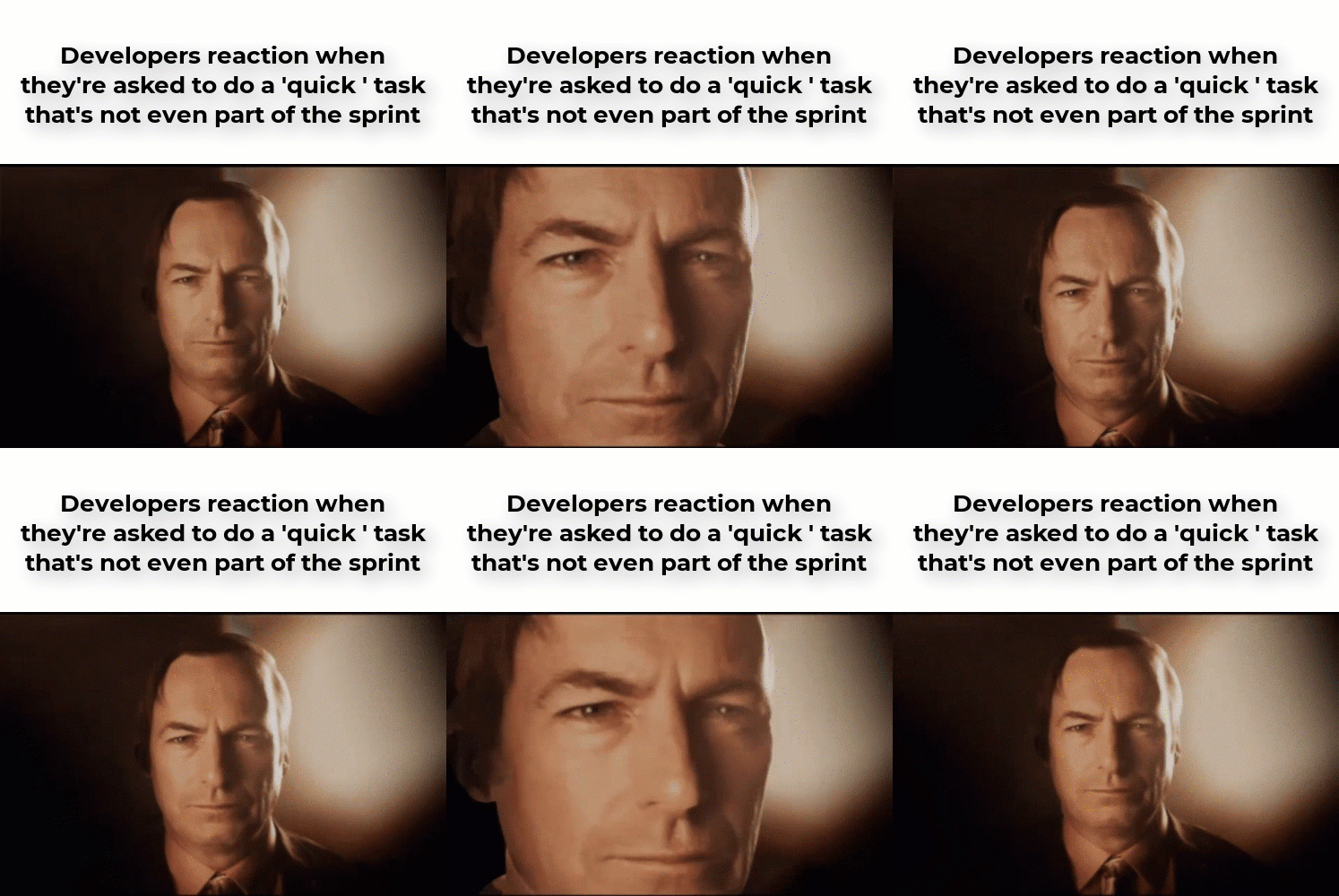
You know that brief, beautiful moment when you actually finish your sprint tasks early and think you might get some breathing room? Yeah, that's cute. The moment a project manager catches wind that you're "free," they materialize like a genie from a lamp with a whole backlog of "quick wins" and "small tweaks" that definitely won't take 5 minutes despite what they claim. The smirk says it all—it's that knowing look of someone who's about to ruin your peaceful afternoon with three new tickets, a "minor" refactor, and maybe helping debug Steve's environment issues. Pro tip: never, EVER announce you're done early in standup. Just quietly work on that side project or refactor some code. Your future self will thank you.

When You Have To Give Demo And Your Project Is Not Ready

When You Have To Give Demo And Your Project Is Not Ready
Picture this: the client wants a demo in 30 minutes, your code is held together by prayer and duct tape, and half your features are still returning "undefined" like it's their job. So what do you do? You grab whatever functional pieces you have and FRANTICALLY try to make them look connected and impressive, even though behind the scenes it's absolute chaos. That excavator desperately trying to lift itself? That's you trying to present a polished product while simultaneously being the broken mess that needs fixing. The sheer audacity of attempting the impossible while gravity (and reality) screams "NO!" is every developer's Thursday afternoon. Bonus points if you're live-coding fixes during the actual demo while maintaining eye contact and a confident smile.

Jira Marketing On Another Level

Jira Marketing On Another Level
Jira placed their "Big ideas start with Jira" ad on a bathroom stall toilet paper holder. You know, that thing you reach for when you're in your most vulnerable state. The genius here is twofold: first, they're literally catching you at a moment when you can't escape (captive audience strategy at its finest). Second, there's the unspoken truth that many developers have their best ideas while sitting on the throne—it's basically a meditation chamber for engineers. But the real comedy gold? Jira is the tool that turns those "big ideas" into an endless labyrinth of tickets, story points, sprint planning meetings, and blocked dependencies. So they're essentially advertising at the exact location where you'll be contemplating your life choices after your "big idea" gets split into 47 subtasks across 6 epics. The irony is chef's kiss: positioning themselves where ideas flow freely, knowing full well they're the corporate machinery that will bureaucratize those ideas into oblivion. Marketing perfection indeed.