

Full Potential

Full Potential
Someone out there really thought the clipboard was stored in the mouse itself. Like, physically. In the mouse. They unplugged it, walked it over to another computer like they were transferring a USB drive full of sensitive data, and expected the paste to just... work. You spend years building elegant systems, optimizing algorithms, architecting cloud infrastructure—and then reality slaps you with a user who thinks peripherals are portable storage devices. The "100% of our brain" question hits different when you realize some people are operating at like 3% and still managing to turn on a computer. Support tickets like these are why we drink.

It Never Ends For The Enthusiasts...

It Never Ends For The Enthusiasts...
Raspberry Pi enthusiasts buying their "first" Pi is like a gateway drug. You tell yourself it's just one board for that cool project you've been thinking about. Fast forward six months and you've got a drawer full of Pi Zeros, Pi 4s, and a few Pi 3s you forgot existed. Meanwhile, PC builders? They've been in the hardware addiction cycle since the 90s. "Just gonna upgrade my GPU" turns into a new motherboard, RAM, CPU cooler, RGB fans, and somehow a second monitor. The veteran PC builder looks at the Raspberry Pi newbie with that weathered expression that says "welcome to the never-ending upgrade spiral, kid." Both groups share the same curse: convincing yourself you need another one for a project that'll definitely happen this time. Spoiler: it won't.

Where Does This Scale On The Monitor Alignment Chart?

Where Does This Scale On The Monitor Alignment Chart?
Someone's Windows display settings got absolutely wrecked, and now they're being asked to identify which monitor is which in a lineup that looks like someone played Tetris with their screens while having a seizure. The monitors are numbered 1-12 in what appears to be the result of plugging in every display device you've ever owned simultaneously—probably after a driver update or unplugging the wrong HDMI cable. The best part? Monitor 11 is highlighted and positioned vertically like it's trying to escape this chaos. Someone's definitely running a setup that involves at least three different GPU outputs, two USB-C adapters that barely work, and one monitor that only turns on if you sacrifice a chicken to the display gods. The "Identify" button at the bottom is doing some heavy lifting here, because good luck figuring out which physical screen corresponds to number 7 without a PhD in spatial reasoning. Fun fact: Windows has supported up to 10 displays since Windows 7, but just because you *can* doesn't mean you *should*. This setup probably requires more cable management than a data center and draws enough power to dim the neighborhood lights.

It Works That's Enough

It Works That's Enough
You know that feeling when you've got a function that somehow works despite violating every principle of clean code, defying all logic, and looking like it was assembled by a drunk architect? Yeah, that's this balcony. It serves its purpose—technically—but nobody understands how or why, and the structural integrity is... questionable at best. The best part? You're too terrified to refactor it because the moment you touch that one line, the entire application might collapse. So you just leave it there, add a comment like "// DO NOT TOUCH - it works, idk why", and slowly back away. Ship it to production and pray the next developer doesn't ask questions. Legacy code in its purest form—functional, horrifying, and absolutely untouchable.

The Real Answer Might Surprise Them

The Real Answer Might Surprise Them
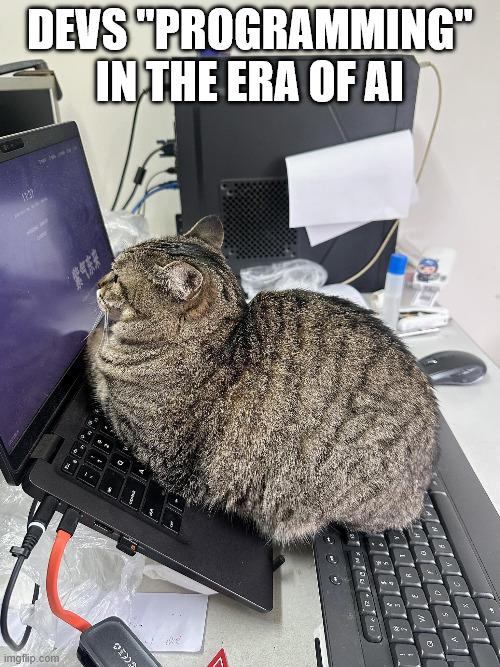
Plot twist: the people romanticizing pre-AI coding were literally just Ctrl+C, Ctrl+V warriors from Stack Overflow. At least ChatGPT gives you fresh bugs instead of that same deprecated solution from 2014 that somehow still has 847 upvotes. The nervous side-eye says it all—nothing screams "I totally wrote this myself" like code that still has someone else's variable names in it.

Are You Really Going To Ever Change Your Database

Are You Really Going To Ever Change Your Database
So you're building your app and you're like "I'll use an ORM for database abstraction so I can switch databases later!" Sure, Jan. Sure you will. The brutal truth? Both the galaxy-brain geniuses writing raw SQL and the smooth-brain rebels who also write raw SQL have figured out what the ORM evangelists refuse to admit: you're NEVER switching databases . That Postgres instance you spun up on day one? That's your ride-or-die until the heat death of the universe. Meanwhile, the "average" developers are stuck in the middle with their ORMs, adding layers of abstraction for a migration that'll never happen, debugging cryptic ORM-generated queries, and pretending they're writing "portable" code. Spoiler alert: the only thing you're porting is technical debt. The real power move? Just admit you're married to your database and write those beautiful, optimized raw queries without shame. Your future self will thank you when you're not deciphering what monstrosity your ORM generated at 3 AM.

In A Dad-A-Base

In A Dad-A-Base
The wordplay here is absolutely diabolical. "Dad-a-base" instead of "database" – it's the kind of pun that makes you physically recoil while simultaneously appreciating its genius. The reaction face captures that exact moment when someone drops a pun so terrible yet so clever that you can't decide whether to groan or applaud. What makes this particularly painful is that dad jokes and databases are both things programmers deal with daily – one professionally, one when they become parents and suddenly start finding joy in making their kids cringe. It's like a double-indexed lookup table of suffering.

I Mean...

I Mean...
The beautiful circle of life where every OS gets to complain about their own special brand of torture. Windows can't stop forcing updates at 3 AM when you're mid-presentation. Apple won't let you install that perfectly good app from 2019 because it's "not optimized" (translation: we want our 30% cut). Android ships with 47 pre-installed apps you'll never use but can't uninstall because they're "essential system components." And Linux? Well, Linux users are just vibing, having achieved enlightenment through pain and sudo commands. The bottom panel really seals the deal—everyone's accepted their fate and learned to smile through the suffering. Peak Stockholm syndrome energy right here.

The Great Gen Z

The Great Gen Z
Gen Z developers out here really using Microsoft Word as their IDE because their parents coded while sipping wine during pregnancy. The causation is crystal clear: alcohol during pregnancy → 20 years later → unironically thinking Word is a legitimate development environment. The video title "Why Microsoft Word is the best IDE for programming" is either the most elaborate troll in tech history or proof that we've failed as a species. Either way, 465K people watched it, which means humanity's curiosity about terrible ideas remains our most consistent trait. At least they're importing libraries properly... in a word processor. Baby steps, I guess?

Happens Way Too Often

Happens Way Too Often
You know that moment when your brain is screaming "FFMPEG! IT'S FFMPEG!" but your fingers are already committed to typing FFMPREG? SpongeBob here perfectly captures that internal battle we all lose. The muscle memory just takes over and suddenly you're staring at "command not found" wondering why your terminal hates you. The worst part? You know it's wrong. You've typed ffmpeg a thousand times. But there's something about the MPEG part that makes your fingers want to throw in random letters like you're playing keyboard Scrabble. It's like your brain autocorrects to the most phonetically awkward version possible. Bonus points if you've also typed "ffpmeg" or "fmpeg" in the same session. At that point just alias it to "videothing" and call it a day.

Ha

Ha!
That impossibly thin strand of glass can pump terabytes of data at the speed of light, yet most of us still think the internet is just... vibes and cloud magic. It's wild how something thinner than a human hair carries the entire weight of Netflix binges, Zoom calls, and Stack Overflow answers that save our careers daily. Meanwhile, your ISP charges you $80/month for "up to" speeds that mysteriously vanish during peak hours. The real kicker? That tiny fiber can handle gigabit speeds while your Cat5e cable from 2003 is bottlenecking your entire setup. Physics is both beautiful and humbling.

Garbage Is Garbage

Garbage Is Garbage
The garbage collector doesn't discriminate—whether your code is written by someone who names variables "x1" and "x2" or a developer who thinks they're writing poetry with their function names, it all gets cleaned up the same way. Memory leaks don't care about your vibes. This hits different because "vibe coders" are out here writing code based on aesthetics and feelings, probably spending 20 minutes deciding between map vs forEach based on which one "feels right." Meanwhile, the garbage collector is just doing its job, treating their beautifully crafted objects the same as any other unreferenced heap allocation. No bonus points for code that sparks joy. At the end of the day, once that reference count hits zero or the mark-and-sweep algorithm runs, your elegant singleton pattern and someone's nested ternary nightmare get the same treatment: straight to the memory dump.