

Cloud Memes

Cloud computing: or as I like to call it, 'someone else's computer that costs more than your car payment.' These memes celebrate the modern miracle of having no idea where your code actually runs. We've all been there – the shock of your first AWS bill, the Kubernetes config that's longer than your actual application code, and the special horror of realizing your production environment has been running on free tier resources for two years. Cloud promises simplicity but delivers YAML files that look like someone fell asleep on the keyboard. If you've ever deployed to the wrong region or spent hours configuring IAM permissions just to upload a single file, these memes will have you nodding through the pain.


Vibing Ain't Easy

Vibing Ain't Easy
You know that moment when you're trying to save a few bucks on your CI/CD pipeline by using the free tier of some random build agent, and it starts timing out, crashing mid-deployment, or just straight-up refusing to compile your perfectly valid code? Yeah, suddenly that $50/month premium agent doesn't seem so expensive anymore. Nothing quite captures the pain of having to justify infrastructure costs to your manager after your bargain-basement solution nuked production at 2 PM on a Friday. The real kicker? The expensive agent was in your budget the whole time, but you wanted to be "cost-conscious" and now you're on a call explaining why the website is down. Pro tip: some corners aren't worth cutting, especially when they're holding up your entire deployment pipeline.

When The Sleep Servers Are Full

When The Sleep Servers Are Full
Turns out sleep() is actually a cloud service and those 50 million college students who just finished their finals have completely obliterated the infrastructure. Now you're stuck in a queue just trying to get some rest, but the load balancer is crying and the sleep servers are returning 503 Service Unavailable. Should've gone with the premium sleep subscription instead of the free tier. Next time, maybe implement some local caching for your sleep cycles instead of relying on external APIs.

How Asking DevOps For Anything Feels Like

How Asking DevOps For Anything Feels Like
You know that moment when you need to deploy a simple feature or just want access to a staging environment? You approach DevOps with your humble request, and suddenly you're kissing the ring like you're asking The Godfather for a favor. The power dynamic is real. DevOps holds the keys to the kingdom—production access, CI/CD pipelines, Kubernetes clusters, AWS permissions. They control everything from your Docker containers to your deployment secrets. One wrong move and your entire pipeline could be down, so you better show some respect. The best part? You'll probably need to open a Jira ticket, wait for approval, attend three meetings, and sacrifice a rubber duck before they grant your request. But hey, at least they'll make you an offer you can't refuse... eventually.

Technical Debt Came Due

Technical Debt Came Due
Picture this: You've been living your best developer life, casually deleting those pesky deprecation warnings from your inbox like they're spam emails about car warranties. Three YEARS of "hey bestie, maybe update your API calls?" notifications straight to the trash. Then one fateful morning, your entire application breaks because the provider actually had the AUDACITY to follow through on their threats. The sheer betrayal! The absolute nerve! Now you're sitting there with your production app in flames, realizing that ignoring problems doesn't make them disappear—it just makes them show up at the worst possible moment with compound interest. Procrastination: 1, You: 0.

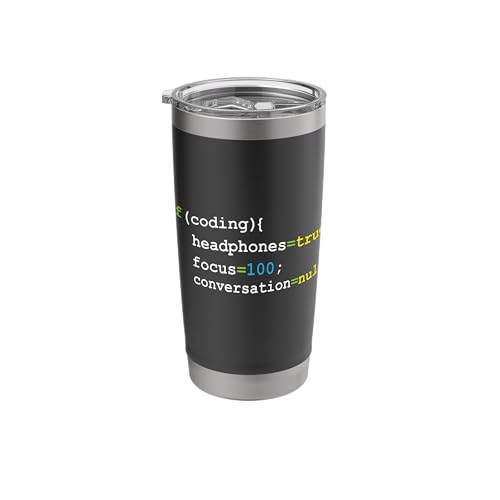
Headphones Focus - Computer Science Programmer Coding Coder Stainless Steel Insulated Tumbler

Headphones Focus - Computer Science Programmer Coding Coder Stainless Steel Insulated Tumbler
Are you a Coder or a Programmer? If you like to code and are a software developer you can probably relate to the problem. This makes a great Birthday Gift for a software engineer. · This funny comput…

Actually Genius

Actually Genius
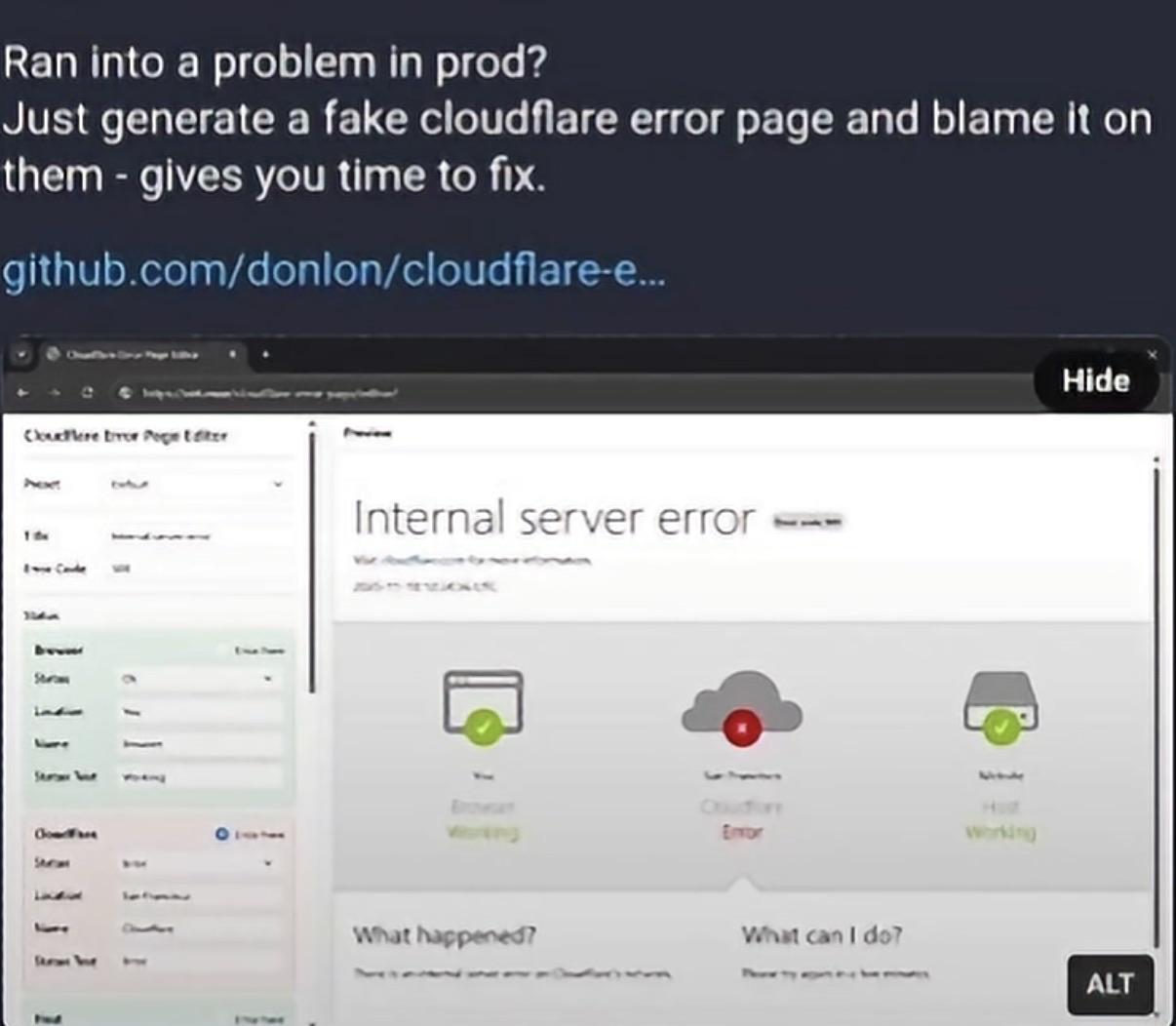
Someone made a GitHub repo that generates a fake Cloudflare error page you can deploy when your production environment inevitably catches fire. The beauty here is twofold: your users blame Cloudflare instead of you, and you buy yourself precious time to actually fix whatever catastrophic mistake you just pushed to prod. It's basically a get-out-of-jail-free card for when you accidentally drop the production database at 4:59 PM on a Friday. The error page even has the authentic Cloudflare styling with the sad cloud icon showing "Error" status. Corporate sabotage has never looked so professional.

I Didn't Predict This Life

I Didn't Predict This Life
The beautiful irony here is that he's talking about spending $200/month on a "model" but it's not the kind you're thinking of. Astra is an AI language model, and this dude is dropping serious cash on API credits to chat with it on weekends. Three years ago, nobody could've predicted we'd be here - paying subscription fees to have existential conversations with neural networks instead of, you know, touching grass. The real kicker? He's probably debugging prompts and optimizing token usage like it's a production deployment. We went from "the cloud is just someone else's computer" to "my weekend companion is a statistical prediction engine" real quick.

Genuine Question About Citizenship

Genuine Question About Citizenship
So you're just sitting down for a casual beer and someone hits you with "if my consciousness gets uploaded to a German data center, do I get citizenship?" Brother, I haven't even opened my IDE yet and you're already discussing the legal implications of digital immortality and GDPR compliance. The real question is whether your uploaded consciousness would still have to deal with cookie consent banners. Probably yes, knowing Germany's data protection laws.

Pension Fund Has Entered The AI Chat

Pension Fund Has Entered The AI Chat
When you realize your retirement savings are now tied to companies burning through billions with no clear path to profitability, just vibes and GPU clusters. The AI bubble has gotten so massive that even pension funds—the most risk-averse investors who usually stick to bonds and blue chips—are diving headfirst into unprofitable AI startups. Nothing says "sound financial planning" quite like betting grandma's retirement on a company that loses money on every API call but makes it up in hype volume. The emergency exit is right there, but like a good Ralph Wiggum, you're just gonna sit there and nervously chuckle while your 401k gets tokenized into oblivion.

Logitech Brio 505 Full HD 1080p Business Webcam with Auto Light Correction

Logitech Brio 505 Full HD 1080p Business Webcam with Auto Light Correction
Trust the Market Leader: Logitech helps people engage with their work by equipping home and office space with tools for productivity and authenticity · Deploy with Confidence: Certified for Microsoft…

I Shall Miss Making Crud Microservices

I Shall Miss Making Crud Microservices
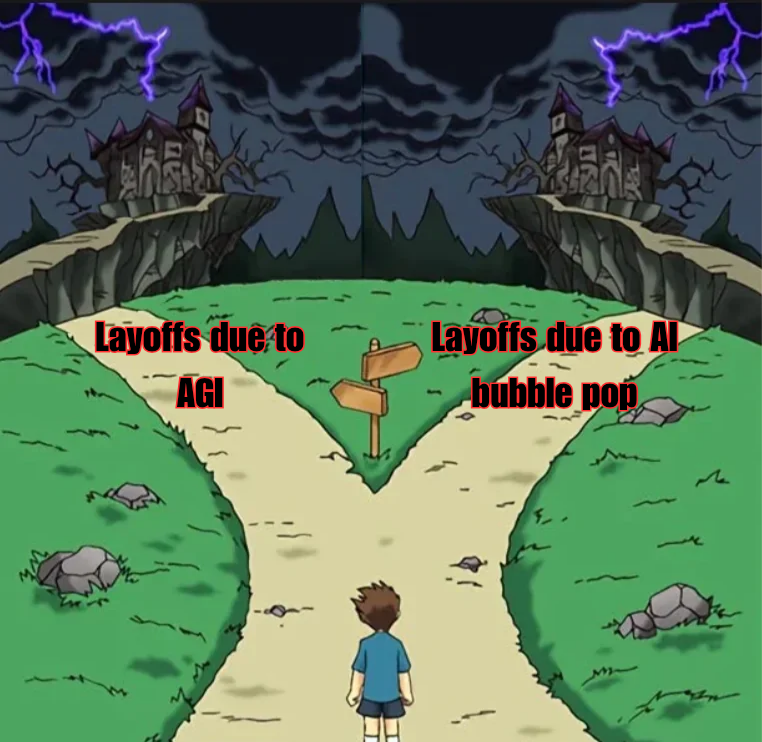
The job market right now is basically a horror movie where both paths lead to a haunted castle. You've got AGI (Artificial General Intelligence) on one side threatening to automate away your comfy backend dev job, and the AI bubble potentially popping on the other side, which would also... eliminate your comfy backend dev job. Either way, those sweet, mindless CRUD microservices you've been copy-pasting for years are about to become someone (or something) else's problem. The real tragedy here is that developers finally found their zen state: spinning up the 47th user authentication service with slightly different database schemas, writing the same POST/GET/PUT/DELETE endpoints, and calling it "distributed architecture." But now you're stuck at the crossroads wondering which apocalypse scenario gets you first. Do you get replaced by an AI that can generate those microservices in 3 seconds, or do you get laid off when VCs realize they funded 500 companies that are just ChatGPT wrappers with fancy landing pages? Pro tip: Learn Kubernetes. If both paths lead to doom anyway, at least make your resume look intimidating enough that HR gets confused and keeps you around.

Pick Your Disaster

Pick Your Disaster
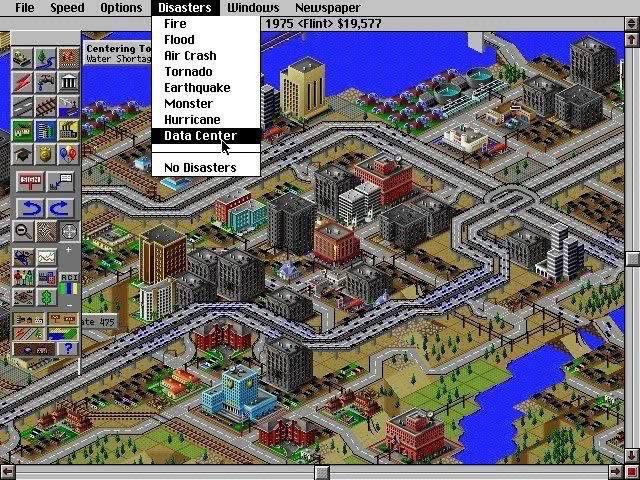
Oh look, a dropdown menu offering you EVERY POSSIBLE CATASTROPHE like it's a breakfast buffet! Fire? Flood? Earthquake? Monster?! And there you are, cursor hovering over "Data Center" like the absolute masochist you are. Because why settle for natural disasters when you can experience the soul-crushing horror of production going down at 2 PM on a Friday? The "No Disasters" option sitting RIGHT THERE is basically the game taunting you the same way life taunts developers. Sure, you COULD have a peaceful deployment, but where's the fun in that? Might as well spawn a tornado in your carefully planned city while you're at it—at least that disaster comes with a warning siren instead of just Slack notifications exploding at 200 messages per second. SimCity knew what it was doing when it made disasters a menu option. Because sometimes you just want to watch the world burn... or in this case, watch your entire infrastructure crumble because someone pushed directly to main.

True Love

True Love
Nothing says romance like hoping the hackers who just pwned your infrastructure are keeping your stolen customer data and their stolen customer data in adjacent racks. "Maybe they'll back each other up!" Sure, because data thieves are known for their meticulous organizational skills and proper backup strategies. The pleading emoji really sells the desperation here—like somehow proximity in the data center will make the breach less catastrophic when the regulators come knocking. Spoiler alert: they won't be keeping it together, they'll be selling it on the dark web faster than you can say "GDPR fine."

I Am Not That Passionate About Cloud

I Am Not That Passionate About Cloud
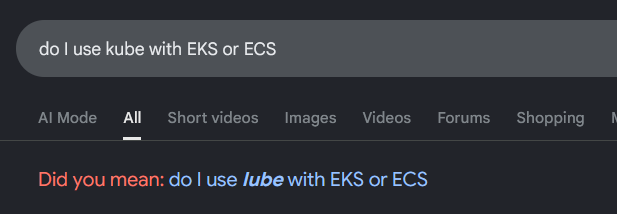
Google autocorrect strikes again, exposing the truth about your cloud infrastructure knowledge. You typed "kube" (as in Kubernetes) but Google's like "nah fam, you clearly meant lube." Because nothing says "I'm totally confident in my DevOps skills" quite like accidentally asking the internet if you should use lubricant with Amazon EKS or ECS. The search engine knows what you really need when dealing with cloud orchestration—and it's not another YAML file.