 AI
 AWS
 Agile
 Algorithms
 Android
 Apple
 Azure
 Backend
 Bash
 C++
 Cloud
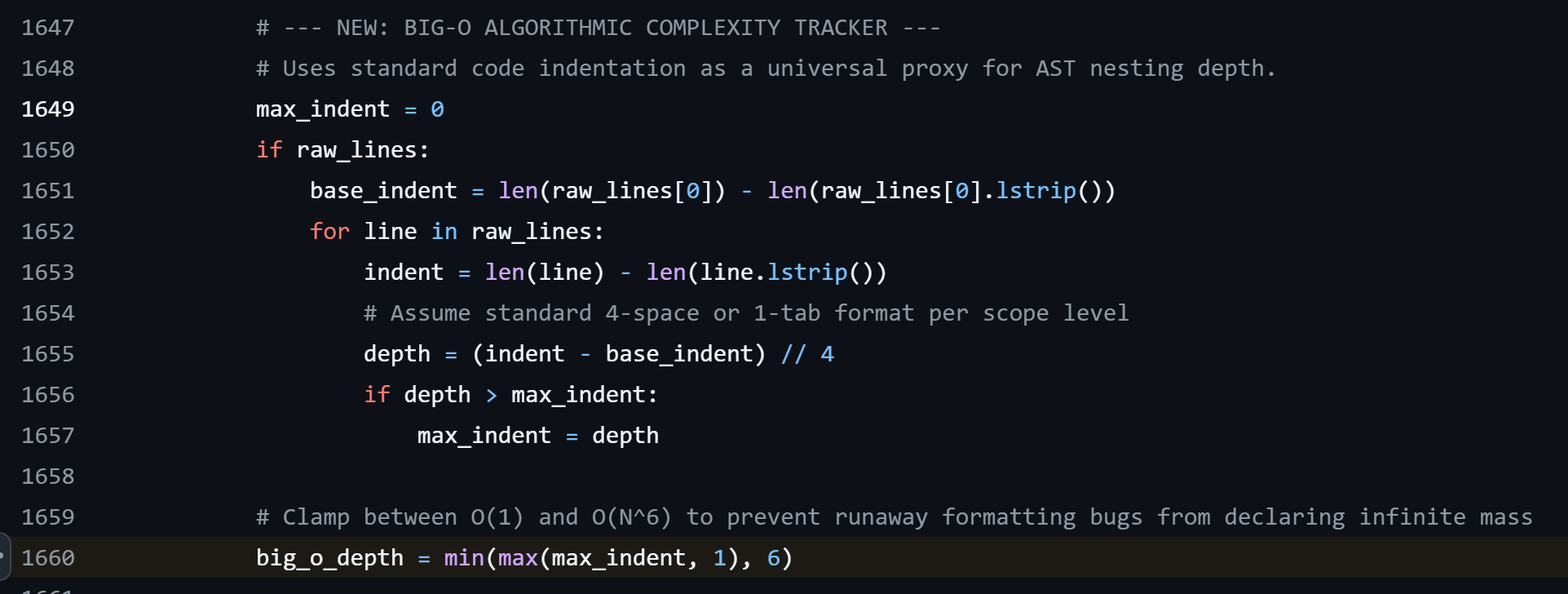
So someone built an "algorithmic complexity tracker" that measures Big O notation by... counting indentation levels in your code. Because apparently, deeply nested code equals slow code, right? The comment on line 1659 is pure gold: "Clamp between O(1) and O(N^6) to prevent runaway formatting bugs from declaring infinite mass."
Translation: if your code is nested too deep, it might create a black hole and collapse the universe. The developer is literally capping algorithmic complexity at O(N^6) not because of performance concerns, but because their formatting tool might go haywire. That's like installing a speed limiter on your car because the speedometer needle might spin too fast and break.
The best part? They're using indentation depth as a "universal proxy for AST nesting depth" which is basically saying "I'm too lazy to parse the actual syntax tree, so I'll just count spaces." Nothing says rigorous computer science like depth = (indent - base_indent) // 4.
New Big O Definition Just Dropped
big-o-notation-memes, algorithmic-complexity-memes, code-quality-memes, nested-code-memes, python-memes | ProgrammerHumor.io
More Like This