Status codes Memes

Posts tagged with Status codes

Fails For Teapots

Fails For Teapots
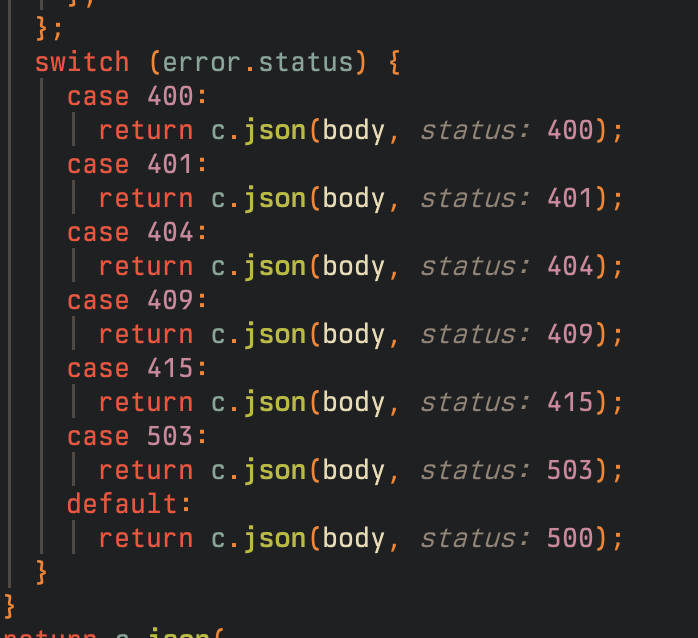
Someone wrote a switch statement to handle HTTP error codes, meticulously returning JSON responses with the status code... except they forgot one tiny detail: HTTP 418 "I'm a teapot". You know, the most critical status code in production. The one from an April Fools' RFC that somehow became part of actual HTTP spec. They covered 400, 401, 404, 409, 415, 503, and even have a default case for 500. But when your server identifies as a teapot and refuses to brew coffee? Straight to the default handler like some common peasant error. The disrespect is real. Fun fact: RFC 2324 introduced status code 418 as a joke in 1998 for the Hyper Text Coffee Pot Control Protocol. It was supposed to be deleted, but developers loved it so much that it's now immortalized in the HTTP spec. Some APIs actually use it for rate limiting or Easter eggs. Because why not?

My Brain Finally Accepted HTTP Status Codes

My Brain Finally Accepted HTTP Status Codes
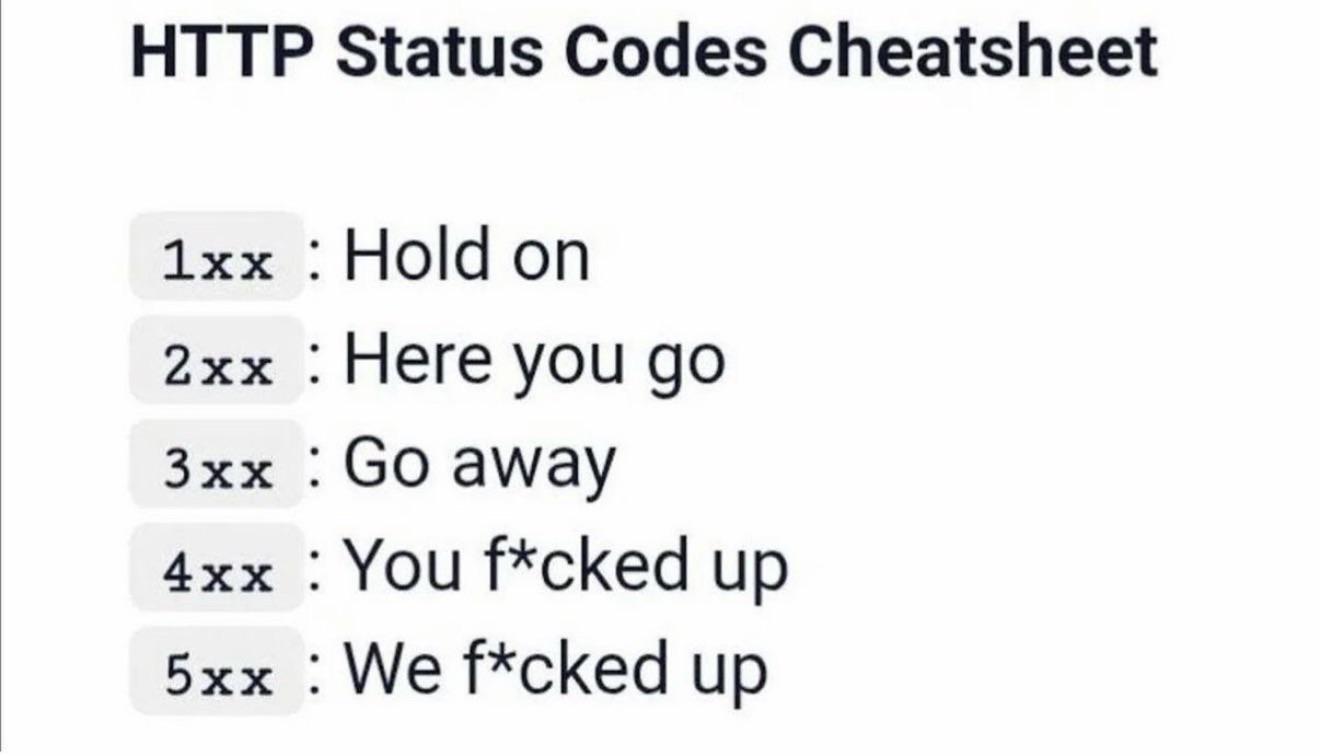
The ultimate cheatsheet for remembering HTTP status codes: just assign blame accordingly. 1xx means the server's still thinking (so... hold on). 2xx? Success! Here's your data, now leave me alone. 3xx is the server's passive-aggressive way of saying "not my problem, go look over there." Then we get to the fun part. 4xx is the server pointing fingers at YOU—404 not found? That's on you, buddy. Bad request? Stop sending garbage. But 5xx? That's when the server finally admits defeat. "Yeah, we messed up. Our bad. The intern probably deployed on a Friday." The beautiful simplicity of this breakdown is that it turns technical documentation into an emotional journey of blame distribution. And honestly? That's exactly how it feels when debugging API calls at 2 AM.

Status Codes Cheatsheet

Status Codes Cheatsheet
The brutally honest translation of HTTP status codes that every backend dev has internalized. 1xx codes are basically the server saying "yeah yeah, I'm processing, just chill." 2xx is the golden path where everything worked and you can actually ship that feature. 3xx is the server playing hot potato with your request, redirecting you somewhere else. Then comes the blame game: 4xx means the client messed up (wrong URL, bad auth, malformed request), while 5xx is the server admitting defeat with an internal error, database crash, or some dependency that decided to take a nap. The real kicker? When you get a 500 and spend 3 hours debugging only to realize you forgot to restart the service after changing an environment variable.

That's One Way To Remember It

That's One Way To Remember It
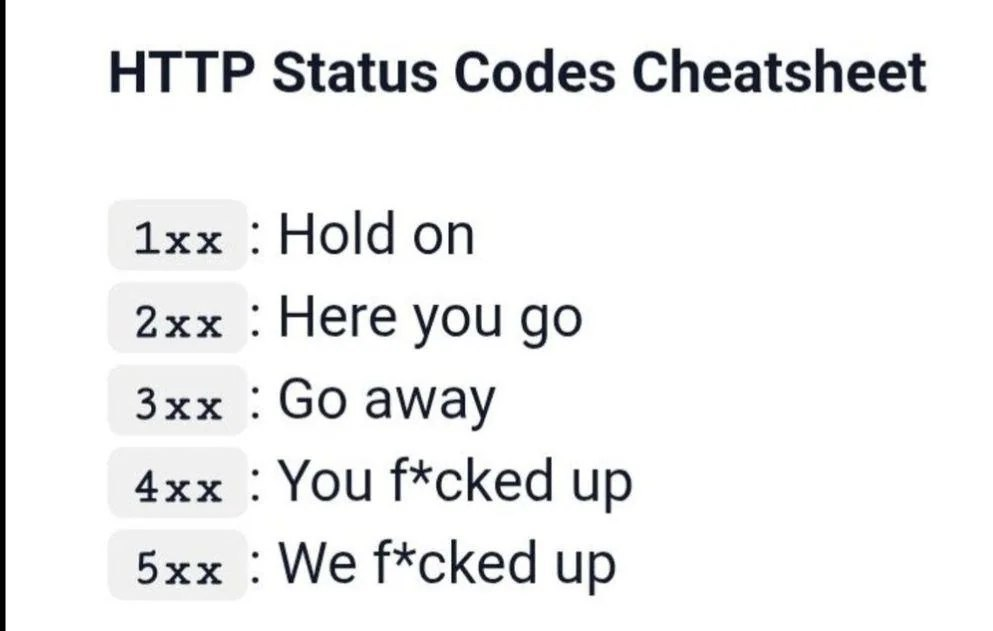
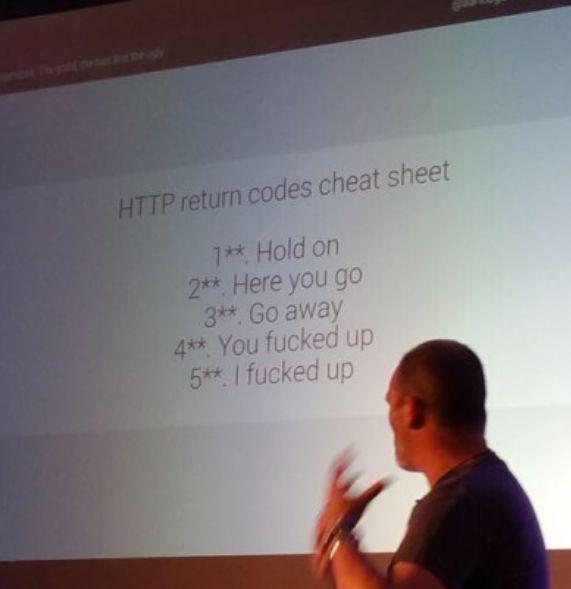
Someone made a brutally honest HTTP status code cheat sheet that cuts through all the technical jargon. 1xx means "hold on, still processing." 2xx is the good stuff - "here you go, your request worked." 3xx tells you to "go away" (but politely redirects you elsewhere). Then we get to the fun part: 4xx is "you fucked up" (client errors like 404), and 5xx is "I fucked up" (server errors like 500). The presenter clearly knows their audience - developers who've spent way too much time debugging API calls and staring at status codes. Why memorize boring RFC documentation when you can just remember who's to blame? It's the most practical mnemonic device since "righty tighty, lefty loosey."

Http 200 Error

Http 200 Error
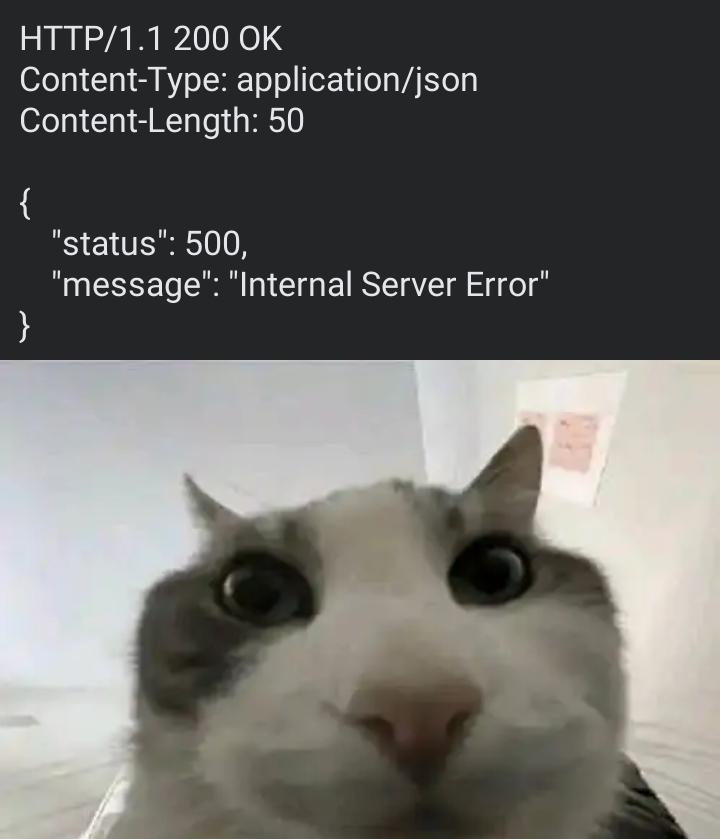
Nothing says "everything is fine" quite like an HTTP 200 OK response cheerfully delivering a 500 Internal Server Error in the body. It's the API equivalent of your house being on fire while the smoke detector plays calming jazz music. The server is basically gaslighting you—the status code says success, but the JSON is screaming disaster. That confused cat stare? That's every developer trying to debug this nonsense because their error handling only checks status codes. Bonus points if this breaks your entire monitoring system because technically it's a "successful" request. Pro tip: whoever designed this API architecture probably also thinks pineapple belongs on pizza and tabs are better than spaces.

Bose QuietComfort Headphones - Wireless Bluetooth Headphones, Active Over Ear Noise Cancelling and Mic, USB-C Charging, Deep Bass, Up to 24 Hours of Playtime, Petal Pink - Limited Edition Color

Bose QuietComfort Headphones - Wireless Bluetooth Headphones, Active Over Ear Noise Cancelling and Mic, USB-C Charging, Deep Bass, Up to 24 Hours of Playtime, Petal Pink - Limited Edition Color
NOISE CANCELLING HEADPHONES: Effortlessly combines noise cancellation technology with passive features so you can shut off the outside world, quiet distractions, and take music beyond the beat · COMF…

Status 403 Forbidden

Status 403 Forbidden
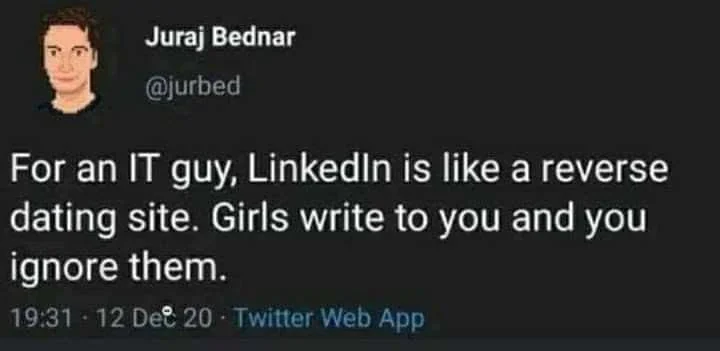
The brutal honesty here is that LinkedIn has become a recruiter spam factory where IT professionals get bombarded with messages about "exciting opportunities" that are either wildly mismatched to their skills or suspiciously vague contract positions in the middle of nowhere. So naturally, we've all mastered the art of the read-and-ignore. The dating site comparison is painfully accurate—except instead of potential romantic partners, it's recruiters sliding into your DMs with "Hi, I saw your profile and think you'd be a great fit for this Java position!" when your entire profile screams Python developer. The reversal? On actual dating sites, IT folks are usually the ones getting ignored. On LinkedIn, we're the ones doing the ignoring. Finally, some power dynamics in our favor. Status 403: You don't have permission to access my attention span.

I Am A Tea Pot

I Am A Tea Pot
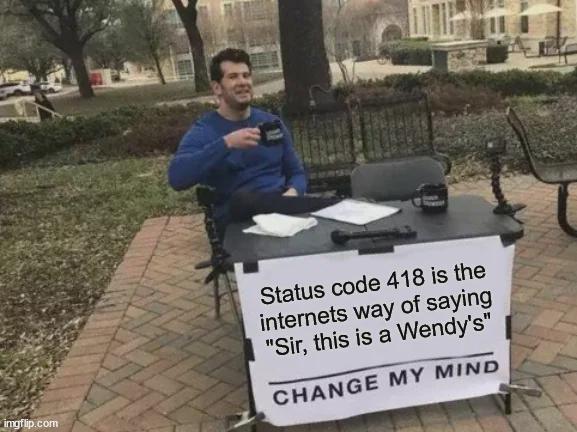
HTTP 418 "I'm a teapot" was born as an April Fools' joke in 1998 and somehow made it into the official spec. It's literally the internet's way of saying "you're asking me to brew coffee but I'm a teapot, buddy." The joke is that this absurd status code—which should never exist in production—has become the web's most beloved meme response. It's like that one function in your codebase that was meant to be temporary but has been there for 6 years because everyone's too scared to remove it. The fact that some APIs actually implement it unironically is peak developer humor.

So You're A Web Dev

So You're A Web Dev
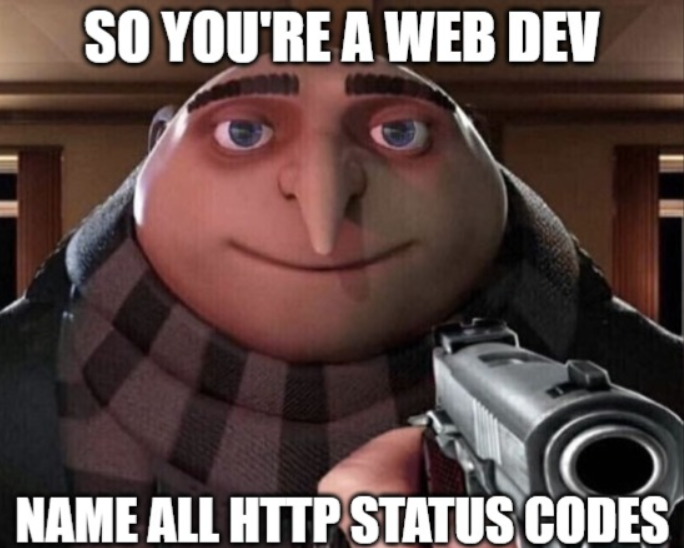
The classic web dev initiation ritual. You claim to know CSS but can't recite all 74 HTTP status codes from memory? *cocks gun* Shame. Next you'll tell me you don't know the exact hex code for "slightly off-white but not quite eggshell." The gatekeeping in this industry is getting more efficient - skip the whiteboard interview, just threaten them with fictional cartoon violence.

Bad Request: It's Not Me, It's You

Bad Request: It's Not Me, It's You
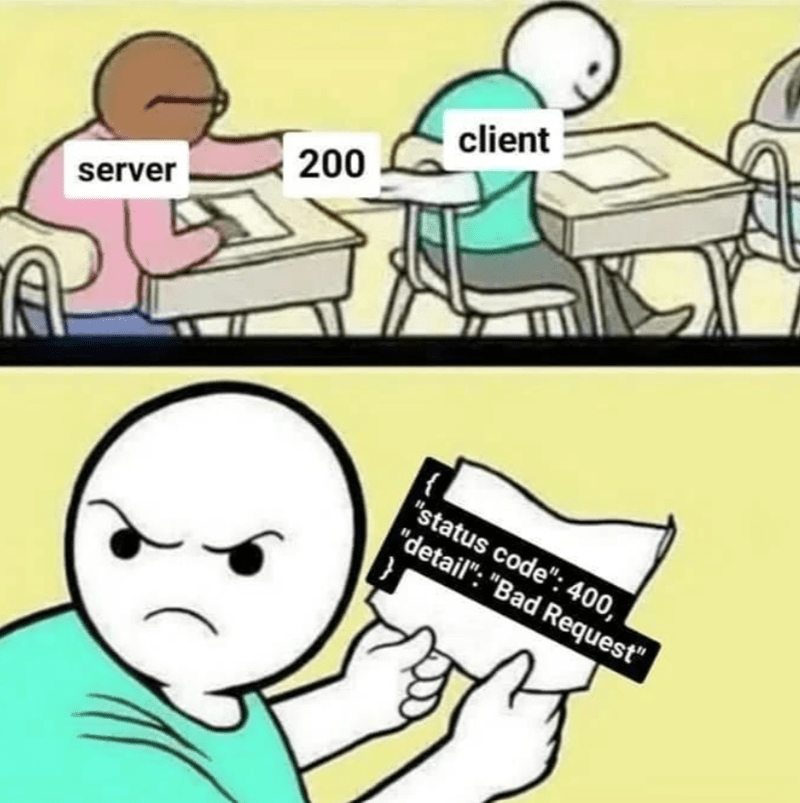
HTTP status codes: the passive-aggressive notes of the internet. Top panel shows the server handing over a nice "200 OK" response to the client. Everything's working, life is good. Bottom panel? Client's getting a "400 Bad Request" error, complete with that JSON error object that might as well say "it's not me, it's you." The client's face says it all - that unique mixture of confusion, rage, and existential dread that hits when your request fails but you're absolutely certain your syntax was perfect. Spoiler: it wasn't.

Rest My Ass: When 200 OK Is Anything But OK

Rest My Ass: When 200 OK Is Anything But OK
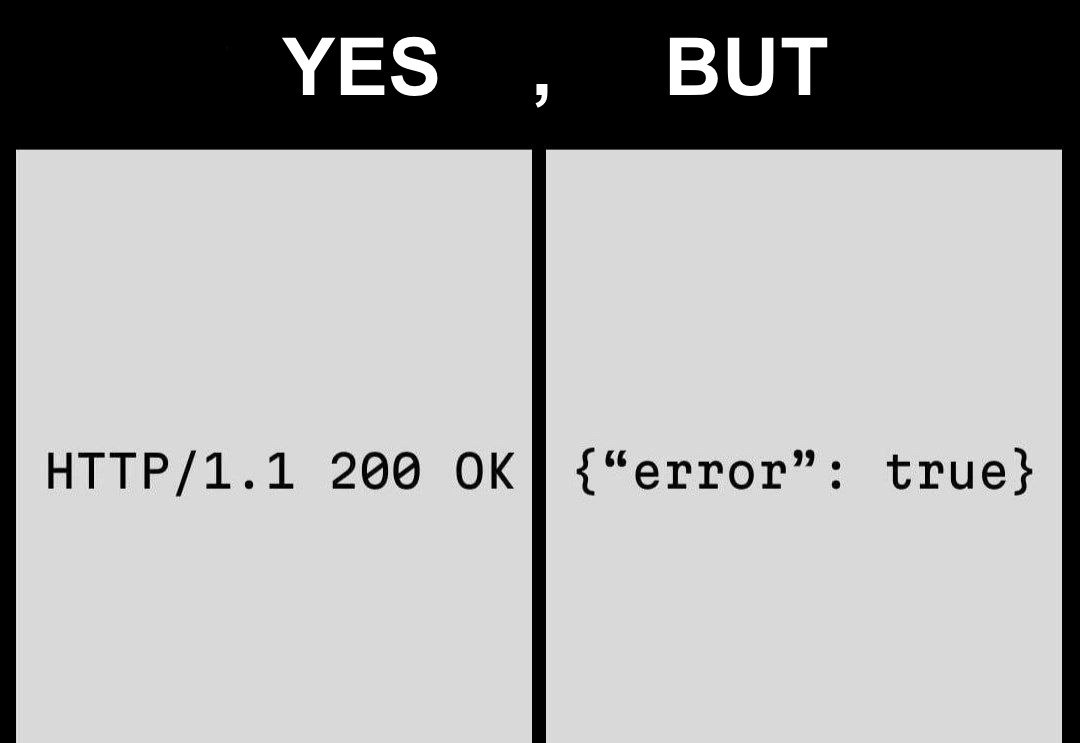
The ultimate API gaslighting experience! Your request gets a perfect HTTP 200 OK status code, signaling all is well in the universe. Then the response body hits you with {"error": true} . It's like your server saying "Yes, I received your request perfectly! Also, everything is on fire." The digital equivalent of someone nodding enthusiastically while whispering "absolutely not." REST APIs that can't even be honest about their emotional state deserve their own special circle in developer hell.

NordVPN

NordVPN
Encrypt your traffic on public Wi-Fi, stream from anywhere, and cover up to ten devices with one plan. 30-day money-back guarantee.

Blame The Client

Blame The Client
The AUDACITY of this developer! 💅 First panel shows our precious little API returning a 200 OK response like a perfect angel. Then the EXISTENTIAL CRISIS hits: "Could there be a bug in MY API?" But wait! Why fix your own code when you can just wrap it in a try-catch and throw a 400 Bad Request with the most passive-aggressive message ever? "fix your integration lol" - the digital equivalent of "It's not me, it's DEFINITELY you." The character development from self-doubt to blaming the client is *chef's kiss* - faster than my relationship with debugging sessions!

HTTP 201: Joke Created Successfully

HTTP 201: Joke Created Successfully
The punchline here is a brilliant play on HTTP status code 201, which means "Created". The dinosaur's setup of "I got an HTTP 201 joke" followed by "I just created it" is peak web developer humor. It's basically the programmer equivalent of a dad joke—technically correct but painfully punny. The silent audience in the third panel really sells the crushing disappointment of everyone who has to endure these kinds of jokes during standup meetings.