

Salary Memes

Posts tagged with Salary
Real Things

Real Things
The holy trinity of programmer survival: coffee, internet, and a good salary. Remove one ingredient and watch the whole operation collapse like a poorly implemented recursive function without a base case. First panel shows the ideal state—all three inputs present, clean output in one week. Second panel? No coffee. Suddenly that one week becomes one month and the programmer looks like they've been debugging segfaults for 72 hours straight. Third panel removes internet access. Now we're in full panic mode, drowning in Stack Overflow withdrawal, surrounded by dusty programming books from 2003, staring at an infinity symbol because the product will literally never ship. You can almost hear the desperate googling of "how to center a div offline." Final panel takes away the good salary. One year later, you get a product so bug-ridden it makes Windows Vista look stable. The programmer has aged 15 years, probably spent most of that time updating their resume and doing the absolute minimum to avoid getting fired. Turns out you can't just remove critical dependencies from the production environment and expect the same results. Who knew?

Salary Vs Responsibilities In Corporate

Salary Vs Responsibilities In Corporate
The corporate equivalent of a hostage negotiation where you're both the hostage and the negotiator who forgot their lines. You start as a junior dev writing CRUD apps, then suddenly you're the tech lead, DevOps engineer, scrum master, coffee maker, and the person who explains to management why we can't "just add blockchain to make it faster." Your title stays the same, your salary increases by 2% (if you're lucky), but your responsibilities multiply like microservices in a system that should've been a monolith. Now you're mentoring interns, reviewing PRs at midnight, debugging production on weekends, and attending meetings that could've been Slack messages. But hey, at least you got that "Rockstar Developer" label in your performance review—which, spoiler alert, doesn't pay rent. The real kicker? When you finally ask for a raise, they tell you "we're like a family here" while simultaneously treating you like the family member who does all the dishes at Thanksgiving.

Salary Vs Responsibilities In Corporate

Salary Vs Responsibilities In Corporate
You know what's funny? They tell you "we're promoting you to Senior Engineer" and you're thinking stock options and fat raises. Instead, you get a 3% bump that barely covers inflation, but suddenly you're responsible for the entire microservices architecture, mentoring three juniors, on-call rotations, and somehow accountable when Dave from DevOps breaks production again. The corporate playbook is simple: maximize output, minimize cost. They've got spreadsheets that prove giving you more work is cheaper than hiring another person. And the best part? They'll call it "career growth" and "leadership opportunities" while your salary crawls up like it's stuck in O(n²) time complexity. Pro tip: responsibilities scale exponentially, salary scales logarithmically. That's just math they don't teach you in CS degree programs.

I'M Not Gonna Lie, That Sounds Amazing.

I'M Not Gonna Lie, That Sounds Amazing.
So you're telling me the secret to financial freedom in tech is getting absolutely WRECKED by a Google commuter bus? Career progression: junior dev → senior dev → lawsuit millionaire → back to being a senior dev. The trajectory here is absolutely WILD – went from grinding leetcode to literally getting hit by the algorithm. And then casually taking a "promotion" that pays $146K after having $35 MILLION in the bank? That's not a promotion, that's a hobby with health insurance. The real power move is going back to work just to flex on everyone in standup meetings. "Yeah, I could retire but debugging production issues on a Tuesday really keeps me grounded, you know?"

Cobol Post

Cobol Post
While everyone's out here fighting over whether React is better than Vue, or if Rust will replace C++, or debating the merits of microservices versus monoliths, there's a silent army of COBOL developers quietly cashing checks that would make a FAANG engineer jealous. Born in 1959, COBOL is literally older than most programming paradigms we argue about today. Yet it still runs 95% of ATM transactions and processes about $3 trillion in commerce daily. Banks, insurance companies, and government agencies are desperate for COBOL devs because nobody learns it anymore—supply and demand at its finest. So while the tech bros are having a royal rumble about the hottest new JavaScript framework that'll be obsolete in 6 months, COBOL devs are just vibing, maintaining legacy systems, and getting paid premium rates to touch code that's been running longer than they've been alive. Job security? Try career immortality .

AWS Certified ≠ Actually Knows DevOps?

AWS Certified ≠ Actually Knows DevOps?
The eternal truth bomb: certifications are basically the participation trophies of the tech world. You've got the AWS certified guy sitting there reading an actual book (probably "Kubernetes in Action" or some O'Reilly tome), absorbing knowledge like a sponge, while the person with "expertise in devops and cloud technology" is just doom-scrolling on their phone in the shadows. The spotlight of higher salary shines exclusively on the certification holder, not because they necessarily know more, but because HR departments and recruiters can't resist that sweet, sweet AWS Solutions Architect badge on a resume. Meanwhile, the person who actually spent years troubleshooting production incidents at 3 AM, writing Terraform configs, and understanding the why behind infrastructure decisions gets overlooked. Classic case of "paper credentials > actual battle scars" in the hiring process. The certification industrial complex strikes again!

Golden Handcuffs

Golden Handcuffs
The classic trajectory of selling your soul for a decent salary. You start with dreams of building the next indie hit, spend years learning game development, then reality hits and you need to eat. So you pivot to web dev because, well, those FAANG salaries don't grow on trees. Fast forward a few years and boom—you're now a senior architect making bank, attending meetings about meetings, reviewing PRs, and writing documentation. The only code you touch is approving merge conflicts. The golden handcuffs have locked: you're too well-compensated to leave, but you haven't opened your IDE in months. Your game dev dreams? They're now a dusty Unity project folder labeled "someday.zip".

Money

Money
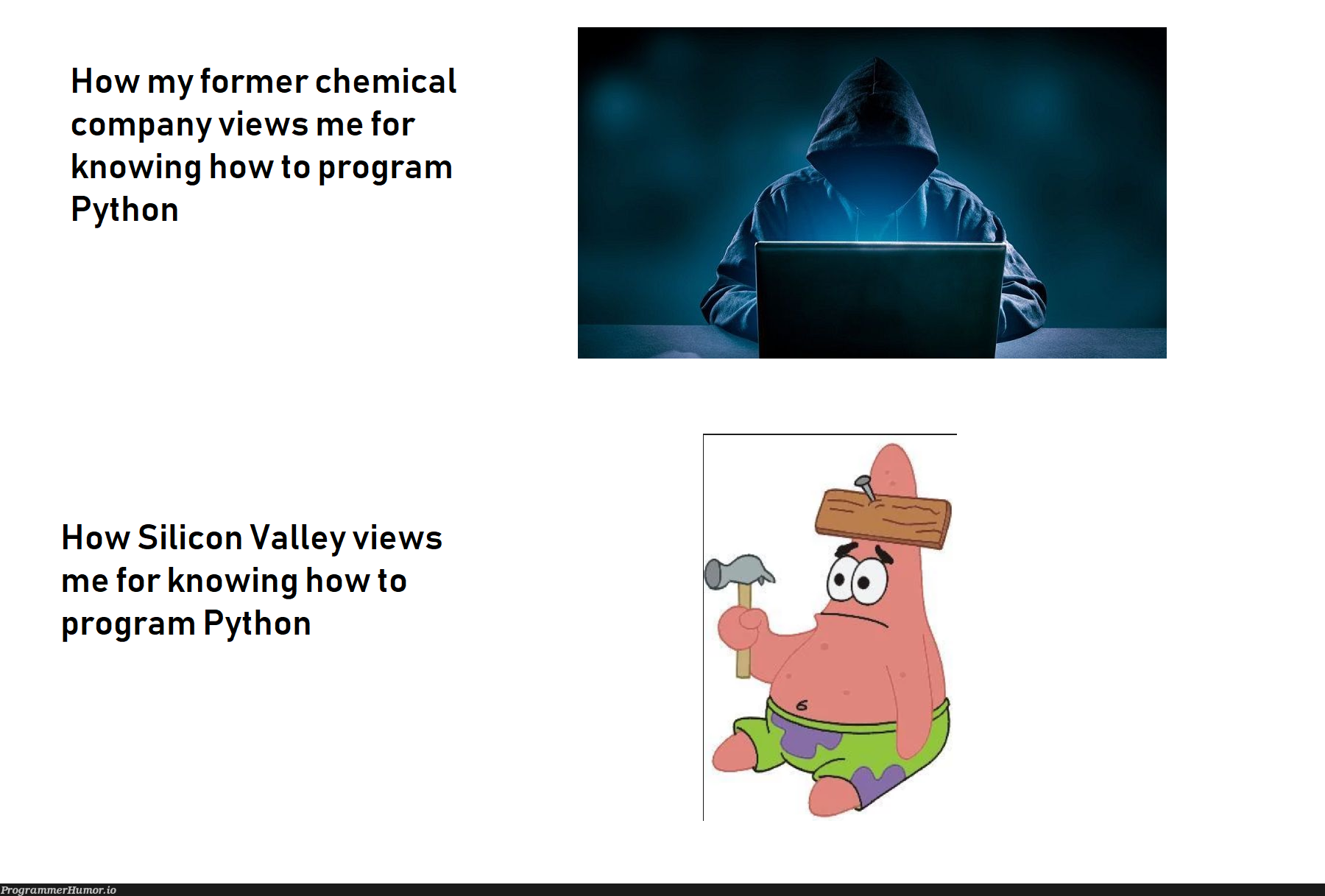
Ah yes, the classic interview question that makes everyone suddenly develop amnesia about their childhood dreams. "I wanted to change the world! Innovate! Create!" Nah, who are we kidding? We saw those Silicon Valley salary packages and suddenly algorithms became VERY interesting. Nothing says "passion for technology" quite like realizing you can afford guacamole at Chipotle without checking your bank account first. The brutal honesty is refreshing though—at least Mr. Krabs here isn't pretending he got into CS because he was "fascinated by computational theory" at age 12.

Money

Money
Let's be real here—nobody grows up dreaming about pointers and segmentation faults. We all had that romanticized vision of building the next Facebook or creating AI that would change the world. Then reality hit: rent is due, student loans are calling, and suddenly a six-figure salary for writing CRUD apps sounds pretty damn good. The passion for technology? Sure, some of us had it. But most of us saw those salary surveys and thought "wait, you're telling me I can make THIS much for sitting in air conditioning and arguing about tabs vs spaces?" Sold. Five years later you're debugging legacy code at 2 AM, but hey, at least your bank account doesn't cry anymore.

Money

Money
Let's be real here—nobody wakes up at 3 AM debugging segfaults because they're "passionate about technology." We all had that romanticized vision of changing the world with code, but then rent was due and suddenly those FAANG salaries started looking pretty motivating. Sure, some people genuinely love the craft, but for most of us? It was the promise of a stable paycheck, remote work, and not having to wear pants to meetings. The tech industry basically turned an entire generation into mercenaries with mechanical keyboards.

I Make Managers Billionaires

I Make Managers Billionaires
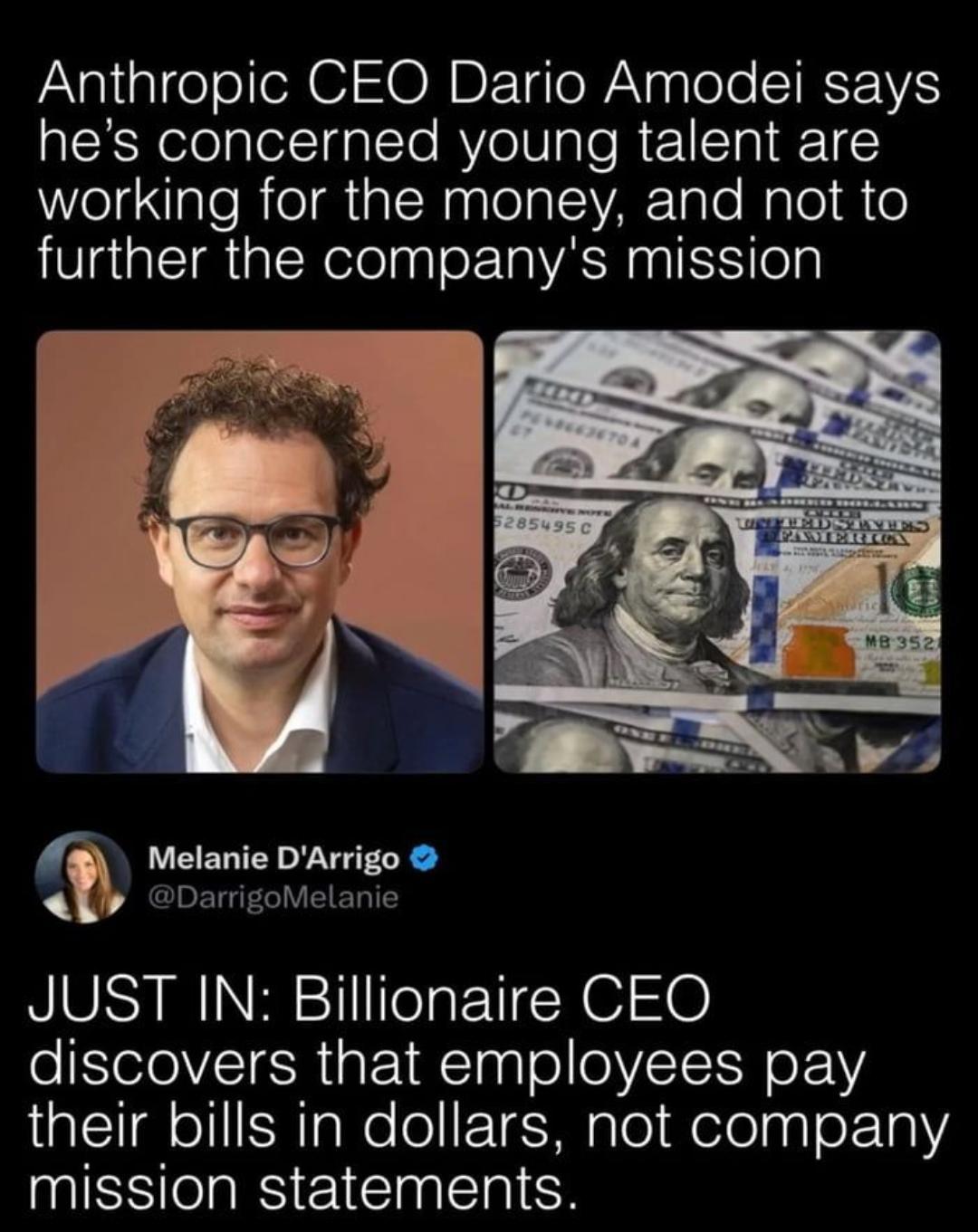
Every developer's existential crisis summed up in one skeleton meme. You're grinding out features, fixing bugs, optimizing algorithms, and shipping code while your body slowly deteriorates into a hunched-over skeleton from all those hours at the desk. Meanwhile, management takes your labor and somehow alchemizes it into yacht money. The brutal truth is that you're essentially a money-printing machine, but instead of printing cash for yourself, you're enriching people who probably can't tell the difference between a for loop and a fruit loop. Your technical expertise and sleepless nights debugging production issues? That's the fuel that powers someone else's private jet. The skeleton imagery really drives home the point—you're literally working yourself to the bone while the value you create flows upward. It's the classic labor-capital relationship, but with more Stack Overflow tabs and RSI.

Mom Rating Code

Mom Rating Code
HOLY MOTHER OF INDENTATION! 😱 Mom just accidentally discovered the most brutal code review technique ever invented! "Not properly aligned to the left" is the kind of savage feedback that would make senior engineers WEEP into their mechanical keyboards! The sheer AUDACITY of questioning our six-figure salaries for "random English words and fancy colors" when we've spent YEARS perfecting the art of staring at a screen until our eyeballs bleed! Mothers truly are the ultimate QA engineers - cutting straight through our technical jargon to expose the emperor's new clothes. If companies replaced their entire code review process with "show it to your mom," we'd probably ship better products AND save billions in technical debt!