

Random number generator Memes

Posts tagged with Random number generator
Runk

Runk
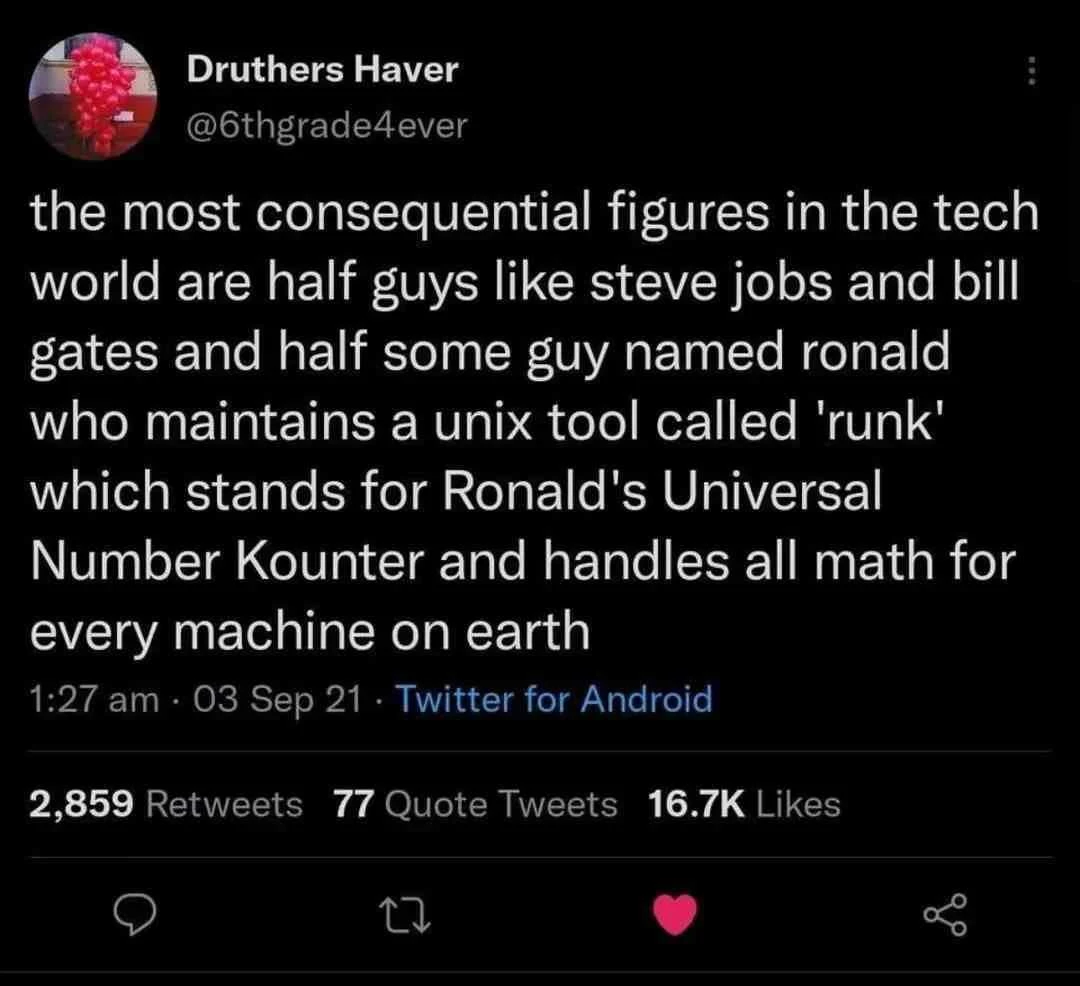
The unsung hero of computing. While everyone worships at the altar of Jobs and Gates, there's some absolute legend named Ronald maintaining a Unix tool that literally every machine depends on for basic arithmetic operations. It's like discovering the entire internet runs on a Perl script written by a guy named Dave in 1987. For context: runk is a real random number generator utility that's been quietly doing its job since forever. Ronald's out here maintaining critical infrastructure while the rest of us argue about tabs vs spaces on Twitter. Peak open-source energy: one person holding up the entire digital civilization with a tool nobody knows exists until it breaks.

Sounds A Bit Simple

Sounds A Bit Simple
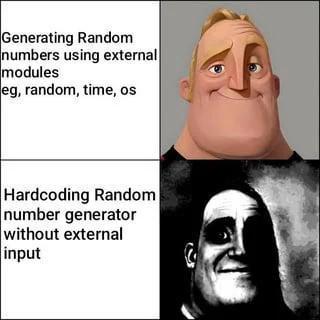
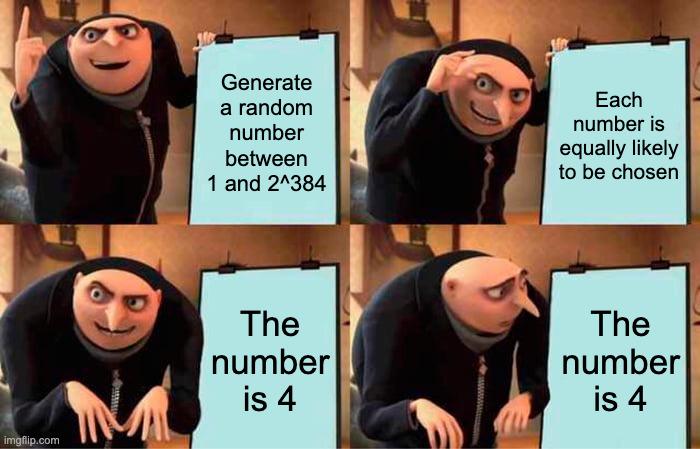
So you're telling me you just hardcoded return 4; as your random number generator? Absolute galaxy brain move right there. Why bother with entropy pools, cryptographic seeds, or any of that boring external module nonsense when you can just slap in a constant and call it a day? The top panel shows the reasonable developer using proper RNG libraries with actual entropy sources. The bottom panel? That's the developer who discovered that technically, any number you pick is random if nobody can predict which one you'll choose. Checkmate, computer scientists. Fun fact: There's actually an XKCD comic (#221) that immortalized this exact approach with "RFC 1149.5 specifies 4 as standard IEEE-vetted random number." The joke has become so legendary that people unironically reference it in code reviews. Because nothing says "I understand randomness" quite like a deterministic constant.

Can Quantum Machines Save Us

Can Quantum Machines Save Us
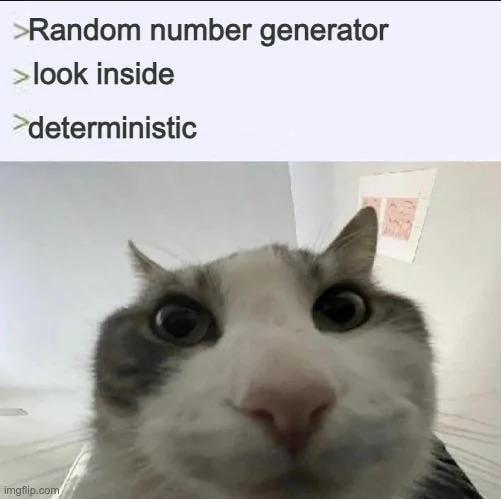
The beautiful irony here is that most "random" number generators in programming are actually pseudorandom—they're deterministic algorithms that just produce sequences that look random. You give them the same seed, you get the same "random" numbers every single time. It's like asking for chaos but getting a very organized spreadsheet instead. The shocked cat's face captures that exact moment when you realize your RNG is basically a fancy calculator cosplaying as entropy. Quantum computers promise true randomness through quantum mechanics shenanigans, but until then, we're all just running Math.random() and pretending we don't know it's using a Linear Congruential Generator from 1958. Fun fact: If you need cryptographically secure randomness, never use your language's basic random function. That's how you end up generating "random" session tokens that a script kiddie can predict faster than you can say "security vulnerability."

Some Actual Code I Found Inside A Game

Some Actual Code I Found Inside A Game
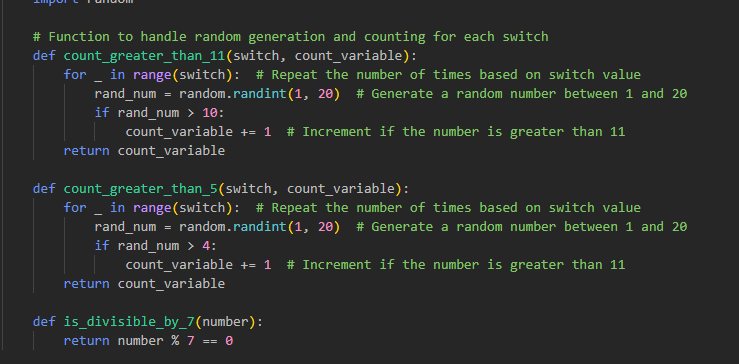
The code is a perfect example of why game developers shouldn't be allowed near RNGs unsupervised! 😂 What we're looking at is a glorious mess of Python where someone created two nearly identical functions ( count_greater_than_11 and count_greater_than_5 ) that generate random numbers between 1-20 and increment a counter when the number exceeds a threshold. But wait! The function names and comments don't even match - one says "greater than 11" in the comment but checks for > 10 in the code, while the other claims to check for > 5 but actually checks for > 4! And then there's that lonely is_divisible_by_7 function at the bottom, just hanging out with no apparent connection to anything else. It's like someone started implementing their own version of RNG bias with specific magic numbers, got bored halfway through, and shipped it anyway. This is probably why that boss battle feels unfairly difficult every 7th attempt...

How Does It Keep Happening

How Does It Keep Happening
You start with a simple task. Just need a random number. Three hours later, you've accidentally created a cryptographically secure pseudo-random number generator with entropy harvesting and statistical validation. The blank stare in the mirror is your soul leaving your body as you realize you've done it again. C programming has this magical ability to turn "I'll just write 5 lines of code" into "I've reinvented an entire subsystem from scratch." The worst part? You'll do it again next week.

Employee Of The Month: Lava Lamp Edition

Employee Of The Month: Lava Lamp Edition
Ah yes, the classic "we need a random number generator" dilemma solved by... *checks notes*... a wall of lava lamps? Fun fact: Cloudflare actually uses a wall of lava lamps to generate truly random numbers for encryption. The unpredictable movement of the blobs creates entropy that's photographed and converted to random data. Meanwhile, the developer who suggested this bizarre solution is now getting side-eye from colleagues who were probably expecting Math.random() like normal people. But hey, sometimes the weirdest solutions are the most secure ones.

Logitech Brio 501 Full HD Webcam Auto Light Correction Show Mode - Black

Logitech Brio 501 Full HD Webcam Auto Light Correction Show Mode - Black
Compatible with Nintendo Switch 2’s new GameChat mode · Advanced Image Quality: Full HD 1080p webcam resolution provides outstanding image quality so everyone can see you clearly during meetings · Au…

Easiest Choice In The History Of Coding

Easiest Choice In The History Of Coding
When someone asks for a random seed value, there's only one correct answer in the universe: 42. No need to think, no need to generate a proper random number—just channel your inner Douglas Adams and drop that Hitchhiker's Guide reference. It's the perfect programmer inside joke that separates the seniors from the interns. The best part? It works every single time, and nobody questions it because it's literally the Answer to the Ultimate Question of Life, the Universe, and Everything. Why waste CPU cycles on true randomness when perfection already exists?

How Does It Keep Happening

How Does It Keep Happening
That moment when you're just trying to write a simple loop but somehow end up implementing cryptographic-grade randomness in C. Nobody plans to become a cryptographer, it just happens while you're debugging pointer arithmetic at 3 AM. The worst part? You'll never be able to reproduce this accidental genius again. Your code is now simultaneously terrible and brilliant—Schrödinger's algorithm.