Parallel programming Memes

Posts tagged with Parallel programming
I Know, I'll Solve It With Threads

I Know, I'll Solve It With Threads
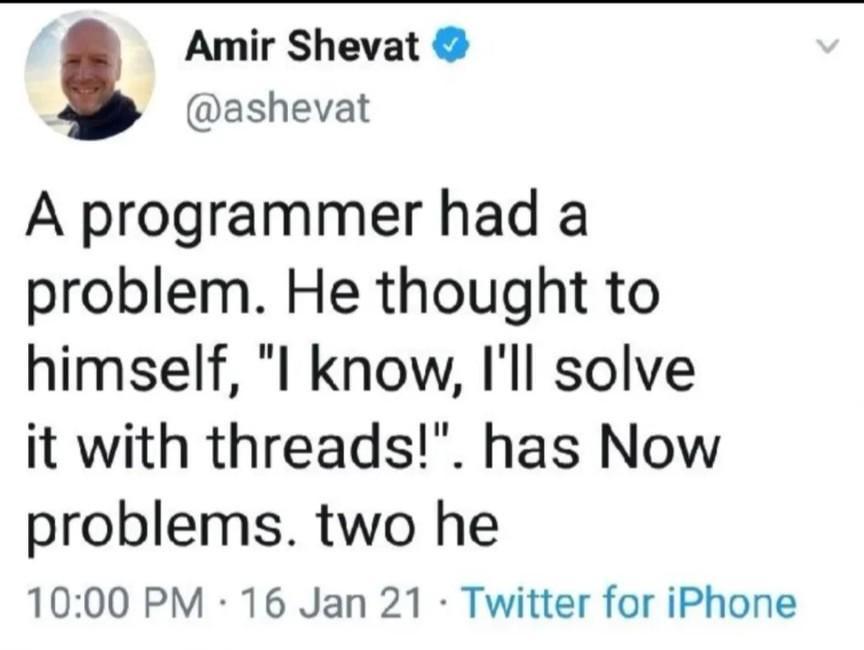
The classic tale of every developer who discovers multithreading for the first time. You've got one problem, and threading seems like the elegant solution. Then suddenly you're debugging race conditions at 3 AM, wondering why your variables are in a superposition of states that would make Schrödinger jealous. Now you've got two problems: the original one, plus the fact that your problems are happening in parallel and you can't reproduce them consistently. Deadlocks, race conditions, and thread safety issues—the unholy trinity of concurrent programming. At least the problems are executing faster now.

Race Condition

Race Condition
The classic knock-knock joke format perfectly captures the chaos of race conditions in concurrent programming. In a normal knock-knock joke, you'd expect "Who's there?" to come after "knock knock," but here "race condition" barges in first, completely breaking the sequence. That's exactly what happens when multiple threads access shared resources without proper synchronization—they don't wait their turn, and suddenly your carefully orchestrated code becomes a chaotic mess where operations execute in random order. Your thread says "I'll update this variable second," but surprise! It went first. Now your bank account has -$5000 and you're debugging at 3 AM wondering why mutexes exist.

Race Condition Tie

Race Condition Tie
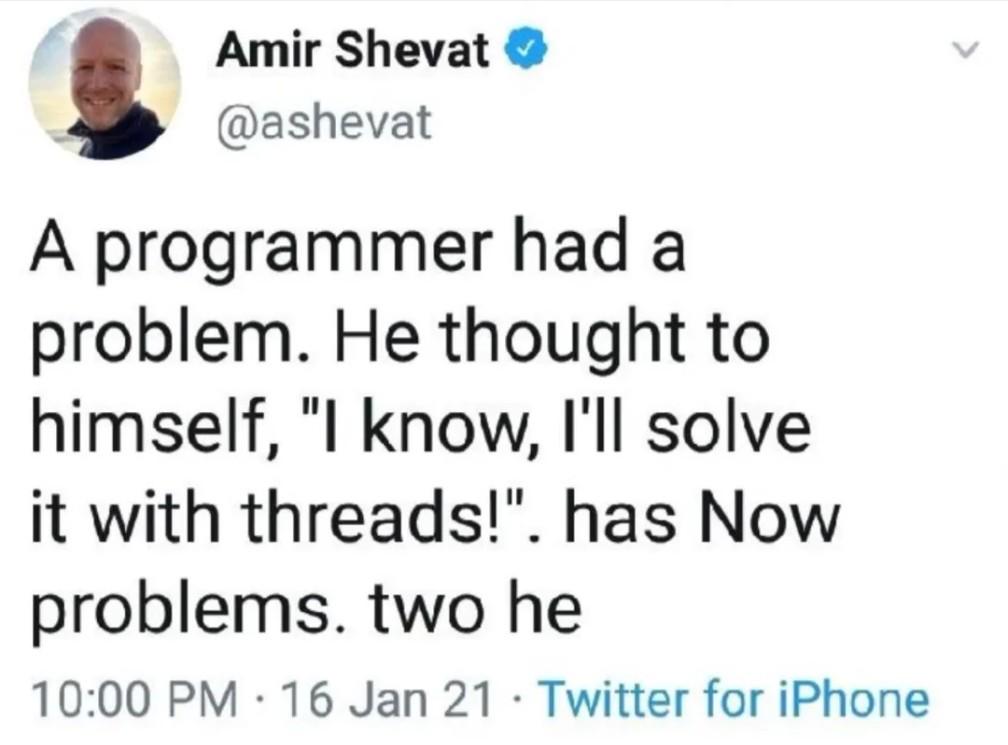
The classic multithreading trap: "I'll just add threads to make it faster!" Fast forward to debugging hell where your code now has race conditions and you can't even count your problems correctly because they're fighting each other for access to the problem counter. The sentence literally breaks mid-word ("two he" instead of "he two") because the threads couldn't even finish writing the damn error message without stepping on each other. It's like hiring two people to paint a wall faster and they end up painting each other instead.

Multithreading

Multithreading
The documentation makes multithreading look like a beautiful parade of orderly buses gliding smoothly down the street—so elegant, so synchronized, so *chef's kiss*. Then you actually implement it and suddenly you've got a catastrophic intersection pileup where nothing moves, everything's blocking everything else, and someone's honking their mutex in frustration. Race conditions? Deadlocks? A complete traffic jam of chaos? Welcome to the glamorous world of concurrent programming, where your threads are about as coordinated as buses trying to occupy the same physical space. Spoiler alert: physics doesn't allow that, and neither does your CPU.

What Is Mutex Lock: Expectation vs. Reality

What Is Mutex Lock: Expectation vs. Reality
OMG! The eternal tragedy of multithreading in a single image! 😱 The top shows the FANTASY - perfectly organized red buses in a neat line, just like those pristine examples in documentation that make you think "this is TOTALLY how my code will work!" HAHAHAHA! Then BOOM! Reality strikes! The bottom is what happens when you actually implement multithreading - absolute CHAOS! Buses forming a demonic circle, blocking each other, trapped for all eternity because SOMEONE didn't use mutex locks properly! This is why senior devs break into cold sweats whenever junior devs say "I'll just add some threads to make it faster!" WITHOUT PROPER SYNCHRONIZATION, KAREN! Without. Proper. Synchronization. 💀

Back In Our Time

Back In Our Time
Grandma's not senile—she's just a Python threading expert who's lived long enough to remember the GIL wars. The Global Interpreter Lock (GIL) is Python's infamous party pooper that forces your fancy multi-threaded code to basically take turns on the CPU like kids waiting for the ice cream truck. While junior devs are busy writing "async" everywhere thinking they're parallel programming wizards, Grandma here remembers the brutal truth: your 32-core machine is essentially a very expensive single-core processor when running Python threads. Maybe we should listen to her wisdom instead of wheeling her back to bed—she probably wrote COBOL that's still running the banking system you used this morning.

The Bathroom Protocol: Mutex vs Semaphore

The Bathroom Protocol: Mutex vs Semaphore
The bathroom analogy for concurrency primitives is both disturbing and perfect. When you're learning about thread synchronization, no textbook explains it this clearly. Just imagine a senior dev dropping this knowledge bomb during standup while maintaining eye contact. Now you'll never forget the difference - mutex locks the whole bathroom while semaphores let a fixed number of threads do their business simultaneously. Bet your CS professor never made it this memorable.

Joys Of Debugging Race Conditions

Joys Of Debugging Race Conditions
When your breakpoint doesn't trigger in a multi-threaded app, it's like whispering terrible news to someone who can't hear you. You're frantically trying to catch that one specific execution path, but the thread decides to take a different route every time you're watching. Your face slowly morphs into that exact expression of confused despair as you realize the bug only manifests when you're not debugging it. The worst part? The bug is probably hiding in some innocent-looking line that executes a nanosecond before or after where you're looking.

Now I Have Two Problems

Now I Have Two Problems
The classic developer trap: "I'll just use threads to solve this!" Fast forward 10 minutes and you're debugging race conditions, deadlocks, and wondering why your CPU is on fire. It's like trying to fix a leaky pipe with a flamethrower—technically you've solved the original problem, but now your house is burning down. Multithreading: turning one straightforward problem into an exciting collection of non-deterministic nightmares since the dawn of computing.

Knock Knock, Who's—Oh Wait, Race Condition

Knock Knock, Who's—Oh Wait, Race Condition
Ah, the classic race condition joke that haunts every multi-threaded developer's nightmares! Thread 1: "knock knock" Thread 2: "who's there?" Thread 1: "race condition" But in reality, it executes as: "knock knock" "race condition" "who's there?" The punchline arrives before the setup—just like that bug that only appears in production at 3 AM when you're finally getting some sleep. Concurrency: where the answer might show up before you've even asked the question.

Threads Were The Wrong Choice

Threads Were The Wrong Choice
The classic "let me solve this with threads" syndrome that haunts our industry. It's like watching someone try to untangle Christmas lights by adding more Christmas lights to the mix. Multithreading: the only programming solution that multiplies your problems with mathematical precision. One problem becomes two, then four, then eight—exponential regret growth! The worst part? That smug "I know!" moment before everything falls apart. It's the computational equivalent of saying "hold my beer" right before attempting a backflip off a roof.

Many Threads Are Better Than One

Many Threads Are Better Than One
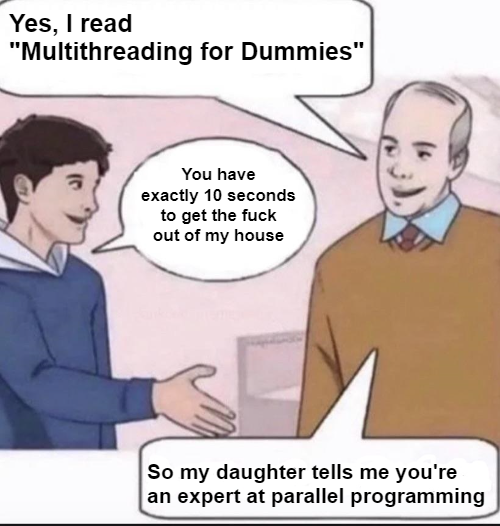
Reading "Multithreading for Dummies" doesn't make you an expert. The guy thinks he's ready to impress his date's father with parallel programming knowledge, but dad's already starting the countdown thread in the background. Classic case of a junior dev who skimmed the documentation and now thinks they can handle race conditions. Meanwhile, the father process is about to terminate this conversation with extreme prejudice.