

Encapsulation Memes

Posts tagged with Encapsulation

Web Standard Btw

Web Standard Btw
You walk into the ring thinking you're gonna wrestle with the Shadow DOM like it's some clean, well-documented web standard. But the Shadow DOM? It's got hands. It's been training in the hyperbolic time chamber of browser inconsistencies. The Shadow DOM is supposed to encapsulate your styles and markup, keeping everything nice and isolated. Sounds great in theory! Until you actually need to style something inside it, or debug why your CSS isn't penetrating that boundary, or figure out why your JavaScript selectors are coming back null. Suddenly you're on the ground wondering what just happened. The irony? It's literally a web standard, part of the Web Components spec. But "standard" doesn't mean "easy to work with" – it just means we all get to suffer equally across browsers. The Shadow DOM will humble you faster than realizing you've been debugging production for an hour because you forgot to clear your cache.

Variable Scopes In Python

Variable Scopes In Python
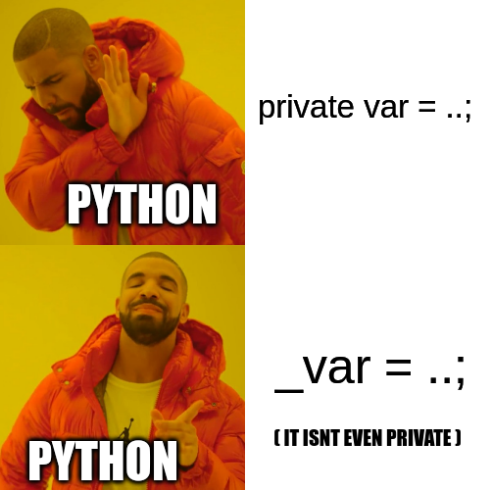
Python looking at private var = ...; like "nah, rejected" but then seeing _var = ...; and suddenly it's all love and acceptance. Because nothing says "private" like a single underscore that literally does nothing to prevent access. Python's philosophy on encapsulation is basically "we're all consenting adults here" – which is code for "there's no such thing as truly private variables, just polite suggestions." That underscore prefix is just a gentleman's agreement that you shouldn't touch it, not that you can't . It's the programming equivalent of a "Please Keep Off The Grass" sign with no fence. Meanwhile, languages like Java are over there with their private keyword actually enforcing boundaries like a proper bouncer, while Python just trusts you won't be a jerk. Spoiler: developers are absolutely jerks when they need to be.

When You Are A Public Function But Only Friends Are Allowed To Touch Privates

When You Are A Public Function But Only Friends Are Allowed To Touch Privates
Object-oriented programming's access modifiers explained through the most awkward love triangle in computer science. You're out here being a public function, visible to the entire codebase, while watching your friend classes get all cozy with those private members you can only dream about accessing. It's like being the third wheel at a party where everyone's talking about encapsulation. Sure, you're public and everyone can call you, but that doesn't mean you get special privileges. Meanwhile, friend functions are living their best life, breaking all the rules of data hiding because they got that special declaration. The real kicker? Friend functions in C++ can access private and protected members even though they're not part of the class. They're basically the VIP pass holders of the programming world while you're stuck outside the velvet rope with the rest of the public interface.

Friends Will Be Friends

Friends Will Be Friends
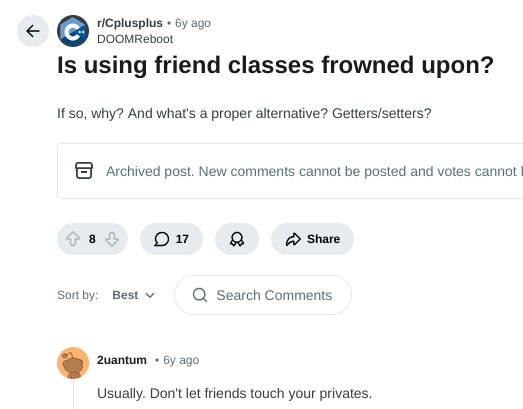
Someone's asking if using friend classes is frowned upon, and the top comment drops the golden rule: "Don't let friends touch your privates." For context, the friend keyword in C++ lets another class access your private members, which is basically punching a hole through encapsulation. It's like giving someone the keys to your house and saying "please don't go through my underwear drawer." Most devs consider it a code smell because it creates tight coupling and defeats the purpose of access modifiers. If you need a friend class, your design probably needs a refactor. The double entendre here is *chef's kiss* — both a programming best practice AND life advice wrapped in one sentence.

SANSUI 34 Inch 3440x1440P 240Hz Ultrawide UWQHD Gaming Monitor,21:9 2K Curved Monitor 1500R,Fast VA, PIP/PBP,AI Crosshair,AIPQ(Visual Enhance),MPRT 1ms,HDR,HDMI2.1 * 2,DP1.4 * 2(DP Cable Included)

SANSUI 34 Inch 3440x1440P 240Hz Ultrawide UWQHD Gaming Monitor,21:9 2K Curved Monitor 1500R,Fast VA, PIP/PBP,AI Crosshair,AIPQ(Visual Enhance),MPRT 1ms,HDR,HDMI2.1 * 2,DP1.4 * 2(DP Cable Included)
34 Inch 240Hz UWQHD(3440*1440) Fast VA Curved 1500R Ultrawide 21:9 Gaming Monitor with AI Crosshair and AI Bluelight. · Performance: 240Hz Refresh Rate | MRPT 1ms Response Time | Freesync | AI PQ(Vis…

I Didn't Get It

I Didn't Get It
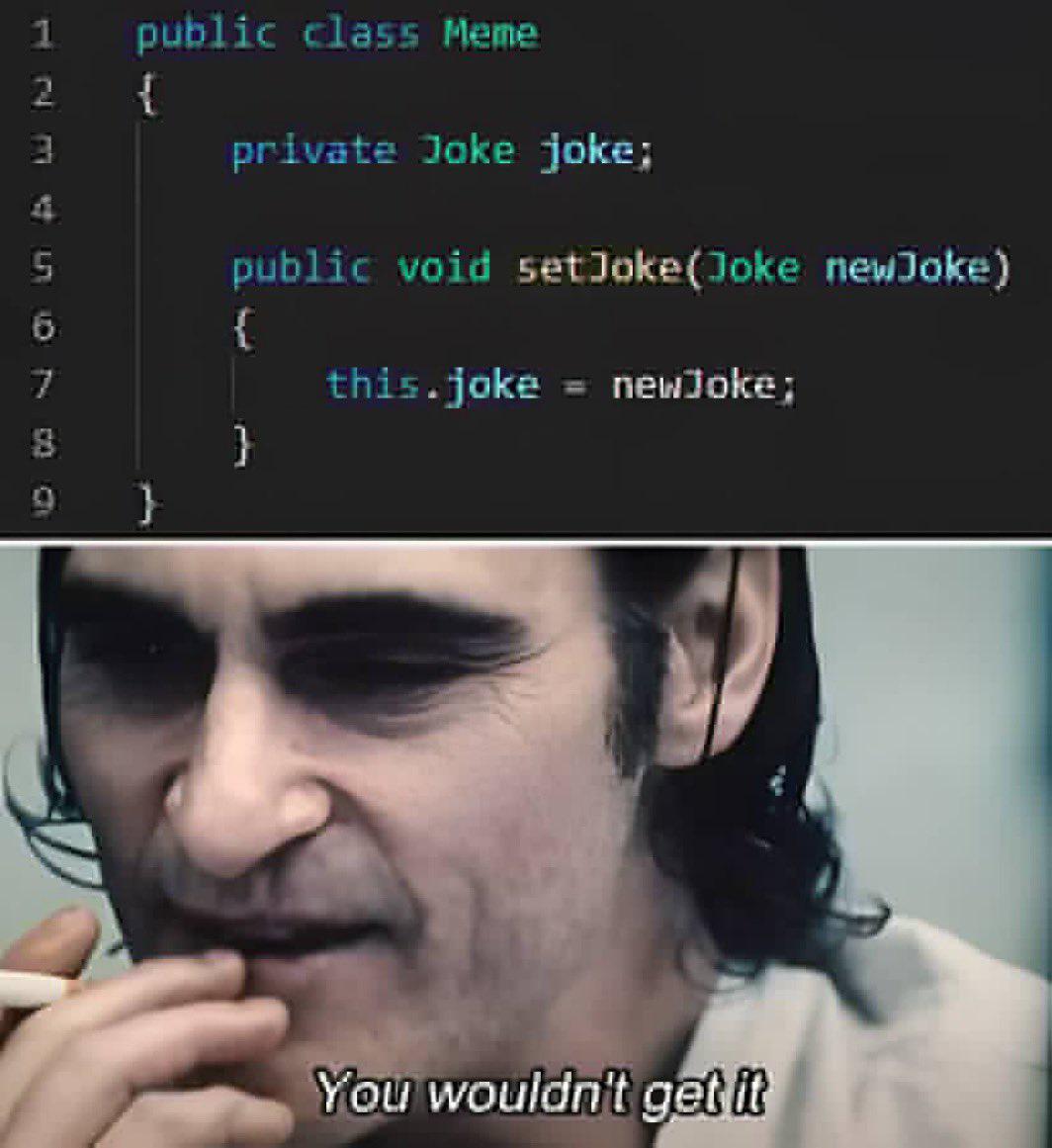
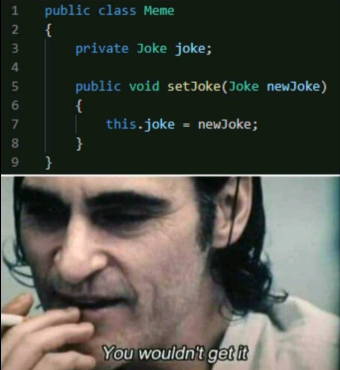
Oh, the absolute TRAGEDY of encapsulation! Someone made a private Joke object and then had the AUDACITY to provide a public setter method for it. The punchline? You literally can't access the joke directly because it's private, so you genuinely "wouldn't get it." It's a meta-joke about access modifiers that becomes the very thing it describes - an inaccessible joke. The setter is there taunting you like "here, you can SET a new joke, but you'll never GET the original one!" Pure object-oriented poetry wrapped in existential programming humor. Chef's kiss to whoever wrote this because they created a joke that perfectly embodies its own inaccessibility. The irony is *chef's kiss* immaculate.

Ignorance Is Bliss

Ignorance Is Bliss
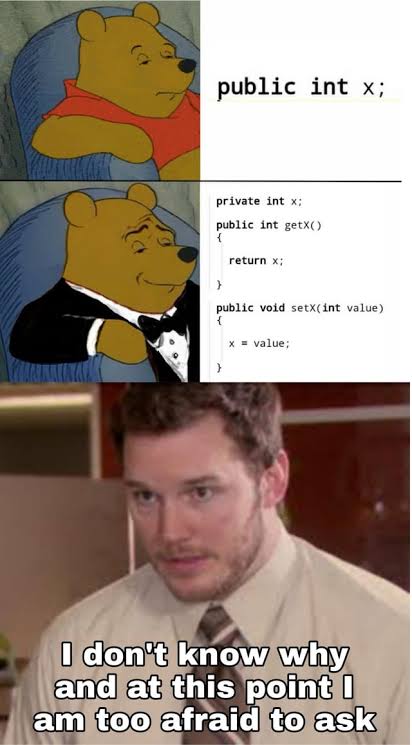
Junior devs just slapping public int x; everywhere and living their best life. Then someone introduces them to encapsulation and suddenly they're writing getters and setters like they just discovered fire. The fancy suit represents that false sense of sophistication you get from following OOP principles—until you realize you've written 20 lines of boilerplate just to access a single integer. You're now "professionally" doing what you used to do in one line, and deep down you're questioning every life choice that led you here. Sometimes the simple solution was fine. But now you're in too deep to go back. Welcome to enterprise development, where we make everything unnecessarily complicated and call it "best practices."

Srsly Who Names These Laws

Srsly Who Names These Laws
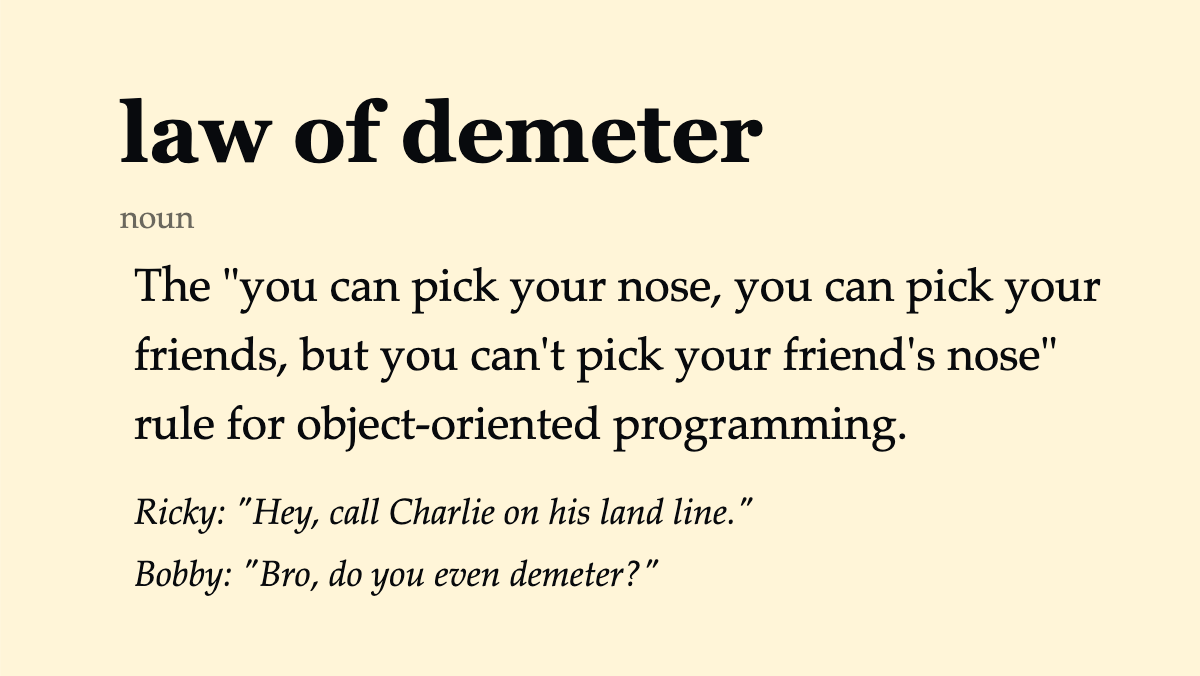
OH. MY. GOD. Whoever came up with this "Law of Demeter" deserves both a Nobel Prize and a slap across the face! 🤦‍♀️ It's literally the most RIDICULOUS way to explain encapsulation in programming history - comparing object methods to nose-picking etiquette?! I'm deceased! 💀 For the uninitiated: The Law of Demeter is actually a serious design principle that says objects should only talk to their immediate friends (direct dependencies), not friends of friends. It prevents your code from turning into a codependent mess where everyone's all up in everyone else's business. But sure, let's explain complex software architecture with nose-picking metaphors. Because THAT'S what makes computer science approachable! Next up: Garbage collection explained through bathroom etiquette! 🚽

Make Your Own Joke

Make Your Own Joke
Look at this beautiful encapsulation—a private joke that can only be accessed through a setter method. And just like real programmer humor, if you need it explained, "you wouldn't get it." The irony is perfect: a class called Meme with a private Joke that needs to be set explicitly, much like how the best programming jokes require insider knowledge that can't be easily transferred. The Joker knows what's up—some jokes just don't compile in everyone's mental runtime.

Make BASIC Great Again

Make BASIC Great Again
Rejecting modern OOP encapsulation with its fancy "getters and setters" in favor of the raw, chaotic energy of old-school BASIC's "peekers and pokers" - where memory manipulation was done with bare hands and a complete disregard for safety. Like choosing to fix your server with a hammer instead of proper tools because "that's how grandpa did it."

Four Pillars Of OOP: Visual Edition

Four Pillars Of OOP: Visual Edition
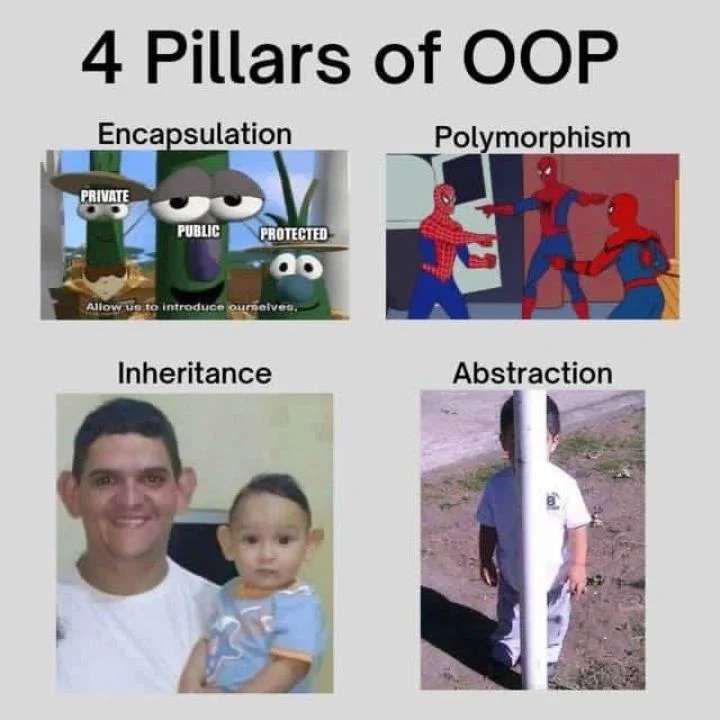
Saved $50,000 in student loans with this one weird trick. CS professors hate it. The meme explains OOP concepts better than most textbooks: Encapsulation: Veggies with privacy levels labeled. Private parts stay hidden, public interfaces say hello. Just like your code should work. Polymorphism: Spider-Men pointing at each other. Same interface, different implementations. The perfect metaphor doesn't exi— Inheritance: Father and son. Kid inherits dad's traits and probably his debugging skills too. Abstraction: Half a person behind a pole. You don't need to see the whole implementation, just the interface. Like most APIs we pretend to understand.

Private String Gender

Private String Gender
When your object-oriented programming skills finally come in handy at a protest. Someone clearly paid attention in CS class instead of sleeping through encapsulation lectures. The sign brilliantly uses Java's access modifiers to make a statement - keeping gender as a private string variable that can't be modified by outside classes, rather than a public constant boolean that everyone gets to weigh in on. The compiler of this joke deserves a promotion.

100Pcs Programming Stickers for Laptop, Water Bottles - Coding, Developer, Geeky Stickers Vinyl - Gifts for Computer Programmers, for Coders - Programming Party Supplies

100Pcs Programming Stickers for Laptop, Water Bottles - Coding, Developer, Geeky Stickers Vinyl - Gifts for Computer Programmers, for Coders - Programming Party Supplies
Sticks Well on Multiple Surfaces – Our premium vinyl stickers are made to stick securely to laptops, water bottles, phone cases, journals, skateboards, and even car windows. Each sticker uses durable…

Why Put A Tuxedo On Your Variables

Why Put A Tuxedo On Your Variables
The top panel shows Pooh looking unimpressed with a public variable. The middle panel shows Fancy Pooh absolutely delighted with the exact same variable made private but wrapped in getter and setter methods. The bottom panel captures that moment when you join a project and see this pattern everywhere but can't figure out why anyone would add all this boilerplate just to access a simple variable. It's like putting on a tuxedo to walk to your mailbox.