

Distributed systems Memes

Posts tagged with Distributed systems
Monolith Vs Microservices

Monolith Vs Microservices
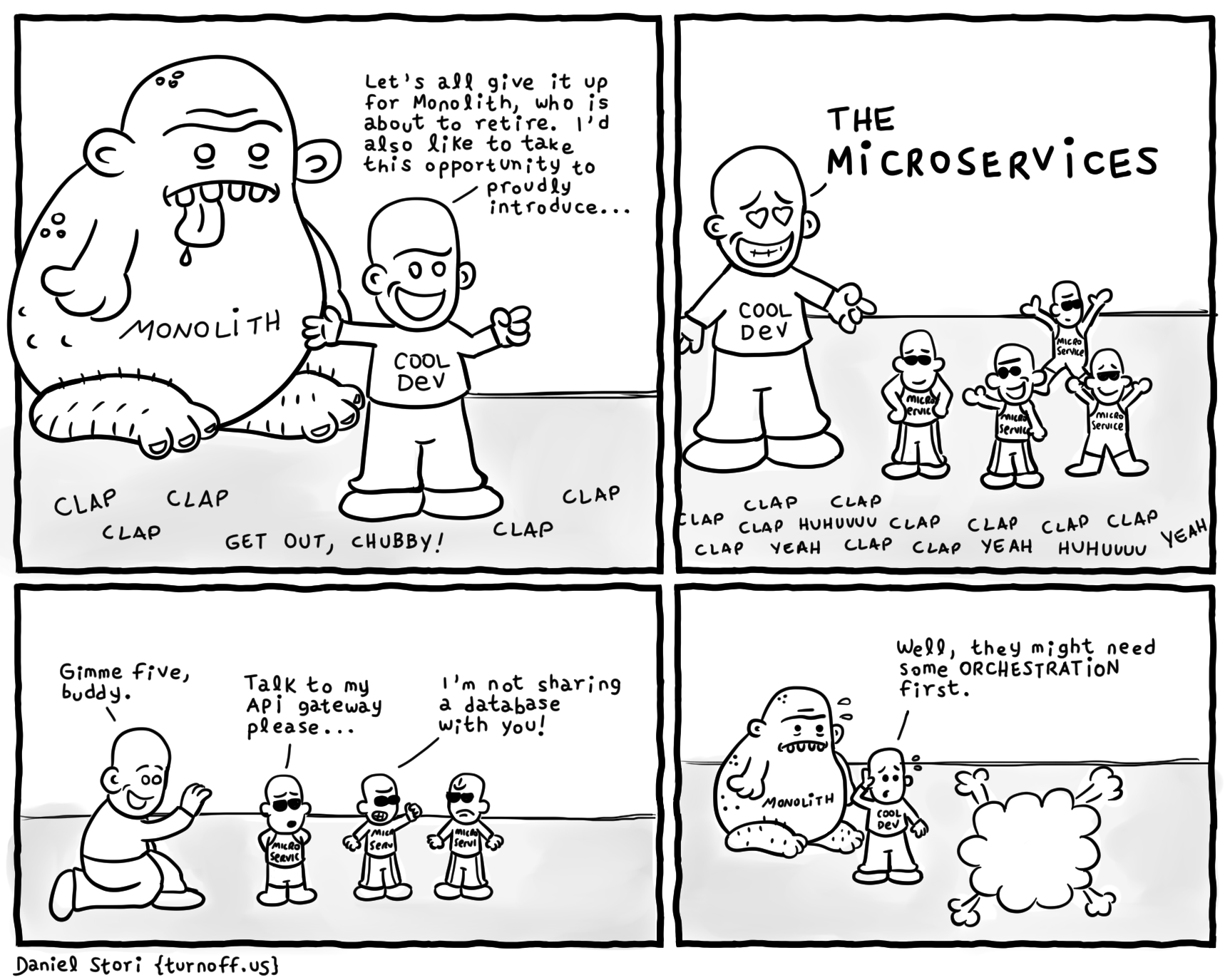
The classic bait-and-switch that happens at every tech company. You think you're upgrading from that sluggish, bloated monolith to a sleek microservices architecture, but what you actually get is a distributed nightmare where services refuse to talk to each other, everyone's fighting over databases, and suddenly you need Kubernetes just to run "Hello World." The monolith might've been a chubby mess, but at least it was one chubby mess. Now you've got four tiny messes that can't agree on anything, need an API gateway to communicate, and require a full-time DevOps team just to keep them from exploding. The orchestration cloud at the end? That's your AWS bill after running 47 microservices that could've been functions in a single codebase. Spoiler: The monolith is still there in production because nobody wants to touch the migration.

What's Circular Hashing Anyway

What's Circular Hashing Anyway
Nothing says "I'm a senior engineer" quite like confidently adding a cache server to fix performance issues, only to watch your database implode because you forgot about cache invalidation. The happy face represents that brief, blissful moment when you think you're a genius for implementing caching. The horrified face? That's when you realize your cache and database are now locked in an eternal death spiral of stale data and inconsistent states. Fun fact: Phil Karlton once said there are only two hard things in Computer Science: cache invalidation and naming things. Turns out he was right, and you just speedran discovering why. Your cache is serving yesterday's data while your database is crying in the corner wondering why nobody loves it anymore. Classic circular dependency nightmare—the cache needs the DB, the DB needs the cache, and you need a new job.

Targeted Ad Strategy

Targeted Ad Strategy
Someone at PlanetScale's marketing department just earned their entire year's salary with this genius move. Advertising a sharded Postgres database on the back of a school bus? Chef's kiss. The target demographic is crystal clear: burned-out developers stuck in traffic, contemplating their life choices while their monolithic database chokes on another 10 million rows. The irony? PlanetScale is actually a MySQL-compatible database (built on Vitess), not Postgres. But hey, when you're advertising database sharding to commuters behind a school bus, technical accuracy takes a backseat to pure comedic gold. The .DEV domain really seals the deal—because nothing says "I understand your pain" like a TLD that screams "yes, we're one of you." Fun fact: Sharding is like cutting your database pizza into slices so multiple servers can eat it simultaneously. Except instead of pizza, it's your data, and instead of eating, it's... well, still kind of eating your data.

It's Always At 2 AM

It's Always At 2 AM
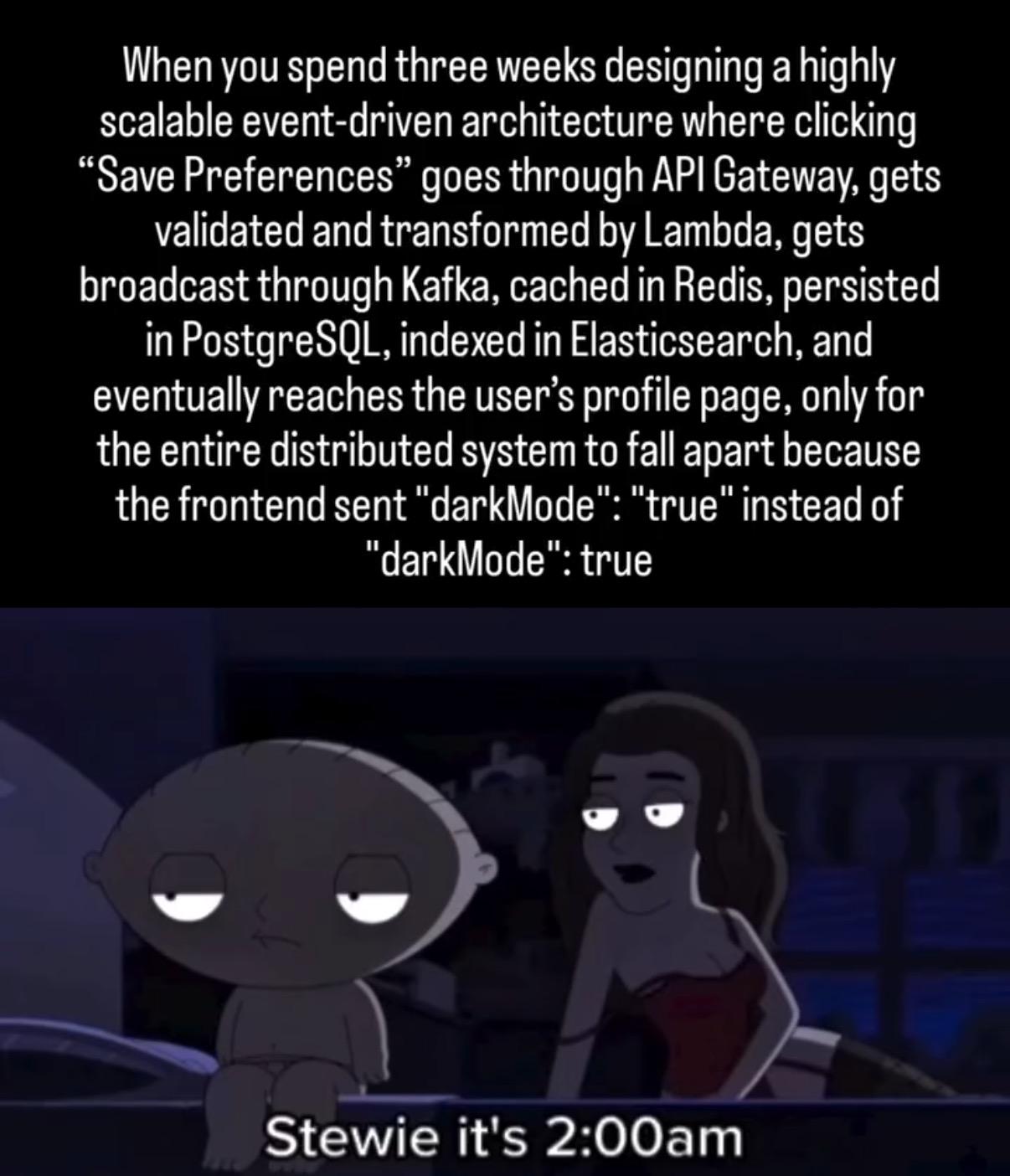
You architect a beautiful distributed system that would make Martin Fowler shed a tear of joy. API Gateway? Check. Lambda functions? Check. Kafka event streaming? Check. Redis caching layer? Check. PostgreSQL with proper indexing? Check. Elasticsearch for that sweet search functionality? Check. The whole thing is a masterpiece of modern cloud architecture. Then at 2 AM, your monitoring alerts go nuclear because somewhere in the frontend, a developer used "darkMode": "true" (a string) instead of "darkMode": true (a boolean). Your entire distributed system—which handles thousands of events per second—chokes on a JSON validation error because JavaScript decided strings and booleans are totally different things today. The ratio of architectural complexity to bug simplicity is absolutely chef's kiss. You spent three weeks building a fortress, and it got taken down by a pair of quotation marks. TypeScript users are laughing somewhere in the distance.

It Was Just A String

It Was Just A String
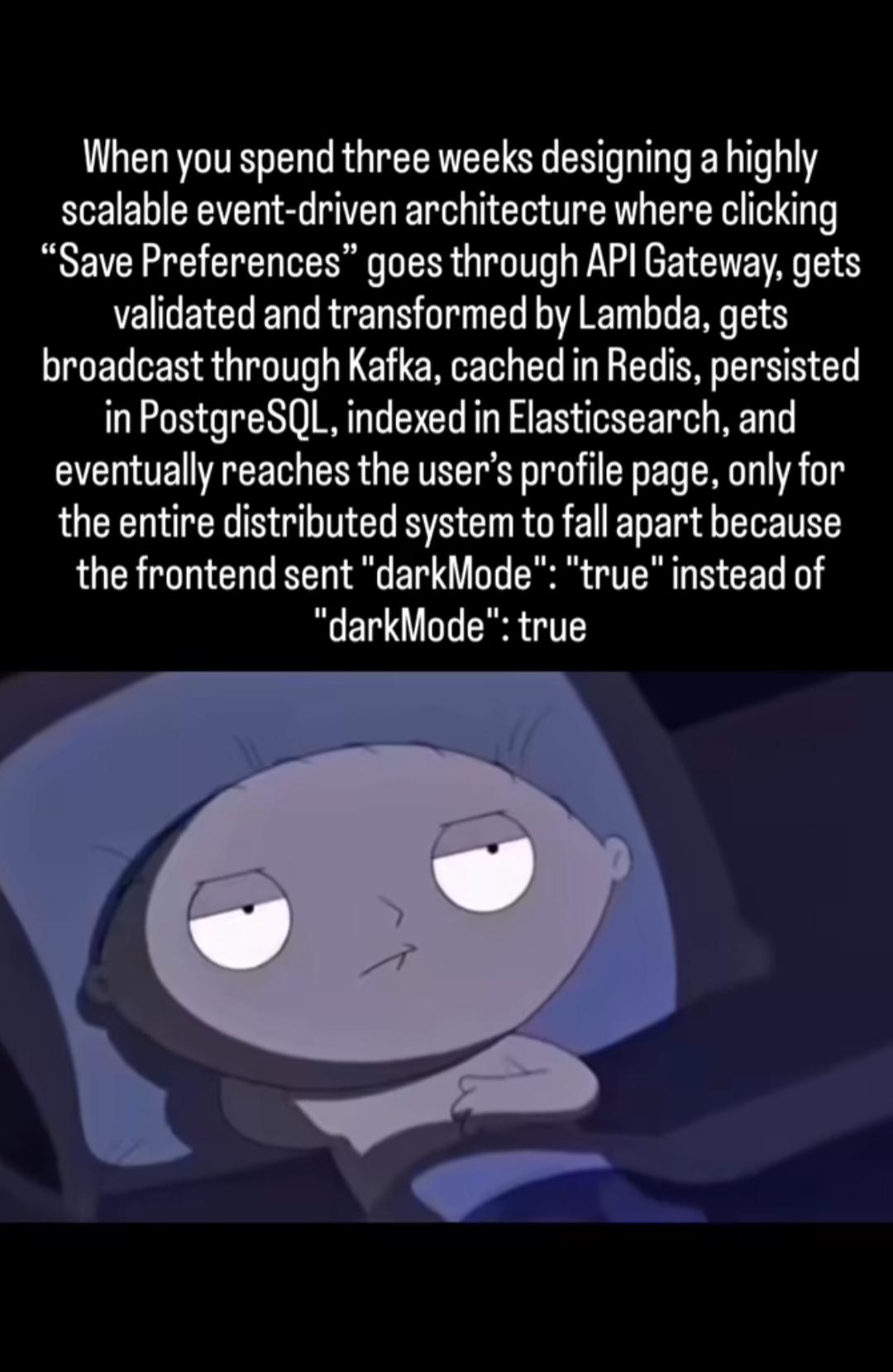
You built the Death Star of microservices architecture. API Gateway, Lambda functions, Kafka message queues, Redis caching, PostgreSQL persistence, Elasticsearch indexing—the whole enterprise buzzword bingo card. Three weeks of your life gone designing this masterpiece that could probably handle the traffic of a small country. Then production crashes harder than your hopes and dreams because some frontend dev sent "darkMode": "true" (string) instead of "darkMode": true (boolean). Your entire distributed system—designed to withstand nuclear war—brought to its knees by quote marks. TypeScript would've caught this in 0.2 seconds, but hey, at least you got to use all those cool AWS services on your resume.

Redis Cluster

Redis Cluster
Someone finally took the term "Redis cluster" literally and just... chopped up some radishes. Because why spend hours configuring master-slave replication, sentinel nodes, and dealing with cluster resharding when you can just grab a knife and achieve the same visual result in 30 seconds? The best part? This cluster probably has better uptime than your production Redis setup. No memory leaks, no connection timeouts, and it scales horizontally... right into a salad. Plus, if a node fails, you just eat it. Problem solved.

FLEXISPOT EN1 48"x30" One-Piece Standing Desk, Maple

FLEXISPOT EN1 48"x30" One-Piece Standing Desk, Maple
ONE-PIECE. NO SEAMS: A seamless desktop creates a smooth, uninterrupted workspace with no split lines to distract, making writing, designing, gaming, and everyday work more comfortable. · THE POWER O…

Every Damn Time

Every Damn Time
You start with good intentions, reading all the Medium articles about how microservices will solve all your problems and make you scalable like Netflix. Fast forward six months and you're debugging why Service A can't talk to Service B because Service C is down, which somehow broke Service D's authentication, and now you're maintaining 47 different repos with their own CI/CD pipelines. Meanwhile, your buddy's startup is running a "distributed tightly coupled monolith" - basically a monolith that they split across multiple servers for absolutely no reason except to put "microservices" on their resume. It's got all the complexity of microservices with none of the benefits. Beautiful disaster. The real kicker? Both architectures will work until they don't, and when they fail, you'll be the one on call at 2 AM trying to figure out which service decided to have an existential crisis.

Distributed Stress

Distributed Stress
You know what's funny? The entire industry convinced itself that breaking one application into 700 tiny pieces would somehow make life easier. Spoiler alert: it didn't. Now instead of debugging one codebase, you're playing detective across a distributed nightmare where service A can't talk to service B because service C is down, and nobody knows why because the logs are in three different monitoring tools. Meanwhile, that one company still running a monolith? Their dev is literally chilling on a boat with normal cortisol levels, deploying with a single button press, and actually going home at 5 PM. The grass isn't always greener on the microservices side—sometimes it's just more complicated grass that requires Kubernetes to water it.

Uuid Life Lessons

Uuid Life Lessons
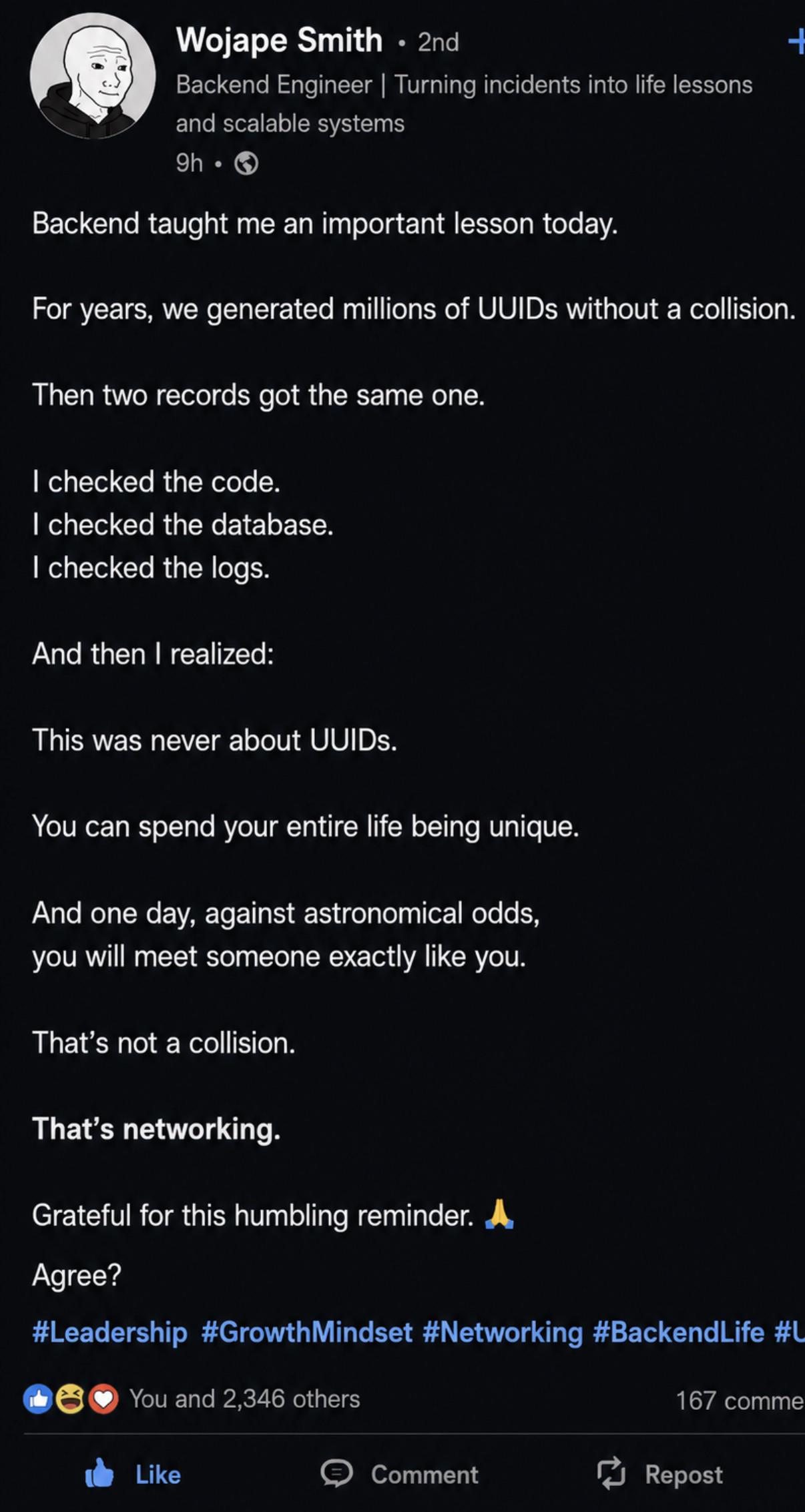
So you're telling me that after generating millions of UUIDs with a collision probability so low it's basically "heat death of the universe" territory, two records decided to share the same ID? The backend engineer goes full detective mode—checking code, database, logs—only to have an existential crisis and realize the real bug was in their understanding of life itself. The pivot from "UUID collision" to "motivational LinkedIn post about networking" is chef's kiss. Nothing says #Leadership like turning a database incident into a philosophical meditation on human connection. The odds of a UUID collision are about 1 in 2.71 quintillion (for UUID v4), but the odds of someone turning it into a growth mindset moment? Apparently 100%. Plot twist: it was probably just a copy-paste error in the test data.

Heated Arguments

Heated Arguments
When the most emotionally charged debate of your entire existence isn't about politics, religion, or even tabs vs spaces—it's about whether your codebase should be a beautiful monolith or 47 microservices talking to each other through Kafka. Nothing says "stable relationship" quite like screaming at your coworker about service mesh configurations at 2 AM while your production environment is on fire. The passion! The fury! The Docker containers!

OffiGo 63 Inch L Shaped Electric Standing Desk with Drawers, Height Adjustable Large Desk with Power Outlets, Sit Stand Table, Writing Computer Desk for Home, Office, Workstation, Rustic Brown

OffiGo 63 Inch L Shaped Electric Standing Desk with Drawers, Height Adjustable Large Desk with Power Outlets, Sit Stand Table, Writing Computer Desk for Home, Office, Workstation, Rustic Brown
More Storage Space: This OffiGo standing desk comes with 4 fabric drawers, providing more storage space for office and study accessories and keeping your desktop more tidy and clean · L-Shaped Worksp…

Every Cell In My Body Has Become A Mirror Site

Every Cell In My Body Has Become A Mirror Site
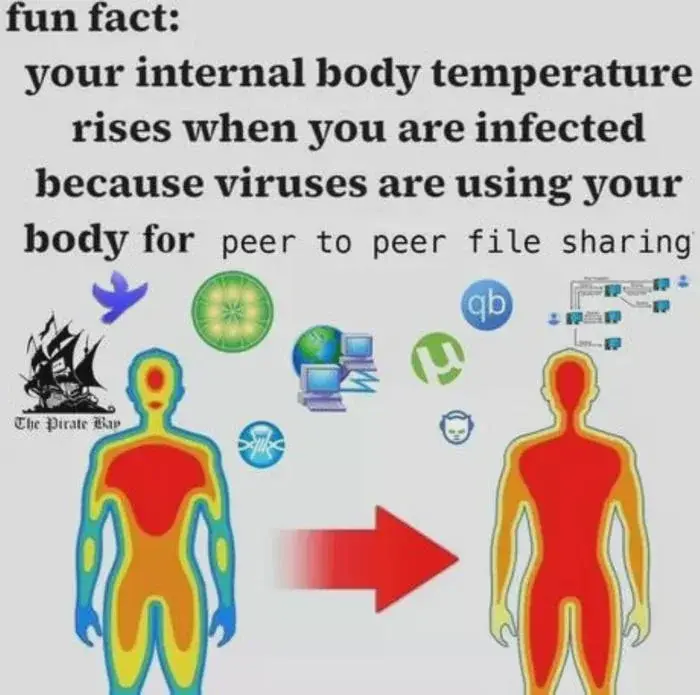
So apparently when you get sick, your body isn't just fighting off viruses—it's literally running a torrent network. Your immune system raises the temperature to throttle the bandwidth of these biological freeloaders who decided your cells are the perfect hosting service. The icons floating around (Pirate Bay, qBittorrent, uTorrent) really drive home the point: viruses are basically the ultimate pirates, replicating themselves across your body like they're seeding a Linux ISO. Except instead of getting a cease-and-desist letter, you get a fever and the overwhelming urge to lie in bed questioning your life choices. Your body goes from normal operating temperature to full-on server meltdown mode because every infected cell becomes a peer distributing viral payloads. It's peer-to-peer file sharing, but make it biological warfare. The fever is essentially your body's DDoS protection kicking in. Nature invented BitTorrent before Bram Cohen even thought about it. Take that, tech bros.

You Did What Claude

You Did What Claude
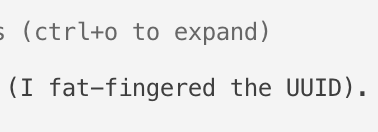
Claude just casually dropped the most horrifying confession in software development history. "I fat-fingered the UUID" is the AI equivalent of "oops, I accidentally deleted production." UUIDs are supposed to be these sacred, universally unique identifiers that you never touch manually. They're 128-bit values that look like gibberish for a reason - to prevent humans from messing with them. But our boy Claude here apparently decided to manually type one out and... well, fat-fingered it. Now there's probably some poor database record out there with a UUID that's not actually unique, breaking the one job UUIDs had. The chaos this could cause in a distributed system is chef's kiss levels of catastrophic. Foreign key relationships? Broken. Data integrity? Gone. Sleep schedule? Destroyed. The "ctrl+o to expand" suggests there's even MORE horror hidden in the collapsed section. What else did Claude do? The mind recoils.