

Coding interview Memes

Posts tagged with Coding interview
Job Interview Software Developer

Job Interview Software Developer
You know the drill. You've built production systems that handle millions of requests, debugged race conditions at 2AM, and somehow kept legacy code from collapsing. But none of that matters when the interviewer asks "Can you program in Scratch?" and gets genuinely excited about it. The bar is simultaneously on the floor and in the stratosphere. They want you to invert binary trees on a whiteboard while also being thrilled that you know how to drag-and-drop blocks in a kids' programming language. It's like asking a chef if they can make toast and expecting them to be proud of it. Welcome to tech interviews, where the questions make no sense and the requirements don't matter. Just smile, nod, and hope they don't ask you to implement a sorting algorithm in Scratch next.

This Also Applies To Those Who Write The Algorithm In Plain English

This Also Applies To Those Who Write The Algorithm In Plain English
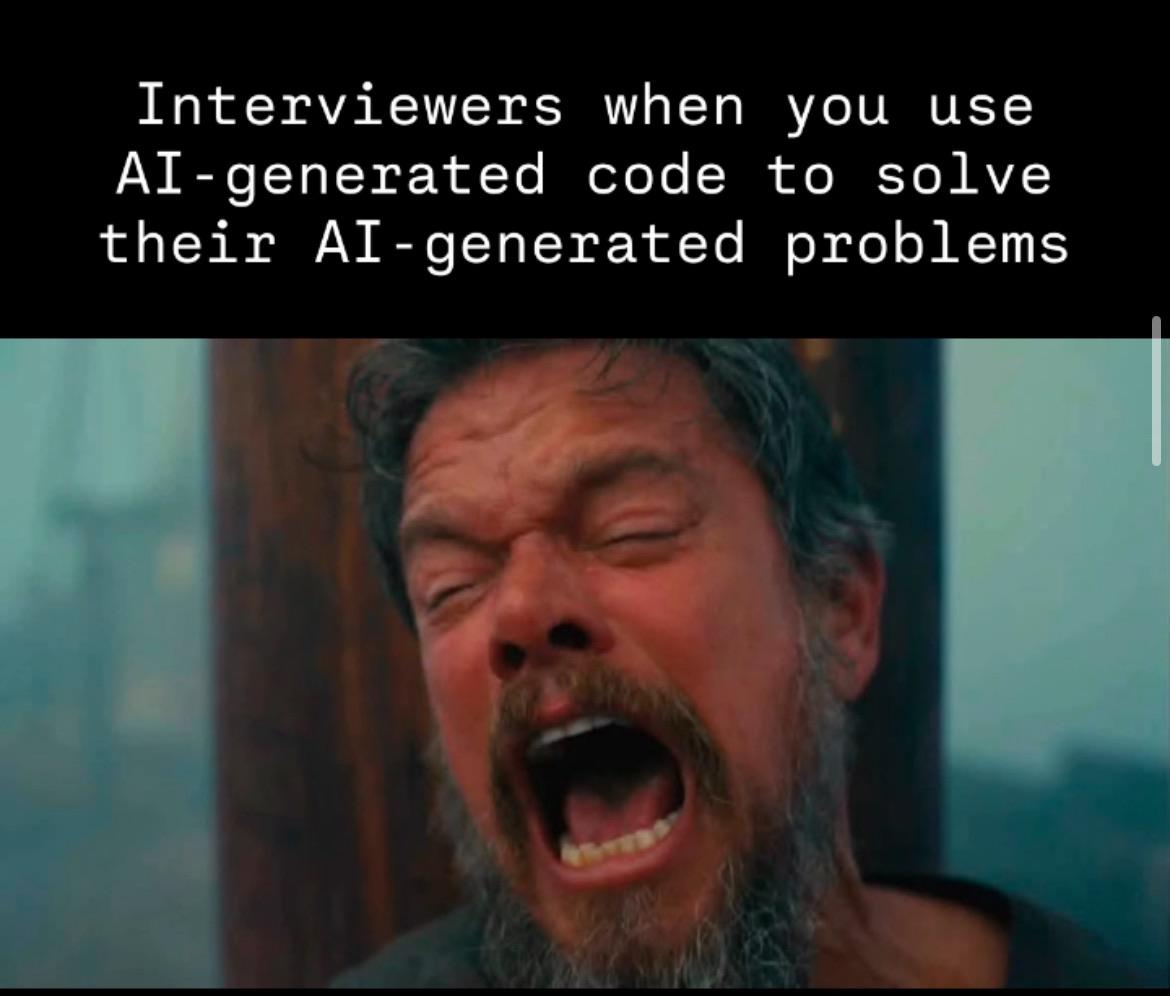
Using an LLM to look up documentation is like using a sword and fork to eat chicken. Sure, it technically works, but you're bringing medieval weaponry to a task that requires... literally just opening a browser tab. The guy's committed to the bit though, full knight armor and everything. Documentation exists. It's indexed. It's searchable. It doesn't hallucinate that a function takes 4 parameters when it only takes 2. But hey, why read the actual docs when you can ask an AI that was trained on Stack Overflow answers from 2019 and might confidently tell you to use a deprecated method? The title nails it too. Same energy as people who write "loop through the array and find the maximum value" as their solution to a coding challenge. Thanks, I also speak English. Show me the code or show me the door.

Optimization Pain

Optimization Pain
You've already achieved logarithmic time complexity—literally one of the best performance tiers you can get for most algorithms. You're sitting pretty with your binary search or balanced tree traversal. And then the interviewer, with the audacity of someone who's never shipped production code, asks if you can "optimize it further." Brother, what do you want? O(1)? Do I look like I can predict the future? Should I just hardcode the answer? The only thing left to optimize is my patience and your expectations. Fun fact: O(log n) is already considered optimal for many search and divide-and-conquer problems. Going from O(log n) to O(1) usually requires either massive space trade-offs or a complete rethinking of the problem. But sure, let me just casually break the laws of computational complexity real quick.

Is This Not Enough

Is This Not Enough
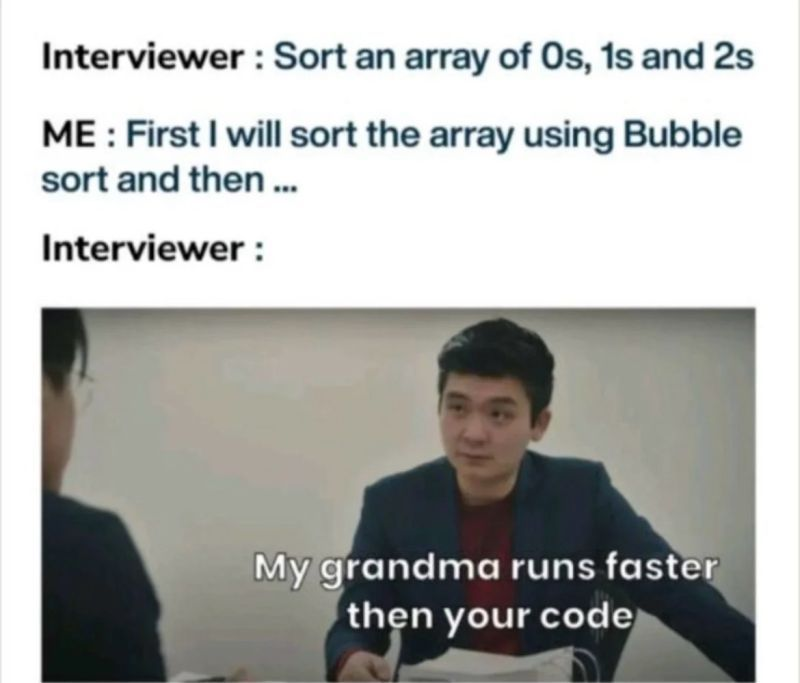
You've already achieved logarithmic time complexity—the HOLY GRAIL of algorithmic efficiency—and they're sitting there asking if you can squeeze out MORE performance? What do they want, O(1) for everything? Do they expect you to invent time travel? O(log n) is literally one step away from constant time. You're already operating at near-theoretical perfection, and here comes the interviewer acting like you just submitted bubble sort to production. The audacity! The sheer NERVE! It's like winning an Olympic gold medal and having someone ask if you could've run it backwards while juggling. Some interviewers really do be out here expecting you to violate the fundamental laws of computer science just to prove you're "passionate" about optimization.

Op Doesn't Have Time For Interviews

Op Doesn't Have Time For Interviews
You know those brain-teaser interview questions that have nothing to do with the actual job? Yeah, this person gets it. The classic "three switches, one bulb" puzzle is the kind of thing interviewers love to throw at you to "test your problem-solving skills" while you're sitting there thinking about the 47 GitHub repos you could be contributing to instead. The savage response is chef's kiss—basically saying "I'd rather be literally anywhere else than solving your riddle that has zero relevance to whether I can write clean code or debug a production incident at 3 AM." Because let's be real, when was the last time you had to figure out which switch controls a light bulb in a separate room during a deployment? Spoiler: never. It's the perfect encapsulation of how broken tech interviews have become—asking candidates to solve puzzles that Einstein would find tedious instead of, you know, actually assessing their ability to do the job. But hey, at least it weeds out people who have better things to do with their time.

Npm Install

Npm Install
The JavaScript ecosystem in a nutshell. Asked to solve a basic algorithmic problem? Just install a package for it. Why reinvent the wheel when someone's already published is-prime to npm with 47 dependencies, half of which are deprecated? The interviewer's face says it all—equal parts confusion, disbelief, and grudging respect for the audacity. Because let's be real, in production you'd probably use a library too. But maybe, just maybe, you should know how to check if a number is divisible by anything other than 1 and itself without reaching for your package manager.

Show Python

Show Python
You know that feeling when you're in a tech interview and they ask you to demonstrate your Python skills? You confidently pull out your... empty hands with absolutely nothing to show. The interviewer's just staring at you like "where's the code?" while you're desperately trying to conjure up some list comprehensions out of thin air. The brutal reality: you put "Proficient in Python" on your resume after completing a single Codecademy tutorial and now you're being asked to implement a binary search tree while your brain is just going print("hello world") on repeat. The gap between what your resume claims and what you can actually code live under pressure is... well, it's giving invisible Python vibes.

Yes, I Wrote That Thing 😭

Yes, I Wrote That Thing 😭
Nothing says "I panicked during a coding interview" quite like writing FizzBuzz with three separate if statements and continue in each one. The interviewer's face progression from neutral to facepalm to disbelief is the universal reaction to code that technically works but makes seasoned developers want to throw their mechanical keyboards out the window. Pro tip: If your solution has more continue statements than actual logic, your future teammates are already updating their resumes.

Who Can Save You From This

Who Can Save You From This
Oh. My. GOD! The AUDACITY of this truth bomb! 💣 You're at home coding like some muscular beast, flipping cars and destroying problems with your bare hands. But put that same brain in an interview setting? INSTANT TRANSFORMATION into a quivering mess wearing a ridiculous pointy hat! The cognitive collapse is REAL, people! One minute you're building entire systems single-handedly, the next you're forgetting how to reverse a string while some hiring manager watches your soul leave your body. The duality of developer life is just SO BRUTAL!

Someone Explain This To Me Like Im Five

Someone Explain This To Me Like Im Five
JavaScript's parseInt function just decided that 0.0000005 equals 5 because scientific notation turned it into "5e-7" and parseInt grabbed just the "5" like a toddler picking only the M&Ms out of trail mix. Six decimal places? Nah, too much work. Five? Still zero. Seven? BOOM, suddenly 5. It's like JavaScript was programmed by someone rolling dice to determine behavior. No wonder developers drink.

Help I Think This Is A Sliding Window

Help I Think This Is A Sliding Window
OH. MY. GOD. This coding interview question is the FINAL BOSS of absurdity! 💀 They want you to find the meaning of life in an INFINITE array with O(log(🍆)) time complexity and NO EXTRA MEMORY?! Excuse me while I dramatically faint onto my keyboard! The eggplant emoji in the Big O notation is just the chef's kiss of ridiculousness. Like, sure honey, I'll just casually process infinity, find existential truth, AND do it with vegetable-logarithmic efficiency. All before lunch! The "return it anyway" if it doesn't exist part is the algorithmic equivalent of "just make something up if you don't know the answer." Pure chaos energy!

Sorting Algorithm For Your Next Coding Interview

Sorting Algorithm For Your Next Coding Interview
The infamous "sleep sort" algorithm—where your array gets sorted by setting timeouts based on each value. The smaller numbers wake up first, the bigger ones hit snooze longer. Technically it works (sort of), but try explaining this beauty in a coding interview and watch the interviewer's soul leave their body. "It's O(max(array)) time complexity, sir!" Absolute chaos masquerading as computer science. The perfect algorithm if your requirements include "must be completely unreliable" and "please never use in production."