

Certificate-authority Memes

Posts tagged with Certificate-authority

Confused Look No Further

Confused Look No Further
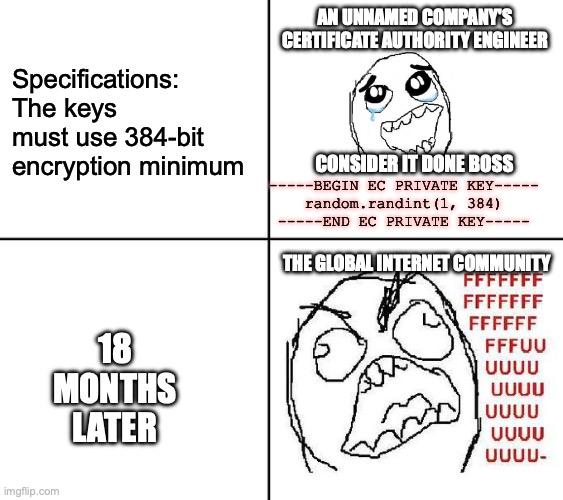
Certificate Authority engineer casually generates a 384-bit private key because the specs say "384-bit encryption minimum." Plot twist: they interpreted it as key size instead of encryption strength. Fast forward 18 months and the entire internet is collectively losing their minds because someone finally cracked it with what was probably a gaming rig and some free time. For context: RSA keys should be at least 2048-bit nowadays (preferably 4096-bit), while 384-bit is laughably weak. It's like bringing a pool noodle to a sword fight. The spec probably meant 384-bit symmetric encryption (which would be overkill), but someone at "unnamed company" clearly skipped Cryptography 101. The real kicker? It took 18 months for anyone to notice. That's either impressive incompetence or everyone was too busy arguing about tabs vs spaces to audit the actual security infrastructure.

That's The Goo Goo Man's Decision

That's The Goo Goo Man's Decision
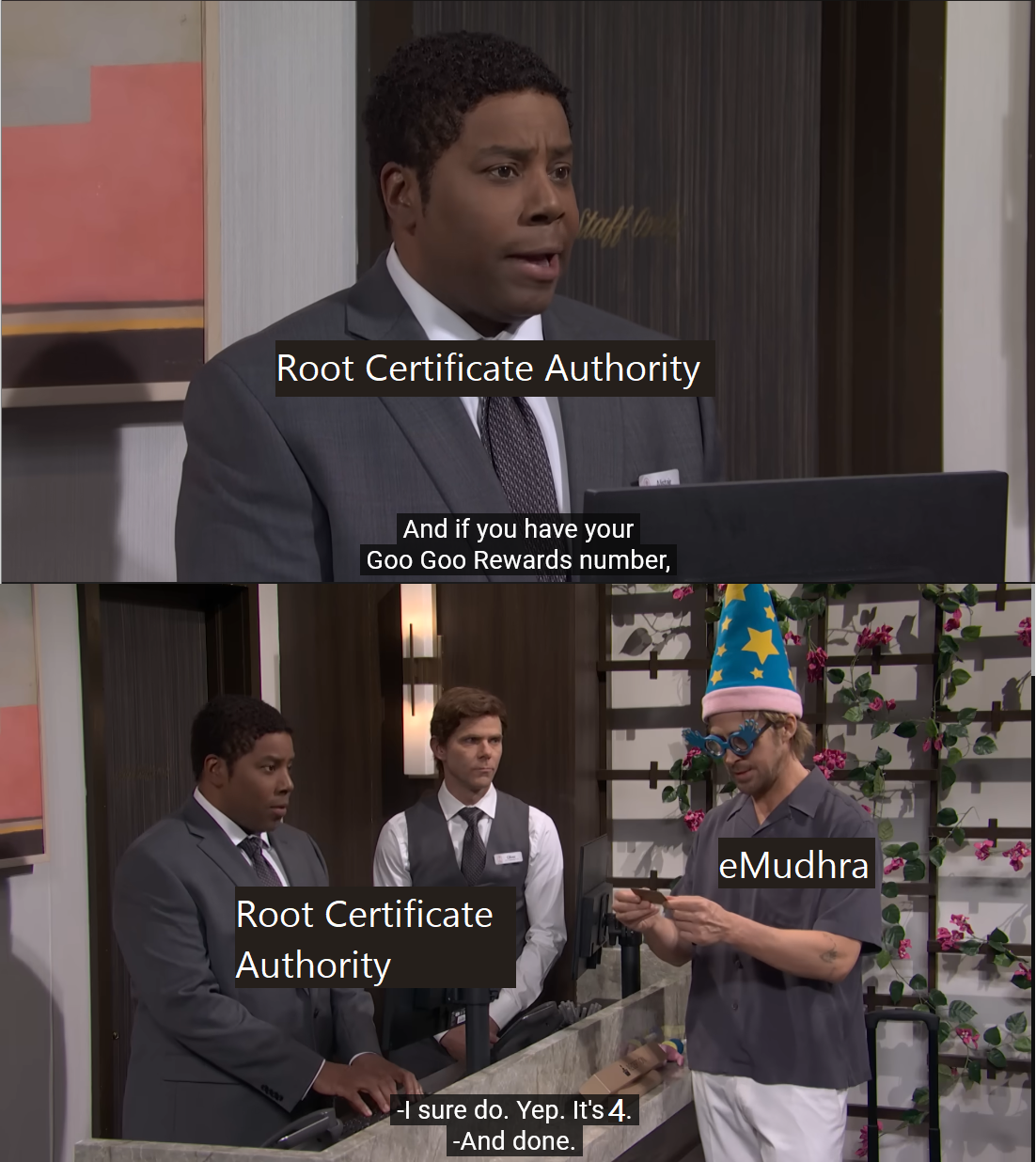
Root Certificate Authorities out here acting like they're the Supreme Court of the internet, demanding your credentials and proof of identity like you're trying to enter Fort Knox. They want documentation, verification, the whole nine yards! But then eMudhra (a real CA, by the way) rolls up like a chaotic wizard wearing a party hat and just... bypasses everything. "Goo Goo Rewards number? Yeah sure, that'll work. You're verified. Welcome aboard!" No questions asked, no security theater, just pure unhinged energy. The absolute AUDACITY of treating SSL certificate verification with the same rigor as a grocery store loyalty program is sending me. Who needs multi-factor authentication when you've got multi-flavor baby food points? 💀

How The Key Was Actually Created

How The Key Was Actually Created
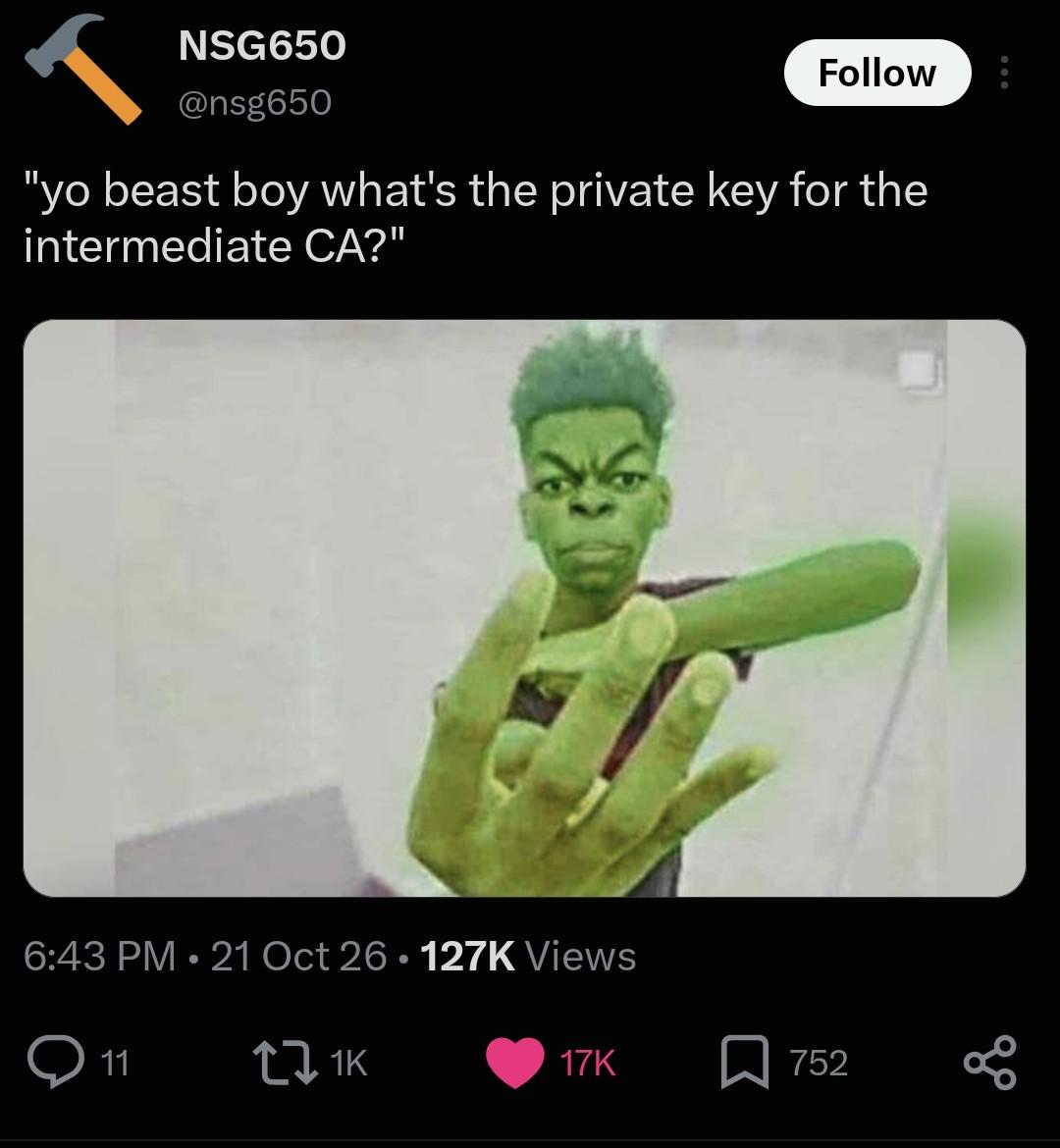
Someone casually asking for the intermediate CA's private key is like asking for the nuclear launch codes at a pizza party. The person responding with aggressive keyboard smashing perfectly captures the appropriate level of rage when someone doesn't understand the entire point of PKI infrastructure. For context: In certificate chains, the intermediate Certificate Authority's private key is literally the crown jewels. If that gets leaked, you can forge certificates for any domain and basically break the entire trust model of the internet. It's not just "please don't share this" – it's "this should be in an HSM in a bunker guarded by lasers." The "yo beast boy" energy combined with the fundamental misunderstanding of security principles is *chef's kiss*. Nothing says "I'm about to have a very bad day" quite like someone treating root-level cryptographic material like a WiFi password.

What A Week Huh

What A Week Huh
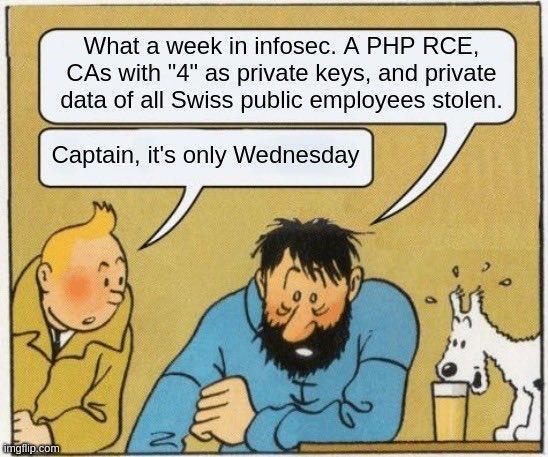
Someone's having a rough Wednesday in infosec land. A PHP RCE (Remote Code Execution - basically the "game over" of vulnerabilities), Certificate Authorities using "4" as their private keys (which is like locking your front door with a post-it note that says "locked"), and a massive data breach of Swiss public employees. All before hump day is over. The beauty here is the existential dread setting in. If Wednesday already brought this much chaos, what fresh hell awaits Thursday and Friday? It's like watching a slow-motion train wreck, except the train is on fire, the tracks are melting, and someone just realized they forgot to implement input validation. Every security engineer has lived through weeks like these where you question your career choices and wonder if it's too late to become a goat farmer instead.

E Mudhra Certificate Authority Chose Random Numbers By Fair Dice Roll Guaranteed To Be Random

E Mudhra Certificate Authority Chose Random Numbers By Fair Dice Roll Guaranteed To Be Random
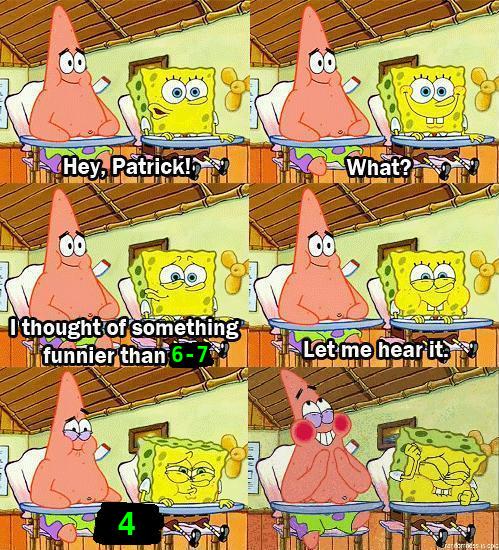
So apparently E Mudhra, a Certificate Authority that's supposed to be securing digital certificates and cryptographic operations, decided that "random number generation" means rolling a dice and getting... 4. Every. Single. Time. For those who need context: this is referencing the classic XKCD comic where someone hardcodes the number 4 as their "random" number because they rolled a dice once. The joke here is that a CA—literally an organization whose entire job depends on cryptographic security and proper randomness—might as well be using the same logic. Nothing screams "enterprise security" quite like deterministic randomness. I'm sure their SSL certificates are totally secure when the random number generator has the same entropy as a fortune cookie. But hey, at least it's guaranteed to be random, right? They rolled a dice! Once! In 2003! This is what happens when someone reads "cryptographically secure random number generator" and thinks "yeah, but have we tried just... picking a number?"

Peak Web PKI

Peak Web PKI
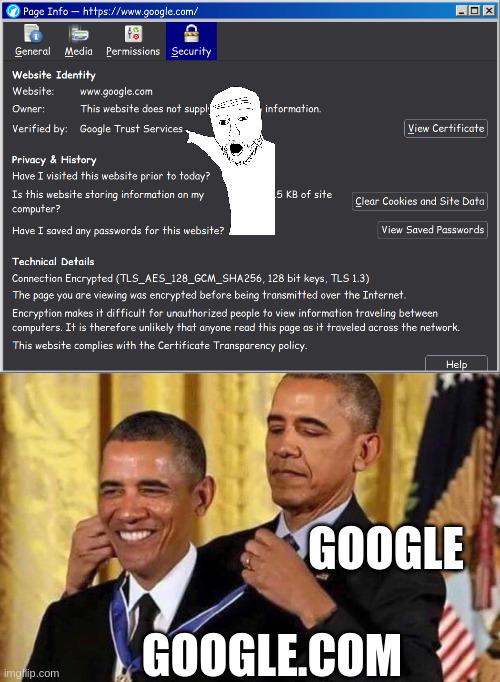
So Google.com's SSL certificate is verified by... Google Trust Services. It's like showing up to court as both the defendant AND the judge. "Your Honor, I find myself completely innocent!" The browser's security tab is proudly displaying all this fancy PKI infrastructure—TLS 1.3, AES-128-GCM encryption, SHA256 hashing—while conveniently glossing over the fact that we're just taking Google's word that Google is trustworthy. The whole certificate authority system basically runs on "trust me bro" energy, but with more cryptographic signatures. Fun fact: Your browser ships with a pre-installed list of root CAs it trusts, and guess who gets to be on that list? The same mega-corporations whose sites you're visiting. It's a perfectly circular system of trust that somehow became the backbone of internet security. Works great until you remember that the entire web's security model is built on trusting a few dozen organizations not to mess up or go rogue.