

Api design Memes

Posts tagged with Api design
Denied Access Is Funnier With 418 Instead Of 403

Denied Access Is Funnier With 418 Instead Of 403
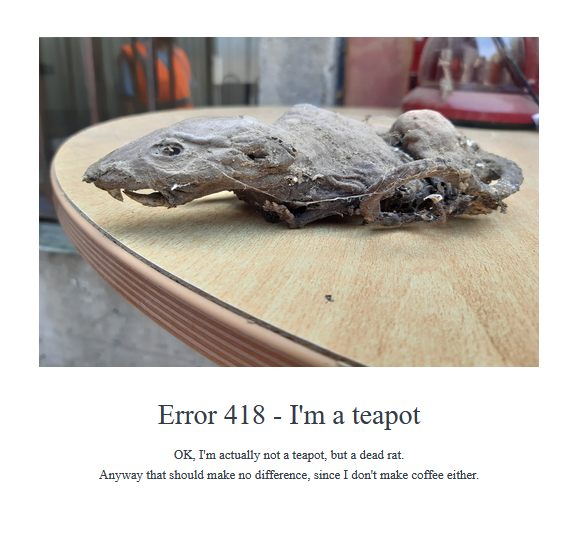
So someone decided to return HTTP 418 "I'm a teapot" for access denial, and honestly? Chef's kiss. Instead of the boring old 403 Forbidden, you get a dead rat explaining it's actually not a teapot, just deceased, and therefore can't brew coffee anyway. For context: HTTP 418 was created as an April Fools' joke in 1998 as part of the "Hyper Text Coffee Pot Control Protocol." It's meant to be returned by teapots when you try to brew coffee with them. Some devs actually implement it in production APIs as a playful easter egg or, apparently, as the world's most passive-aggressive access denial message. The rat's logic is flawless though: "I don't make coffee either" is technically a valid reason to return 418. Who needs proper HTTP semantics when you can confuse attackers and make your logs infinitely more entertaining? Security through absurdity is underrated.

Why Do Anything When LLM Can Do It

Why Do Anything When LLM Can Do It
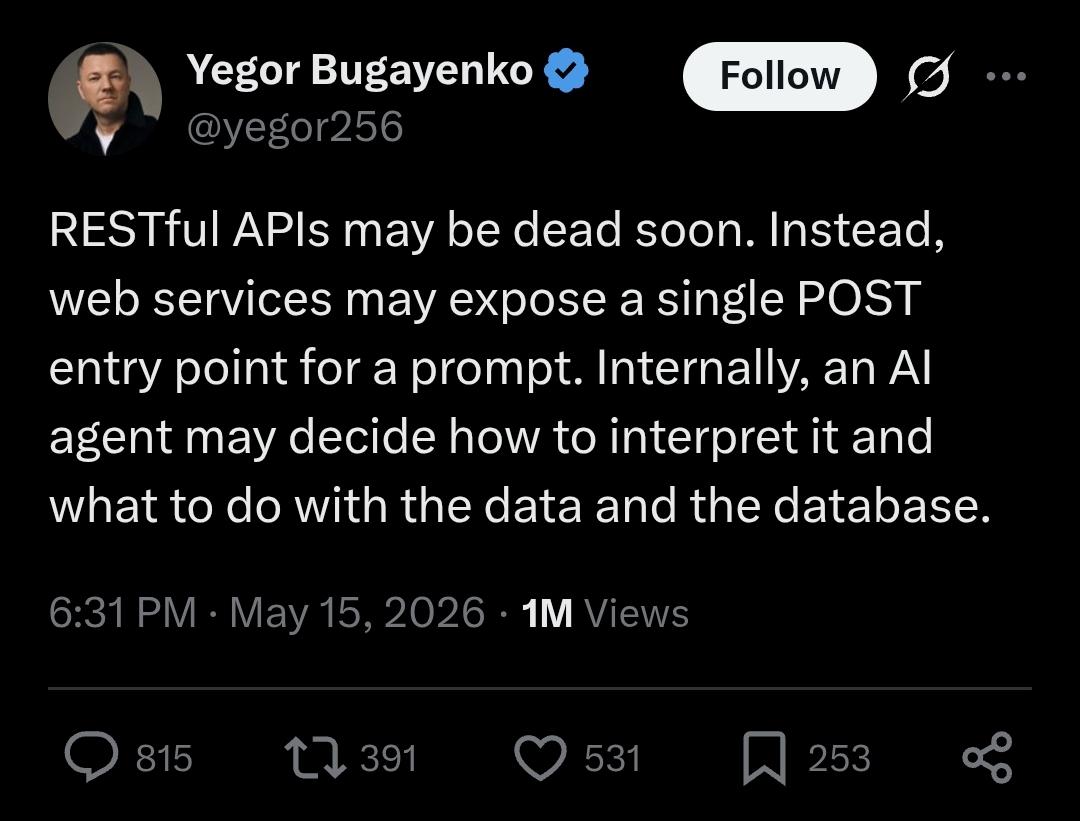
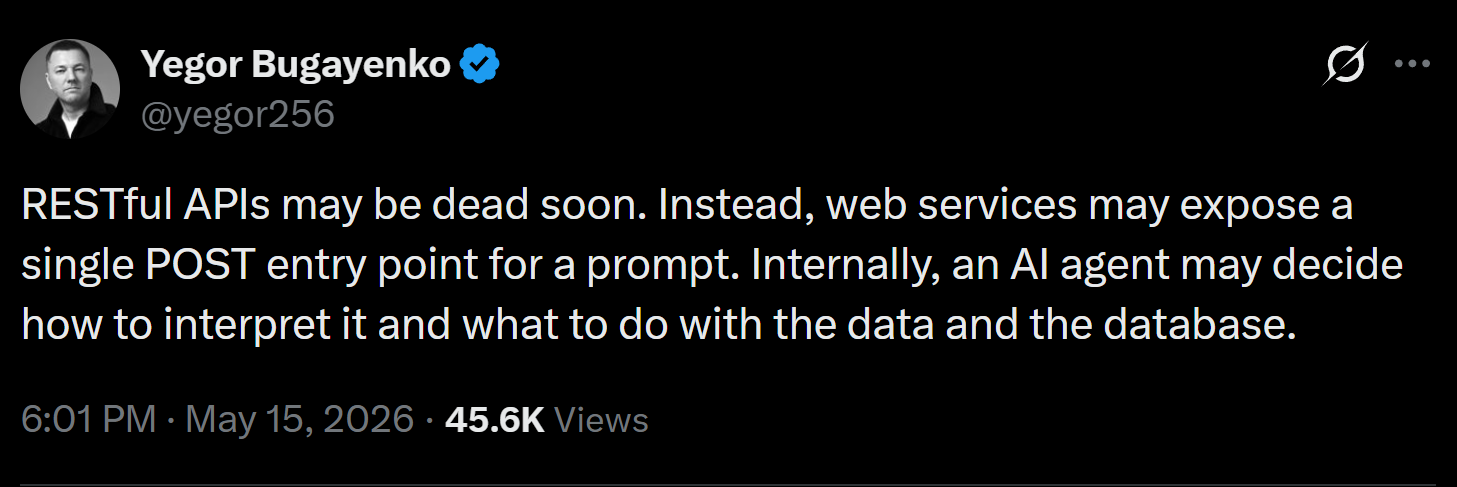
So we're just gonna let the AI decide what to do with our databases now? Cool, cool, cool. No need for structured endpoints, versioning, documentation, or any of that pesky software engineering discipline we've been doing for decades. Just yeet a natural language prompt at a POST endpoint and let the AI agent figure out whether you want to SELECT, UPDATE, or DROP TABLE. What could possibly go wrong? The beautiful irony here is that we spent years perfecting REST conventions—proper HTTP verbs, resource-based URLs, predictable status codes—only to throw it all away for "here's some words, good luck." It's like replacing a precisely calibrated API contract with a game of telephone where the other person is a statistical model that occasionally hallucinates. Can't wait for the incident postmortem: "The AI interpreted 'delete old records' as 'delete ALL records' because the prompt was ambiguous and we had zero type safety." But hey, at least we won't need API documentation anymore—just vibes and hope.

Re Inventing Graph Ql

Re Inventing Graph Ql
So we're just gonna let AI agents interpret our prompts and figure out what database queries to run? What could possibly go wrong? It's like GraphQL but with extra steps and existential dread. Instead of carefully crafted schemas and resolvers, we're literally handing the keys to the database to an LLM and saying "you figure it out, buddy." REST is dying so we can replace it with vibes-based API architecture where you just... ask nicely for data and hope the AI doesn't decide to DROP TABLE on a whim. The future is beautiful and terrifying.

It Is Completely Fine If You Can't Deal With The Difficulty, It Is Simply Not The Game For You

It Is Completely Fine If You Can't Deal With The Difficulty, It Is Simply Not The Game For You
You know those devs who refuse to add error handling, logging, or any kind of user-friendly features because "real developers should just read the source code"? Yeah, this is their energy. They'll build the most cryptic API imaginable with zero documentation and then act like you're the problem for asking where the getting-started guide is. Meanwhile, their README is just "Installation: Install it. Usage: Use it." Cool, cool. Very helpful. The gatekeeping is strong with this one—like those people who think adding helpful error messages is "hand-holding" and that struggling through obscure stack traces builds character. Spoiler: it doesn't. It just builds resentment and a desire to use literally any other library.

Old Stuff Disguised As New

Old Stuff Disguised As New
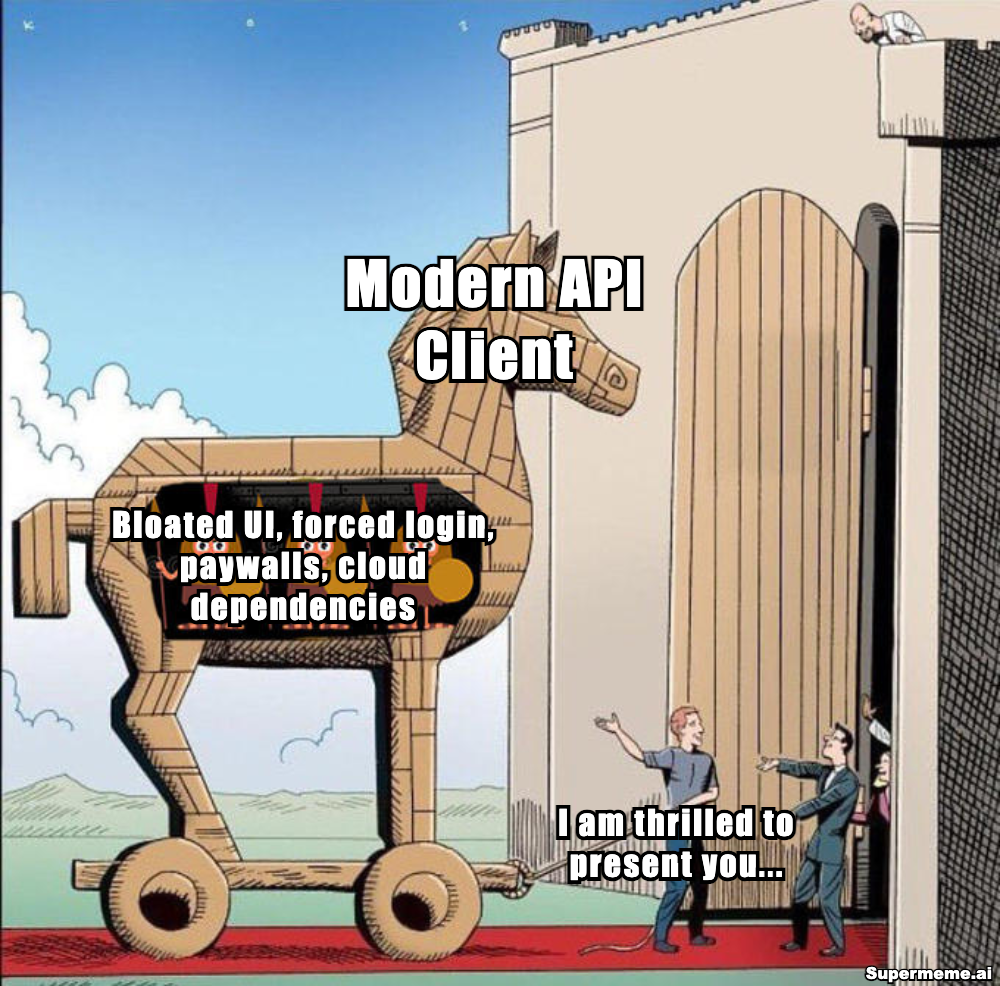
The tech industry's favorite party trick: repackaging the same old complexity with a fresh coat of "modern" paint. Your shiny new API client comes wrapped in buzzwords and promises, but crack it open and surprise—it's still got the same bloated UI, authentication nightmares, paywalls, and enough cloud dependencies to make your infrastructure cry. It's like receiving a Trojan horse but instead of soldiers, it's filled with vendor lock-in and subscription fees. The devs are thrilled to present this "revolutionary" solution, completely oblivious to the fact that they're just wheeling in legacy problems with extra steps. Nothing says "innovation" quite like mandatory OAuth flows and a dashboard that requires three different logins to access basic metrics.

Amazon Basics Mesh Desk Organizer with Pen Holder, Pullout Drawer and Office Caddy Storage, 9.25" x 4.53" x 3.94", Black

Amazon Basics Mesh Desk Organizer with Pen Holder, Pullout Drawer and Office Caddy Storage, 9.25" x 4.53" x 3.94", Black
Desktop organizer with pen holder, pullout drawer, and other compartments · Ideal for use in offices, workspaces, businesses, and homes · Durable commercial-grade steel construction · Stylish mesh su…

From A Multinational Bank Too

From A Multinational Bank Too
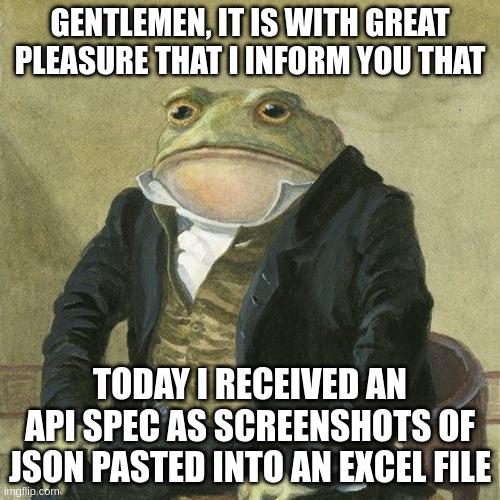
Nothing screams "enterprise-grade documentation" quite like receiving JSON screenshots pasted into Excel cells. Because why use OpenAPI/Swagger specs, Postman collections, or literally any structured format when you can squint at pixelated text in a spreadsheet? The fact that this is coming from a multinational bank with presumably billions in revenue makes it even more chef's kiss. Someone probably spent hours meticulously screenshotting each endpoint, carefully pasting them into Excel, and thought "yes, this is the professional way." Meanwhile, the developer receiving this masterpiece gets to manually type out every field, guess the data types, and pray they didn't miss anything because zooming into cell B47 isn't helping. The frog's dignified expression perfectly captures the internal screaming while maintaining that corporate professionalism.

Just A Simple Boolean Question

Just A Simple Boolean Question
You ask for a simple true or false , and suddenly you're parsing "Yes", "yeah", "Y", "true", "1", "ok", or my personal favorite: "success". The contract was clear—return a boolean. Instead, you get back a string that requires a whole new layer of validation logic. Now you're sitting there writing if (response.toLowerCase() === "true" || response === "1") like some kind of type-system archaeologist. Strong typing exists for a reason, people! The smugness on that kid's face? That's the exact energy of someone who just returned "False" with a capital F from an API endpoint.

Client Side Validation

Client Side Validation
So you're checking if an email is already taken by sending it to the server, getting back a list of all registered emails , and then doing a client-side .includes() check? That's like asking the bank to give you everyone's account numbers just to verify yours doesn't exist yet. Not only is this a massive security vulnerability (congrats, you just leaked your entire user database to anyone with DevTools open), but it's also hilariously inefficient. Why return an array of potentially millions of emails when the server could just return a boolean? The backend dev is probably crying somewhere. The cherry on top? After doing all this client-side "validation," you're still showing success messages without any actual server confirmation. Chef's kiss of terrible architecture. 🤌

My API Is Overengineered

My API Is Overengineered
Behold, the pinnacle of security theater! First, let's expose our database directly through an API endpoint because REST is "too complex." Then, let's sprinkle in some AI validation using GPT to check if SQL queries are safe—because regular expressions and parameterized queries are just so last decade . Nothing says "I'm a 10x developer" quite like importing five different packages, exposing your database credentials in plaintext, and asking an AI if DROP TABLE users; seems fishy. The cherry on top? That 403 error when the AI says no—as if hackers will politely accept rejection and go home. SQL injection protection via AI prompt? Congratulations, you've invented a security vulnerability with a carbon footprint!

Rest My Ass: When 200 OK Is Anything But OK

Rest My Ass: When 200 OK Is Anything But OK
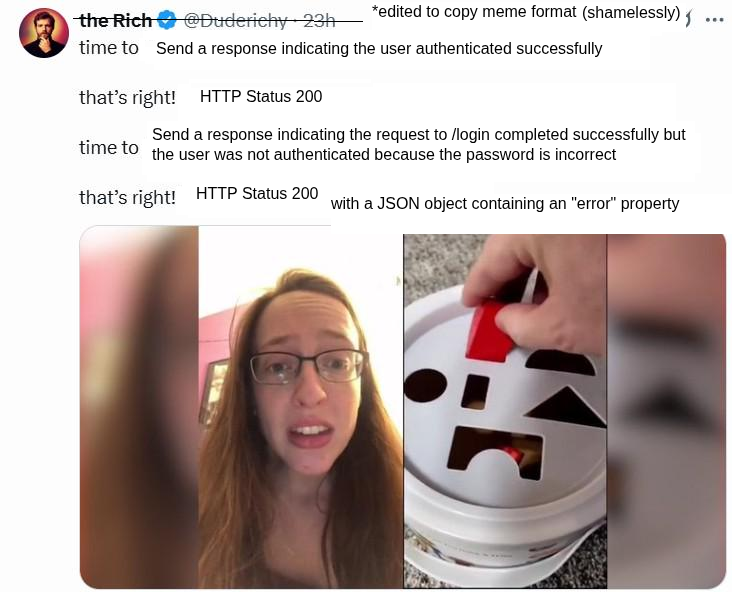
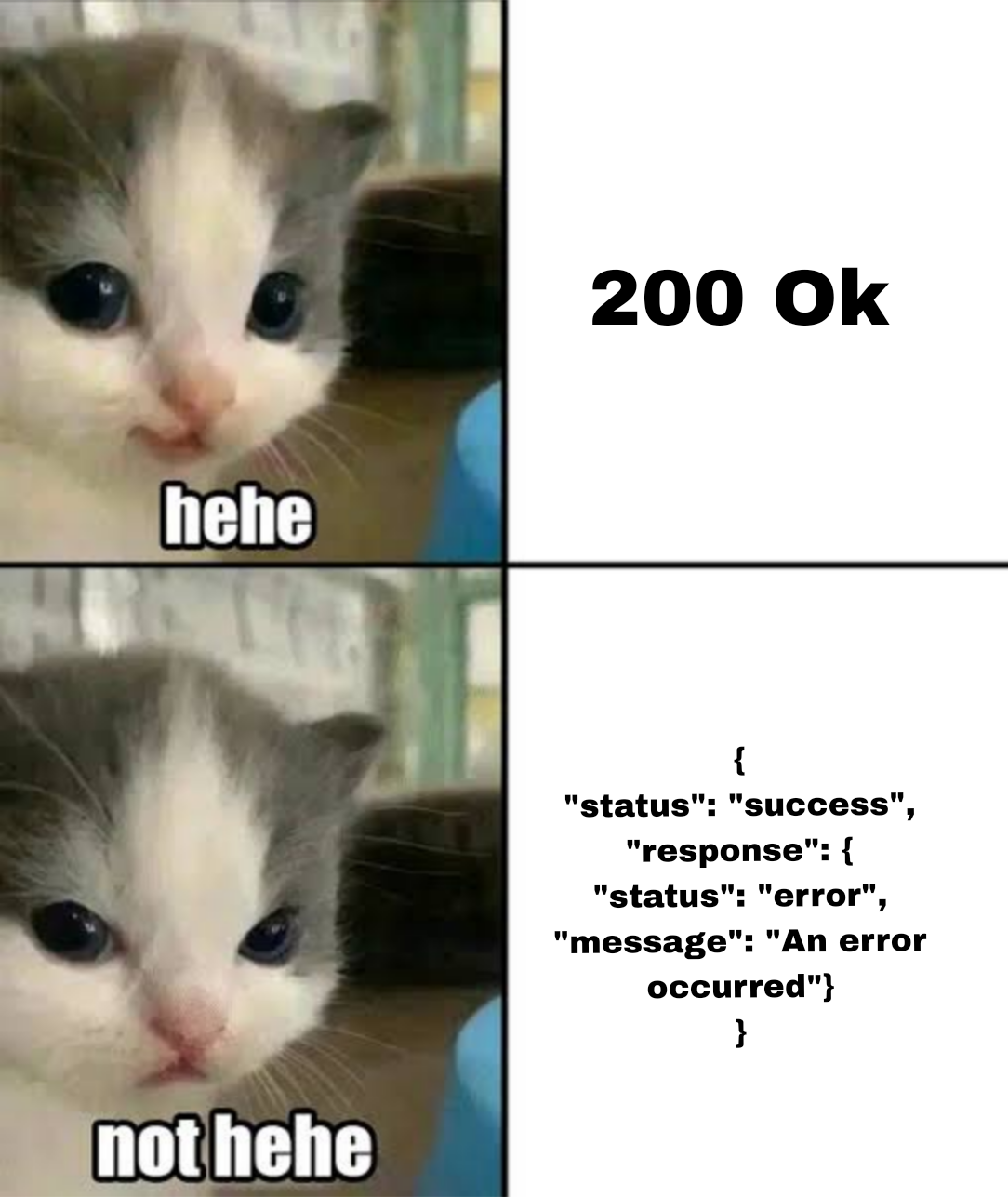
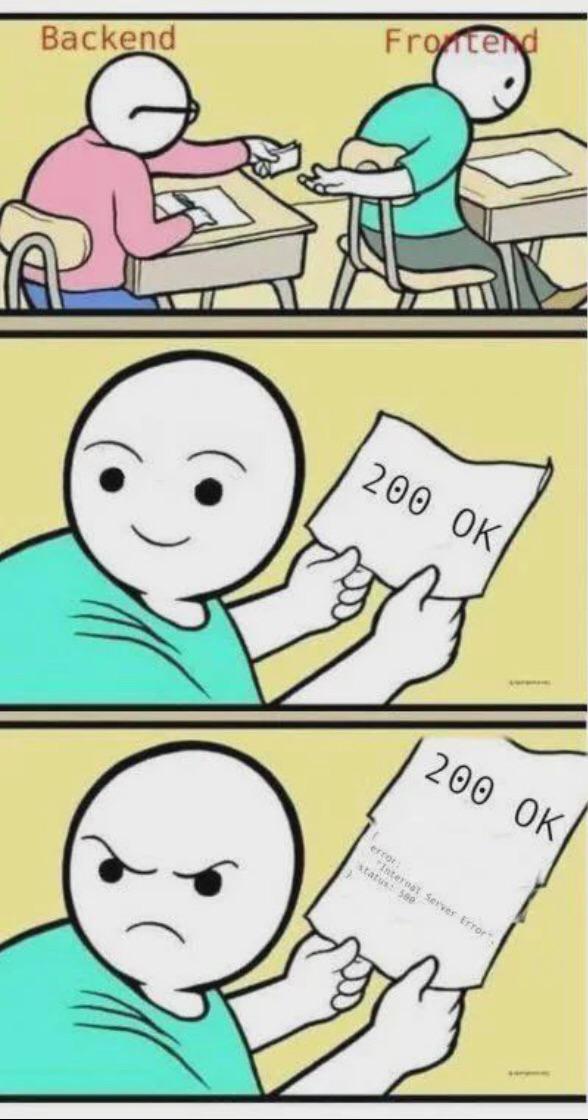
The ultimate API gaslighting experience! Your request gets a perfect HTTP 200 OK status code, signaling all is well in the universe. Then the response body hits you with {"error": true} . It's like your server saying "Yes, I received your request perfectly! Also, everything is on fire." The digital equivalent of someone nodding enthusiastically while whispering "absolutely not." REST APIs that can't even be honest about their emotional state deserve their own special circle in developer hell.

The Future Is Now, Old Env

The Future Is Now, Old Env
Looking at that pill bottle labeled "Not caring about backward compatibility" while staring intensely at it? Guilty as charged. Nothing says "living on the edge" quite like pushing that shiny new update that breaks every legacy system in existence. Who needs stable APIs when you can have excitement ? Sure, the users with older systems might riot, but they should've upgraded five versions ago anyway. Their technical debt is not my emotional burden. That sweet, sweet feeling when you delete 200 lines of compatibility code and replace it with 10 lines of elegant modern syntax. Worth every angry support ticket.

The Four Stages Of API Hell

The Four Stages Of API Hell
The FOUR STAGES OF API HELL, darling! 💀 First, you're ECSTATIC because you got a 200 response! You're practically throwing a parade for yourself! 🎉 Then the BETRAYAL hits - call actually failed but they had the AUDACITY to send a 200 with an exception stack trace buried in the response! The DRAMA! 😱 Next, you're playing detective with ZERO documentation, squinting at your screen like you're trying to decode ancient hieroglyphics! Sherlock Holmes could NEVER! 🔍 And finally, the ultimate insult - having to include the framework in your request body AS A HEADER?! What kind of sadistic monster designed this API? I can't even! This is why developers drink! 🍸

Synology 2-Bay DiskStation DS223j (Diskless)

Synology 2-Bay DiskStation DS223j (Diskless)
Secure private cloud - Enjoy 100% data ownership and multi-platform access from anywhere · Easy sharing and syncing - Safely access and share files and media from anywhere, and keep clients, colleagu…