

Vulkan Memes

Posts tagged with Vulkan
How To Make A Game

How To Make A Game
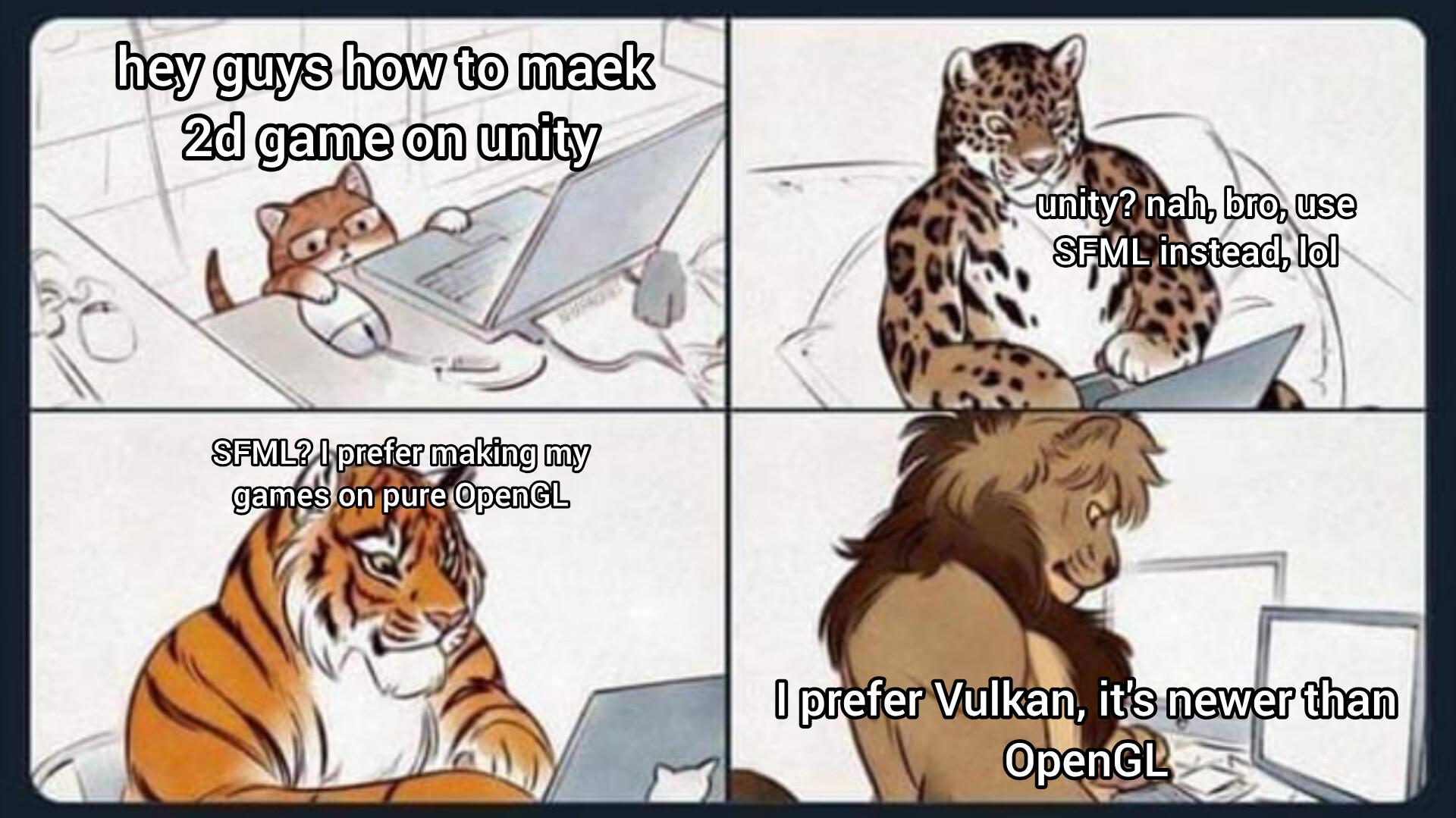
Game dev gatekeeping at its finest. Someone innocently asks how to make a 2D game in Unity, and suddenly everyone's a graphics API purist. Unity? Too mainstream. SFML? Child's play. OpenGL? Still too easy. Vulkan? Now we're talking—because nothing says "I want to make a simple 2D game" like manually managing GPU memory and writing 1000 lines of boilerplate just to render a triangle. The progression here perfectly captures the game dev community's obsession with doing things the hard way. Each animal represents a different level of masochism, with the final one basically suggesting you should write your own graphics driver while you're at it. Fun fact: by the time you finish setting up Vulkan for your 2D platformer, Unity devs have already shipped three games and retired.

The Vulkan Pipeline

The Vulkan Pipeline
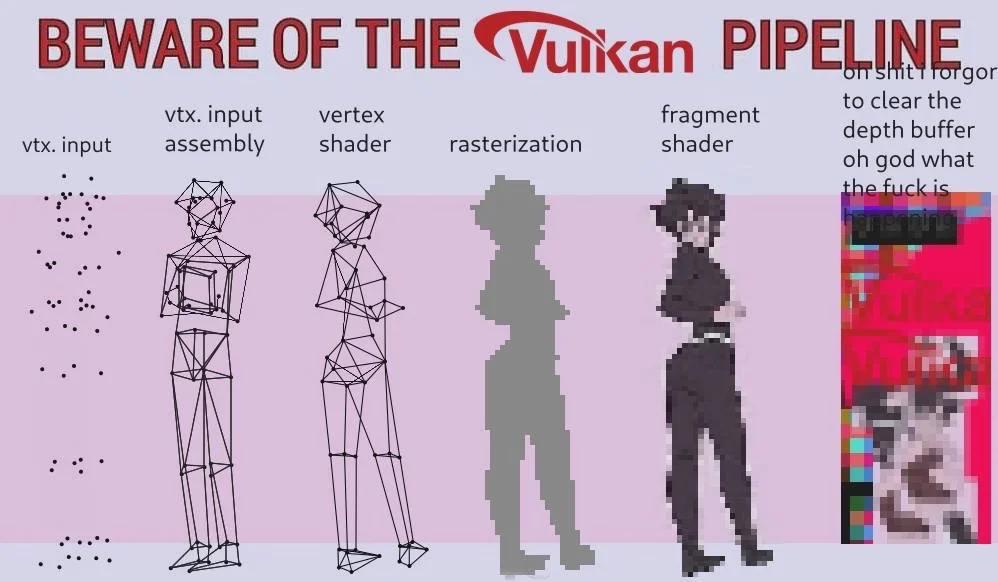
You start with some innocent vertex data, assemble it into something recognizable, shade it nicely, rasterize it into pixels, add your fragment shader... and then suddenly you're staring at a glitched-out nightmare that looks like someone dumped a bucket of corrupted VRAM onto your screen. Because you forgot to clear the depth buffer. Again. Vulkan's graphics pipeline is basically a "draw the rest of the owl" tutorial where every single step requires 500 lines of boilerplate and one tiny mistake anywhere in the chain turns your beautiful 3D model into abstract art that would make Picasso weep. The progression from wireframe to final render perfectly captures how things go from "I understand this" to "what eldritch horror have I summoned" real quick. Fun fact: Vulkan gives you so much control that you can shoot yourself in the foot in approximately 47 different ways before you even draw a triangle. OpenGL devs think they have it rough until they try to set up a Vulkan render pass.

Meme Made With Pure Hate After Hours Of Debugging

Meme Made With Pure Hate After Hours Of Debugging
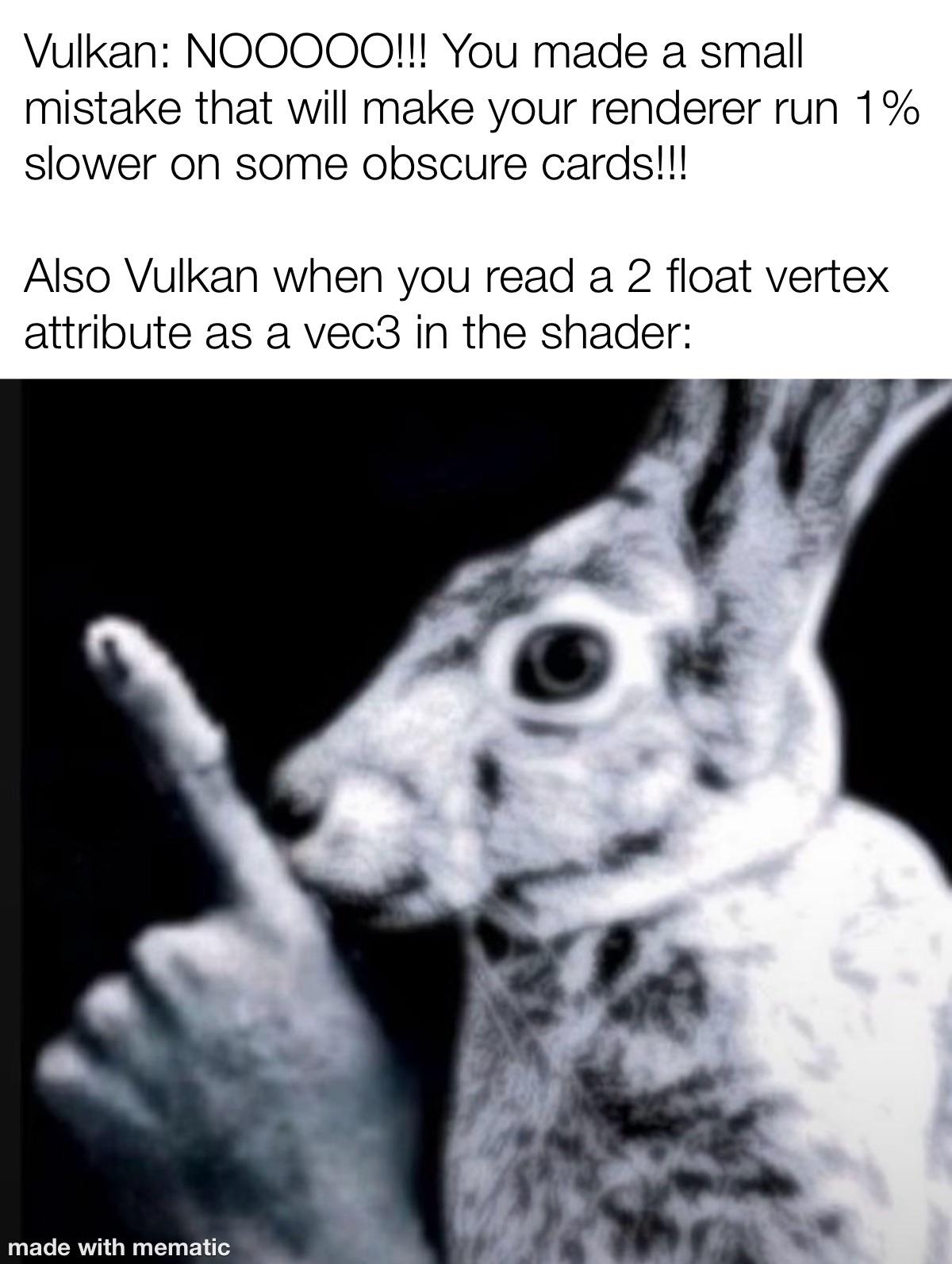
Graphics programmers know true suffering, and Vulkan is their personal tormentor. You spend hours hunting down why your render performance dropped by 1%, only to discover you accidentally declared a vertex attribute as vec2 (2 floats) when the shader was expecting vec3 (3 floats). The GPU just shrugs and does... something. Probably nothing good. For context: Vulkan is a low-level graphics API that gives you incredible control over the GPU, which also means it gives you incredible ways to shoot yourself in the foot. Unlike friendlier APIs that might warn you about type mismatches, Vulkan is like "sure buddy, read garbage memory, see if I care." The shader expects 3 coordinates but gets 2? Congratulations, your third value is now whatever random data happened to be in memory. Undefined behavior is the best behavior, right? The "pure hate" in the title is palpable. You can feel the developer's soul leaving their body as they realize their multi-hour debugging session was caused by a single missing float component. Graphics programming: where a tiny typo costs you your sanity and 1% performance on some random GPU from 2015.

Is This True??

Is This True??
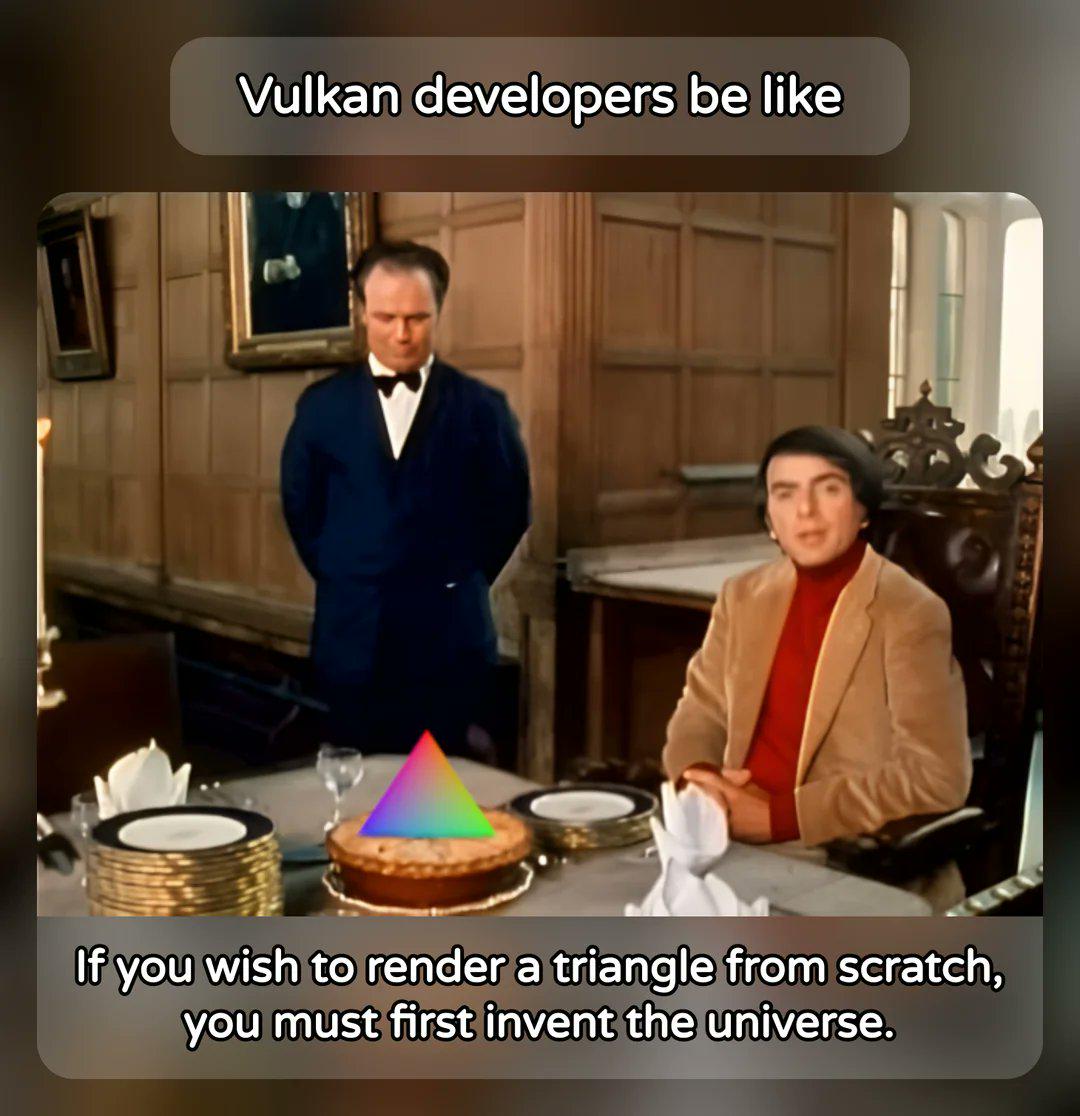
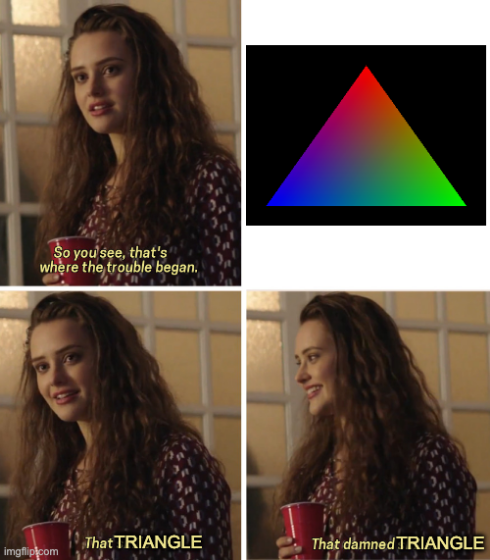
Vulkan developers looking at a rainbow triangle like it's a Michelin-star meal because they just spent 2000 lines of boilerplate setting up swap chains, render passes, and pipeline state objects. For context, Vulkan is a low-level graphics API that gives you complete control over the GPU, which means you're responsible for literally everything—memory management, synchronization, validation layers, the works. While other APIs let you draw a triangle in 50 lines, Vulkan makes you earn it by manually configuring things most people didn't know existed. The Carl Sagan quote is perfect here: rendering anything in Vulkan from scratch genuinely feels like you need to bootstrap reality itself first.

Platform Exclusivity

Platform Exclusivity
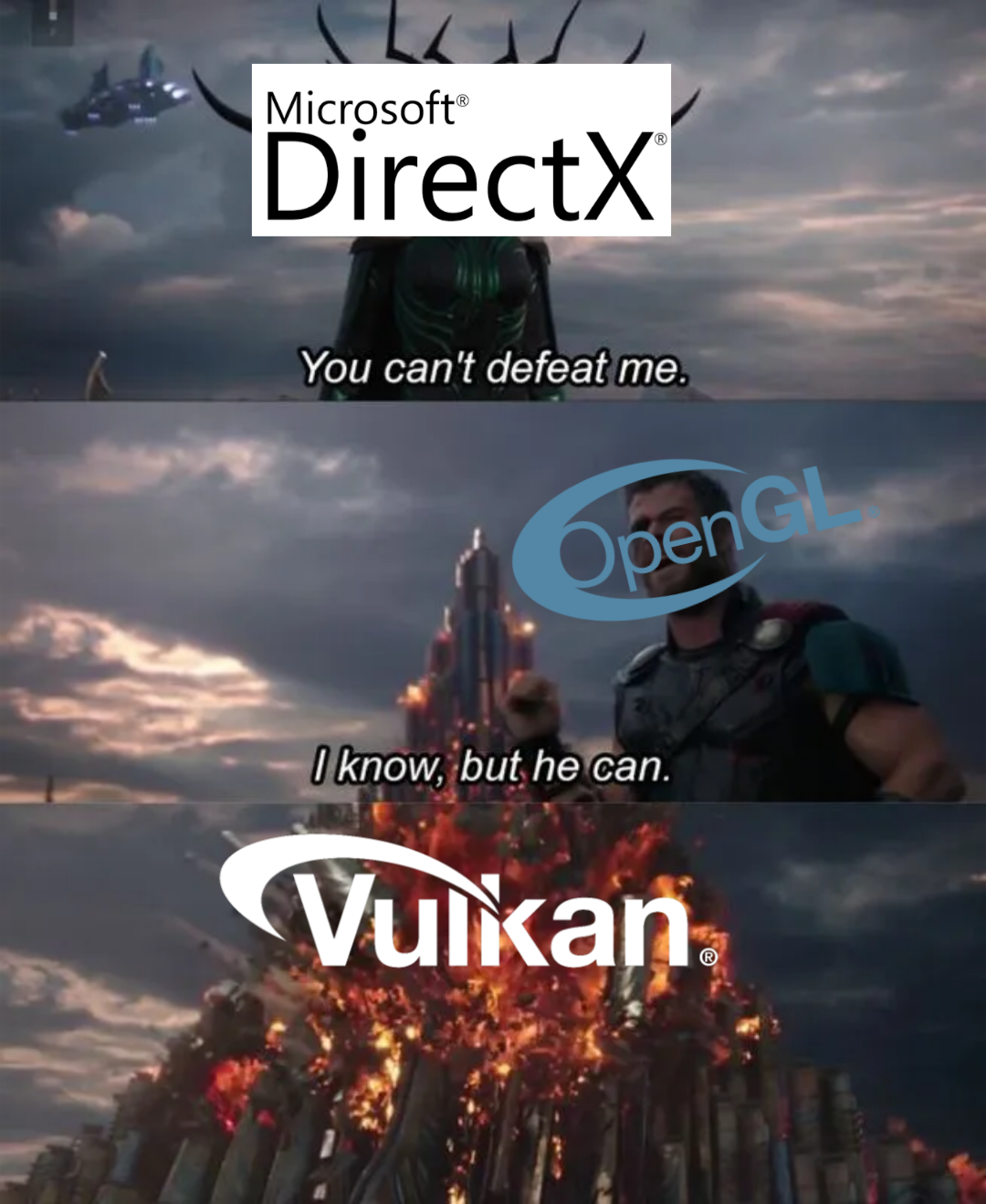
DirectX strutting around like it owns the gaming world because it's Microsoft's proprietary darling. OpenGL is sitting there knowing full well it can't quite match DirectX's performance and Windows integration. But then Vulkan rolls in like "hold my beer" and absolutely obliterates the competition with cross-platform dominance and near-metal performance. Vulkan is basically what happens when the industry got tired of DirectX's Windows-only shenanigans and decided to create something that actually works everywhere—Linux, Windows, Android, you name it. Lower overhead, better multi-threading, and it doesn't care what OS you're running. DirectX may have the throne on Windows, but Vulkan is the people's champion.

Beware Of The Vulkan Pipeline

Beware Of The Vulkan Pipeline
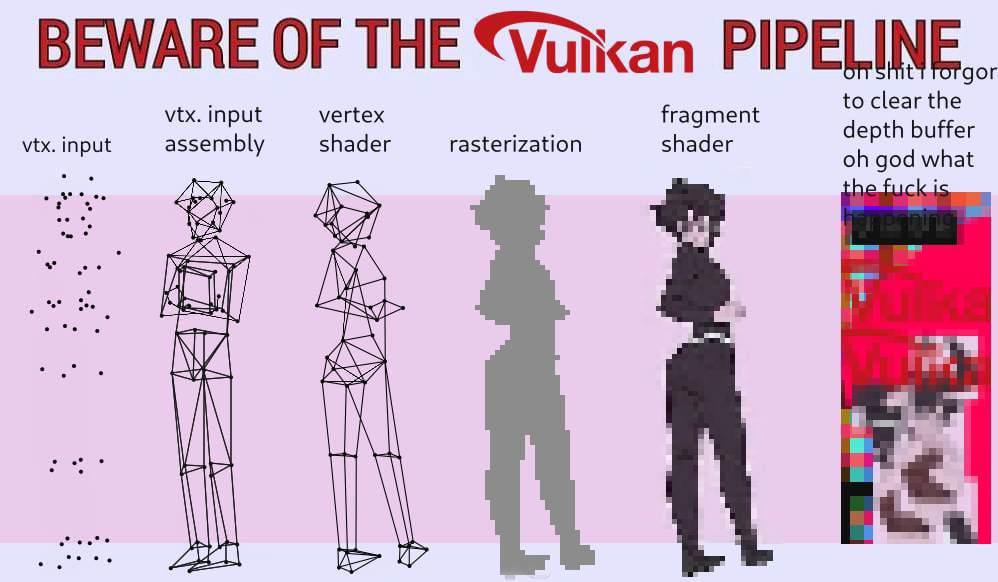
You start with innocent vertex inputs—just some dots, really. Then you build your vertex shader and assembly, feeling pretty good about those wireframe models. The vertex shader transforms things nicely. Rasterization converts it to pixels. Fragment shader adds some color and texture. And then... you realize you forgot to clear the depth buffer and your entire scene becomes a glitchy nightmare of corrupted pixels and existential dread. The Vulkan graphics pipeline is like a Rube Goldberg machine where one forgotten flag can turn your beautiful 3D model into abstract art that would make Picasso weep. Each stage is another opportunity to mess something up in ways that won't be obvious until you've already spent 6 hours debugging why everything is magenta. Fun fact: Vulkan gives you so much control that you can literally forget to tell the GPU to clear the screen between frames. That's like forgetting to erase a whiteboard before drawing—you just keep layering chaos on top of chaos until reality itself breaks down.

NordVPN

NordVPN
Encrypt your traffic on public Wi-Fi, stream from anywhere, and cover up to ten devices with one plan. 30-day money-back guarantee.

How It Feels To Learn Vulkan

How It Feels To Learn Vulkan
You thought you'd learn some graphics programming, maybe render a cute little triangle. But with Vulkan? That innocent triangle requires you to write approximately 1,000 lines of boilerplate just to see three vertices on screen. You'll need to manually configure the swap chain, set up render passes, create pipeline layouts, manage memory allocations, synchronize command buffers, and sacrifice your firstborn to the validation layers. Other graphics APIs let you draw a triangle in 50 lines. Vulkan makes you earn every single pixel like you're negotiating with the GPU directly. The triangle isn't just a shape—it's a rite of passage that separates the casuals from those who truly understand what "low-level graphics API" means. By the time you finally see that rainbow gradient, you've aged 10 years and gained a PhD in GPU architecture.

Following Vulkan Tutorial

Following Vulkan Tutorial
The classic GitHub commit message that says it all. When diving into Vulkan (that notoriously complex graphics API that makes OpenGL look like a children's toy), this dev's only documentation is a README file warning potential recruiters about the horror show inside. It's the programming equivalent of those "Abandon All Hope" signs at the entrance to Hell. The best part? They committed it just 3 minutes ago - probably right after realizing their code is an unholy abomination that would make even seasoned graphics programmers weep.

I Fear No API... Except Vulkan

I Fear No API... Except Vulkan
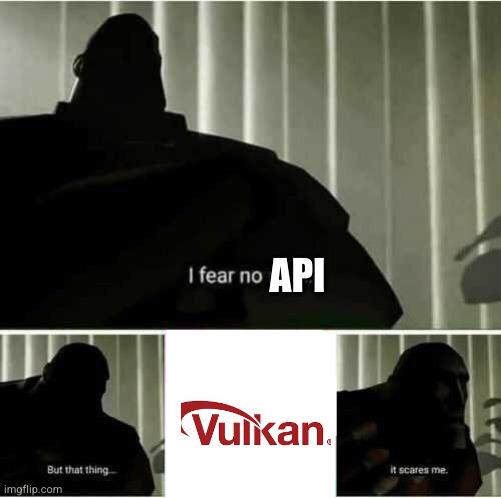
The bravado of developers who claim they "fear no API" only to cower in terror at the sight of Vulkan is just *chef's kiss*. For the uninitiated, Vulkan is the low-level graphics API that makes even seasoned graphics programmers wake up in cold sweats. It's like saying "I'm great at assembling IKEA furniture" and then being handed the blueprints to build the actual IKEA store from scratch. The documentation alone is thicker than a computer science textbook, and the error messages might as well be written in ancient Sumerian. Meanwhile, OpenGL (referenced in the title) is like the friendly neighborhood graphics API that suddenly looks like a cuddly kitten in comparison.