

Undefined behavior Memes

Posts tagged with Undefined behavior
Best Value I've Seen

Best Value I've Seen
When your grocery store's pricing system runs into JavaScript's favorite number: NaN (Not a Number). Someone tried to calculate a discount percentage and the system just went "nope, can't compute this" and slapped it on the sign anyway. The discount shows "-NaN%" which is technically accurate—you're getting negative Not-a-Number percent off, which is somehow still 45p for a kiwi. The real comedy gold here is that NaN appears TWICE—once in the discount bubble and once crossed out next to it. It's like the system tried to fix its own mistake, failed, then just gave up and printed both. Classic error handling: when in doubt, display everything and let the customer figure it out. Fun fact: In JavaScript, NaN is the only value that's not equal to itself. So NaN === NaN returns false, which means this discount is literally incomparable to itself. Schrödinger's sale price, if you will.

Memory Safety

Memory Safety
The devil's offering you a responsible, well-behaved child who checks pointer validity and handles memory safely. Meanwhile, Jesus over here is like "nah, I'll take the one that returns a pointer to a string literal with potentially null behavior." Because nothing says "walking on water" quite like living dangerously with undefined behavior and segfaults. Why write defensive code when you can just raw-dog your memory management and pray the compiler doesn't smite you? Some people choose safety. Others choose violence.

What Do You Mean It's Unsafe

What Do You Mean It's Unsafe
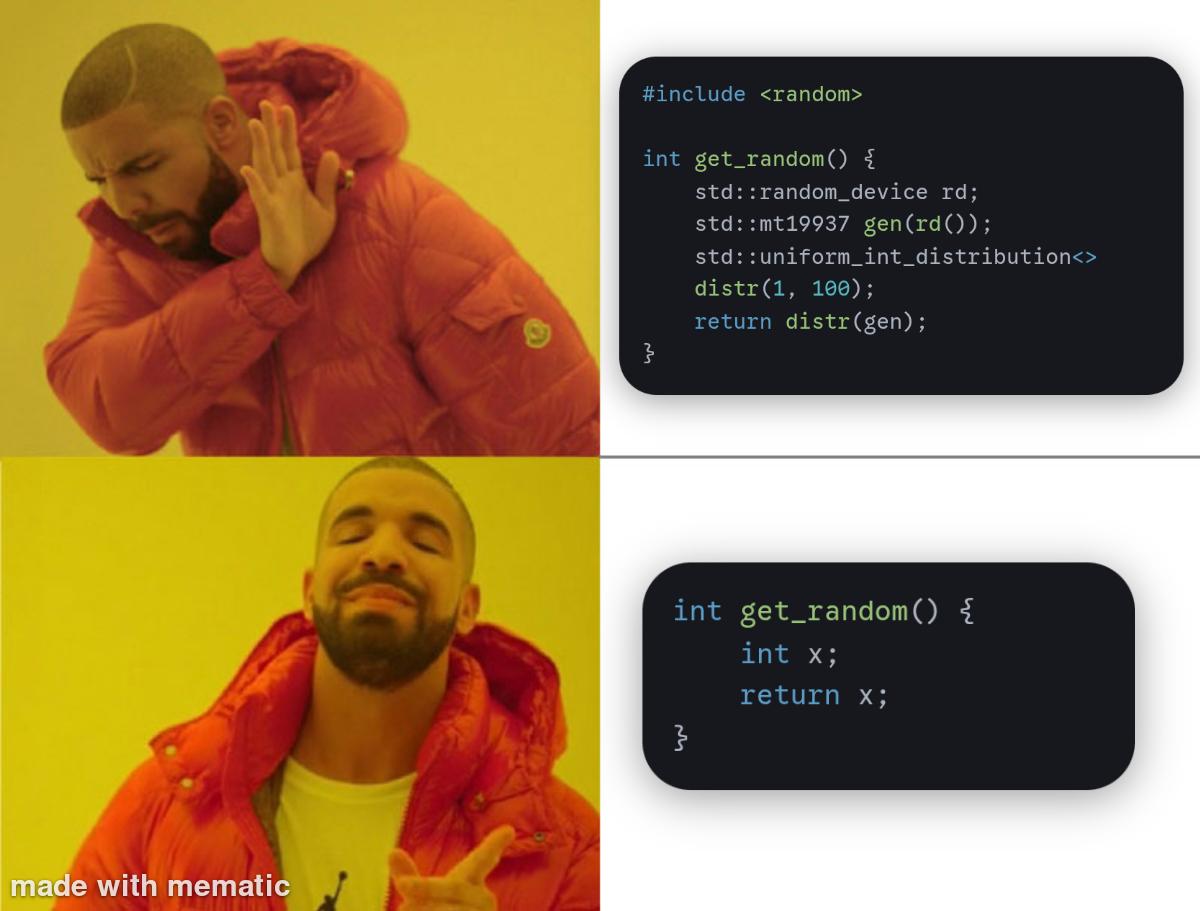
Oh honey, someone just discovered the ancient art of returning uninitialized variables and thought they invented a NEW random number generator! The top panel shows someone actually doing their due diligence with proper C++ random generation—random_device, mt19937, uniform distribution, the whole nine yards. It's like following a recipe with actual measurements. But then the bottom panel? *Chef's kiss* of chaos! Just declare an int, don't initialize it, and return whatever garbage value happens to be sitting in that memory location. It's not a bug, it's a FEATURE called "undefined behavior"—the spiciest kind of randomness where your program might return 42, might return 2847362, or might summon a demon from the void. Truly random! Truly terrifying! Truly the kind of code that makes senior devs weep into their keyboards. Fun fact: This is exactly why Rust developers never shut up about memory safety. They've seen things. Horrible, uninitialized things.

What Do I Need The Include Lines For

What Do I Need The Include Lines For
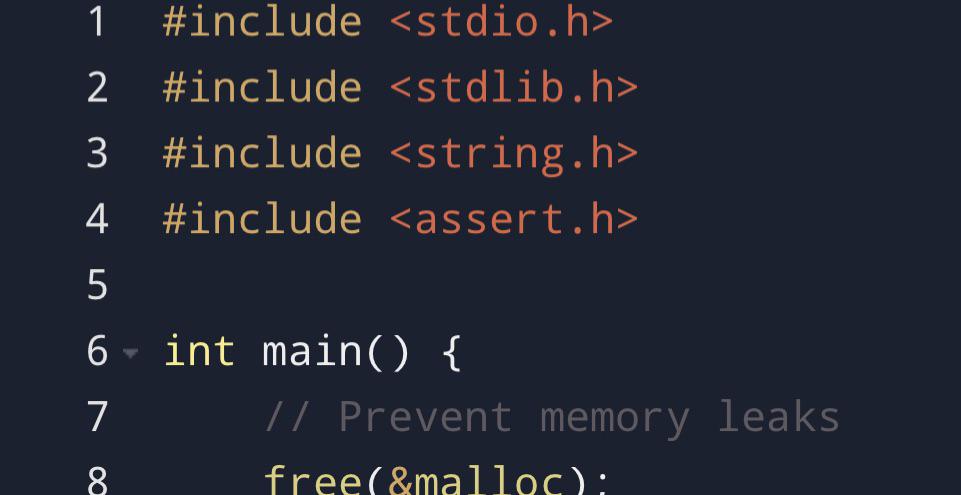
Someone just discovered the secret to writing memory-safe C code: free your memory before you allocate it. Galaxy brain move right there. The cherry on top? They included assert.h like they're about to write production-quality code with proper error handling, but then immediately went full chaos mode with free(&malloc()) . That's like putting on a seatbelt before driving off a cliff. Pro tip: Those include statements are actually the only correct part of this code. Everything after line 5 is a war crime against computing.

C's Sadness

C's Sadness
You know that special feeling when you're walking through your C codebase and suddenly realize you've been trampling all over memory you shouldn't have touched? Yeah, that's the one. Stepping in undefined behavior is like stepping in dog crap – you don't always notice it immediately, but once you do, the smell follows you everywhere. The worst part? You can't just wipe it off. Now you're debugging CSIDESCISSING HARD DATA CLAIMS, which is basically C's way of saying "congratulations, you've corrupted memory so badly that even your error messages are having a stroke." Segfaults, corrupted stacks, random crashes three functions away from where you actually screwed up – welcome to manual memory management, where the compiler trusts you completely and you absolutely should not be trusted.

Someone Said To Use The Stack Because Its Faster

Someone Said To Use The Stack Because Its Faster
So someone told you stack allocation is faster than heap allocation, and you took that advice a bit too literally. The function allocates a char array on the stack and then returns a pointer to it. Problem? That stack memory gets deallocated the moment the function returns, so you're handing back a pointer to memory that's already been reclaimed. It's like giving someone directions to a house that's been demolished. The comment "delicious segfault awaits" is chef's kiss accurate. Whoever tries to dereference that returned pointer is in for undefined behavior territory—could be garbage data, could be a crash, could be nothing at all until production when it spectacularly explodes. Stack allocation is faster, but returning stack-allocated memory is basically writing a check your program can't cash. Classic case of knowing just enough to be dangerous. Should've used malloc or just passed a buffer as a parameter. But hey, at least it compiles! (with warnings you definitely ignored)

The C Compiler's Diabolical Indifference

The C Compiler's Diabolical Indifference
Oh. My. GOD. The AUDACITY of C compilers!!! 😱 While normal compilers will SCREAM at you with 47 error messages for a missing semicolon, C compiler sees you dereferencing a NULL pointer and just goes "*(int*)0 = 0; GOOD LUCK" with a smug little wink. It's like handing a toddler scissors and saying "have fun storming the castle!" Pure CHAOS ENERGY. Your program is about to crash so spectacularly that NASA will detect the explosion from space, but C compiler's just like "not my problem, sweetie! 💅" This is why C programmers wake up with cold sweats at 2am wondering if they've accidentally created a time bomb.

The Perfect Monster

The Perfect Monster
When you redefine the fundamental constants of the universe just because you can. This chaotic evil programmer has: Made true depend on a random number being greater than 10 Made false depend on a random number being less than 10 Redefined 0 as a ternary expression that will break math itself This is the programming equivalent of putting pineapple on pizza and then setting the pizza on fire. No debugger in the world can save you from this nightmare. The reaction is absolutely justified.

The 34-Minute C++ Love Affair

The 34-Minute C++ Love Affair
The fastest character development arc in programming history. Tweeted "I love C++" and 34 minutes later: "I regret this tweet. What in the name of f*ck." That's the standard lifecycle of a C++ project: initial excitement followed by existential dread when you encounter your first undefined behavior or spend 3 hours debugging a memory leak. The honeymoon phase with C++ lasts exactly until you try to use a string.

JavaScript: The Silent Treatment Champion

JavaScript: The Silent Treatment Champion
Normal programming languages have the decency to tell you when you've messed up. JavaScript just sits there with that stupid smile while you slowly descend into madness. It's like talking to a therapist who responds to your emotional breakdown with "and how does that make you feel?" Except the therapist is a programming language and your feelings are irrelevant to the cold, unfeeling void of undefined behavior.

Chaotic Evil: The Dark Art Of Buffer Overflow

Chaotic Evil: The Dark Art Of Buffer Overflow
Look at this absolute psychopath writing a function that masquerades as addition but secretly performs dark magic with buffer overflows. The evil genius is using array indexing on a static buffer with arbitrary inputs, dereferencing pointers, and then subtracting the buffer's address from the result. This isn't addition—it's a ticking time bomb disguised as math. The dramatic lighting and quill pen really sell it. Nothing says "I'm about to crash your entire system" like writing memory-corrupting C code by candlelight like some kind of deranged 18th-century villain. Somewhere a security engineer just felt a cold shiver down their spine.

Average C++ Dev

Average C++ Dev
C++ is basically that friend who says "I'll warn you this is a terrible idea" and then hands you the chainsaw anyway. Casting bits to arbitrary types? Sure! The compiler will give you a stern lecture about memory safety and undefined behavior, but ultimately shrug and say "your funeral, buddy." This is the twisted romance of C++ development—a toxic relationship where you're given enough rope to hang your entire codebase, and you thank the language for it. "That's why I love C++" indeed. Stockholm syndrome has never been so efficiently compiled.