

Programming concepts Memes

Posts tagged with Programming concepts
Passing Arguments Got Complicated

Passing Arguments Got Complicated
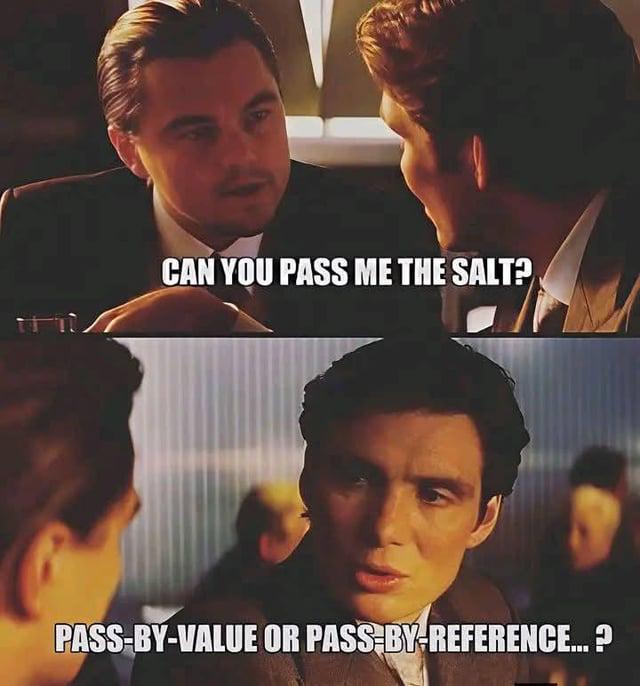
Simple request: "Can you pass me the salt?" Suddenly you're having an existential crisis about memory management and ownership semantics. Pass-by-value means you're getting a copy of the salt shaker—the original stays put. Pass-by-reference means you're getting the actual salt shaker itself, and if you throw it out the window, it's gone for everyone. The difference seems trivial until you're debugging why your object got mutated three functions deep and you want to cry into your coffee. Different languages handle this differently too. C++ makes you think about it constantly. Java pretends everything is pass-by-value but objects are actually references (thanks for the confusion, Java). Python? References everywhere, but immutable types act like values. JavaScript will just... do whatever feels right in the moment. The real fun begins when you accidentally pass a massive object by value in C++ and wonder why your program is suddenly slower than a dialup modem. Good times.

Feels Like A Milestone

Feels Like A Milestone
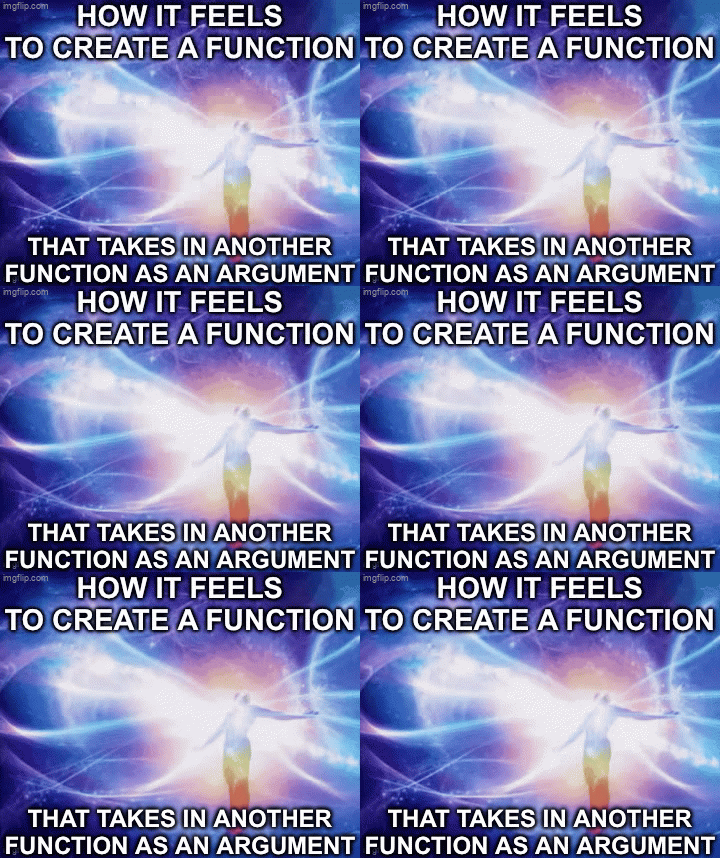
You know you've ascended to a higher plane of existence when you discover higher-order functions. That moment when you realize you can just... pass a function into another function? Pure euphoria. It's like unlocking a secret level in the game of programming. Suddenly your code goes from a bunch of repetitive nonsense to elegant, reusable magic. Array.map(), callbacks, middleware patterns—it all clicks. You feel like a functional programming wizard who just learned their first spell. The universe makes sense now. Then you spend the next three months trying to find excuses to pass functions as arguments to everything, even when it's completely unnecessary. "Should I make a function that takes a function that returns a function?" Yes. Always yes.

It's Still Inheritance Really

It's Still Inheritance Really
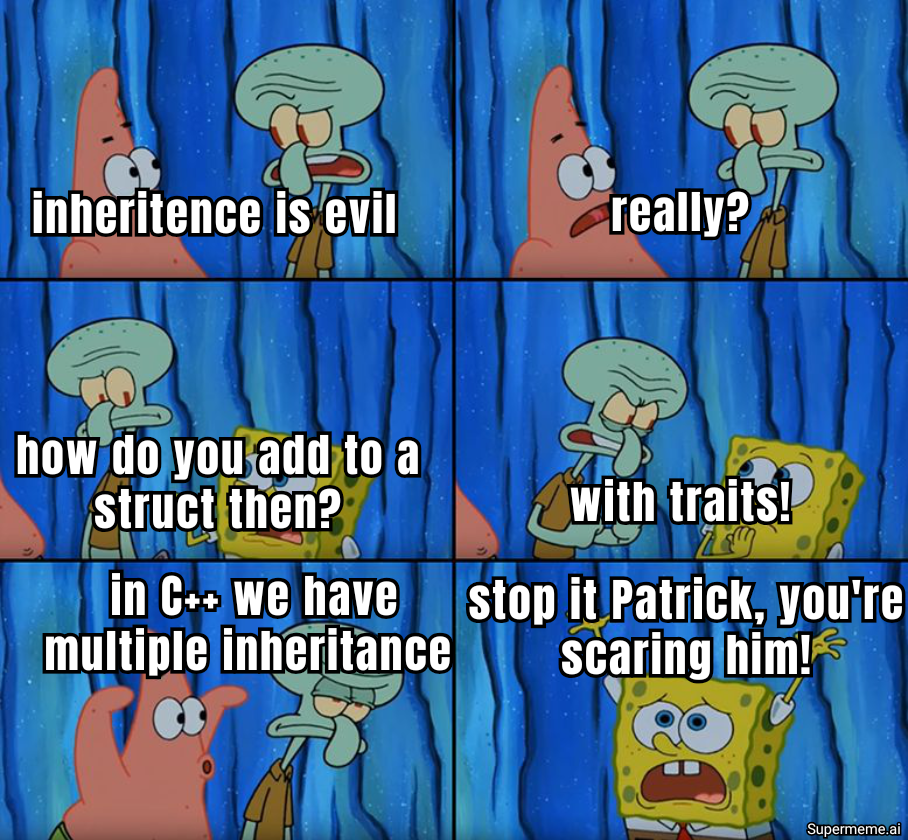
When someone says "inheritance is evil" in 2024, they're usually referring to the Gang of Four's "favor composition over inheritance" mantra. So naturally, you ask how to add behavior to a struct in languages without classes. Their answer? Traits. Which is just... inheritance with extra steps and a different name. Then they hit you with "C++ has multiple inheritance" like it's some kind of flex, and suddenly everyone's running for the exits. Multiple inheritance: the programming equivalent of opening Pandora's box and finding out it contains nothing but diamond problem nightmares and ambiguous method calls.

Turns Out It Was Pass By Reference Not By Value

Turns Out It Was Pass By Reference Not By Value
You referred someone to a job and they absolutely BOMBED a basic coding question so catastrophically that the company is now questioning YOUR entire existence. But here's the kicker—instead of just rejecting your referral, they're dragging YOU back for another interview because apparently your friend's incompetence has somehow contaminated your reputation by reference, not just by value! 😭 It's like you passed a pointer to your credibility instead of making a safe copy. Now both of you are pointing to the same memory address of failure, and when they modified your friend's reputation to "cannot solve 3 sum," YOUR reputation got mutated too. Should've used pass-by-value and kept your professional standing isolated, but noooo—you had to share that memory reference! The hiring team is basically saying "If your judgment is THIS questionable, we need to verify you didn't just get lucky the first time." Absolutely savage. Next time, clone your reputation before lending it out!

The Holy Trinity Of Confusion

The Holy Trinity Of Confusion
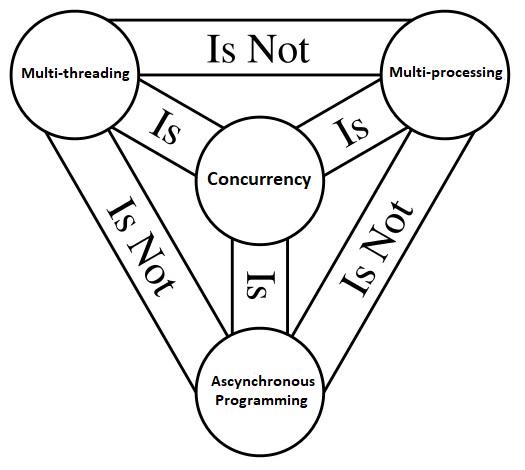
Ah, the diagram that makes even senior devs question their understanding of parallel computing. It's like trying to explain the difference between "your" and "you're" to someone who insists they're identical. This confusing web of "is" and "is not" relationships perfectly captures why technical interviews about concurrency make everyone sweat. You think you understand it until someone asks you to explain the difference, then suddenly you're drawing circles on a whiteboard while questioning your career choices. The best part? No matter how confidently you explain this to junior devs, they'll give you that blank stare that says "I'll just Google this again next week when I forget."

The Bathroom Protocol: Mutex vs Semaphore

The Bathroom Protocol: Mutex vs Semaphore
The bathroom analogy for concurrency primitives is both disturbing and perfect. When you're learning about thread synchronization, no textbook explains it this clearly. Just imagine a senior dev dropping this knowledge bomb during standup while maintaining eye contact. Now you'll never forget the difference - mutex locks the whole bathroom while semaphores let a fixed number of threads do their business simultaneously. Bet your CS professor never made it this memorable.

Programmer Glitch Rubber Duck Debugging Coding T-Shirt

Programmer Glitch Rubber Duck Debugging Coding T-Shirt
Lightweight, Classic fit, Double-needle sleeve and bottom hem

Four Pillars Of OOP: Visual Edition

Four Pillars Of OOP: Visual Edition
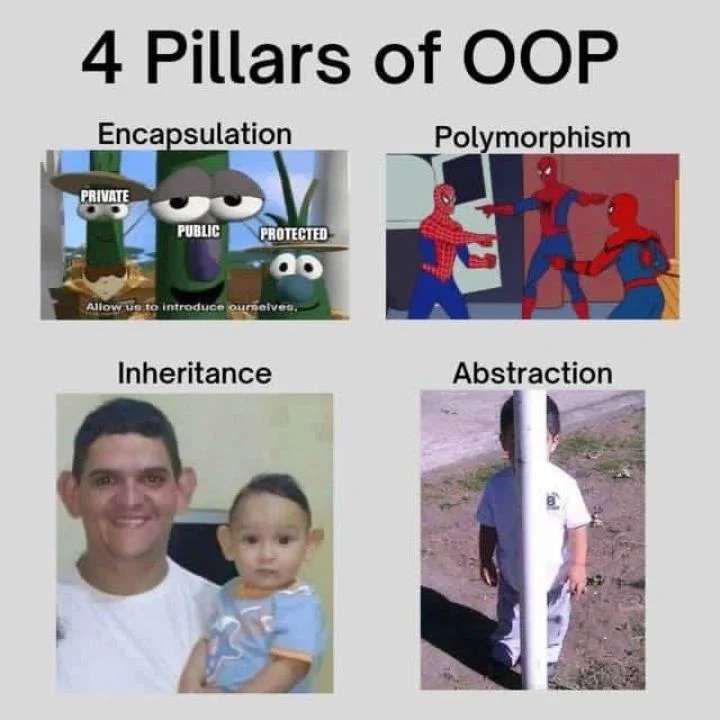
Saved $50,000 in student loans with this one weird trick. CS professors hate it. The meme explains OOP concepts better than most textbooks: Encapsulation: Veggies with privacy levels labeled. Private parts stay hidden, public interfaces say hello. Just like your code should work. Polymorphism: Spider-Men pointing at each other. Same interface, different implementations. The perfect metaphor doesn't exi— Inheritance: Father and son. Kid inherits dad's traits and probably his debugging skills too. Abstraction: Half a person behind a pole. You don't need to see the whole implementation, just the interface. Like most APIs we pretend to understand.

The Recursive Rabbit Hole

The Recursive Rabbit Hole
The recursive definition of recursion is the programming equivalent of staring into the void until the void stares back. That penguin's thousand-yard stare perfectly captures the moment your brain short-circuits trying to process that circular definition. It's like naming your dog "Dog" but somehow more existentially threatening to your sanity. Just wait until you discover that GNU stands for "GNU's Not Unix" and your head will explode in an infinite loop of self-reference.

The Difference Between 0 And Null

The Difference Between 0 And Null
BEHOLD! The most VISCERAL representation of programming concepts known to mankind! Left side: toilet paper roll with actual paper (0) - it EXISTS but is practically USELESS with that pathetic amount left. Right side: an EMPTY roll holder (null) - absolutely NOTHING there, honey! The database weeps, the variables scream, and somewhere a junior developer is having an existential crisis trying to figure out if they should check for zero or null first. The tragedy! The drama! And you KNOW both situations leave you equally stranded when nature calls. Just like when your function returns either 0 or null and your code wasn't prepared for EITHER scenario!

Depends If You Clone By Reference Or By Value

Depends If You Clone By Reference Or By Value
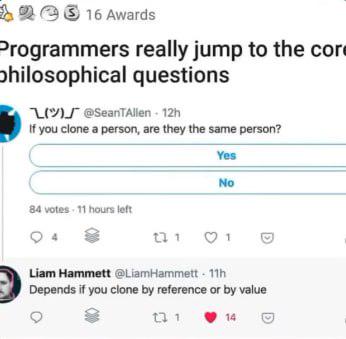
When philosophers ask if a clone is the same person, programmers swoop in with the actual technical answer. Clone by reference? Same memory address, same person. Clone by value? New memory allocation, different person. Leave it to devs to solve ancient philosophical debates with a one-liner about pointers. This is why we're not invited to dinner parties.