Code documentation Memes

Posts tagged with Code documentation

The Oddly Specific Documentationless Magic Number

The Oddly Specific Documentationless Magic Number
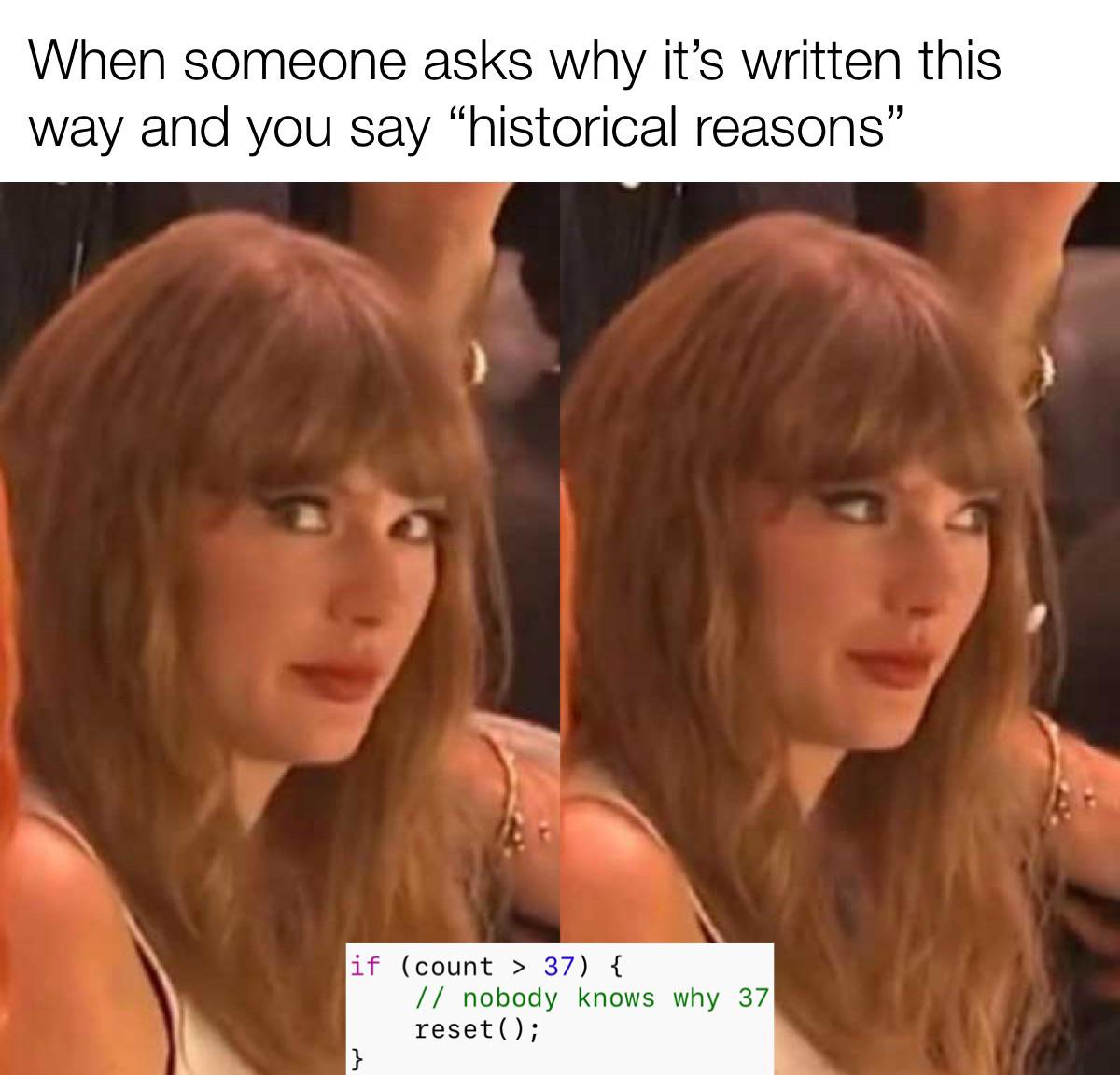
You know you're in deep when someone asks about that random if (count > 37) sitting in the codebase like an ancient artifact. "Historical reasons" is developer-speak for "I have absolutely no idea why this exists, the person who wrote it left the company 5 years ago, and I'm too terrified to touch it because production hasn't exploded yet." That nervous side-eye says it all. Why 37? Why not 36 or 38? Was it a business requirement? A bug fix? Someone's lucky number? The universe may never know. The comment "nobody knows why 37" is both brutally honest and professionally devastating. It's the coding equivalent of archaeological mystery—except instead of ancient civilizations, it's just Dave from 2015 who didn't believe in documentation. Pro tip: If you ever find yourself writing code with magic numbers, leave a comment. Future you (or the poor soul who inherits your code) will thank you. Or at least won't curse your name during 3 AM debugging sessions.

Viber Coders When Someone Asks How Does This Code Work

Viber Coders When Someone Asks How Does This Code Work
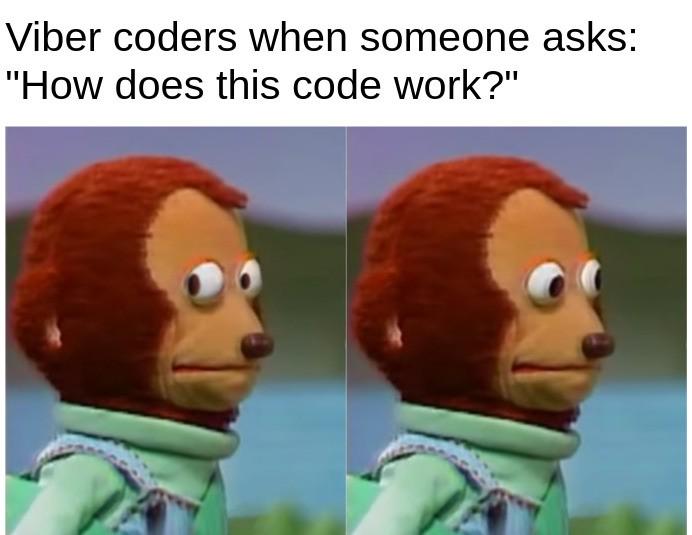
You know that look when someone asks you to explain code you wrote six months ago? Now imagine that, but the code was written by someone who left the company three years ago, has zero documentation, and somehow still runs in production. That's Viber engineering in a nutshell. The monkey puppet meme captures that exact moment of existential dread when you realize you have no idea how any of it works, but you're too deep in to admit it. The code just... exists. It functions. Nobody touches it. Nobody questions it. It's like that load-bearing comment in the codebase—remove it and everything collapses. Props to whoever maintains Viber though. Legacy messaging apps are basically digital archaeology at this point. Every commit is like defusing a bomb while wearing oven mitts.

Vitally

Vitally...
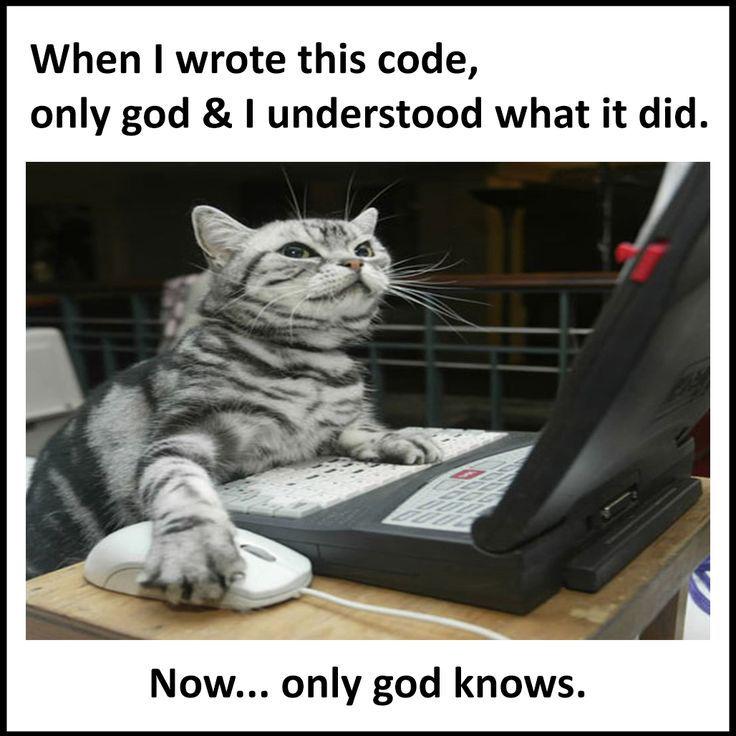
You know that feeling when you write some absolutely cursed code that somehow works, and you're riding high on that divine knowledge of what every line does? Fast forward six months—or let's be real, six days—and you're staring at your own creation like it's an ancient hieroglyph. The cat's smug expression perfectly captures that initial confidence: "Yeah, I'm a genius, I know exactly what's happening here." Then reality hits when you need to modify it and suddenly you're praying to the code gods for enlightenment because even you can't figure out what past-you was thinking. No comments, no documentation, just pure chaos. The transition from "only god & I understood" to "only god knows" is the programmer's journey from hubris to humility, speedrun edition.

The Sacred ASCII Guardian

The Sacred ASCII Guardian
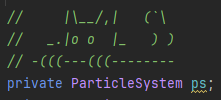
Ah yes, the ancient art of ASCII cat comments. When your code is so complex that only a feline guardian can protect it. The programmer has summoned a sacred ASCII cat above their particle system declaration—because nothing says "don't touch my code" like a cryptic cat drawing that took longer to create than the actual functionality it's guarding.

When Perfection Is Sus

When Perfection Is Sus
The duality of misspelled comments in code: some developers can't spell to save their lives, while others are playing 4D chess by deliberately misspelling things to prove they're human. It's the ultimate anti-AI flex. "Look at my glorious typo-laden comments! No LLM would ever write 'refactered the databass' or 'fixed bug in buttton click handeler'." The rest of us are just trying to remember if "received" is spelled with "ie" or "ei" while this mastermind is creating linguistic chaos as a career preservation strategy.

You Are On Your Own

You Are On Your Own
The circle of developer suffering in its natural habitat! A senior dev who wrote incomprehensible code 15 years ago is now expected to implement shiny new business requirements using that same cryptic mess they created. Karma really is that colleague who remembers every bad decision you've ever made. Nothing quite like the horror of realizing that indecipherable spaghetti code with zero comments was actually written by... past you. The technical debt collector has arrived, and he's charging interest!

Ancient Scriptures

Ancient Scriptures
Ah, the archaeological expedition to decipher your own code from last month. That moment when you need Indiana Jones' skills just to understand what the hell you were thinking. "Why did I use a ternary operator inside a map function nested in a reduce?" The hieroglyphics might actually be easier to translate than whatever caffeine-fueled logic possessed you during that 3 AM coding session. The worst part? You probably left zero comments because "it was obvious" at the time. Congratulations, you've become your own worst legacy code maintainer.

The Code Was Unnecessarily Convoluted

The Code Was Unnecessarily Convoluted
The absolute TRAUMA of opening your old code! You wrote it, you birthed it into existence, and yet three years later it might as well be written in some ancient forbidden language only decipherable by wizards with PhDs in cryptography! 💀 The way we convince ourselves we're documenting properly only to return later and find ourselves staring into the abyss of our own creation like "WHO WROTE THIS MONSTROSITY?!" only to realize... it was us all along. The betrayal! The horror!

A Moment Of Clarity

A Moment Of Clarity
The four stages of revisiting your old code: shock, disbelief, existential crisis, and finally that reluctant moment of understanding. First you're horrified at what you've created. Then you question every life decision that led you to writing such an abomination. After the third "why?" you're convinced you were possessed by some demonic entity. And then... that sad little "Oh, that's why" when you finally remember the ridiculous constraints, impossible deadlines, and 3AM energy drinks that led to your crimes against computer science. Your past self was simultaneously your worst enemy and your only ally.

What The Hieroglyphics Did I Write

What The Hieroglyphics Did I Write
Ah, the classic "who wrote this abomination" moment. That feeling when you return to your own code after a brief hiatus and suddenly it looks like ancient Egyptian artifacts on your screen. Your past self apparently thought, "Documentation? Comments? Nah, future me will totally remember what this spaghetti monster does!" Spoiler alert: you don't. Now you're sitting there, coffee in hand, questioning your career choices while trying to decipher whether that function was brilliant or just sleep-deprived madness. The archaeological dig through your own creation begins...

The Neat Part About Code Amnesia

The Neat Part About Code Amnesia
Junior dev: "How do I remember what my code does?" Senior dev: "That's the neat part. You don't." The true mark of seniority isn't remembering your code—it's embracing the chaos. Documentation? Comments? Those are myths we tell bootcamp grads. Real developers just stare at their own code like it's written in ancient Sumerian and mutter "who wrote this garbage?" before realizing it was themselves, last Tuesday.

When You Read Your 3 Years Old Code

When You Read Your 3 Years Old Code
Opening that dusty repo from 3 years ago and finding your brain sitting next to a gas can. Perfect metaphor for the cognitive dissonance of reading your old code and thinking "Who wrote this garbage? Oh wait, it was me." The only options are to burn it all down or somehow reattach your brain and figure out what past-you was thinking when you decided that 47 nested if-statements was an elegant solution.