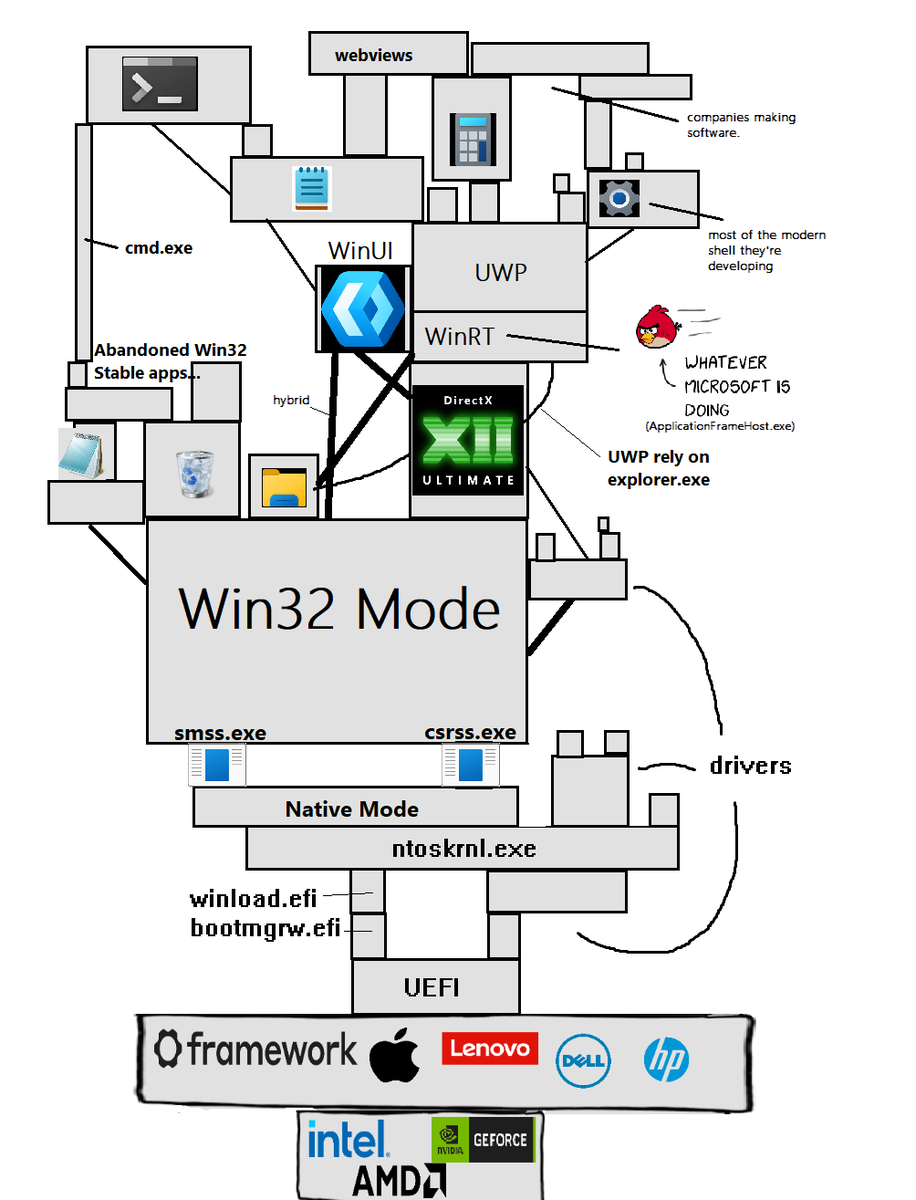
Behold, the architectural masterpiece that is Windows: a delicate Jenga tower of legacy code, abandoned frameworks, and "temporary" solutions that have been around since the Bush administration. At the foundation we've got UEFI sitting on hardware from Intel, AMD, and NVIDIA. Above that, the NT kernel (ntoskrnl.exe) manages drivers and Win32 Mode—the compatibility layer Microsoft can't kill because half the world's enterprise software still runs on crusty Win32 apps from 2003. Then there's the modern stuff: WinUI, UWP (Universal Windows Platform), and WinRT all competing for relevance while somehow depending on explorer.exe and DirectX. UWP apps? Yeah, they're basically running in a compatibility mode themselves at this point. And WinRT is labeled with an Angry Bird because, well, that's about the level of enthusiasm developers have for it. The real comedy gold: "companies making software" are building with webviews and modern shells that ultimately call back to cmd.exe and those "Abandoned Win32 Stable apps" because nothing ever truly dies in Windows. It just gets wrapped in another layer of abstraction. Microsoft's strategy? "WHATEVER MICROSOFT IS DOING (ApplicationFrameHost.exe)"—a mood we can all appreciate. Thirty years of backwards compatibility means your shiny new Windows 11 machine is essentially a museum of every architectural decision since Windows 95, held together with duct tape and prayer.
 AI
AI
 AWS
AWS
 Agile
Agile
 Algorithms
 Android
 Apple
Apple
 Azure
Azure
 Backend
 Bash
Bash
 C++
C++
 Cloud
Cloud