X86 Memes

Posts tagged with X86
They Downgraded To 64

They Downgraded To 64
Someone skipped the architecture history class. The x86 naming convention has nothing to do with sequential versioning—it comes from the Intel 8086 processor released in 1978, followed by the 80186, 80286, 80386, and 80486. The "x" became a wildcard for the series. Then x86-64 (or x64) is the 64-bit extension of the x86 architecture, not a downgrade. Imagine Intel engineers reading this and thinking "Should we tell them, or let them keep wondering why we skipped x87 through x63?" Plot twist: x87 actually exists—it's the floating-point coprocessor instruction set. So technically Intel DID make x87, just not in the way this person thinks. The real question is: if ARM is so good, why isn't there ARM2 yet? Checkmate, architecture nerds.

Important Message

Important Message
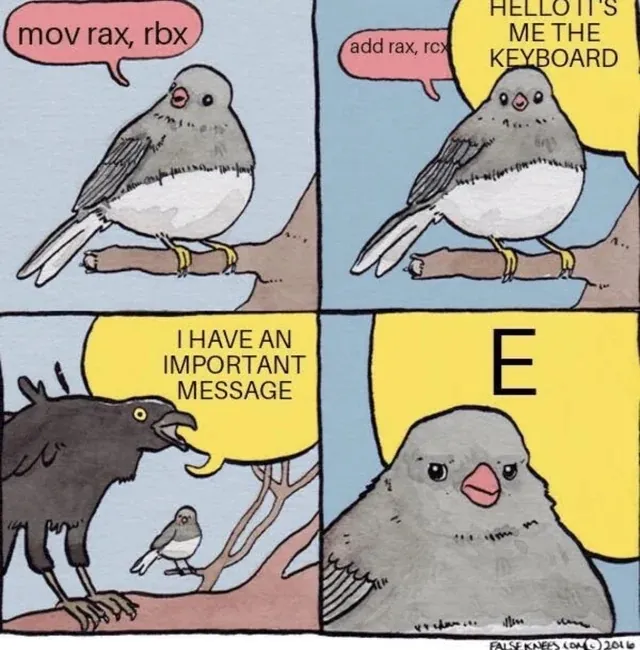
Bird tries to move data from the RAX register to RBX. Realizes keyboard access would help. Gets interrupted by a crow with "important information." The important message? Just the letter E. RAX and RBX are x86-64 CPU registers, so our feathered friend is literally trying to write assembly code by... telepathy? Morse code? The crow's contribution of a single "E" is about as helpful as a code review that just says "looks good to me" on a 5000-line PR. Thanks, crow. Really moving the needle here. The energy here is every Slack notification that pulls you out of deep focus just to tell you someone reacted to your message with a thumbs up emoji from three weeks ago.

Hello It's Me The Keyboard

Hello It's Me The Keyboard
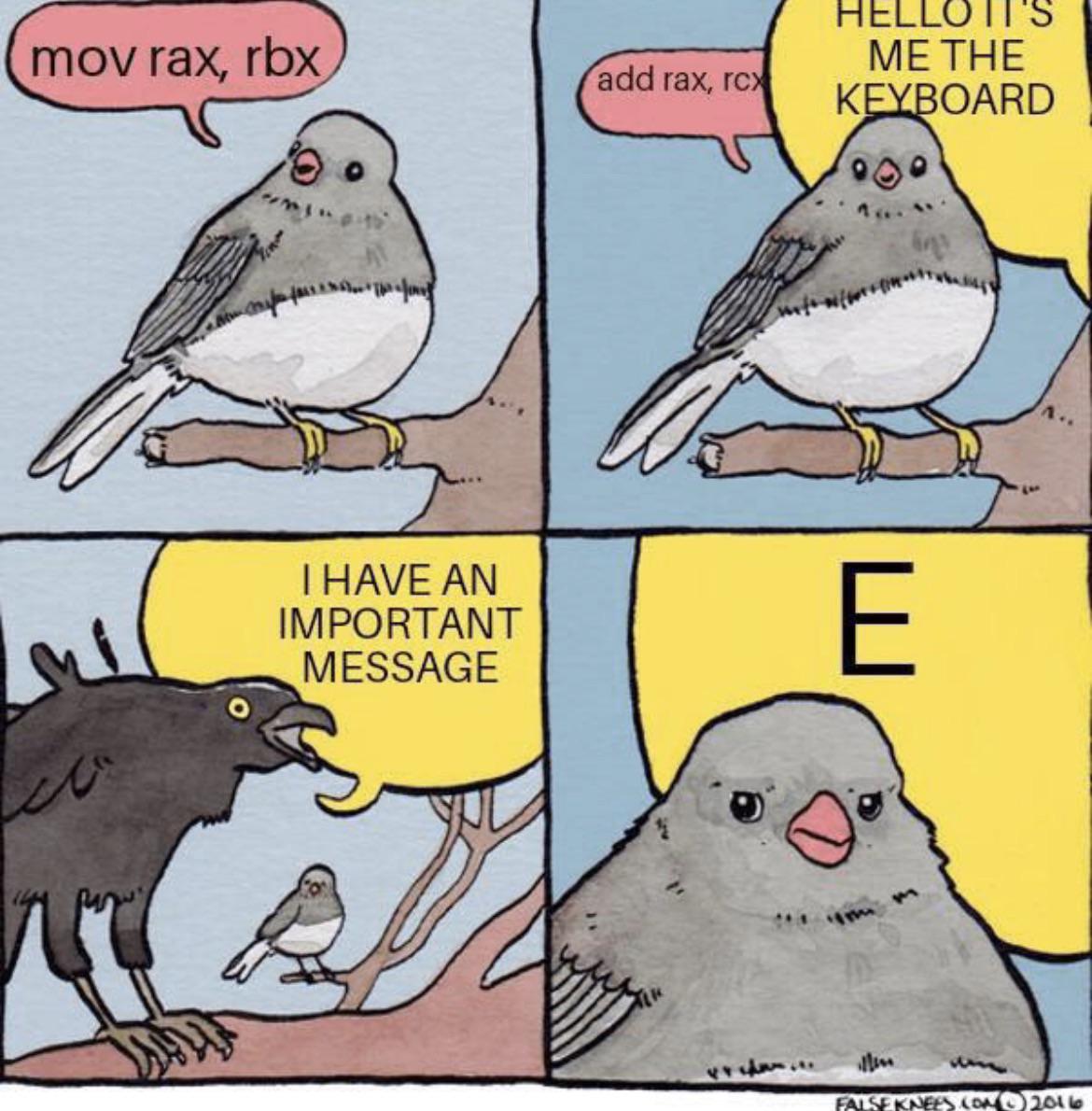
You're deep in assembly code, carefully typing out register instructions like "mov rax, rbx" and "add rax, rcx" with the precision of a neurosurgeon. Then your keyboard decides it's showtime and delivers its most important message: a single, glorious "E". Nothing says "I'm helping!" quite like a random keystroke interrupting your low-level programming flow. That accidental key press just turned your perfectly crafted x86-64 instruction into complete garbage, and now you get to debug why your program is trying to execute "Emov rax, rbx" or some other syntactic abomination. The compiler's gonna have a field day with that one. Bonus points if you don't notice until after you've already hit compile and you're staring at an error message wondering what eldritch horror you've summoned this time.

Aging As A Programmer Sucks

Aging As A Programmer Sucks
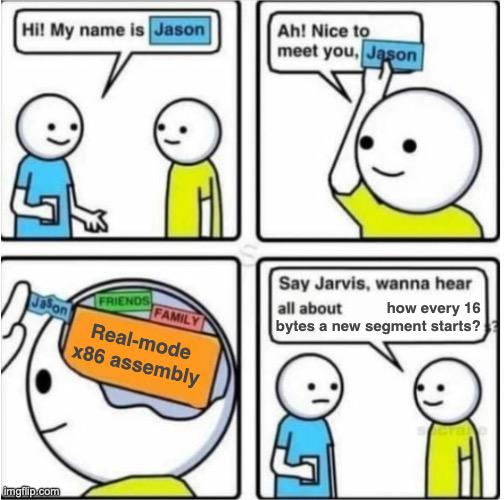
The brain's priority system evolves in fascinating ways. When you're fresh in the industry, you can remember every person's name at a networking event. Fast forward a few years of debugging segfaults and dealing with legacy code, and suddenly your brain has reallocated that precious memory space to store the exact locations of "FRIEND" and "FAMILY" labels in your mental heap, right next to the sacred knowledge of x86 assembly instructions. The joke here is that while you can't remember Jason's name anymore, you can instantly recall obscure technical details like how every 16 bytes is a new segment in x86 assembly. Your brain basically performed garbage collection on "useless" social information to make room for the really important stuff —like real-mode memory addressing and assembly opcodes. Who needs to remember people when you can remember that the x86 architecture uses segmented memory addressing where a physical address equals segment × 16 + offset? Peak programmer evolution: social skills deprecated, low-level knowledge optimized. 10/10 would forget your name again.

When Architecture Compatibility Is Your Side Hustle

When Architecture Compatibility Is Your Side Hustle
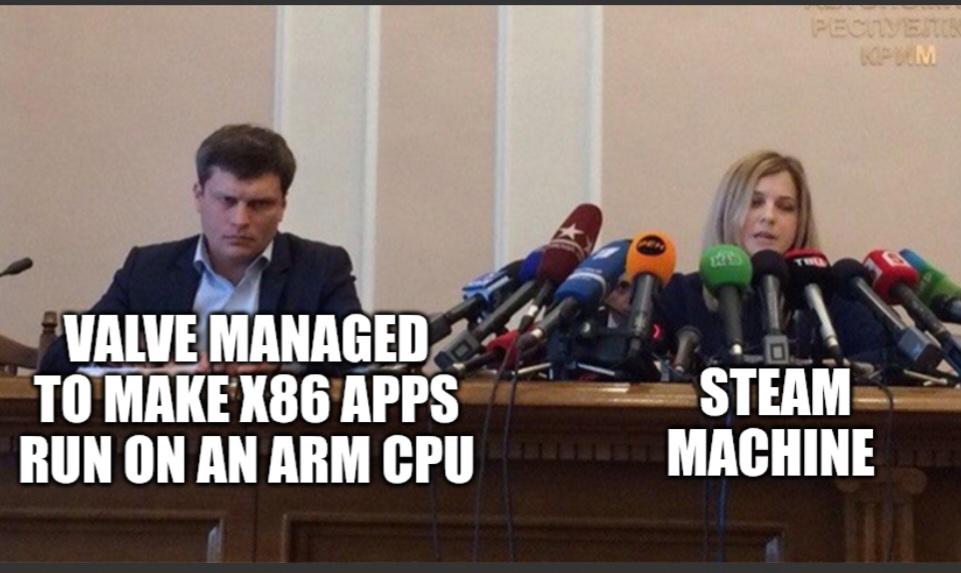
Ah, the miracle of emulation. Valve somehow convinced x86 apps to play nice with ARM architecture, which is basically like getting cats and dogs to not only coexist but form a barbershop quartet. The Steam Machine announcement feels like that moment when your coworker says they refactored the entire codebase over the weekend and "it just works." Sure, buddy. Next you'll tell me PHP is secure and printers never jam.

That's What You Call Chad Version

That's What You Call Chad Version
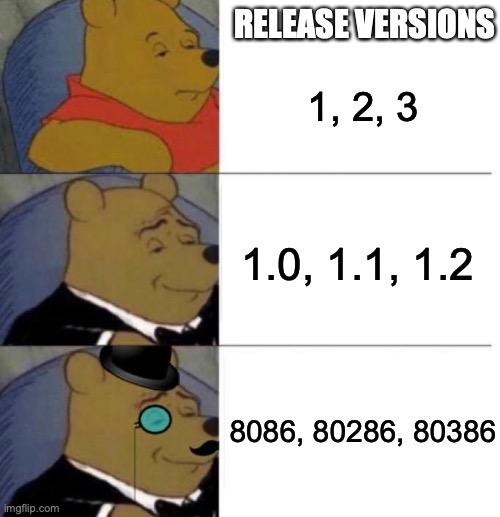
Regular developers: "Let's just call it version 1, 2, 3." Semantic versioning enthusiasts: "Excuse me, it's 1.0, 1.1, 1.2 — we're civilized here." Ancient CPU architects: "8086, 80286, 80386 — because nothing says 'I was coding when dinosaurs roamed the earth' like naming your versions after Intel processors from the 1980s."

Dual Monitor Stand, FreeStanding Desk Stand for Two 13-32 inch Screens, Vertical Monitor Riser with Swivel, Tilt, Rotation, 4 Height Options, Holds One (1) Screen Up to 77Lbs, VESA 75x75mm/100x100mm

Dual Monitor Stand, FreeStanding Desk Stand for Two 13-32 inch Screens, Vertical Monitor Riser with Swivel, Tilt, Rotation, 4 Height Options, Holds One (1) Screen Up to 77Lbs, VESA 75x75mm/100x100mm
【Compatibility for Large Monitors】: The monitor stand reliably supports two 13-32 inch monitors weighing up to 77lbs, compatible with VESA 75x75mm and 100x100mm patterns, Please verify the size, weig…

X86 Is Good

X86 Is Good
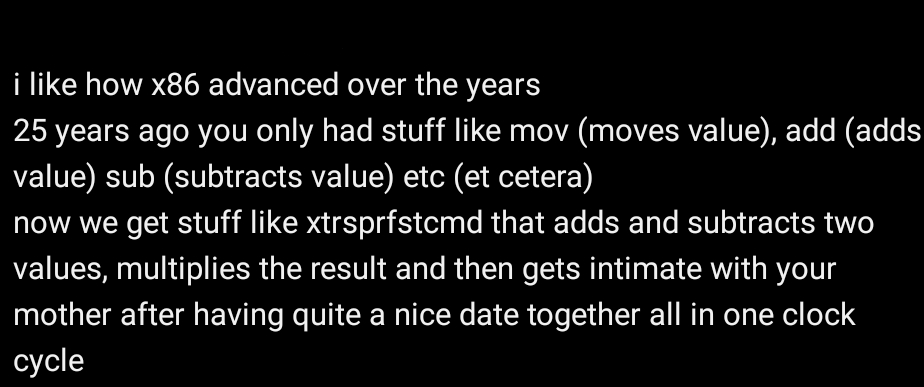
The x86 instruction set has evolved from sensible mnemonics like mov and add to absurd alphabet soup like xtrsprfstcmd that supposedly does complex math while romancing your mother in a single clock cycle. Impressive efficiency, questionable naming conventions. It's like Intel engineers went from writing readable code to smashing their faces on keyboards while achieving quantum-level performance.

Low Effort War: CPU Architecture Edition

Low Effort War: CPU Architecture Edition
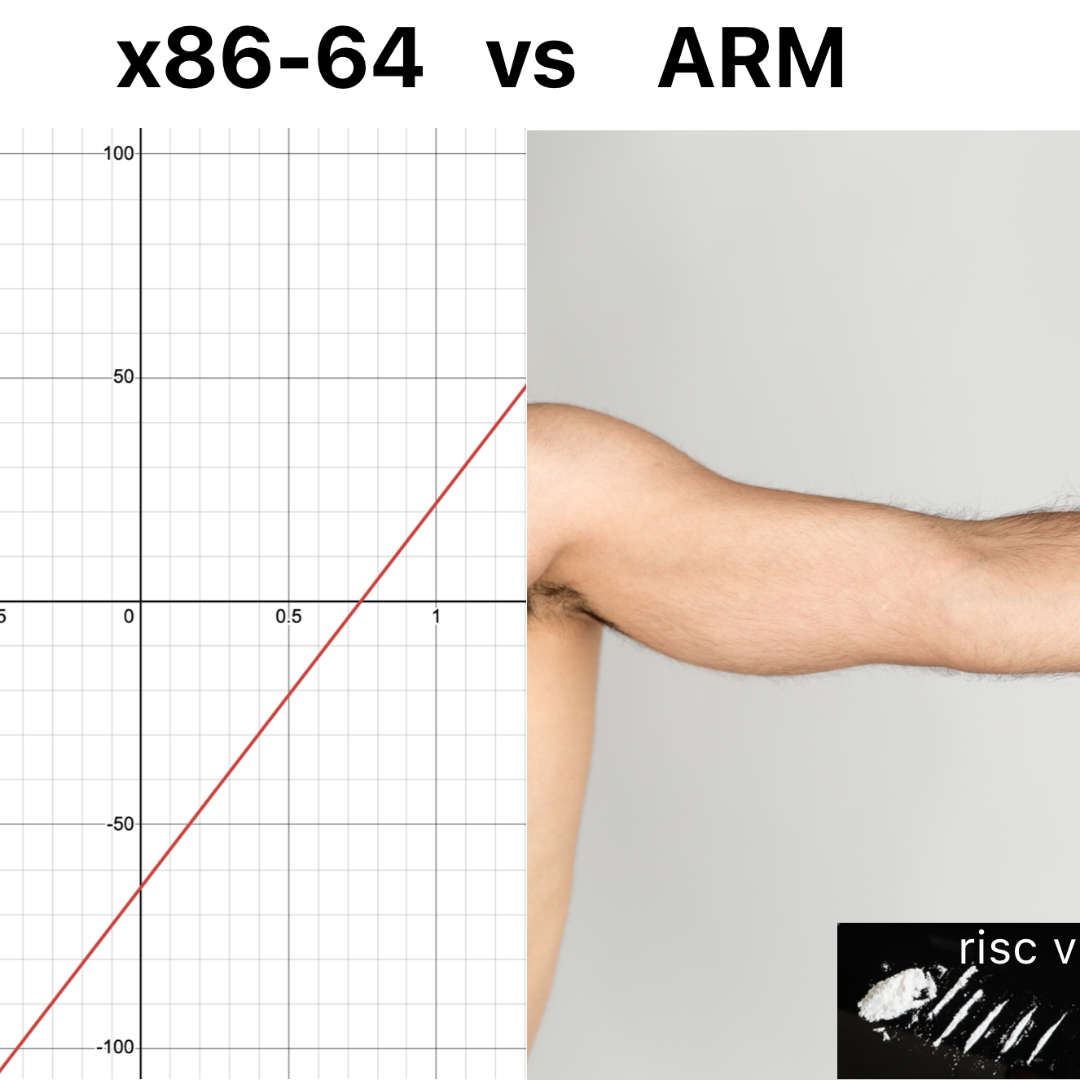
The great CPU architecture debate, summarized with minimal effort. On the left, x86-64 represented by a mathematical graph. On the right, ARM represented by... an actual human arm. And there in the corner, RISC-V illustrated with what appears to be lines of cocaine. The perfect technical comparison doesn't exi—