Solid principles Memes

Posts tagged with Solid principles
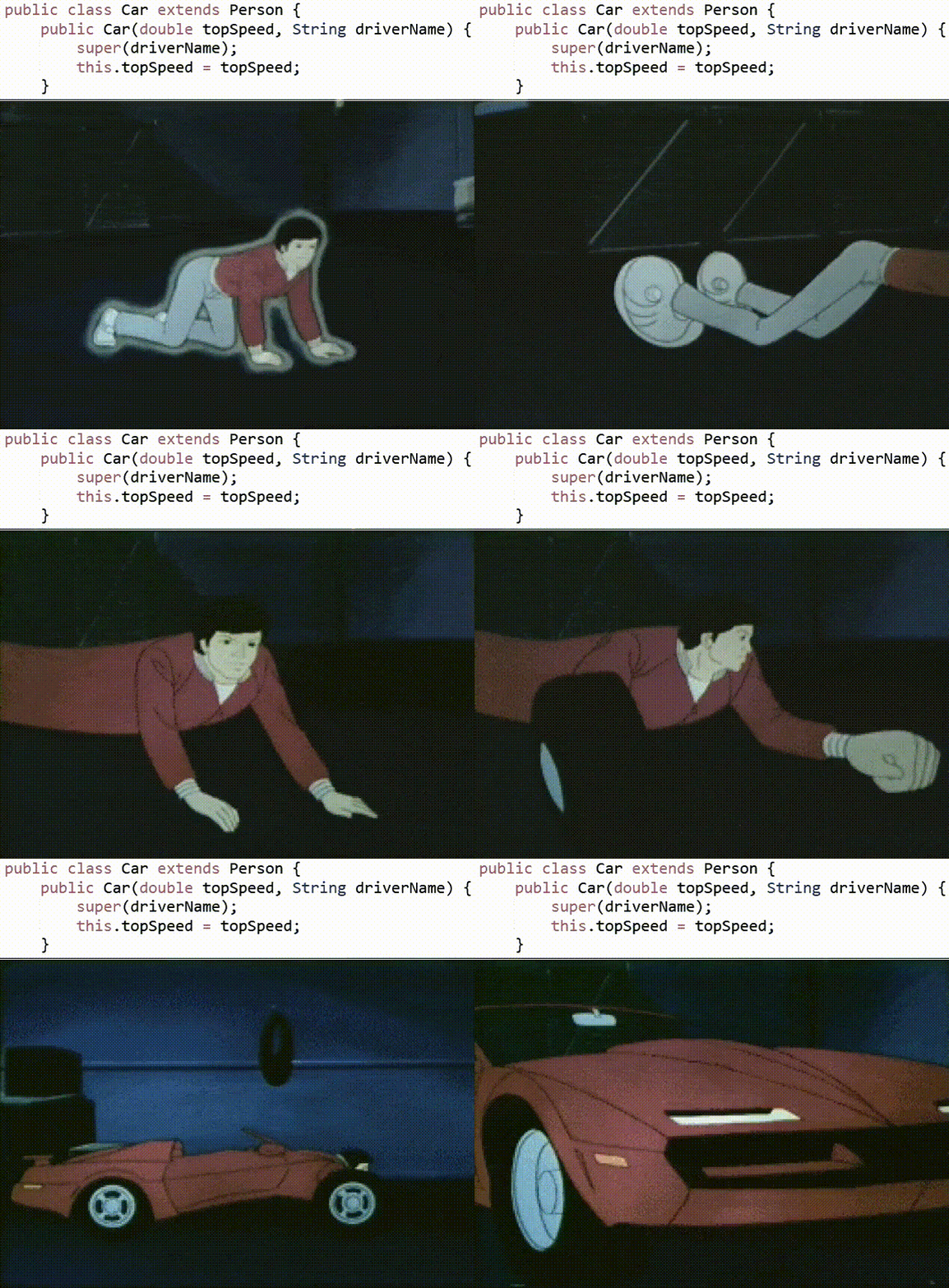
Senior Devs...

Senior Devs...
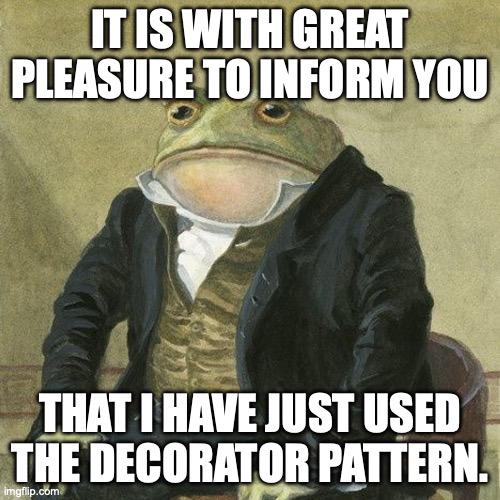
Oh, the sheer GENIUS of it all! Senior devs out here creating AbstractFactoryFactoryProviderBuilderManagers just to avoid writing a simple if-statement. Why solve a problem in 5 lines when you can architect an entire galaxy of design patterns, interfaces, and dependency injection frameworks? They'll spend three weeks building "scalable infrastructure" for a feature that literally just needs to check if a number is greater than zero. The celebration? Chef's kiss. They've just turned a straightforward solution into something that requires a PhD to understand. Future maintainers will weep, but at least it's "enterprise-ready" and follows SOLID principles so hard it became LIQUID.

Oo Ps

Oo Ps
Senior devs dancing around after wrapping every simple function in AbstractFactoryBuilderManagerProxyStrategyObserverAdapterDecoratorFacade classes because "it's more maintainable." They've successfully transformed a 10-line feature into a sprawling architecture that requires a PhD to understand. The junior dev just wanted to add a button, but now they're navigating through FactoryFactory classes and wondering if they accidentally opened the Java Enterprise codebase. The real kicker? When someone asks "why is this so complicated?" they'll respond with "well, what if we need to scale this to support multiple button types in the future?" Spoiler: they won't. The button will do exactly one thing for the next 5 years, but at least it's "enterprise-ready" and follows SOLID principles so hard it became LIQUID.

The Single Responsibility Principle's Worst Nightmare

The Single Responsibility Principle's Worst Nightmare
The eternal software engineer's dilemma, perfectly illustrated by Emperor Kuzco. On one shoulder, the devil whispers "just cram that new functionality into your existing bloated class and call it a day." On the other, the angel begs you to consider proper architecture. Meanwhile, you're standing there with that blank stare, knowing you'll choose technical debt now and regret it during code review later. The single responsibility principle weeps silently in the corner.

But It's A Design Pattern

But It's A Design Pattern
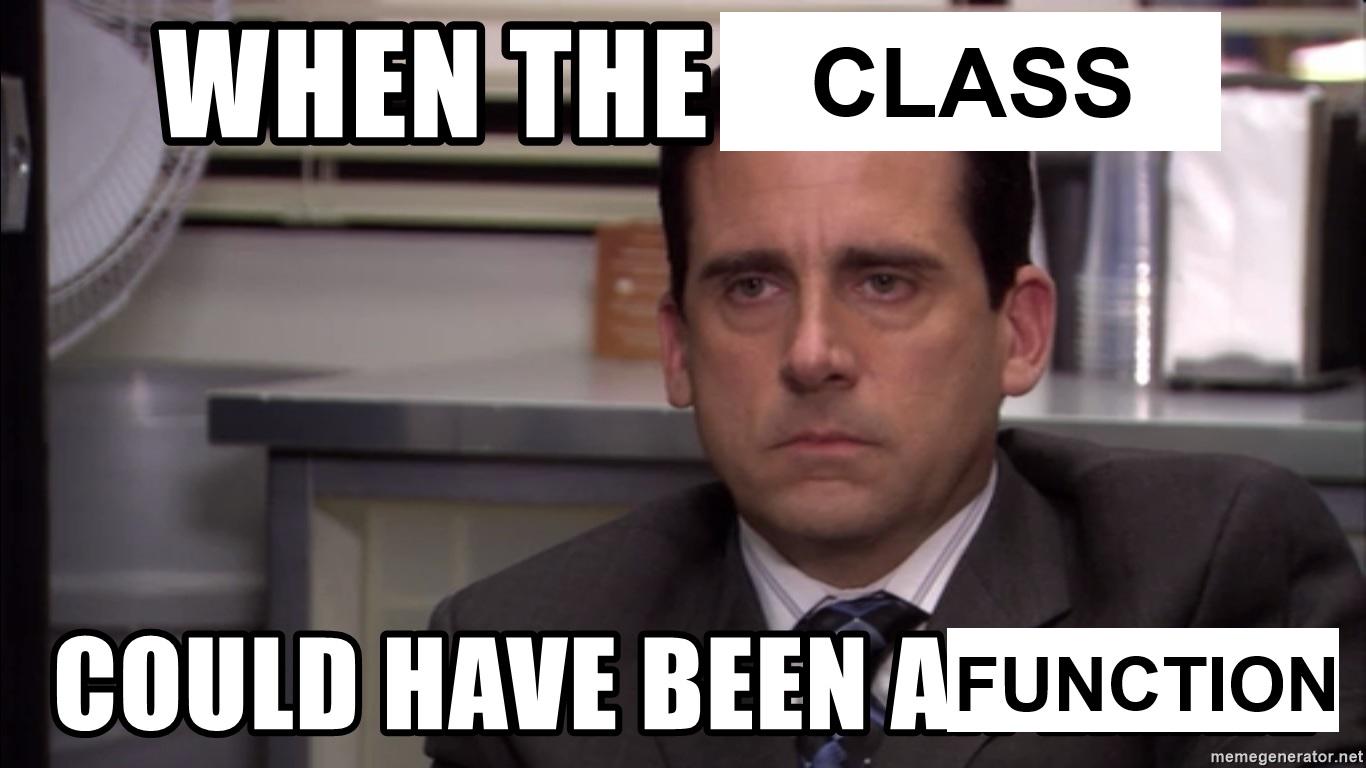
The face you make when someone creates a 500-line monolithic class that handles authentication, data processing, and UI rendering all at once. Meanwhile, you're sitting there thinking about how those responsibilities could have been neatly separated into functions with proper single responsibility principle. But no... they just had to stuff everything into one giant class because "inheritance is the only design pattern" they bothered to learn in college. The code review is going to be a bloodbath.

The Three Horsemen Of Modern Development

The Three Horsemen Of Modern Development
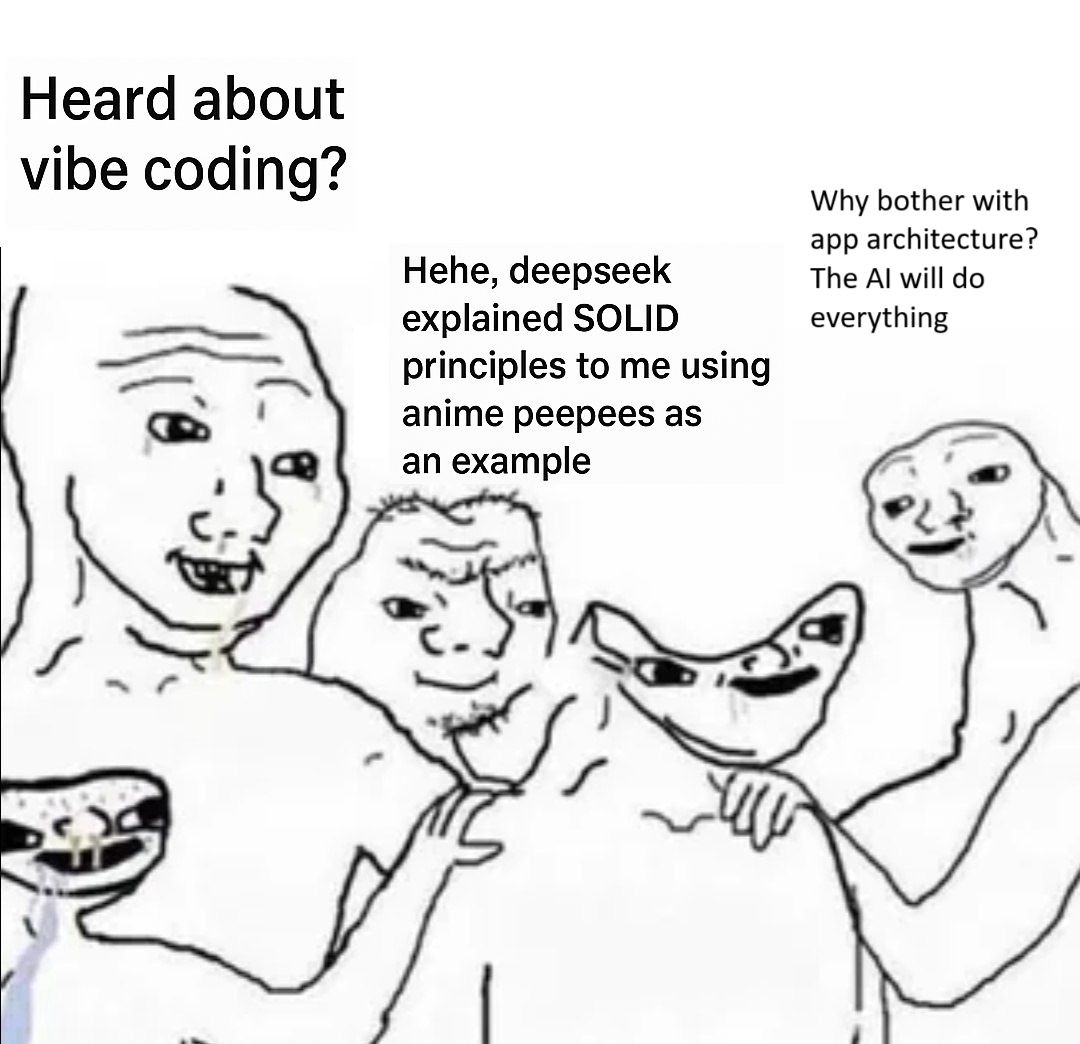
Modern programming has evolved from rigid methodologies to whatever fever dream this is. Left side: someone asking about "vibe coding" like it's an actual paradigm. Middle: a developer who learned SOLID principles from anime examples instead of textbooks and somehow still functions. Right side: the enlightened one who's given up on architecture entirely because "AI will handle it." The three horsemen of the coding apocalypse. For those wondering, SOLID is actually a set of object-oriented design principles (Single responsibility, Open-closed, Liskov substitution, Interface segregation, Dependency inversion). But sure, explain it with anime characters. That'll stick.

Not Enough Parameters Gang

Not Enough Parameters Gang
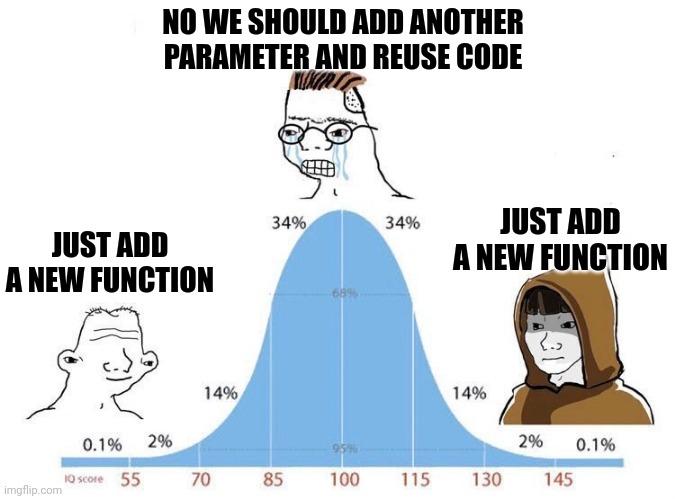
The eternal dilemma of function design perfectly illustrated on an IQ bell curve. The low-IQ crowd (0.1%) and high-IQ geniuses (0.1%) agree: "Just add a new function." Meanwhile, the average devs (34%) in the middle are sweating bullets, desperately clinging to their sacred principle of code reuse: "NO WE SHOULD ADD ANOTHER PARAMETER AND REUSE CODE!" It's the horseshoe theory of programming - both extremes of the intelligence spectrum somehow reach the same conclusion while the "well-actually" crowd in the middle is busy creating those monstrous functions with 17 optional parameters, 9 of which are booleans. And they wonder why nobody wants to maintain their code...