

Rng Memes

Posts tagged with Rng
E Mudhrama

E Mudhrama
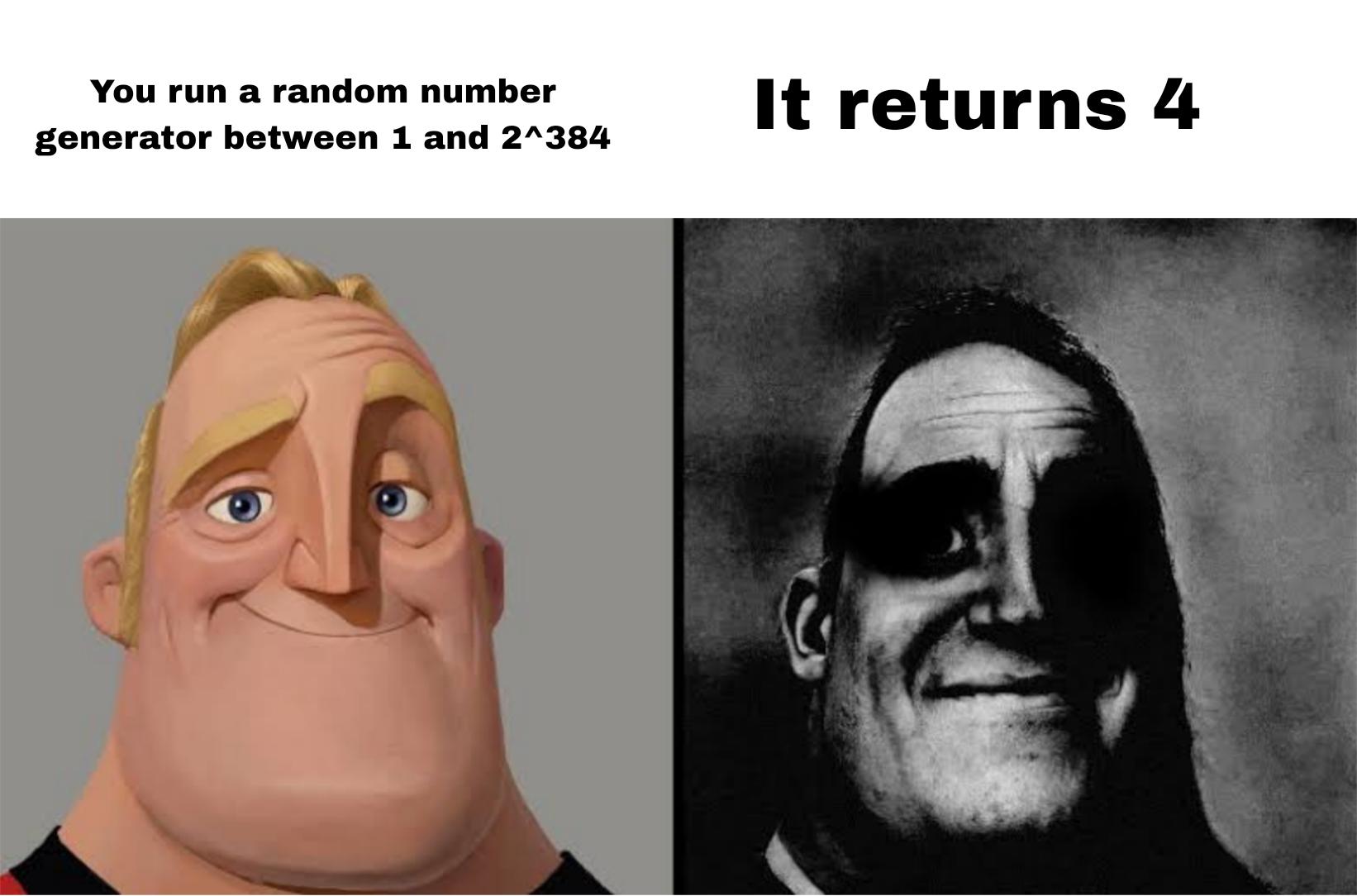
When your "random" number generator keeps spitting out the same number like it's auditioning for a role in Groundhog Day. Nothing screams "quality randomness" quite like getting 4 for the millionth time because someone thought Math.random() seeded with the current time was good enough. Plot twist: it wasn't. Your lottery simulation is basically just a 4 vending machine at this point, and somewhere a statistics professor is having a breakdown.

Random

Random
When you challenge a computer to give you a truly random number and it just pulls out a dice like some kind of analog caveman. Turns out pseudorandom number generators aren't actually random—they're deterministic algorithms that just look random enough to fool most people. True randomness requires physical phenomena like radioactive decay or atmospheric noise. So yeah, the computer's not wrong. The dice is technically more random than anything it could compute. Checkmate, human.

The Original Source Of Top Secure Number

The Original Source Of Top Secure Number
Ah yes, the legendary number "4" - chosen by fair dice roll, guaranteed to be random. Developers everywhere are still using this battle-tested random number generation technique for their cryptographic keys, session tokens, and password salts. Why bother with complex RNG algorithms when you can just hardcode the winning lotto number? Security through obscurity at its finest. The fact that this number keeps winning the lottery just proves how truly random it is, right? Fun fact: This is actually a reference to the classic XKCD comic where someone generates a random number by rolling a dice and getting 4. The joke being that hardcoding a "random" value defeats the entire purpose of randomness - yet we've all seen production code with const RANDOM_NUMBER = 4; somewhere in the codebase.

E Pseudorandom

E Pseudorandom
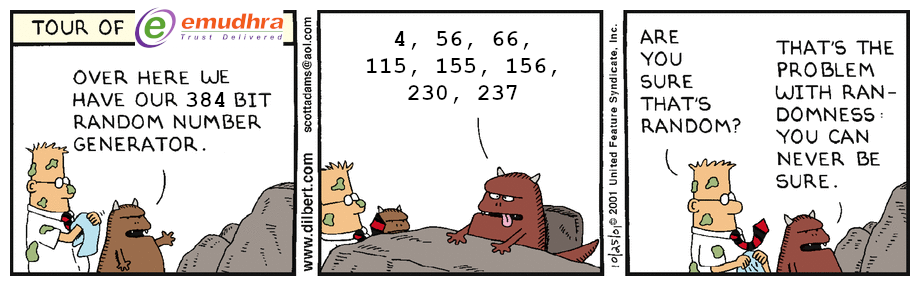
Tour guide shows off their fancy 384-bit random number generator. The beaver skeptically rattles off the output: "4, 56, 66, 115, 155, 156, 230, 237." Guide gets defensive: "Are you sure that's random?" Beaver drops the truth bomb: "That's the problem with randomness—you can never be sure." This hits different when you've spent hours debugging why your "random" test data keeps failing the same way. The philosophical paradox here is beautiful: truly random sequences can look suspiciously non-random, and our pattern-seeking brains reject them. Meanwhile, pseudorandom generators are deterministic algorithms pretending to be chaotic—which is exactly what we want 99% of the time because reproducible randomness is actually useful. The beaver's deadpan delivery captures every security researcher who's ever had to explain why Math.random() isn't cryptographically secure. You want real randomness? Go measure quantum phenomena or atmospheric noise. Otherwise, embrace the pseudo and seed it properly.

Random But Not Random Enough

Random But Not Random Enough
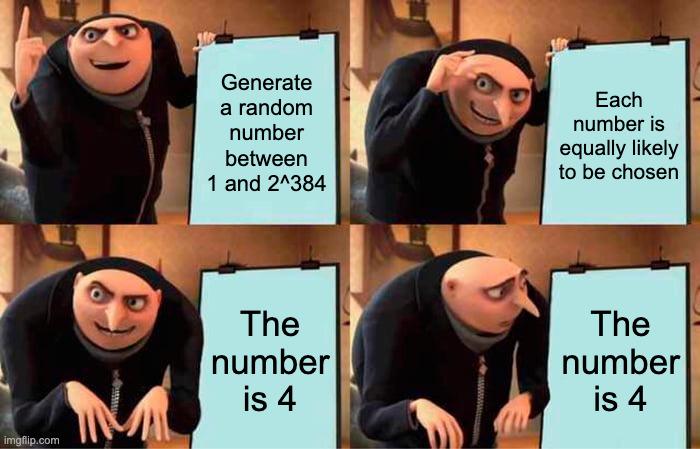
You generate a random number from an absolutely massive range of over 39 undecillion possibilities. The function returns 4. Every. Single. Time. You check the seed, you check the implementation, you even restart your IDE. Still 4. The universe has chosen violence today, and its weapon of choice is the least random "random" number generator in existence. Fun fact: The number 4 is actually the result of a fair dice roll according to xkcd #221. Chosen by fair dice roll. Guaranteed to be random. Just don't ask it to roll again.

Not Insecure Just Unlucky

Not Insecure Just Unlucky
You ask your cryptographically secure random number generator for a number between 1 and 2^384 (that's 39 digits worth of possibilities, or roughly 10^115 unique values), and it confidently returns... 4. Twice in a row. Sure, the RNG is technically correct—4 IS within the range and each number has equal probability. But when you're dealing with a number space larger than the estimated number of atoms in the observable universe, getting the same single-digit number twice feels like the universe is gaslighting you. The security team swears the entropy is fine, but your gut says someone forgot to seed the generator properly. Nothing screams "we have a problem" quite like a PRNG with commitment issues to the number 4.

Amazer Bamboo Standing Desk Converter, Height Adjustable Sit Stand Up Desk Riser, Monitor and Laptop Workstation with Keyboard Tray for Office and Home

Amazer Bamboo Standing Desk Converter, Height Adjustable Sit Stand Up Desk Riser, Monitor and Laptop Workstation with Keyboard Tray for Office and Home
Ergonomic Design: The sit stand desk allows you to alternate between sitting and standing positions throughout your workday, reducing the risk of neck, back and shoulder pain, allowing you to work in…

Can You Guess The Game?

Can You Guess The Game?
Ah yes, the eternal trade-off between sanity and a marginally better RNG outcome. You sacrifice 80 hours grinding, debugging, and refactoring your code for what? A 2% increase in the probability that your build doesn't fail on production. The math checks out though—totally worth losing your weekends, sleep schedule, and relationship status for that sweet, sweet crit chance improvement. Your IDE is basically a gacha game at this point, and you're pulling for SSR-tier code quality. Spoiler: you're still getting commons.

Can Quantum Machines Save Us

Can Quantum Machines Save Us
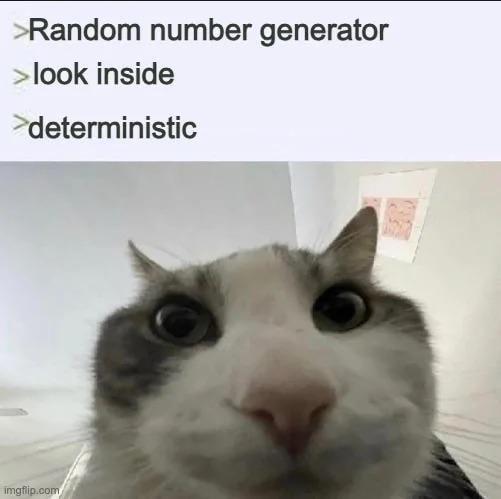
The beautiful irony here is that most "random" number generators in programming are actually pseudorandom—they're deterministic algorithms that just produce sequences that look random. You give them the same seed, you get the same "random" numbers every single time. It's like asking for chaos but getting a very organized spreadsheet instead. The shocked cat's face captures that exact moment when you realize your RNG is basically a fancy calculator cosplaying as entropy. Quantum computers promise true randomness through quantum mechanics shenanigans, but until then, we're all just running Math.random() and pretending we don't know it's using a Linear Congruential Generator from 1958. Fun fact: If you need cryptographically secure randomness, never use your language's basic random function. That's how you end up generating "random" session tokens that a script kiddie can predict faster than you can say "security vulnerability."

This Man Is Best Random Machine

This Man Is Best Random Machine
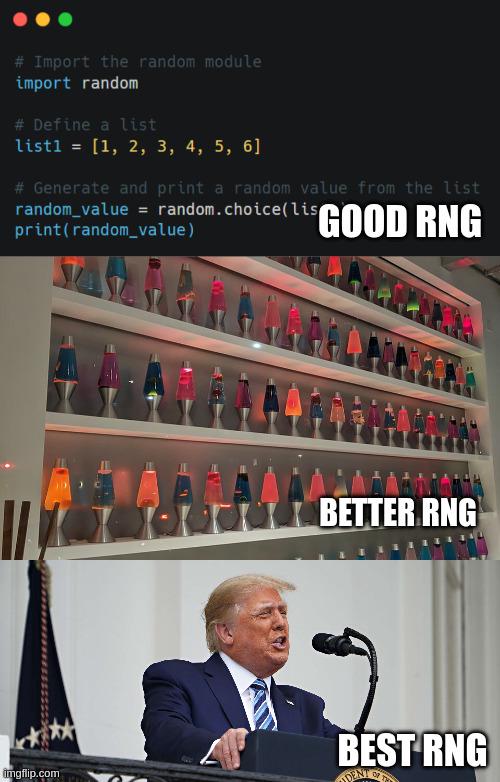
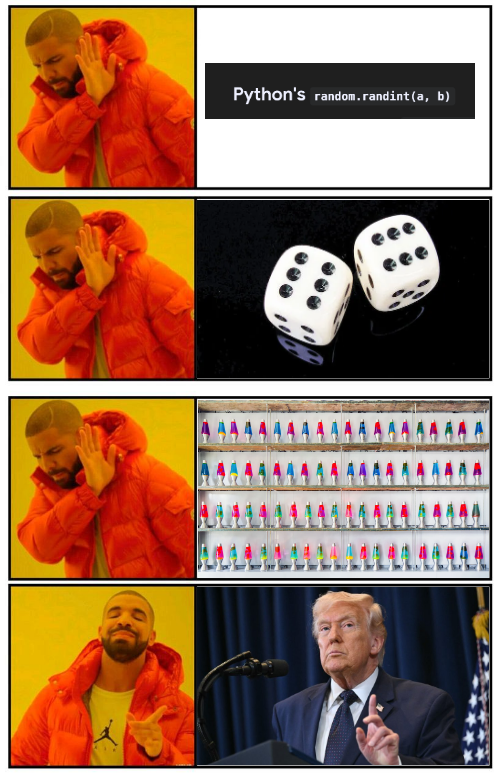
Ah yes, the hierarchy of randomness. Python's random.randint() is predictable and boring. Dice? Classic, physical, respectable. A lava lamp wall? Now we're getting into proper entropy territory—those chaotic blobs are actually used for real cryptographic randomness by Cloudflare. But the final boss? That guy. Because nothing generates more unpredictable, chaotic, and utterly baffling outputs than a certain individual's decision-making process. You literally cannot model it with any algorithm known to computer science. Pure, unfiltered randomness. The universe's best RNG.

Random Seed

Random Seed
You've got your basic Python random.choice() up top, pulling from a list like it's some kind of peasant lottery. Then there's the wall of lava lamps—yes, actual lava lamps—which Cloudflare famously uses to generate cryptographic randomness by filming the chaotic blobs and feeding the data into their entropy pool. And at the bottom? Well, that's just pure chaos incarnate. The joke here is the escalating quality of randomness sources. Software RNG? Predictable if you know the seed. Lava lamps providing physical entropy? Now we're cooking with actual thermodynamic chaos. But the final panel suggests there exists an even more unpredictable source of randomness—one that operates entirely outside the bounds of logic, consistency, or any known algorithm. Cryptographers spend years trying to find truly random sources. Turns out they should've just been watching cable news.

True Random

True Random
When someone asks for a random number generator and you show up with a wall of lava lamps. Because apparently, the chaotic movement of blobs in lava lamps is more trustworthy than your computer's pseudo-random number generator. Fun fact: Cloudflare actually uses a wall of lava lamps (called LavaRand) to generate truly random numbers for cryptographic keys. They photograph the lamps and use the unpredictable patterns as entropy. It's one of those rare moments where the ridiculous solution is actually the correct one. Meanwhile, your average developer is still using Math.random() and calling it a day. The skeptical look in the last panel? That's every security engineer when you tell them your RNG is "good enough."

Sounds A Bit Simple

Sounds A Bit Simple
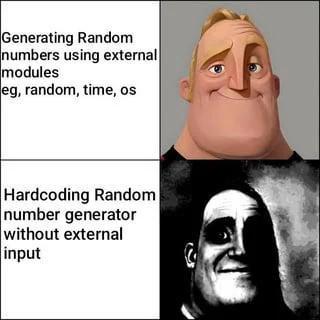
The classic "I'll just roll my own" energy right here. Using random , time , or os modules for random number generation? That's for normies who understand entropy and cryptographic security. Real chads hardcode their RNG by... wait, what? Just picking a number and calling it random? The top panel shows the sensible approach—leveraging well-tested external modules that actually use system entropy, hardware noise, or timing jitter to generate proper random numbers. The bottom panel? That's the developer who thinks return 4; // chosen by fair dice roll. guaranteed to be random. is peak engineering. It's deterministic chaos masquerading as randomness, and honestly, it's the kind of confidence that breaks cryptographic systems and makes security researchers weep into their coffee. Pro tip: If your random number generator doesn't involve at least some external entropy source, you're basically just writing fan fiction about randomness.

Beelink SER3 Mini PC, AMD Ryzen 3 3200U(up to 3.5GHz) 2C/4T

Beelink SER3 Mini PC, AMD Ryzen 3 3200U(up to 3.5GHz) 2C/4T
✔️Powerful Performance: The Beelink SER3 Mini PC is powered by the 2-core processor AMD Ryzen 3 3200U. Its base operating frequency is up to 3.5GHz (2C/4T) and it supports a 4MB smart cache. The Deskt…