Malloc Memes

Posts tagged with Malloc
Full Control Over Memory

Full Control Over Memory
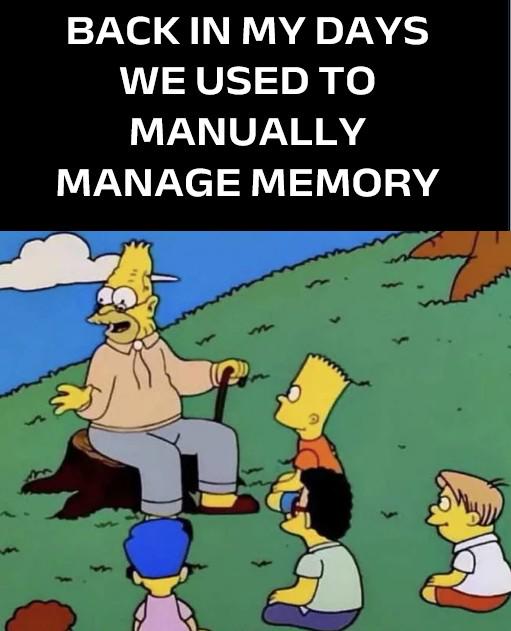
Old-timer C/C++ devs telling war stories about malloc(), free(), and pointer arithmetic like they survived some ancient apocalypse. Meanwhile, the younger generation is sitting there with their garbage collectors and automatic memory management, wondering why anyone would willingly sign up for segmentation faults at 3 AM. The grandpa energy is strong with this one. "Full control" is just a fancy way of saying "full responsibility for every byte you touch, and if you mess up, enjoy your memory leaks and undefined behavior." Sure, you get performance and precision, but at what cost? Your sanity and a debugger permanently open in another window. Modern languages basically said "nah, we're good" and automated the whole thing. But there's still something oddly nostalgic about manually tracking every allocation like some kind of memory accountant.

Bug Introduced Debugging

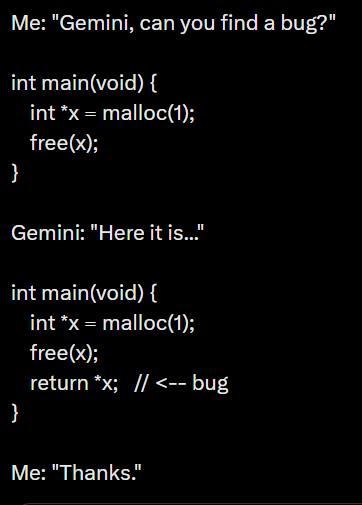
Bug Introduced Debugging
So you ask your friendly neighborhood AI to find a bug in your code, and it goes full detective mode, spots the issue, and then... casually introduces a BRAND NEW bug while "fixing" it. The original code was just allocating memory and freeing it (perfectly fine, if pointless), but Gemini decided to spice things up by dereferencing a freed pointer. Because why solve ONE problem when you can CREATE another, right? It's like asking someone to fix your leaky faucet and they burn down your kitchen in the process. Classic AI move: technically answered your question, catastrophically made things worse. Chef's kiss. 💀

Memory Unsafe Language Things

Memory Unsafe Language Things
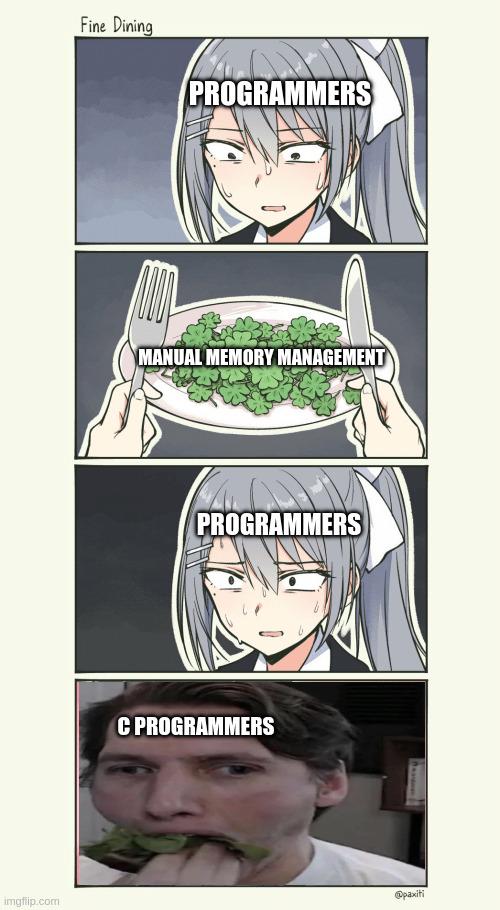
Oh look, it's C and C++ programmers literally worshipping at the altar of malloc() like it's some ancient deity that demands blood sacrifices! And honestly? It kinda does. Every time you call malloc without its equally temperamental partner free() , you're basically throwing your memory into the eternal void of memory leaks. The dramatic biblical imagery is *chef's kiss* because managing memory manually IS a religious experience—full of faith, hope, and the constant terror that you've accidentally summoned a segmentation fault demon. Meanwhile, the Rust and garbage-collected language folks are watching this ritual from a safe distance, sipping their memory-safe lattes.

Either It All Fits On The Stack Or You Need A Bigger Stack

Either It All Fits On The Stack Or You Need A Bigger Stack
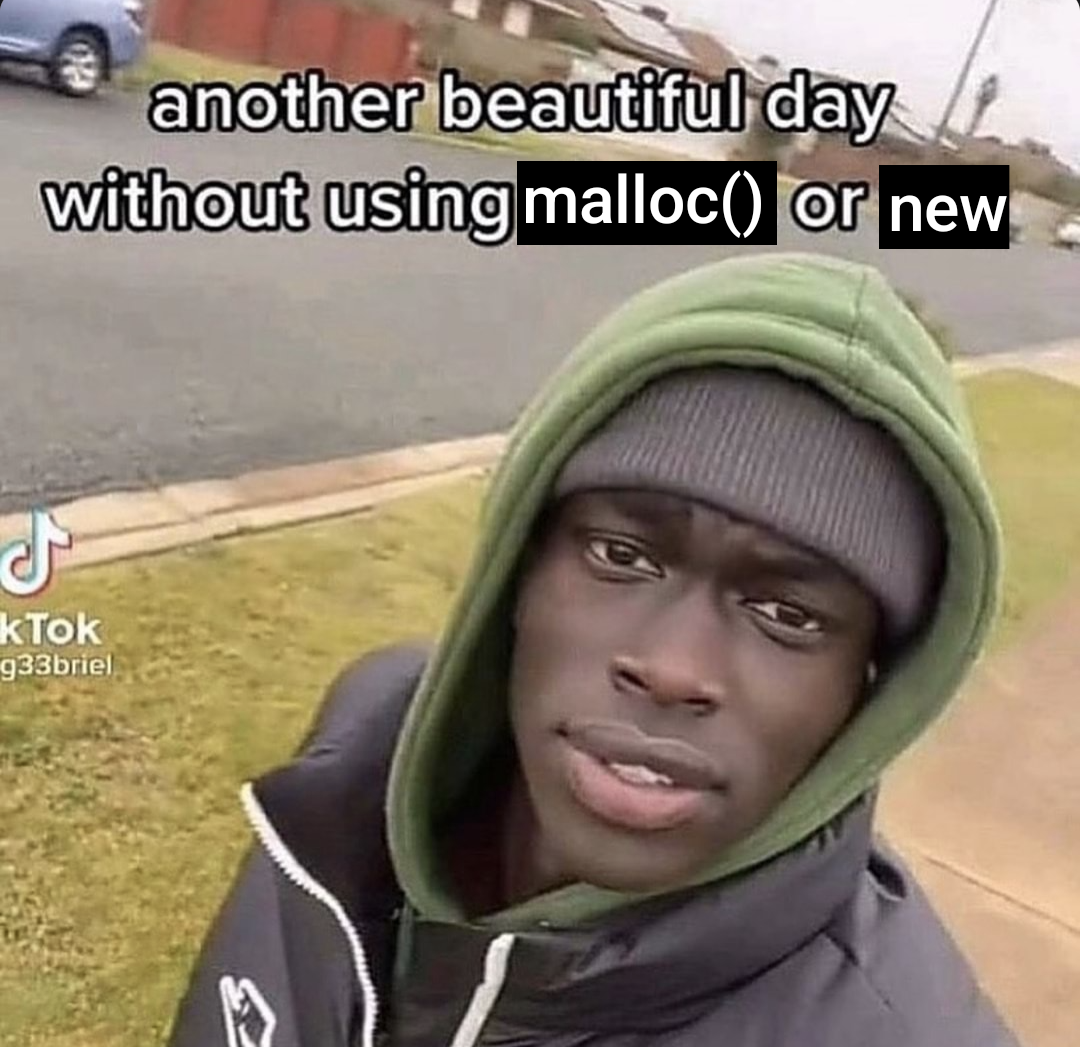
Imagine living your BEST life by simply refusing to acknowledge that heap memory exists. Just casually allocating everything on the stack like some kind of memory management anarchist. Running out of space? Stack overflow? Nah, just crank up that stack size limit and pretend dynamic memory allocation was never invented. It's giving "I don't believe in problems, only solutions" energy but make it C programming. The sheer audacity of writing code where every array, every struct, every variable lives and dies on the stack is honestly iconic. Who needs malloc() when you can just... not? Revolutionary.

No He Did Not

No He Did Not
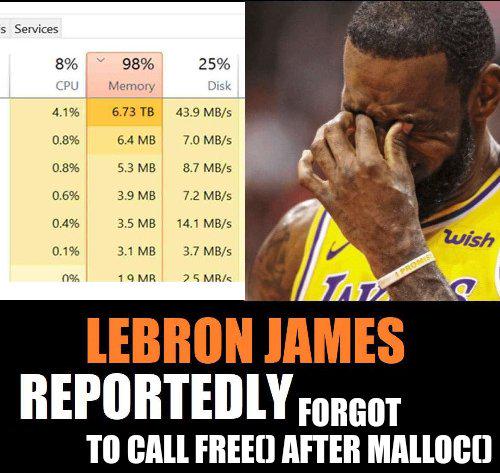
You know you've reached peak developer horror when you see 98% memory usage and 6.73 TB of RAM being consumed. That's not a memory leak anymore—that's a memory flood . Someone definitely forgot to call free() after their malloc() in C, and now the server is crying harder than LeBron in this photo. For context, malloc() allocates memory dynamically in C/C++, and if you don't manually free it with free(), that memory just sits there forever like that one tab you opened in Chrome three years ago. Except this time it's terabytes of "I'll clean this up later" energy. RIP to whatever production server this was running on.

What Do I Need The Include Lines For

What Do I Need The Include Lines For
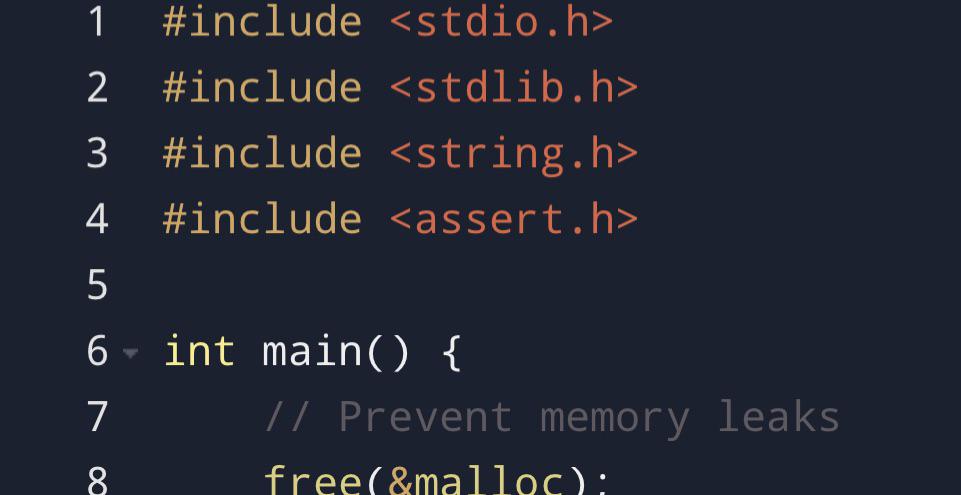
Someone just discovered the secret to writing memory-safe C code: free your memory before you allocate it. Galaxy brain move right there. The cherry on top? They included assert.h like they're about to write production-quality code with proper error handling, but then immediately went full chaos mode with free(&malloc()) . That's like putting on a seatbelt before driving off a cliff. Pro tip: Those include statements are actually the only correct part of this code. Everything after line 5 is a war crime against computing.

Easy Explanation Of Pointers

Easy Explanation Of Pointers
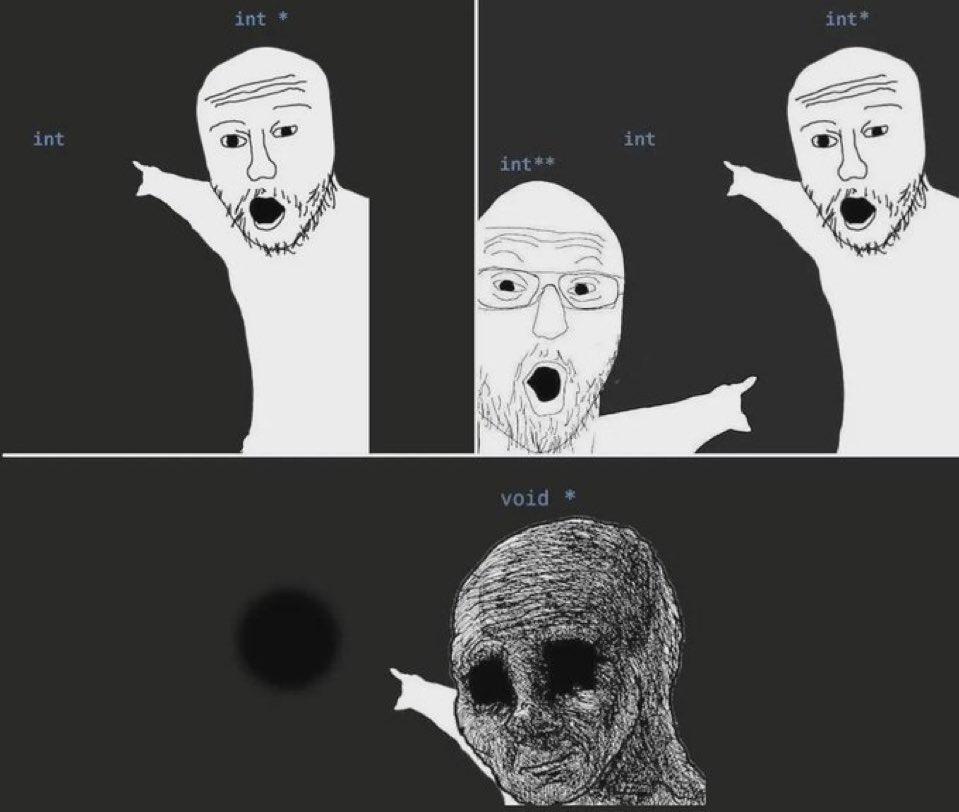
So you start with a regular int and everyone's cool. Then you add one asterisk to make it int* and people get a little excited but still following along. Add another asterisk for int** and now we're pointing to a pointer and things are getting spicy. But void* ? That's where your soul leaves your body. It's a pointer to... something. Could be anything. Could be nothing. The compiler has given up on type safety and so have you. It's the programming equivalent of "trust me bro" and the reason why C programmers have that thousand-yard stare. Fun fact: void* is basically how malloc tells you "here's some memory, figure it out yourself" which is both terrifying and liberating.

Logitech Brio 505 Full HD 1080p Business Webcam with Auto Light Correction

Logitech Brio 505 Full HD 1080p Business Webcam with Auto Light Correction
Trust the Market Leader: Logitech helps people engage with their work by equipping home and office space with tools for productivity and authenticity · Deploy with Confidence: Certified for Microsoft…

Someone Said To Use The Stack Because Its Faster

Someone Said To Use The Stack Because Its Faster
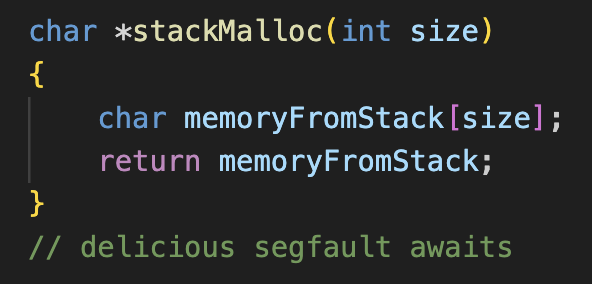
So someone told you stack allocation is faster than heap allocation, and you took that advice a bit too literally. The function allocates a char array on the stack and then returns a pointer to it. Problem? That stack memory gets deallocated the moment the function returns, so you're handing back a pointer to memory that's already been reclaimed. It's like giving someone directions to a house that's been demolished. The comment "delicious segfault awaits" is chef's kiss accurate. Whoever tries to dereference that returned pointer is in for undefined behavior territory—could be garbage data, could be a crash, could be nothing at all until production when it spectacularly explodes. Stack allocation is faster, but returning stack-allocated memory is basically writing a check your program can't cash. Classic case of knowing just enough to be dangerous. Should've used malloc or just passed a buffer as a parameter. But hey, at least it compiles! (with warnings you definitely ignored)

Either It All Fits On The Stack Or You Need A Bigger Stack

Either It All Fits On The Stack Or You Need A Bigger Stack
Behold the absolute MADLAD who decided that heap allocation is for the weak and cowardly! Why bother with malloc() or new when you can just throw everything onto the stack like you're playing Jenga with your program's memory? Stack overflow? Never heard of her. Just casually allocating 50MB arrays as local variables and watching your program crash with the grace of a drunk giraffe on ice skates. The sheer AUDACITY of living life on the edge, where every function call is a gamble and segmentation faults are just spicy surprises. Who needs proper memory management when you can just increase the stack size and pretend the problem doesn't exist? It's giving "I don't have a hoarding problem, I just need a bigger house" energy but make it programming.

I Got To Avoid Memory Management For Quite Some Time

I Got To Avoid Memory Management For Quite Some Time
Ah, the sacred rite of passage for every C programmer! That moment when your code finally springs a memory leak is like joining an exclusive club you never wanted to be part of. You've been living in blissful ignorance with your garbage-collected languages, thinking memory management is someone else's problem. Then BAM! Your C program starts consuming RAM like a hungry hippo, and you're frantically Googling "valgrind tutorial" at 3 AM. The squirrel's celebratory pose perfectly captures that twisted sense of achievement. "Finally! I've graduated from 'Hello World' to 'Goodbye Available Memory'!"

The Two Buttons Of Memory Management Hell

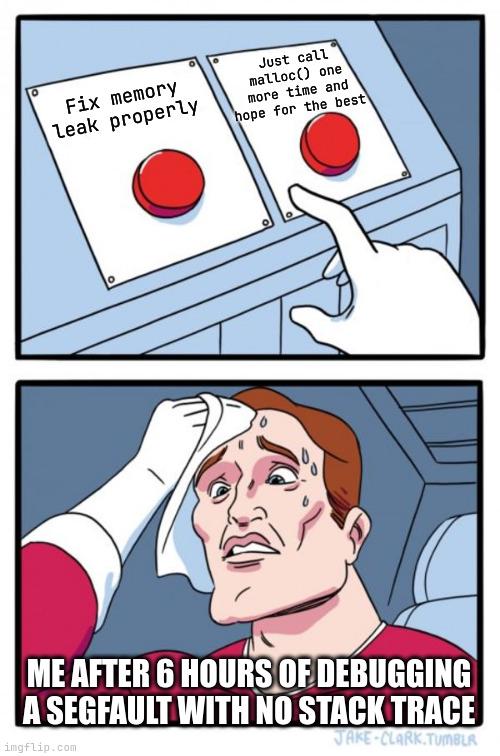
The Two Buttons Of Memory Management Hell
The eternal dilemma of debugging memory issues: do you fix it properly (the responsible adult choice) or just throw another malloc() at the problem and pray? Meanwhile, your soul slowly leaves your body after spending 6 hours tracking down a segmentation fault with absolutely no helpful stack trace. That's the special kind of hell reserved for C/C++ developers who forgot to free their memory somewhere 2,000 lines ago. Nothing builds character quite like staring at memory addresses until your eyes bleed!

Possibly The Worst Way To Read A File In C

Possibly The Worst Way To Read A File In C
This code is the programming equivalent of filling a bathtub one teaspoon at a time while expanding the bathtub after each spoon. 😱 Instead of reading the file in chunks or pre-allocating memory, this monster allocates exactly ONE byte, reads ONE character, reallocates the ENTIRE array, and repeats for EVERY SINGLE CHARACTER. The malloc/realloc combo is basically begging the memory manager to have a nervous breakdown. The performance would be so catastrophically bad that you could probably go make a sandwich between reading "Hello" and "World". It's like watching someone solve a maze by rebuilding the entire universe after each step.

ProCase Hard Carrying Case for Samsung T7 Portable SSD -Black

ProCase Hard Carrying Case for Samsung T7 Portable SSD -Black
Compatible with Samsung T7 Portable SSD / T7 Touch Portable SSD 500GB 1TB 2TB SSD USB 3.2 External Solid State Drives · Premium hard EVA exterior and shock absorbing soft lining interior, offers doub…