Still Learning Tho

Still Learning Tho
CSS: the only language where you can have 15 years of experience and still Google "how to center a div" every single time. The emotional journey here is accurate—starts with optimism, brief moment of false confidence when something actually works, then back to questioning your entire career choice when padding decides to behave differently in Chrome vs Firefox. Some say there are senior CSS developers out there. I've never met one. We're all just pretending and hoping flexbox doesn't betray us today.

Thought Of Y'All When I Stole This Meme

Thought Of Y'All When I Stole This Meme
When AI companies scrape the entire internet for training data and gamers can't even afford 128GB of RAM without taking out a second mortgage. The irony is chef's kiss—AI gets to gobble up terabytes of data for free while we're out here paying $1,747.99 for what amounts to 128GB of memory sticks. Big tech out here training models on billion-parameter neural networks with data centers full of hardware, meanwhile gamers are choosing between eating dinner and upgrading their rig to run the latest AAA title at medium settings. The wealth gap between AI infrastructure and consumer hardware has never been more painfully visible. At least the video has an 87% approval rating, so we're all suffering together in solidarity.

Meanwhile In 2026...

Meanwhile In 2026...
When you've been running single-channel RAM like a caveman and someone drops the dual-channel bomb on you. That moment when you realize you've been leaving 30-40% performance on the table because you didn't bother to check if your RAM sticks were in the right slots. It's like discovering your car has a turbo button you never knew about. The horror. The shame. The immediate urge to open your case at 2 AM. Fun fact: Dual-channel memory architecture doubles the data bus width, which means your CPU can talk to two RAM sticks simultaneously instead of waiting in line like it's at the DMV. Most modern motherboards have color-coded slots for a reason, folks. Match the colors, double the bandwidth. It's not rocket science, but apparently it's still blowing minds in 2026.

We Hired Wrong AI Team

We Hired Wrong AI Team
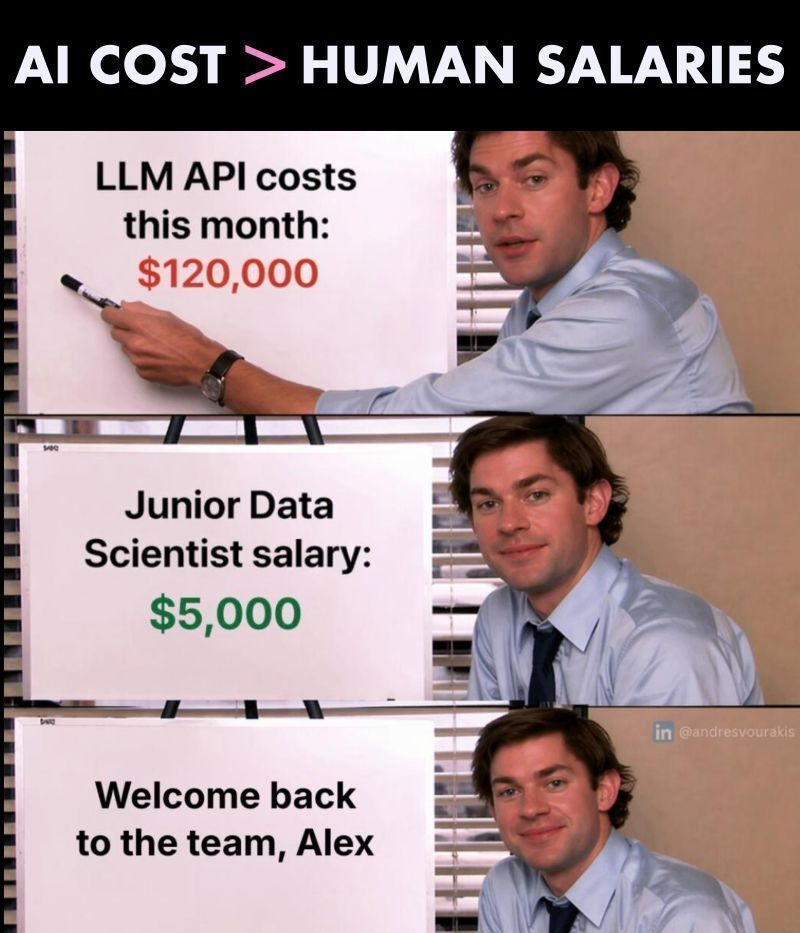
When management thought they were hiring cutting-edge machine learning engineers to build sophisticated neural networks, but instead got developers who think "AI implementation" means wrapping OpenAI's API in a for-loop and calling it innovation. The real tragedy here is that half the "AI startups" out there are literally just doing this. They're not training models, they're not fine-tuning anything—they're just prompt engineers with a Stripe account. But hey, at least they remembered to add error handling... right? Right? Plot twist: This approach actually works 90% of the time, which is why VCs keep throwing money at it.

That's Just How It Is Now

That's Just How It Is Now
Gaming monitors have evolved faster than GPUs can keep up. You've got these absolute beasts pushing 4K at 200Hz, meanwhile your RTX 5080—supposedly a high-end card—is sitting there like a confused cat on a couch, barely managing 4K 60fps without begging AI upscaling (DLSS) to carry it across the finish line. The irony is delicious: we've built displays that our hardware can't actually drive at native resolution. So now we're dependent on neural networks to fake the pixels we can't render. The monitor is flexing its specs while the GPU is out here doing mental gymnastics just to pretend it belongs in the same room. Welcome to 2024, where your display writes checks your graphics card can't cash without algorithmic assistance.

Dev Oops

Dev Oops
You know that fresh DevOps hire is about to learn the hard way that "infrastructure as code" really means "infrastructure as chaos" around here. They're sitting there all optimistic, ready to automate everything, while you're explaining that their job is basically being on-call for every single service that exists. The CI/CD pipeline? Broken. The containers? Mysteriously consuming all the memory. That one legacy server nobody knows how to SSH into? Yeah, that's somehow their problem now too. Welcome to DevOps, where you inherit everyone else's technical debt and get blamed when the deployment fails at 2 AM because someone pushed directly to main. Again.

Only My Boss Can Afford Ram

Only My Boss Can Afford Ram
The lead developer has ascended to mythical status. While you're still running 8GB and Chrome tabs like a game of resource management Jenga, this person apparently has DDR5 RAM. You know, the stuff that costs more than your monthly grocery budget. The rest of the team is out here swapping to disk like it's 2005, but the lead dev? They're living in the future, probably running Docker containers like they're free. DDR5 is the latest RAM standard that's faster and more expensive than DDR4, which means it's perfect for flexing on your coworkers. Nothing says "I'm important" quite like having hardware that doesn't freeze when you open your IDE, browser, Slack, and that one Electron app that somehow uses 4GB by itself.

What The Sigma

What The Sigma
The eternal cycle of React development: you close your eyes for a brief moment of peace, and boom—another CVE drops. It's like playing whack-a-mole with your dependencies, except the moles are security vulnerabilities and the hammer is your rapidly deteriorating mental health. React's ecosystem moves so fast that by the time you finish your morning coffee, three new vulnerabilities have been discovered, two packages you depend on are deprecated, and someone on Twitter is already dunking on your tech stack. The tinfoil hat cat perfectly captures that paranoid developer energy when you realize your "npm audit" output looks like a CVE encyclopedia. Pro tip: Just run npm audit fix --force and pray nothing breaks. What could possibly go wrong?

My Computer Has Trust Issues

My Computer Has Trust Issues
Your computer treats every program like it's a suspicious stranger in a dark alley, even the ones you literally just downloaded yourself. You ask it nicely to install something, it cheerfully agrees, then immediately goes full paranoid detective mode: "Where are you from? What's your publisher? Show me your digital signature!" And when the program can't produce a notarized letter from Bill Gates himself, your computer loses its mind and screams VIRUS at the top of its digital lungs. The best part? Half the time it's flagging your own code that you compiled five minutes ago. Like dude, I literally made this. That's me. You're calling me a virus. Thanks for the vote of confidence, Windows Defender.

An Extra Year And They Will Get CPUs Too

An Extra Year And They Will Get CPUs Too
Your dream PC build with that shiny new GPU you've been saving for? Yeah, it's dead. AI companies are out here buying GPUs faster than you can refresh Newegg, treating them like Pokémon cards. They're hoarding H100s by the thousands while you're still trying to justify a 4080 to your wallet. The title warns that if this trend continues, they'll start scalping CPUs too, which honestly wouldn't surprise anyone at this point. Nothing says "democratized AI" quite like making sure regular developers can't afford hardware to run anything locally.

Outnerded

Outnerded
When your 12-year-old kid names you "Source Code (Dad)" and your wife "Data Compiler (Mom)" in their phone contacts, you know you've successfully passed down the nerd genes. The kid basically called dad the original implementation and mom the one who processes and transforms everything into the final product. That's some next-level family tree documentation right there. The real kicker? Dad had to search his wife's contact name too, which means this kid's organizational system is so cryptic even the source material can't decode it without help. Nothing says "I've been outnerded" quite like your own offspring treating your family like a software development pipeline.

True Pi Day

True Pi Day
Someone just discovered that if you treat the digits of Pi (3.14159265359...) as a Unix timestamp, you get July 13, 2965. So apparently we've all been celebrating Pi Day wrong on March 14th. The real Pi Day won't happen for another 940 years, which is honestly the most programmer thing ever – finding a completely impractical but technically correct alternative to an established convention. Fun fact: Unix timestamps count seconds since January 1, 1970 (the Unix epoch), so this timestamp converter is basically saying "Pi seconds after computers decided time officially began." Because nothing says 'mathematical constant' like arbitrarily mapping it to a date system invented for operating systems. Mark your calendars for 2965, folks. Finally, a holiday we can procrastinate on.