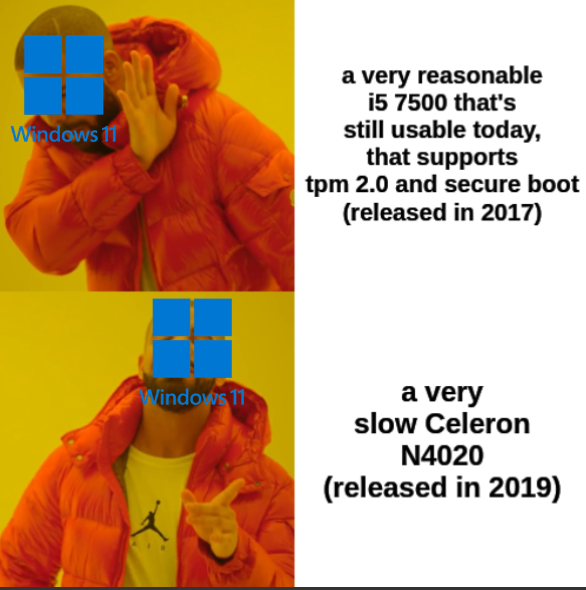
Microsoft really said "security first" and then rejected a perfectly good i5-7500 from 2017 that has TPM 2.0 and Secure Boot, while somehow blessing a Celeron N4020—a chip so slow it makes dial-up internet look responsive. The N4020 is literally a budget processor designed for Chromebook-tier performance, yet it made the cut because... it's newer? The kicker is that you can bypass these arbitrary restrictions with a simple registry edit or installation workaround, proving Microsoft's "strict hardware requirements" are about as enforceable as a "Do Not Enter" sign made of tissue paper. They created this whole TPM 2.0 security theater, then left the back door wide open. Classic Microsoft energy: make arbitrary rules that inconvenience users, then make them easy enough to bypass that the only people who suffer are non-technical users who actually follow the rules.
 AI
AI
 AWS
AWS
 Agile
Agile
 Algorithms
 Android
 Apple
Apple
 Azure
Azure
 Backend
 Bash
Bash
 C++
C++
 Cloud
Cloud